Is Mulch Good for Vegetable Gardens?
As an Amazon Associate we earn from qualifying purchases.
Is mulch good for vegetable gardens? For most beds, yes, but the answer depends on the material, the depth and the crop. Colorado State, New Mexico State and Mississippi State extension publications agree that mulch helps soil hold moisture, moderates soil temperature and keeps ripening fruit off the soil. They also agree that some materials mat down, and that woody material can tie up nitrogen if it is worked into the bed.
Quick answer
- Yes for most vegetable beds. Colorado State says mulching reduces irrigation need by around 50% by cutting evaporation from the soil surface.
- Match the material to the job. Finished compost, shredded leaves and weed-free straw are among the materials these pages recommend for vegetable beds.
- Keep wood chips and bark out of the growing beds, and use them on paths or between raised-bed boxes instead.
- Remove black plastic at the end of the season, because polyethylene does not decompose in the soil.
What mulch does for vegetables
Mulch cuts evaporation from the soil surface. Colorado State says that mulching “minimizes evaporation of water from the soil surface,” which is why it lowers irrigation needs. Mississippi State lists the same job in plain words: it helps the soil hold moisture by reducing evaporation.
Temperature is the second job. New Mexico State says mulches help by insulating soil from extreme temperature changes. Mississippi State says mulch keeps the soil “cooler during hot days and warmer during cold days.”
Weeds are the third. Colorado State says mulch may control weeds, and Mississippi State adds a condition: mulches “should be weed-free and must be applied deep enough to prevent weed seed germination as well as smother existing weeds.”
Fruit and soil contact are the fourth. New Mexico State lists “preventing mud from splashing on crop surfaces” among mulch’s purposes, along with reducing fruit rots in melons, strawberries and tomatoes. Mississippi State says mulch protects ripening tomatoes, melons, pumpkins and squash from contact with the soil.
Compaction is a smaller benefit that gets less attention. Colorado State says that mulching “helps reduce soil compaction forces from rain and traffic”, and that some mulch can later be worked into the bed as a soil amendment.
Soil structure is the last benefit. New Mexico State says that “Such mulches will improve soil structure, improving both water and air penetration into the soil.” Those are the organic mulches, which break down into the topsoil. Mississippi State points out the trade-off: organic mulches “must be replenished periodically.”
Pick a material that fits the bed
Mississippi State divides mulch into two groups. Organic mulches are plant material that decomposes and builds soil structure. Inorganic mulches, such as stone, plastic or fabric, do not decompose, and Mississippi State notes that they “do not contribute organic matter to improve soil structure.” It adds that inorganic mulch may work down into the soil unless it is laid over landscape fabric.
New Mexico State lists what a good mulch should do. It should be non-toxic to plants, easy to apply, free from disease and weed seed, and not so absorbent that it takes moisture away from plants. The page says the choice depends on “availability, cost, the crop to be mulched, and the season of the year”, and adds that a coarse, heavy mulch may be needed on a windy, hillside site.
Compost is a straightforward choice. Colorado State says “Homemade plant-based compost is best but sometimes good local products or bagged products can be found.” New Mexico State says to use “finished (well-cured) compost” by itself or under other mulches, and notes it can be mixed into the soil before planting. For a compost option aimed at raised beds, see compost for raised garden beds.
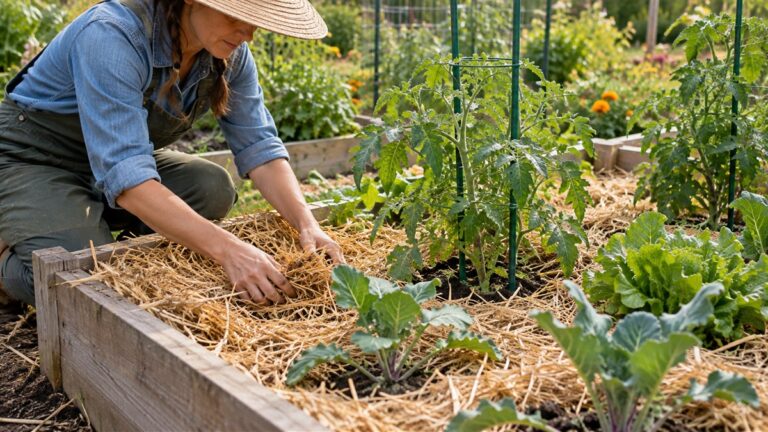
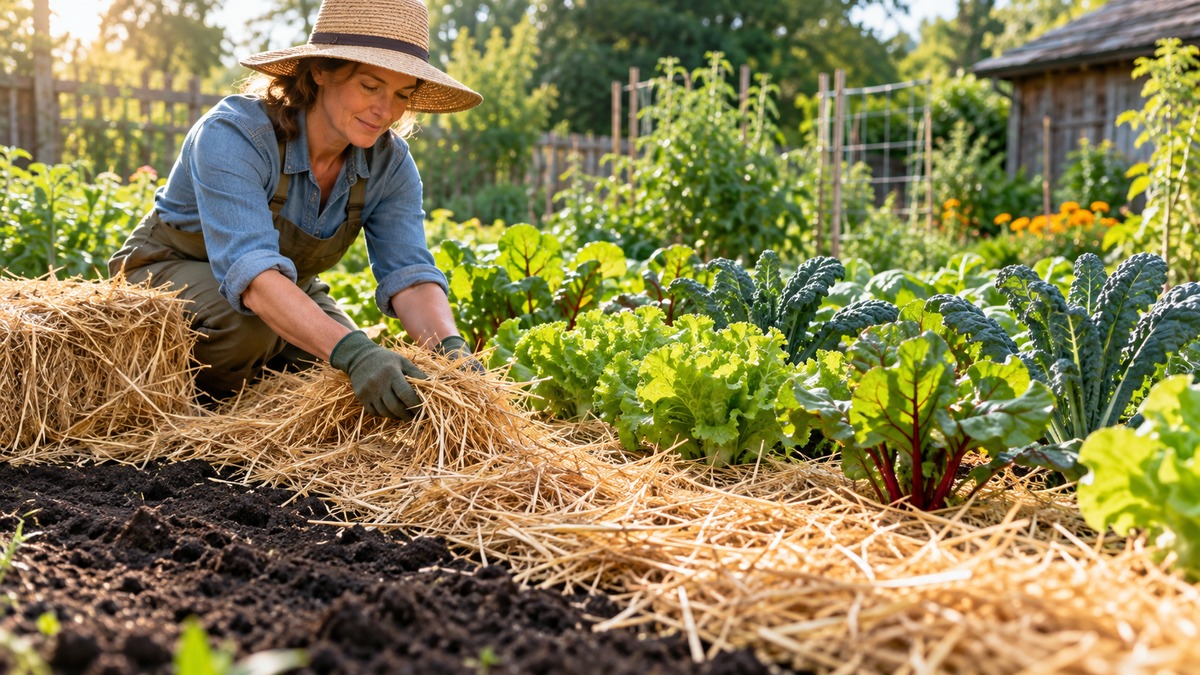
Straw and leaves are the classic cover for vegetable rows. Colorado State says that weed-free straw “makes excellent mulch for vegetables”, and advises buying certified weed-free product. New Mexico State calls straw “a good general mulch used for winter protection and on paths between vegetable rows”, and warns that it “may carry weed seed.” For leaves, New Mexico State says: “If possible, shred the leaves to keep them from packing.”
Colorado State adds that certified weed-free straw is also “a good organic source for clayey soils.” After a few years as summer mulch, it can be worked into the soil in the fall as a soil amendment.
Grass clippings need the most care. Colorado State advises: “Apply fresh clippings in thin layers (up to 1/4 inch thick) and allow each layer to dry before adding more.” New Mexico State gives the same warning in other words: clippings “will mat and ferment if used fresh in a thick layer and alone,” so they should be used dry and in a thin layer. Colorado State adds that thick piles of fresh clippings reduce water and air movement into the soil.
Newspaper is a common weed barrier, and the two pages disagree on how many sheets to use. Colorado State says a couple of sheets may go under grass clippings, and warns that sheets “more than a couple” thick can cause “a soil carbon to nitrogen imbalance”. New Mexico State says to use “three to six sheets thick” and cover them with organic mulch for better appearance and faster decomposition. Both pages agree the paper needs covering, because Colorado State notes that newspapers “blow away with a light wind”.
Woody material is the trickiest. Colorado State says, “Do not use wood or bark chips in the growing beds since they will interfere with future seedbed preparation.” Its raised-bed advice is different: “In a raised-bed garden, wood or bark chips make excellent mulch between the boxes.” Colorado State also says that chips placed on the soil surface “do not tie-up soil nitrogen.” New Mexico State warns about digging them in: “Woody material should not be incorporated into the soil since it will tend to tie up nitrogen in the soil, making it unavailable for plant uptake.” Read together, the pages say to keep chips on the surface and out of the bed.
Plastic is a special case. Colorado State says that because black plastic warms the soil, it is “undesirable for most cool season crops”, so it suits crops such as tomatoes, peppers and melons that are planted early. New Mexico State notes that synthetic mulches warm the soil, which organic mulches do not do, and says that “Plastic mulch must be removed after each growing season.” Colorado State adds that polyethylene “will never decompose in the soil”, so it should be removed in the fall rather than plowed in.
Colorado State also warns that covering plastic with organic mulch “could reduce soil oxygen levels.” New Mexico State describes woven weed barrier as letting moisture and oxygen through while deterring weeds, and says to cut holes for plants or place the barrier between planted rows.
How deep to spread it
Depth is where these pages differ most, so the table lists each figure with the page it comes from. Read the row for your material before you spread anything.
| Material | Depth or limit the page gives | Page |
|---|---|---|
| Finished or plant-based compost | One to two inches | Colorado State |
| Straw, bark and most coarse organic mulches | Two to three inches over the whole area | New Mexico State |
| Grass clippings | Thin layers, up to 1/4 inch each; no more than 1 inch deep overall | Colorado State; New Mexico State |
| Wood or bark chips between raised-bed boxes | Three to four inches, to control weeds | Colorado State |
| Sawdust | One inch deep, not worked into the soil | New Mexico State |
| Plastic film | Depth not stated; remove after each season | New Mexico State |
The pages disagree on sawdust. New Mexico State allows a one-inch layer, while Colorado State advises against fine sawdust because it “could create a carbon to nitrogen imbalance and a barrier to water infiltration.” Colorado State’s warning is the stricter of the two, and it is the one this guide follows.
For the amount of material a bed needs, see our guide to how much soil a raised bed needs.
When to put mulch down
Mississippi State says that “Mid-spring is the ideal time to mulch annual and perennial flower beds and vegetable gardens after the soil has warmed for active root growth.” It advises removing existing weeds first, and says to “Mulch the entire bed.” For winter, it says to “Apply winter mulches after the soil has cooled but before it has frozen.”
Transplants need extra attention. Mississippi State says mulching around new plantings “helps keep moisture in the root ball” until roots establish in the surrounding soil. New Mexico State says mulches are generally applied to most crops “after they have emerged or around transplants.” It also warns about seedlings: moist organic mulch should not touch them, because it can cause damping-off. For the fall side of the routine, see preparing raised beds for winter.
Leafy crops need a gentler touch. Colorado State says to place grass carefully at the base of lettuce and other leafy vegetables, because “Grass sticks to wet lettuce, creating a problem in food preparation.”
Mistakes to avoid
- Digging wood chips or bark into the bed. New Mexico State says woody material should not be incorporated, because it ties up nitrogen.
- Piling fresh grass clippings. Colorado State says thick piles mat and reduce water and air movement, so keep layers thin and dry.
- Using fine sawdust. Colorado State warns that it can create a carbon to nitrogen imbalance and a barrier to water infiltration.
- Leaving plastic down from one season to the next. New Mexico State says plastic mulch must be removed after each growing season.
- Covering plastic with organic mulch. Colorado State warns that this could reduce soil oxygen levels.
- Letting organic mulch build up year after year. Mississippi State says heavy organic mulching over several years can build up soil around the base of plants, and it advises raking off old mulch after three years.
- Keeping a mulch pile that smells sour. Mississippi State says a pile that smells like vinegar, ammonia, sulfur or silage has gone sour, and that turning it once or twice a month helps prevent this.
How we chose
We opened three university pages on mulch, one each from Colorado State, New Mexico State and Mississippi State, and kept only claims that a page states in plain words. The Colorado State and New Mexico State publications are written for vegetable production. The Mississippi State publication is a landscape mulch guide that also covers garden beds, so we used it for vegetable beds only where it names them. We left out retail and blog pages. Where two pages give different depths or rules, both figures stay in the text.
What we could not verify
The pages we opened do not give one depth that fits every garden. They come from three state university systems, and none of them says how the advice changes in other climates.
What the sources do not say
The pages do not give a figure for how much mulch cuts irrigation in a given bed, apart from Colorado State’s estimate of around 50%. They do not compare costs, and they do not say how long each material lasts beyond the rule for heavy organic mulch. On sawdust, newspaper and grass clippings, the figures differ between pages, and the pages do not explain why. Colorado State says the benefits of mulch “depend on the material used and depth to which it is applied”, which is why every figure in this guide stays tied to its page.
Frequently asked questions
Does mulch keep weeds out of a vegetable garden?
It can help. Colorado State says mulch may control weeds. Mississippi State adds that mulch must be weed-free and deep enough to stop weed seeds from germinating, and it says to remove existing weeds before you apply it.
How thick should mulch be on vegetables?
It depends on the material. The table gives the figures: one to two inches for compost, two to three inches for straw and most coarse organic mulches, and grass clippings in thin layers that dry between additions, no more than one inch deep overall. New Mexico State and Colorado State differ on sawdust, and Colorado State’s warning against fine sawdust is the stricter of the two.
Should wood chips go into a vegetable bed?
No, not into the growing bed. Colorado State says not to use them there, and New Mexico State says woody material should not be worked into the soil. Colorado State says chips placed on the surface do not tie up soil nitrogen, and it recommends three to four inches between raised-bed boxes to control weeds.
When is the best time to mulch a vegetable garden?
Mississippi State says mid-spring is ideal, once the soil has warmed for active root growth. It recommends winter mulch after the soil has cooled but before it freezes. New Mexico State says most crops are mulched after they emerge or around transplants.
Can you use grass clippings as mulch?
Yes, in thin layers. Colorado State says to apply fresh clippings up to 1/4 inch thick and let each layer dry before adding more. New Mexico State says to use clippings dry and in a thin layer, and not more than 1 inch deep. Thick, fresh piles mat down and reduce water and air movement into the soil.
Sources
- https://extension.colostate.edu/resource/mulches-for-the-vegetable-garden/ (opened 2026-10-22)
- https://pubs.nmsu.edu/_h/H261/ (opened 2026-10-22)
- https://extension.msstate.edu/sites/default/files/publications/P2301.pdf (opened 2026-10-22)
As an Amazon Associate we earn from qualifying purchases.