How to Cover Plants for Frost
As an Amazon Associate we earn from qualifying purchases.
How to cover plants for frost comes down to three decisions: which plants are worth protecting, what material to use, and how to take it off again. Covering works, but only within limits. The Colorado State University Extension guide, the North Carolina State Extension Madison County page and the University of Wisconsin-Extension Marinette County sheet agree on the basics. Keep the cover off the foliage, seal its edges to the ground, and open it up when the sun is out. This guide walks through each step and the limits the sources set.
Quick answer
- Cover the plants that are at risk. Tomatoes and peppers, vine crops and beans are the sensitive group, while root and cabbage-family crops can handle cold.
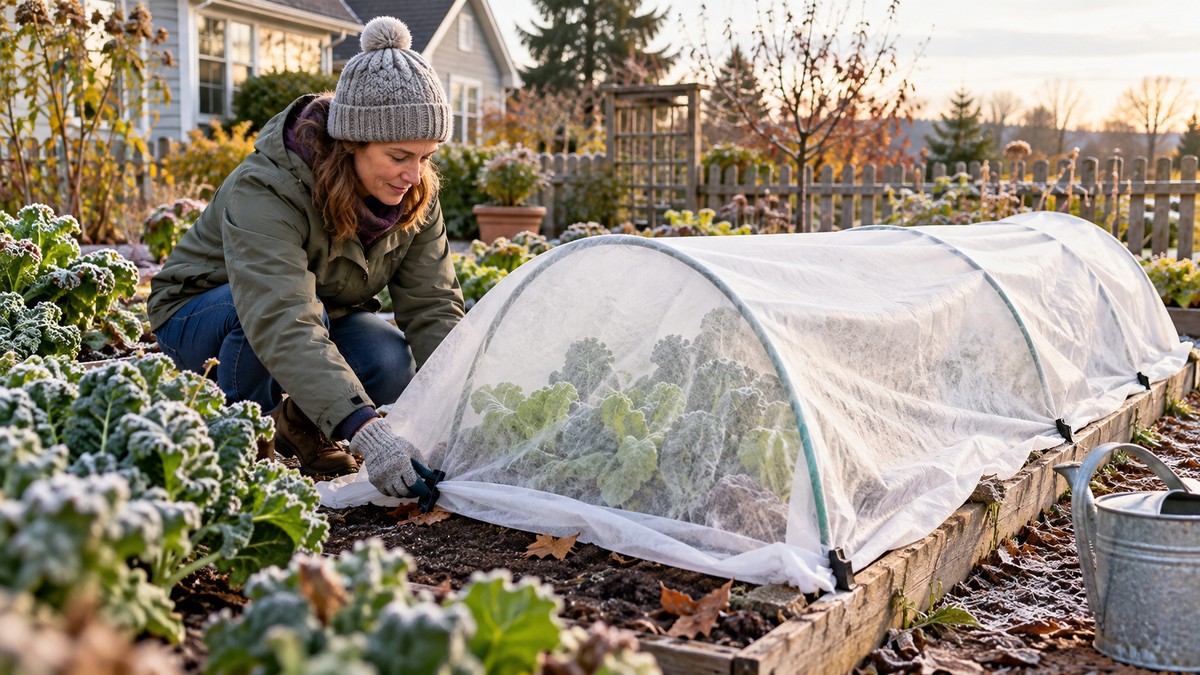
- Hold the cover off the leaves with hoops or a frame, and make sure it reaches the ground and is held down.
- Use cloth or dry sheets rather than plastic tarps laid on the plants, because plastic that touches foliage can freeze the plant.
- Vent or remove the cover during the day, because a closed cover in sunshine can overheat quickly.
Know which kind of frost you face
Colorado State University Extension separates two kinds of frost. An advective frost happens when a cold front moves into the area, and temperatures can drop well below critical levels, which makes crop protection questionable. A radiation frost happens on calm, clear nights with no cloud cover to hold in heat. The guide notes that radiation frosts at the start and end of the growing season are typically only a few degrees below critical levels, which is when covering is worthwhile.
That split matters for the plan. Radiation frosts are the ones where a cover is worth the effort, while an advective frost can drop temperatures far enough that protection becomes questionable. Check the forecast, and cover the plants that matter most before the cold arrives, not after.
Decide which plants are worth covering
Not every plant needs a cover, and a planting plan that groups sensitive crops together makes covering easier. Our guide to vegetables to plant in raised beds can help with that choice. The Marinette County sheet says the plants facing the most risk are the most temperature-sensitive ones, such as basil and melons. Anything in the tomato family, any vine crop and any bean is also likely to face damage. The same sheet says root crops, cabbage-family crops and fully mature crops do not need protection right now. Tomato and pepper plants with many immature fruits are the highest priority, followed by winter squash and pumpkins that still carry immature fruit.
North Carolina State Extension sorts vegetables into three groups by how much cold they take. Freeze-sensitive crops include tomatoes, squash, cucumbers, eggplant, peppers and sweet corn. Semi-hardy vegetables such as beets, celery, leaf lettuce and radishes can survive repeated light frosts in the 30 to 32 degree range. Hardy vegetables such as broccoli, garden peas and carrots tolerate temperatures down to 28 degrees and lower. The NC State page gives a simple rule. Semi-hardy plants should be covered when temperatures fall below 30 degrees, and hardy crops should be covered when temperatures are predicted to fall below 25 degrees.
Marinette County adds a practical option. Basil and melons can be damaged around 35 degrees, and normal protection such as tarps or blankets usually provides only a few degrees of protection. In a cool spot, the guide suggests you may be better served by harvesting melons and basil early than by covering them.
Compare the cover options
The table below compares the materials that the three guides describe, with the figures each source gives. The CSU numbers come from trials in Fort Collins, Colorado, so treat them as local results rather than promises for your garden.
| Cover | What the sources say about protection | Use notes from the sources |
|---|---|---|
| Dry blankets or sheets | Work well as long as the fabric stays dry (CSU); wet fabric can cool the air beside the plants through evaporation | Must be removed in the daytime so the soil can recharge its heat (CSU) |
| Floating row cover | Up to 10 degrees F of protection, depending on material and grade (CSU) | Transmits light and can stay on for an extended period; must come off for insect-pollinated crops (CSU) |
| Plastic on a frame or cold frame | Typically 3 degrees F to over 6 degrees F in Fort Collins trials (CSU) | Open or vent on sunny days, and keep it off the plants (CSU, Marinette) |
| Plastic with Christmas lights inside | 6 degrees F to over 18 degrees F with one 25-light C-7 string per 4 by 5 foot frame unit (CSU trial) | Lights hung under the plastic, turned on at dusk and off at dawn (CSU) |
| Space blanket over plastic | With lights, 18 degrees F to over 30 degrees F in CSU trials; adds protection on extra cold nights (CSU) | Must be removed each day to recharge the soil’s stored heat (CSU) |
| Plastic tarp laid on plants | Not stated as a protection figure | NC State says not to use plastic tarps; Marinette notes tarps drop to air temperature around them and damage touching plants |
| Cone-shaped water-tube protector | Typically down to the mid-teens (CSU) | Warm the soil with black plastic mulch when starting early crops (CSU) |
Hold the cover off the leaves with hoops or a frame
Marinette County puts the principle plainly: the best situation is to have a frame or support that keeps the tarps, sheets or blankets off the plants themselves. CSU says the same thing from the other side. Covers need to be held off the plants to keep the plants from freezing where they touch the cover, and to give the plants room to grow. The air trapped under the cover is what keeps the plant warm, so the plant itself should not be pressed against the fabric.
CSU describes simple hoops. Gardening catalogs sell wire hoops for tunnel or cloche gardening, and you can make your own from electrical conduit, bendable PVC, PEX plumbing tubing or heavy-duty irrigation tubing. Place hoops at three to five foot intervals, depending on how exposed the site is to wind. Black irrigation tubing can heat up in the sun and lose its rigidity, so choose a material that stays firm in warm weather. On a raised bed made of lumber, the guide suggests stapling the plastic to one side of the box, weighting it with rocks, or attaching the hoops with clips.
Seal the edges and hold the cover down
A cover only works if the warm air stays inside. NC State says covers must extend all the way down to the ground and be held down securely with bricks or staples. CSU suggests burying the edges a few inches into the soil or weighting them with rocks, while leaving at least one side accessible so you can get in. Clothespins are a poor choice for this job, because CSU notes that clothespins do not hold in the wind. Its suggestion is small clips from a hardware store.
Water, mulch and move the containers
NC State lists several steps that go beyond the cover. If you are still deciding how to set up beds for the cold months, our guide to preparing raised beds for winter covers that side of the job.
Water plants before freezing temperatures arrive. Mulch roots to minimize temperature swings. Plants in containers should be brought into a garage or other enclosed structure for the night. Small plants, such as strawberries or seedlings, can be covered with a thick layer of dry leaves or pine straw instead of a sheet.
NC State also notes that open blossoms and blossom buds showing color are more sensitive to cold than other plant parts, so those are the parts that need the most attention.
Add heat for the most tender crops
For warm-season tomatoes and summer squash, which dislike even a light frosty nip, CSU says adding a small light inside a cold frame gives better protection. Christmas tree lights work better than one large bulb in the center, because they remove the cold corners and edges. A space blanket laid over the plastic adds more protection on extra cold nights, and CSU reports that one string of C-7 lights with a space blanket reached 18 to over 30 degrees F of protection in its trials. The blanket must be removed each day so the soil can recharge its stored heat.
Cone-shaped protectors made of water-filled tubes work differently. CSU explains that the water releases heat as it freezes, which typically protects plants down to the mid-teens. They also shelter the plant from wind. A protector can outgrow the plant it covers, so check it as the plant grows. For early starts, CSU adds that cold soil is as limiting as cold air, so warm the soil with black plastic mulch when using these products.
Take covers off in the daytime
Daytime management is where many covers fail. CSU says the covering must be opened, at least a slit, during the day to prevent overheating. The guide reports that with just an hour of sun, temperatures under a closed cover can quickly rise to over 130 degrees F. On cool days, open the top a crack. On warm days, slide the plastic down the side so the plants get outdoor air. On freezing nights, close the cover completely. On stormy days with full cloud cover and no direct sun, the cover may stay closed.
Covers also need to come off when pollination matters. CSU notes that on insect-pollinated crops, covers must be removed for pollination to occur. Floating row covers can stay on for longer stretches because they let light and air through, but a flowering crop that depends on bees will need access.
Common mistakes with frost covers
- Laying plastic directly on the plants. NC State says not to use a plastic tarp, and CSU warns that plastic touching the plant can freeze it.
- Using wet sheets. CSU says wet fabric can chill the air beside the plants through evaporation.
- Leaving a plastic cover closed on a sunny day. CSU says temperatures can climb past 130 degrees F in an hour.
- Leaving covers open on a freezing night. CSU says to close the cover completely on freezing nights.
- Letting the cover gap at the bottom. NC State says the cover must reach the ground and be held down.
How we chose
This guide uses three extension pages that we opened and read on 2026-10-22: Colorado State University Extension’s GardenNotes #722 on frost protection, the North Carolina State Extension page for the Madison County Center on protecting gardens from frost, and the University of Wisconsin-Extension Marinette County sheet on frost protection options. We chose them because each one covers covers, timing and plant sensitivity in practical terms, and because each is published by a university extension office. We checked each quoted sentence against the text of the page it came from. We left out gardening blogs, product sellers and commercial pages that came up in our searches. One other extension publication we opened is a commercial vegetable guide about row covers, and we did not use it. We did not rank any products.
What we could not verify
The protection figures in this guide come from the sources, not from a test in any garden. Read them as general guidance and as local trial results.
What the sources do not say
- No page gives one temperature at which every cover works. CSU’s figures come from Fort Collins trials, and the NC State and Marinette figures are general rules of thumb.
- The sources do not say how many hours before a frost to put a cover on, beyond covering when temperatures are predicted to fall.
- The thresholds differ. NC State’s 30 and 25 degree rules are for specific crop groups, while Marinette gives 35 degrees as the damage point for basil and melons.
- The sources do not give protection figures for each fabric weight. CSU gives one figure for floating covers, and that is for its own trial conditions.
- The guides do not cover wind-chill, snow load or the effect of a cover on soil moisture under it.
Frequently asked questions
Do you need to cover plants for a light frost?
Some do. NC State says semi-hardy vegetables should be covered when temperatures fall below 30 degrees, and tender crops such as tomatoes and peppers need protection even from light cold. Hardy crops such as broccoli and carrots can usually handle temperatures down to about 28 degrees, and they should be covered when a predicted drop goes below 25.
Can you use a plastic tarp to protect tomatoes?
NC State says not to use a plastic tarp. Marinette County adds that tarps drop to the air temperature around them, so any plant material touching them is likely to be damaged. Use a cloth or sheet held off the plants on a frame, and vent it in the daytime.
Should you take the cover off during the day?
Yes, at least partly. CSU says a closed plastic cover can heat past 130 degrees F within an hour of sun. Open the cover on cool days and slide it back on warm ones. Remove blankets and sheets during the day so the soil can recharge its heat.
Do floating row covers need to come off for flowers?
On crops that rely on insects to pollinate, yes. CSU says covers must be removed for pollination to occur. Floating covers can otherwise stay on for an extended period, because they transmit light and allow airflow.
Will an old sheet work if it gets wet?
Not well. CSU says covering with blankets and sheets works as long as the fabric stays dry. Wet fabric can cool the air beside the plants through evaporation, which can leave the plants colder than if nothing covered them.
Sources
- Colorado State University Extension, GardenNotes #722, Frost Protection and Extending the Growing Season: https://extension.colostate.edu/resource/frost-protection-and-extending-the-growing-season/ (opened 2026-10-22)
- North Carolina State University Extension, Madison County Center, frost protection article: https://madison.ces.ncsu.edu/2020/05/how-do-i-protect-my-garden-from-frost/ (opened 2026-10-22)
- University of Wisconsin-Extension, Marinette County, Frost Protection Options: https://marinette.extension.wisc.edu/files/2020/10/Frost-Protection-Options.pdf (opened 2026-10-22)