How to Grow Potatoes in Containers
As an Amazon Associate we earn from qualifying purchases.
Learning how to grow potatoes in containers comes down to three jobs: start with seed potatoes, use a deep pot that drains, and add soil as the stems grow. The university and extension pages we opened agree on those jobs, and they all describe hilling as a repeated task. They do not agree on pot size, on how much soil covers the seed, or on how often to hill, so this guide lays out each figure next to its source.
Quick answer
- Plant seed potatoes, not grocery potatoes. Penn State Extension warns against planting potatoes bought from a grocery store.
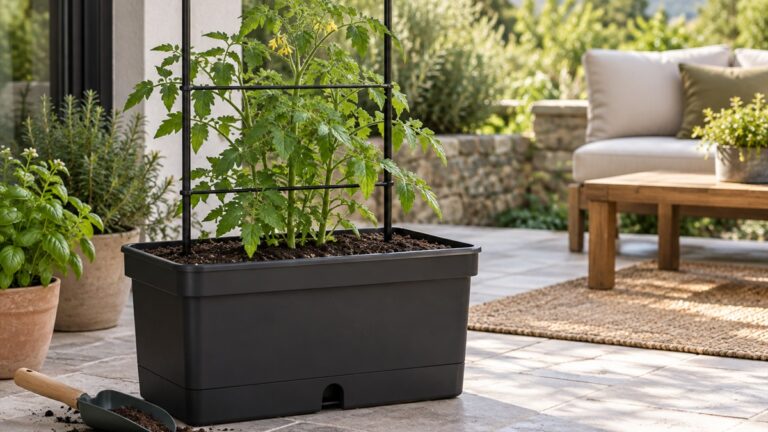
- Choose a large container with drainage. Oregon State University Extension asks for at least 18 inches wide and 3 feet deep, while Penn State accepts 10 to 15 gallons.
- Add soil or straw as the stems grow, keep the soil moist, and dig new potatoes after the plants flower or mature ones after the tops die.
Start with seed potatoes, not grocery potatoes
Oregon State University Extension says to plant “seed potatoes” with sprouting points, which means potatoes grown for planting rather than potatoes sold for eating. Penn State Extension is more specific: “Do not plant potatoes purchased from a grocery store, as these may have been treated with chemicals to keep them from sprouting (to increase their shelf life).” Buy seed potatoes from a garden center or from a supplier that sells them for planting.
Oregon State also gives a pre-sprouting step that suits containers. Stand the seed potatoes “in a warm, dark place with the eyes pointing up until they begin to sprout.” Keep the tubers there until small sprouts appear, then move on to planting.
Choose a container and mix that drains
Pot size is the first place the pages differ. Oregon State says: “Containers for growing potatoes should be at least 18 inches wide and 3 feet deep to allow the most potatoes to grow.” It adds: “In a more shallow container, fewer potatoes will grow.” Penn State Extension sets a smaller range, about 10 to 15 gallons, for any large container with drainage holes. Its ready-made options are the ones it names: “Potato towers and grow bags provide a ready-to-use alternative.” The University of Maryland Extension lists “Potatoes: 30 gallons of potting mix” in its container guidance.
Whatever you choose, match the container to the crop. The University of Maryland Extension makes the same point for every vegetable: “Match container size to plant size, both the top growth and root system.” The UC Davis Tahoe cheat sheet uses a 5-gallon bag or container and plants two or three seed potatoes in it, so it sits at the smaller end of the sizes the pages describe.
For the mix, Penn State Extension says: “Fill your container with a combination of potting mix and compost.” It warns against garden soil because it “may not drain as well as potting mix.” Penn State’s container description includes drainage holes, so check for holes in the bottom before you fill the pot.
Pick a sunny spot and a warm start
Give the pot sun. Oregon State University Extension says that potatoes “grow best in sun; however, they can tolerate some shade”. Penn State Extension says they “prefer full sun and well-drained, slightly acidic soil”. Wait for warm soil before you plant. The University of Maryland Extension says: “The soil temperature should be at least 45 degrees F.” The UC Davis cheat sheet adds that plants “can tolerate light frost if covered or mulched.”
Plant the seed potatoes at the right depth
Penn State Extension gives a layered method. It says: “Begin by adding 4 inches of the potting mixture to the container.” Then: “Next, place 3 to 5 seed tubers, eyes pointing up, and cover them with 3 inches of the potting mixture.” Oregon State uses a shallower cover: “Fill the pot halfway with soil, place potatoes on top, sprouts up, and cover them with 1 inch of soil.” The two pages disagree on how deep to cover the seed, and the difference matters for how much room is left for the stems to grow.
Seed count follows container size. The UC Davis cheat sheet plants “2-3 seed potatoes (same variety) per 5-gallon bag/container,” while Penn State places three to five tubers in its larger 10 to 15 gallon container. Use the lower count for a smaller pot and the higher count for a larger one, and keep the seed pieces the same variety.
Hill as the stems grow
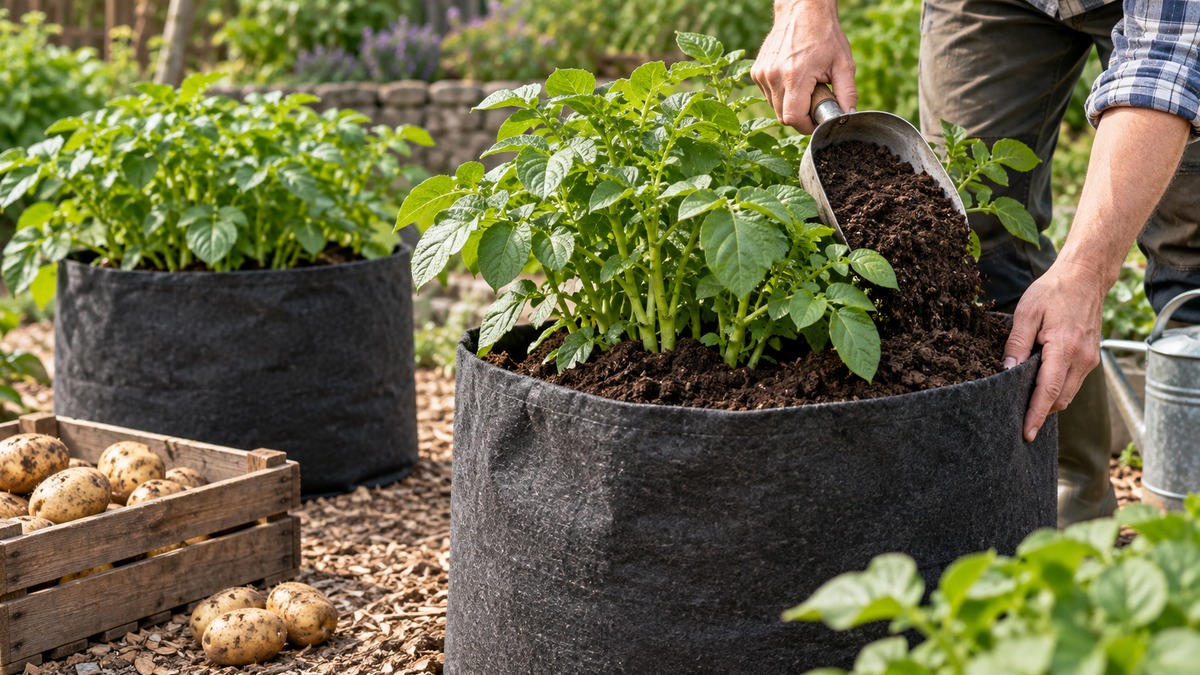
Hilling is the instruction that every page repeats. Penn State says: “When the plants are a few inches tall, add more potting mixture so that the stems are covered, and the leaves are exposed.” It then says: “Repeat this process until the soil level reaches the top of the container.” Oregon State is more precise about the first step: “Add soil or straw once the plant grows about 6 inches tall.” It adds: “Add to the hill several times throughout the season.”
The timing differs. The UC Davis cheat sheet says: “Hill bottom of stem about every 3 weeks until flowering.” The University of Maryland Extension waits until the top is full: “When the tops are fully grown, hill up soil over potatoes around the base of each plant to shield tubers from the sun, which can cause greening or scalding.” Hilling keeps developing potatoes out of the sun, and the Maryland page ties sun exposure to greening.
Water and keep tubers out of the light
Water is the second job. Penn State says: “Water the plants regularly so the soil is moist but not soggy, as containers dry out more quickly than plants in the ground.” Oregon State gives a simpler rule: “Water as needed to keep the soil damp.” Penn State names the risk directly, since a pot dries out faster than the ground around it.
Near the end of the season, the UC Davis cheat sheet changes the routine: “Even water until the leaves die/turn yellow, then stop watering for at least a week.” Keep watering even until the foliage fades, and then stop as that sheet says.
Light is the reason for hilling. The University of Maryland Extension says: “Green portions (chlorophyll) on potatoes are associated with solanine, a bitter, toxic glycoalkaloid.” It adds: “They should be cut out and discarded.” Keep the tubers covered during the season, and treat any green skin the way that page describes.
If you want more on what fills the pot, our article on using raised bed soil in pots covers the mix question in more detail, and our guide to how much soil a raised bed needs helps with volume.
Harvest new potatoes or full-size tubers
You can dig early or wait. Penn State Extension says new potatoes can be dug “around 8 weeks after planting, before the skins have thickened.” The University of Maryland Extension gives a range for the same stage: new potatoes “can be harvested 6 to 8 weeks after planting,” and usually once the plants have flowered. Dig carefully, because the Maryland page says to dig “to avoid damaging the plant and bruising or spearing tubers.”
For full-size potatoes, Penn State says: “Harvest mature potatoes after the plants have died and before a hard frost.” It recommends that you “Choose a dry, warm day and carefully dig the hills with a spading fork.” The University of Maryland Extension adds a rule for wet soil: “Don’t dig potatoes if the soil is wet.” Penn State also warns that “If any potatoes are damaged during harvesting, use them first, as they will not store well.” Oregon State gives the same signal for full-size tubers: “Dig up full-sized potatoes after the tops have died back.”
Cure, clean and store
Penn State Extension says to cure the crop before storage: “cure potatoes for 2 to 3 weeks” by placing them “in a well-ventilated area”. After curing, Penn State advises: “Once cured, brush off any loose soil, but do not wash.”
For storage, the University of Maryland Extension says: “Store tubers in a cool basement in ventilated bags or boxes out of the light to prevent greening.” Keep the storage place dark and cool. Cut out any green parts, which the Maryland page says should be discarded.
Common mistakes to avoid
- Using a pot that is too shallow. Oregon State says that in a more shallow container, fewer potatoes will grow.
- Planting grocery potatoes. Penn State says they may have been treated to stop sprouting.
- Leaving tubers exposed to light. The University of Maryland Extension links sun exposure to greening.
- Digging in wet soil. The University of Maryland Extension says not to dig when the soil is wet.
- Waiting too long to add soil. Oregon State says to add soil or straw once the plant reaches about 6 inches.
How we chose
We began with extension and university pages that came up in a search for potatoes in containers. We kept the Oregon State University Extension potato guide, the Penn State Extension article, and two University of Maryland Extension pages, one on growing potatoes and one on container types. We also kept a University of California, Davis cheat sheet. It is a university document rather than an extension page, so we rely on it only where it gives a figure the others do not. We opened all five pages on 2026-10-22 and read each one for container, planting, hilling and harvest content. We did not rank the pages. Commercial sites and a question-and-answer service also came up, and we left them out because the commercial pages attribute figures to extension programs we could not find.
What we could not verify
The pages do not agree on pot size, the depth of the cover soil, the number of seed potatoes per container, or the hilling interval. They do not give yields for a container of any size, and they do not say how many potatoes a single seed piece will produce. Oregon State’s planting windows are written for Oregon, so they do not apply directly elsewhere. Nothing in this guide is a product recommendation.
What the sources do not say
The sources do not explain why the pages disagree on pot size. They also do not say how deep a pot must be for a particular variety, and they do not compare varieties for container growing. Penn State Extension mentions towers and grow bags, but it gives no details on how they perform. The UC Davis cheat sheet gives a hilling interval, but the extension pages do not, so readers should treat that figure as one source’s view.
Frequently asked questions
Can grocery store potatoes be used for planting?
Penn State Extension says no. It warns that potatoes bought from a grocery store “may have been treated with chemicals to keep them from sprouting”. Buy seed potatoes from a garden center or a supplier that sells them for planting, and start them sprouting before you pot them up, as Oregon State advises.
How big should the container be for potatoes?
The pages disagree. Oregon State asks for at least 18 inches wide and 3 feet deep. Penn State accepts a large container of about 10 to 15 gallons with drainage holes. The University of Maryland Extension lists 30 gallons of potting mix for potatoes. A bigger pot gives more room for tubers, but the pages do not say how much bigger is enough.
How many seed potatoes go in one container?
The UC Davis cheat sheet says two or three seed potatoes per 5-gallon bag or container. Penn State places three to five seed tubers in a 10 to 15 gallon container. Match the count to the size of your pot, and use fewer seed pieces in a smaller container.
When should soil be added to a potato container?
Add soil once the plants are a few inches tall, as Penn State advises, or once they reach about 6 inches, as Oregon State advises. Keep adding soil or straw as the plant grows, until the pot is full. The University of Maryland Extension waits until the tops are fully grown, and the UC Davis cheat sheet hills about every three weeks until flowering.
How long until new potatoes can be dug?
Penn State Extension says new potatoes can be dug around 8 weeks after planting, before the skins have thickened. The University of Maryland Extension gives a range of 6 to 8 weeks, and says new potatoes are usually ready once the plants have flowered. Dig carefully, as the Maryland page advises, to avoid bruising the tubers.
Sources
- https://extension.oregonstate.edu/imported-publication/potatoes (opened 2026-10-22)
- https://extension.psu.edu/potatoes-in-the-garden-and-the-kitchen (opened 2026-10-22)
- https://extension.umd.edu/resource/growing-potatoes-home-garden (opened 2026-10-22)
- https://extension.umd.edu/resource/types-containers-growing-vegetables (opened 2026-10-22)
- https://tahoe.ucdavis.edu/sites/g/files/dgvnsk4286/files/inline-files/2022%20Potato%20Cheat.pdf (opened 2026-10-22)