How Often to Water Containers in Summer
As an Amazon Associate we earn from qualifying purchases.
How often to water container plants in summer depends on the pot, the potting mix, the plant and the weather, so no single schedule works for every container. Extension guidance does not give one daily number. It says to check containers every day in summer, and to check large plantings twice a day. This guide turns those checks into a routine you can repeat through a hot week.
Container plants have a limited amount of soil, so they dry out faster than plants in the ground. The rules below come from five university extension and university pages we opened on 2026-10-22. Where those pages disagree, both versions appear in the text.
Quick answer
- Check summer containers every day. Illinois Extension says large plantings should be checked twice a day, and Iowa State says fast-drying plants need a second check on hot, windy days.
- Water when the mix is dry, using the finger test. Illinois says to water when the first inch or so of soil is dry, while Kansas State says it should be dry at least 3 inches deep.
- Water until the excess drains out of the bottom. Small pots, clay pots and hot, windy weather all call for more frequent watering.
- Do not let plants wilt badly, and water again if the mix has pulled away from the pot.
Why summer containers dry out so fast
Illinois Extension puts the basic problem in one line: “Plants grown in containers need frequent watering as the containers dry fast.” A pot holds only a small volume of soil, and that soil sits exposed to sun and wind. Kansas State University notes that sun and wind change how much water a plant needs, along with the shape and size of the container, the material it is made from, and how dense and mature the plants are.
The pot material matters too. Saskatchewan says that “Plastic and glazed ceramic containers tend to hold moisture longer than porous clay or terracotta containers which dry out much more quickly.” Kansas State’s houseplant section adds that clay suits a gardener who tends to overwater. Size matters as well. Saskatchewan says, “Small containers need to be watered more often than large containers.” A small pot holds less water to begin with.
Check every day instead of watering on a calendar
Iowa State University’s Extension page says that annuals growing in containers “should be checked daily (especially in summer) to determine if they need to be watered.” The same page says that New Guinea impatiens and fuchsia should be checked twice a day, in the morning and again in the late afternoon or evening, because they dry out quickly on hot, windy days.
Illinois Extension’s hot-weather news release is firmer about the routine: “Container soils are designed to drain well so containers and planters need to be checked daily.” It adds that large plantings should be checked twice a day. The watering page takes the same line on schedules: “There are no hard and fast rules when it comes to watering.”
Saskatchewan’s guide gives the weather side of the schedule. It says that windy conditions and hot, dry weather mean watering more often, sometimes twice a day, and that you may need to water less often when the weather is overcast and cool. It also advises checking plants often during a hot spell for signs of wilting or flagging, then watering as often as the plant needs.
Kansas State’s guide is the most direct about containers: “Monitor container gardens daily to determine frequency and amount of water needed.” That sentence moves the decision from the calendar to the pot in front of you.
Use the finger test before you pour
Illinois Extension says the best way to tell whether a plant needs water is to feel the soil: “And if the first inch or so of the soil is dry, water.” The same page warns that moisture meters “are really no substitute for observing the plant and using your finger to see how moist or dry the soil really is.”
Kansas State gives a deeper check for containers. It says to probe the mix with your finger, and that the mix “should be dry at least 3 inches deep before watering.” That is a different rule from Illinois’s first inch, and the two rules should be read side by side. Neither page explains the gap between them, so this guide does not pick one.
Kansas State’s houseplant section offers a pot-size version for indoor plants. It says to water “when the soil is dry 1 inch below the surface in a 6-inch pot, or 2 inches below the surface in a 10-inch pot.” Those figures are for houseplants, not outdoor containers, but they show that the check depth can grow with the pot.
Plants also differ in how they signal thirst. Kansas State notes that “Plants respond differently to moisture deficiency; some wilt sooner than others.” Illinois gives succulents as the example of plants that tolerate and prefer dry soil, set against tropicals. Saskatchewan makes the same split: succulents need the soil to dry out between waterings, while tomatoes, peppers and cucumbers need to be evenly moist for good fruit production.
How much water to give each time
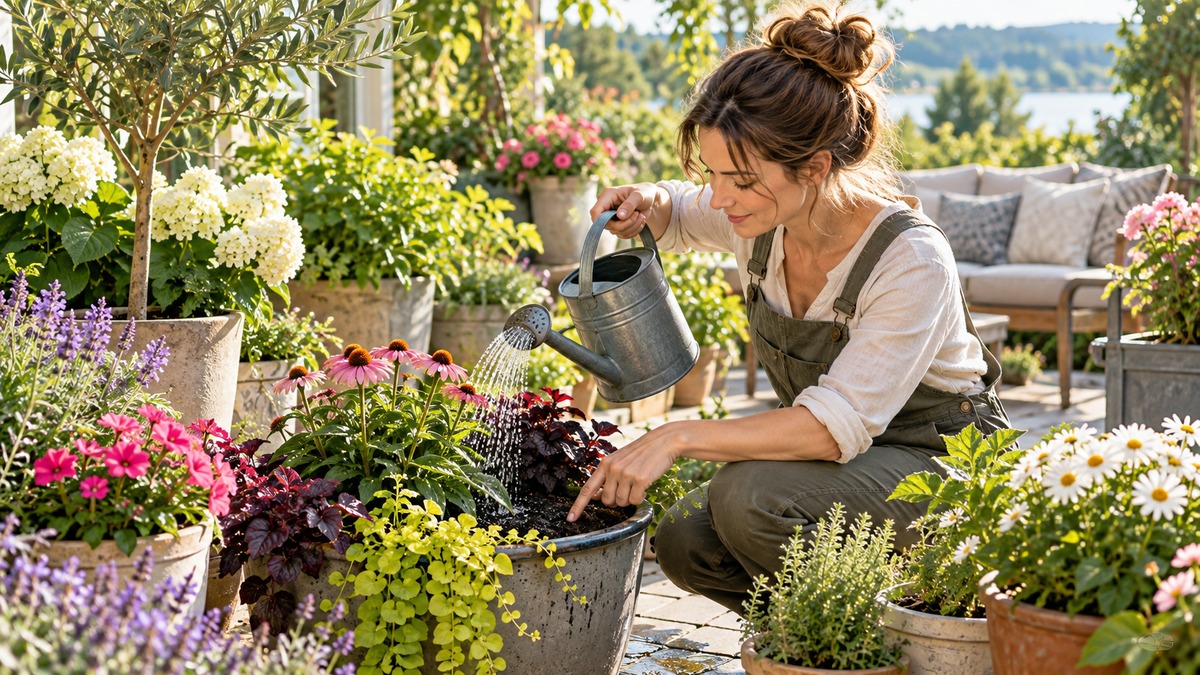
Illinois Extension asks you to apply enough water that the whole soil mass becomes moist, which means water starts to drip out of the drainage holes. Iowa State’s version is shorter: “continue to apply water until water begins to flow out the drainage holes in the bottom of the container.” Saskatchewan asks for a slow, thorough pour, so that all of the mix is moistened and the excess runs out of the drainage hole.
Kansas State explains why the runoff matters. Water draining from the bottom “carries away dissolved salts from fertilizer application, a process called leaching.” Illinois adds that salts from fertilizer and water can build up and cause damage such as burned leaf margins and injured roots. It also advises against softened water as a regular source for containers.
Kansas State also says to water to the limit. Its wording is “Water a container to its maximum capacity (absolute saturation) to ensure that water has soaked through the entire container.” A quick sprinkle that wets only the top of the mix does not meet that standard, and the next section shows what happens when the mix dries too far.
When the mix shrinks and water runs down the side
Soilless mixes are common in containers, and Illinois warns that they “have a tendency to shrink away from the pot edges if allowed to dry out excessively.” Once the mix pulls away, Illinois says water tends to flow through the gap between pot and mix and leave the mix dry. Its fix is to immerse the container in a bucket or sink of water, so that water is absorbed through the drainage holes, until moisture shows on the surface of the mix. A container set up for that kind of watering is covered in our guide to bottom-watering planters.
Illinois’s hot-weather release gives the second-watering rule: “If overly dry, the container mix will shrink and pull away from the sides. Water the container a second time to ensure complete water absorption.” Kansas State’s houseplant advice makes a related point. You should check that water is not just running down the side of the pot where dry mix has pulled away from it.
Where the sources disagree on saucers
This is the one point where the pages give opposite instructions. Kansas State says, “If possible, set the container in a saucer.” It then says to let water run through and sit for at least 30 minutes, and to pour off or extract the extra water. Saskatchewan says the reverse: “Don’t use a saucer under pots – if plants sit in water for too long their roots can rot.”
Both pages agree that standing water is the risk to avoid. A reasonable way to handle the gap is to empty any saucer after watering, which follows Kansas State’s pour-off step and keeps the plant out of standing water, the risk Saskatchewan describes. Saskatchewan also suggests raising pots off the ground on pot feet or bricks, so that water can drain freely from the drainage hole.
Drainage starts with the pot itself. Saskatchewan says that “Any container must have at least one drainage hole – and no gravel in the bottom of the pot, which actually impedes drainage.” Kansas State warns that a flat-bottomed pot on a flat surface may develop an airlock that stops drainage, and it recommends pots with feet or a raised base.
Morning watering and the hottest hours
Saskatchewan states: “The best time of day to water is in the morning. In this way, plant roots will have access to moisture during the heat of the day.” Illinois’s hot-weather release agrees: “In general, watering should occur in the morning to allow time for leaves to dry before nightfall.”
Kansas State adds a tactic for exposed containers. It notes that the soil in exposed containers often gets too hot for plant roots, and that watering during the heat of the day may be needed to cool it. The page says this does not require a full soak, only moistening the plants and the soil surface, and that water from the end of the hose should be cool. Illinois’s container page also advises keeping water off the leaves when you water.
Pots, mix and mulch that change the schedule
Mulch on the surface helps. Saskatchewan says that “A layer of mulch on top of the soil in your containers prevents water loss through evaporation.” The mix matters too. Saskatchewan recommends a soilless mix made from peat or coir with a small share of perlite or vermiculite, and advises against garden soil because it tends to compact.
Water-holding gels are another option. Illinois says that “To help retain moisture in the soil and to lengthen the interval between waterings slightly, you can incorporate one of the many gels available.” It adds the limit: “These products do not eliminate the need for timely watering. They just provide a slight cushion.” Read the label for the amount to mix in, based on the size of the container.
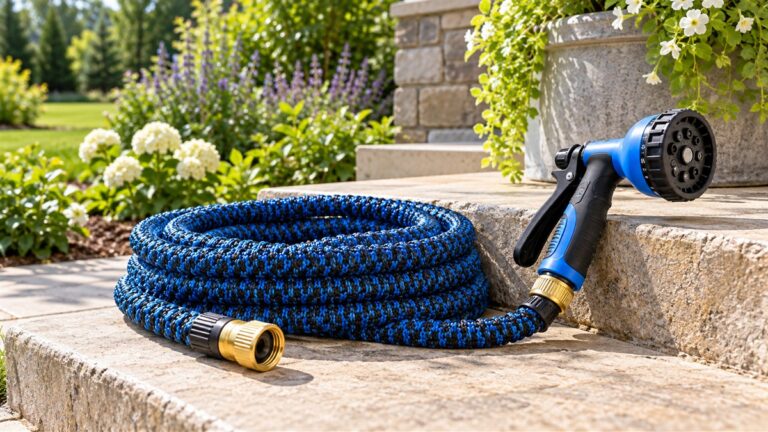
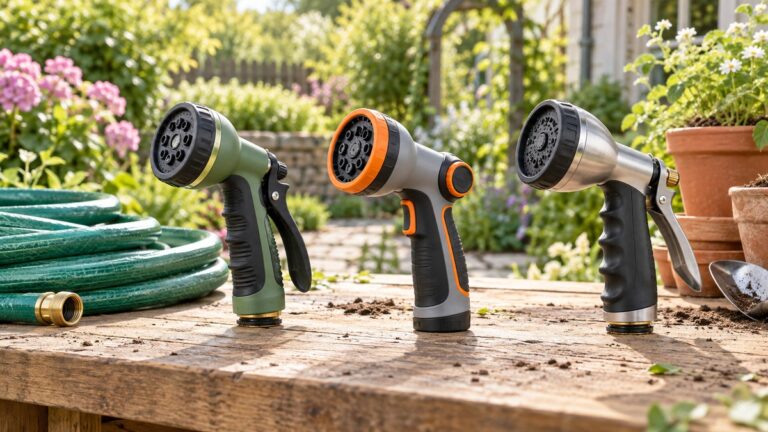
Watering tools also matter. Saskatchewan suggests a watering can or a hose with a rain nozzle, used gently, because a hard spray can wash soil out of pots and damage roots. Illinois notes that drip irrigation can make watering “more convenient and less time consuming” when many containers sit in one area. For a hose setup that gives a gentle spray, see our guide to hose attachments for watering plants.
Mistakes that cost you plants
- Waiting for severe wilting. Illinois says that a plant’s quality and health are greatly affected when it is allowed to wilt severely, so water before that point.
- Giving a light sprinkle. Kansas State asks for saturation, with water running out of the bottom, so the whole mass of mix is moist.
- Leaving the pot in standing water. Illinois warns that an overwatered container becomes waterlogged, and the roots then lack oxygen.
- Using a hard spray. Saskatchewan warns that it can wash soil out of the pot and damage roots.
- Ignoring shrinkage. Once the mix pulls away, Illinois recommends immersion rather than pouring on the top.
- Using softened water. Illinois advises against it, because salts build up in the mix.
How we chose
We limited this guide to university extension and university pages that cover container watering directly, and we opened each one on 2026-10-22 before writing a sentence from it. We kept a claim only when a page states it in plain words, and we checked each quoted sentence against the text of the page it came from. We left out retail and blog pages. Where two pages give different rules, both rules stay in the text.
What we could not verify
The pages we opened do not give a water volume for a summer container, and they do not say how often a given pot should be watered in a given week. Their advice depends on local weather, which none of them can know for your yard.
What the sources do not say
None of the pages gives a watering volume for containers. They give general checks and a saturation point, nothing more. The finger-test depth differs between Illinois, which says the first inch, and Kansas State, which says 3 inches, and the pages do not explain the difference. The houseplant depths from Kansas State apply to indoor pots. The saucer advice conflicts directly, and no page settles it. Iowa State’s page is short and gives no timing range for each pot size, so this guide does not add one.
Frequently asked questions
Do container plants really need water every day in summer?
Often, yes. Illinois Extension and Iowa State both say to check containers every day in summer, and Saskatchewan says that hot, windy weather can call for watering sometimes twice a day. The check comes first, and watering follows only when the mix is dry. A cool, overcast week may need less.
How can you tell whether a potted plant needs water?
Push a finger into the mix. Illinois says that when the first inch or so is dry, it is time to water, and that a meter is no substitute for your finger. Kansas State says the mix should be dry at least 3 inches deep before watering, so check at both depths until you learn which one your plants follow.
Why does the potting mix pull away from the pot?
Soilless mix shrinks when it dries out too far, and water then runs down the gap instead of soaking in. Illinois says to immerse the container so it can absorb water through the drainage holes, and to water a second time when the mix has pulled away from the sides.
Is it better to water in the morning or in the evening?
Saskatchewan and Illinois both point to the morning. Saskatchewan says roots then have moisture during the heat of the day, and Illinois says leaves have time to dry before nightfall. Iowa State’s second daily check for fast-drying plants falls in the late afternoon or evening.
Do water-retaining gels mean you can skip a day?
Not according to Illinois. The gels can lengthen the interval between waterings slightly, but the page says they do not eliminate the need for timely watering. Read the label for the amount to mix in, and keep checking the mix with your finger after you add them.
Sources
- https://extension.illinois.edu/container-gardens/watering (opened 2026-10-22)
- https://extension.illinois.edu/news-releases/consistent-watering-needed-during-hot-weather-gardening (opened 2026-10-22)
- https://yardandgarden.extension.iastate.edu/faq/how-frequently-should-i-water-annuals-containers (opened 2026-10-22)
- https://bookstore.ksre.ksu.edu/download/watering-raised-beds-berms-containers-and-houseplants_MF2805 (opened 2026-10-22)
- https://gardening.usask.ca/articles-and-lists/articles-how-to/how-to-water-outdoor-containers.php (opened 2026-10-22)
As an Amazon Associate we earn from qualifying purchases.