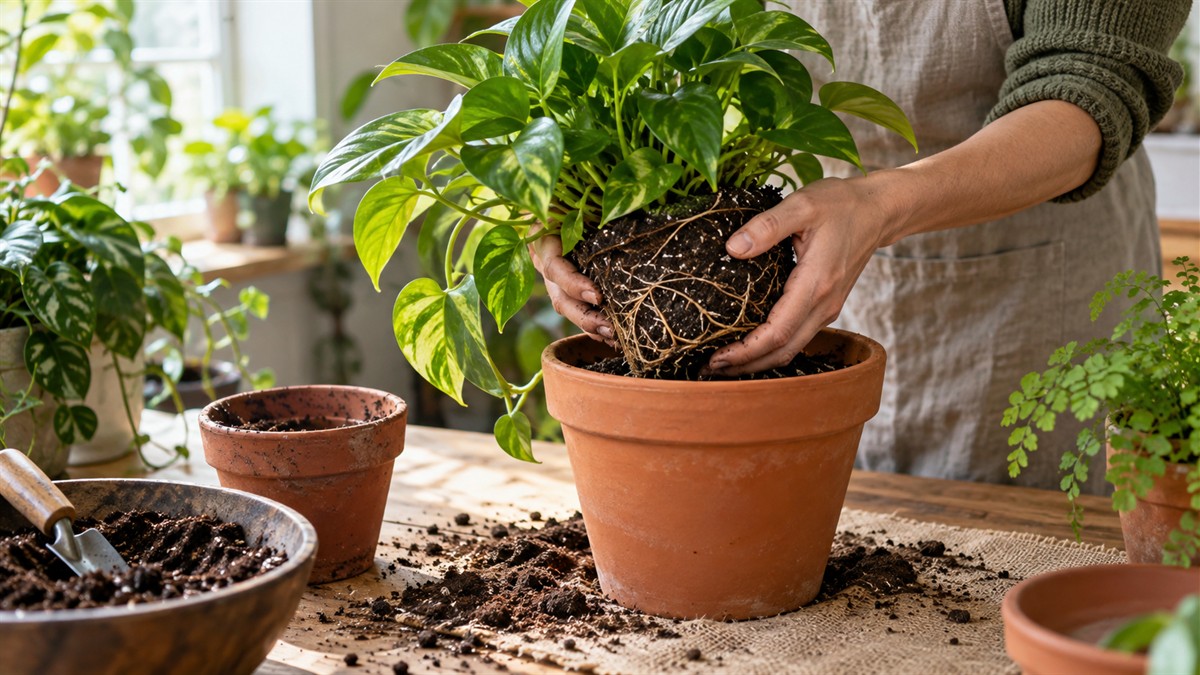
How to Repot a Houseplant Properly
As an Amazon Associate we earn from qualifying purchases.
If you want to know how to repot a plant properly, work in order: timing, pot, mix, roots, depth, then water. The four extension sources we opened cover those same steps and mostly agree. Where they differ, mainly on how much larger the new pot should be and how deep the root ball should sit, this guide shows each figure rather than picking one. Water the plant in at the end, and keep it out of harsh light for a few days.
Quick answer
- Repot in spring, or sooner if the plant is showing stress. Spring is the default, and stress overrides it.
- Pick a pot with drainage holes that is only slightly larger than the current one. The sources give different size steps.
- Use a good quality potting mix, not soil from the garden, and water thoroughly once the plant is in place.
Signs a plant needs a new pot
Roots are the clearest sign. NC State Extension says “A sure sign that it is time to repot is when plant roots appear from the drainage holes or from the soil surface.” Colorado State offers a quick check: spread your fingers over the soil, tip the plant upside down, and lift the container off to look at the roots. A white mass of roots circling the inside of the pot means it is time to repot.
Montana State Extension lists more signs. “The plant is top-heavy and wants to tip over.” It also points to “Lower leaves are yellowing and falling off”, and to salt or mineral buildup on the soil or the pot. NC State adds soil that dries out quickly, and slow growth even when the plant is fed in spring and summer.
When to repot
Spring is the usual answer. NC State says “Spring is the best time for repotting houseplants so they have time during the growing season to get established in their new container.” Colorado State says houseplants “typically respond best to transplanting in the springtime when they are starting active growth.” Montana State gives an earlier window: “The optimal time of year to transplant is late winter/early spring as less daylight makes houseplants somewhat dormant.” It adds that “However, if a plant is showing signs of stress as listed above, repot it anytime.”
Choosing the new pot
Pot size is where the sources differ most. The table gives each source’s step in its own terms.
| Source | Pot size step | Other pot notes |
|---|---|---|
| NC State Extension, Wayne County | No more than 2 inches larger in diameter | Pot should have drainage holes in the bottom |
| Colorado State University Extension | One to two inches larger in diameter | A reused pot must be cleaned thoroughly |
| Montana State University Extension | About one third wider and deeper than the previous pot | Pot material matters; see the section below |
| University of Arkansas Division of Agriculture | No more than 2 inches larger in diameter | At least one drainage hole; may be clay, ceramic or plastic |
Two sources cap the step at 2 inches, Colorado State allows one to two inches, and Montana State uses a proportion. A proportion scales with the pot. By our arithmetic from the Montana figure, a one-third step adds about 2 inches to a 6-inch pot and about 4 inches to a 12-inch pot. That is our calculation, not a number the page gives. Montana State also says to avoid a pot that is too large. Use the step as a ceiling, not a target.
Montana State compares materials. “Plastic is lightweight and usually less expensive.” “Ceramic is heavier, which may be a good option for a taller plant prone to tipping.” Terracotta is “traditional and unglazed (porous), will show mineral/salt buildup sooner, and will wick some moisture from the soil.” For a bigger planter, see our guide to DIY planter boxes for deck railings.
Drainage holes and what not to add
Every source asks for drainage. NC State says the pot “should have drainage holes in the bottom to allow for good water drainage.” Its next point is the one many people miss. Gravel or stones are often placed in the bottom of the pot “with the idea that this will improve drainage”, but “Research has shown that placing such items under the soil actually decreases drainage.” The reason given is that “Water will not move into the gravel layer until after the soil above it becomes saturated.”
Colorado State offers a fix for a large hole: “place a small piece of porous landscape fabric, a coffee filter, or a small shard from a broken container over the hole to reduce the loss of potting mix through the hole while still allowing drainage.” Montana State puts the emphasis on the holes themselves: “Drainage is very important, so make sure there are adequate holes.” It also suggests “a waterproof drainage tray underneath to collect water and protect furniture.”
Choosing the potting mix
Colorado State says “Choose a good quality potting mix.” It describes these mixes as “typically soilless blends with peat for moisture retention and perlite to improve drainage along with compost and fertilizer.” Garden soil is out. Colorado State says “Soil from the garden is not a good option as it does not provide enough drainage and has weed seeds and pathogens in it.” NC State recommends professional or premium potting soil for the job.
Montana State notes that premixed soils are made for different kinds of plants, and that a cactus, orchid or succulent needs its own special blend. For a lot of plants, it says you can make your own mix to save money. It also allows reusing old soil, with a check first: “Check that soil is free from salt/mineral buildup and pests or disease, then add at least 50 percent new soil to refurbish the old.” If you are buying bulk soil for raised beds, see our raised bed soil amounts guide.
Moistening the mix and removing the plant
Start by dampening the mix. NC State says “Before repotting, the potting media should be moistened.” Colorado State puts “a small amount of slightly moistened potting mix in the bottom of the new container” before the plant goes in. Montana State starts with the plant itself: “Water the plant enough to moisten the root ball.” Then remove it. “Gently remove from the pot.” If it is stuck, Montana State says to “tap the sides and bottom of the pot to loosen” it.
NC State recommends holding the plant between your fingers, turning the pot upside down and tapping the rim on a table edge. “Most plants can be removed easily if the pot is held upside-down while tapping the rim on the edge of a table.” Keep the stem out of the process: “Pulling the plant by the stem is not recommended because the stem could be damaged or separated from the plant roots.”
Checking and trimming the roots
Colorado State says to “Inspect the roots of the plant.” Its test is simple: “Healthy roots are white and firm.” Any that are black and mushy should be cut out and discarded. Montana State says to trim “dead, diseased, or damaged roots or roots growing out of the bottom” and to “Gently pull the roots away from one another if they are circling the pot.”
A tightly bound plant needs more work. NC State says roots that have circled the plant must be cut and unwound, “otherwise the roots will never develop normally.” Colorado State advises that if the roots are too tightly bound, you should “score them in a couple of places with a sharp knife.” Montana State warns about tools: “A dull clipper will damage roots and delay regrowth.” Keep the blade sharp.
Setting the depth and filling around the roots
NC State says “Place potting soil in the bottom of the new container.” Then it sets the depth: “The top of the rootball should sit an inch below the rim.” Colorado State puts it differently: “The plant and the top of the soil ball should be slightly below the lip of the pot, at the same level it was in the old pot.” These two depths are not the same. The sources do not say which applies to a given pot, so check the old soil line against the rim before you fill.
Fill the sides gradually. Colorado State says to “Add more potting mix to fill around the sides of the soil ball”, then to “Gently tap the pot on the potting bench to settle the soil in around the roots.” NC State warns against packing: “Do not pack the soil around the plant, instead firm or settle the soil by tapping the pot on a level surface or gently press the soil with your fingers.” It adds “Never pack media after it is wet since it can reduce air space and lead to root problems.”
Watering in and aftercare
NC State says to “water the plant thoroughly until water is seen running through the drainage holes.” Colorado State gives the same step in two words: “Water thoroughly.” After that, the plant needs time. Montana State advises “Keep the newly repotted plant in indirect light for a few days to reduce transplant shock.” It also says “It is normal to see the yellowing of leaves or leaf drop after repotting.” Its feeding advice is “Do not fertilize for at least two weeks to allow roots to regenerate.”
Common mistakes to avoid
- Pulling the plant out by its stem, which NC State advises against.
- Choosing a pot far larger than the step each source gives. Montana State warns against a pot that is too large.
- Adding a gravel layer under the soil, which NC State says reduces drainage.
- Packing the soil down while it is wet, which can reduce the air space the roots need.
- Fertilizing right after the move. Montana State says to wait at least two weeks.
How we chose
We opened each page with curl on 2026-10-22 and read the text that came back. We kept four extension pages that returned HTTP 200 and covered the repotting steps: NC State Extension (Wayne County), Colorado State University Extension PlantTalk, Montana State University Extension, and the University of Arkansas Division of Agriculture. The Arkansas sheet is a PDF, so its quotes were checked against the PDF text. Each quoted sentence was checked word for word against the fetched text. Where two sources give different numbers, the table shows both rather than picking one.
What we could not verify
The four pages agree on the steps. They do not agree on every number, and a few practical points are not covered.
What the sources do not say
- No single pot size suits every plant. The pages give three different size rules, and none explains when to use which.
- Planting depth is not settled. NC State says an inch below the rim, and Colorado State says slightly below the lip.
- The pages we read do not give a fixed interval between repottings. They describe signs and seasons instead.
- None of the pages says how long a plant takes to settle, beyond the few days of indirect light and two weeks without fertilizer.
- The pages do not cover orchids or cacti in depth. Colorado State says to choose a mix “specifically designed for those types of plants.”
Frequently asked questions
How can you tell if a houseplant needs a bigger pot?
Look at the roots first. NC State says roots showing at the drainage holes or the soil surface are a sure sign. Montana State adds that a top-heavy plant, lower yellowing leaves, or salt or mineral buildup on the soil or pot are all signs that a plant needs a new home.
Is winter a bad time to repot?
Not if the plant is struggling. Montana State gives late winter or early spring as the best window, and says a stressed plant can be repotted at any time. NC State and Colorado State both point to spring, when plants are starting active growth.
Can you reuse an old pot?
Yes, if you clean it first. Montana State says “Pots can be reused if they are clean and sterile.” NC State says a used pot should be cleaned to prevent diseases or pests left over from the last plant, and Colorado State makes the same point about pathogens and insects.
Is gravel needed in the bottom of the pot?
The sources say no. NC State reports that gravel or stones placed under the soil decrease drainage, because water does not reach the gravel layer until the soil above it is saturated. The sources point to drainage holes and a good potting mix instead.
How far should the soil come up around the plant?
Colorado State sets the plant at the level it had before, slightly below the lip, and NC State sets the rootball about an inch below the rim. NC State also says “Do not add soil above the original level on the rootball, unless the roots are exposed”, so keep the old soil line in view as you fill.
Sources
- https://wayne.ces.ncsu.edu/news/repotting-houseplants (opened 2026-10-22, HTTP 200)
- https://planttalk.colostate.edu/topics/houseplants/1316-houseplants-repotting/ (opened 2026-10-22, HTTP 200)
- https://www.montana.edu/extension/lila_extn/askstewardrepothouseplant.html (opened 2026-10-22, HTTP 200)
- https://www.uaex.uada.edu/yard-garden/home-landscape/docs/Repotting%20Houseplants.pdf (opened 2026-10-22, HTTP 200)