Can You Plant Raspberries? A Practical Guide
As an Amazon Associate we earn from qualifying purchases.
Can you plant raspberries in a home garden? Yes. The extension guides we opened agree on the basics: plant in spring, give the canes full or nearly full sun, and choose soil that drains well. The guides differ on details such as spacing, planting depth and soil pH, so this guide sets those figures side by side. Read the planting steps before you dig, because the site and the plant type come before the first shovel of soil.
Quick answer
- Yes. Plant bare-root canes in early spring, as soon as the soil can be worked.
- Choose a site that gets at least 6 hours of direct sun a day, with well-drained soil and no heavy clay.
- Space black and purple types 3 feet apart in the row, and red and yellow types 1½ to 3 feet apart, with rows 6 to 8 feet apart.
- Skip any bed where potatoes, tomatoes, peppers, eggplants, other caneberries or strawberries grew in the last three years.
Choose the fruiting habit first
The first decision is the type of raspberry, because the type sets when the berries come and how the canes behave. Oregon State University’s 10-minute guide on growing raspberries puts it this way: “Your first choice is between types that produce once, in early summer, and those that produce twice, in summer and fall.” The same guide explains the two kinds of canes. “Primocanes are one-year old canes that grow and produce only leaves.” “Floricanes are two-year old canes that produce berries and leaves.”
The Oregon State guide names summer-bearing choices such as Willamette, Meeker and Cascade Delight, and fall-bearing choices such as Heritage and Caroline. It presents them as examples for its own region, so check a local list before you buy. Climate is the next filter. New Mexico State University’s publication says: “Although red raspberries prefer cooler areas, everbearing varieties have successfully produced fall crops in warmer areas.” That sentence points red types toward cooler gardens and says everbearing types can still give a fall crop in warmer ones.
The same publication explains the everbearing habit. Everbearing red raspberries “send up new canes during the spring and summer and produce berries during the fall of the same year.” Summer-bearing types do not work that way. Their fruit comes from the older canes, so a summer-bearing planting and an everbearing planting need different pruning, which is covered further down.
Pick a sunny site with good drainage
Sun and drainage are the two site conditions both guides address most directly. Iowa State University’s article says: “The planting site should receive at least 6 hours of direct sun each day.” Oregon State is softer on shade. Its guide says raspberries “can tolerate partial shade, but full sun yields best.” Iowa State adds a warning about trees: “Avoid shady areas near large trees and shrubs.”
Drainage matters just as much. Iowa State says: “Raspberries grow poorly in heavy clay or poorly drained soils.” Oregon State says to “Avoid heavy clay soils” and recommends that you “Grow plants in well-drained, fertile, loamy soil with moderate water-holding capacity.” If your ground is heavy, Iowa State states that “Planting in raised beds can improve drainage.” Oregon State describes a raised mound for the same purpose. For raised beds, see how much soil a raised bed garden needs and the best way to fill raised beds before you add plants.
Soil pH is the one figure where the two guides differ. The table shows both ranges as each source states them.
| Source | Soil pH stated |
|---|---|
| Oregon State University, 10-minute guide | 5.5 to 6.5 |
| Iowa State University, 2013 article | 6.0 to 6.8 |
Both ranges include 6.0 to 6.5, so soil in that span fits both guides. The sources we opened do not say how to test pH, so check the method with your local extension office.
Keep old crops and weeds out of the bed
Oregon State gives a clear rule about the bed’s history: “Avoid a site where potatoes, tomatoes, peppers, eggplants, other caneberries, or strawberries have grown the last 3 years.” The reason it gives is that “These crops are susceptible to many of the same insects and diseases as raspberries.” Put simply, a bed that grew tomatoes or potatoes recently is a poor place for the new canes, even when the soil looks fine.
Weeds need the same care before planting. Iowa State says that “Perennial weeds, such as quackgrass, are extremely difficult to control in a raspberry planting.” The article also advises avoiding ground that is heavily infested with perennial weeds, and it adds that “If possible, remove all wild brambles near the new raspberry planting to prevent the spread of disease.” Clearing the ground before the first cane goes in is far easier than clearing it among established plants.
Buy healthy canes
Raspberries are usually sold as bare-root plants. Oregon State recommends one step at the nursery: “Purchase certified disease-free plants to minimize disease problems.” Iowa State gives the reason for that advice: “Plants obtained from an old patch are often diseased.” It also warns that “Virus-infested raspberries may appear healthy, but grow and yield poorly.” A healthy-looking cane can still be a poor buy, which is why the source of the plant matters as much as its appearance.
Iowa State notes that “Raspberries may be purchased as dormant, bare-root stock or as tissue cultured plants.” Tissue cultured plants are small and actively growing, so they follow a different planting rule from dormant canes, covered in the next section. Dormant canes are the usual choice when you want the plant to settle in before the heat of summer arrives.
Plant in spring at the right depth
Spring is the window both guides name. Iowa State’s guidance is specific: “Early spring (late March and April) is the best time to plant dormant, bare-root raspberry plants in Iowa.” Oregon State puts it more simply: “Plant early in the spring as soon as soil is workable.” The two statements point to the same season, so spring is the place to start unless your local extension office gives different dates for your area.
Tissue cultured or other actively growing plants follow a different rule. Iowa State says that “Actively growing plants should be planted when the danger of frost is past.” It also advises hardening them off first: “Harden actively growing plants outdoors for a few days before planting them in the garden.” Start them in a sheltered spot, then give them longer periods of direct sun over several days before they go into the bed.
Depth is the detail most often missed. Iowa State advises: “Plant red and yellow raspberries 2 inches deeper while black and purple raspberries should be set 1 inch deeper than previously grown.” Oregon State uses a different reference point: “Place the highest point where roots attach to canes about 1 to 2 inches below ground level.” Iowa State measures from the depth the plant had in the nursery, and Oregon State measures from the ground surface. Check the nursery mark on the cane and the crown before you decide how deep to set it.
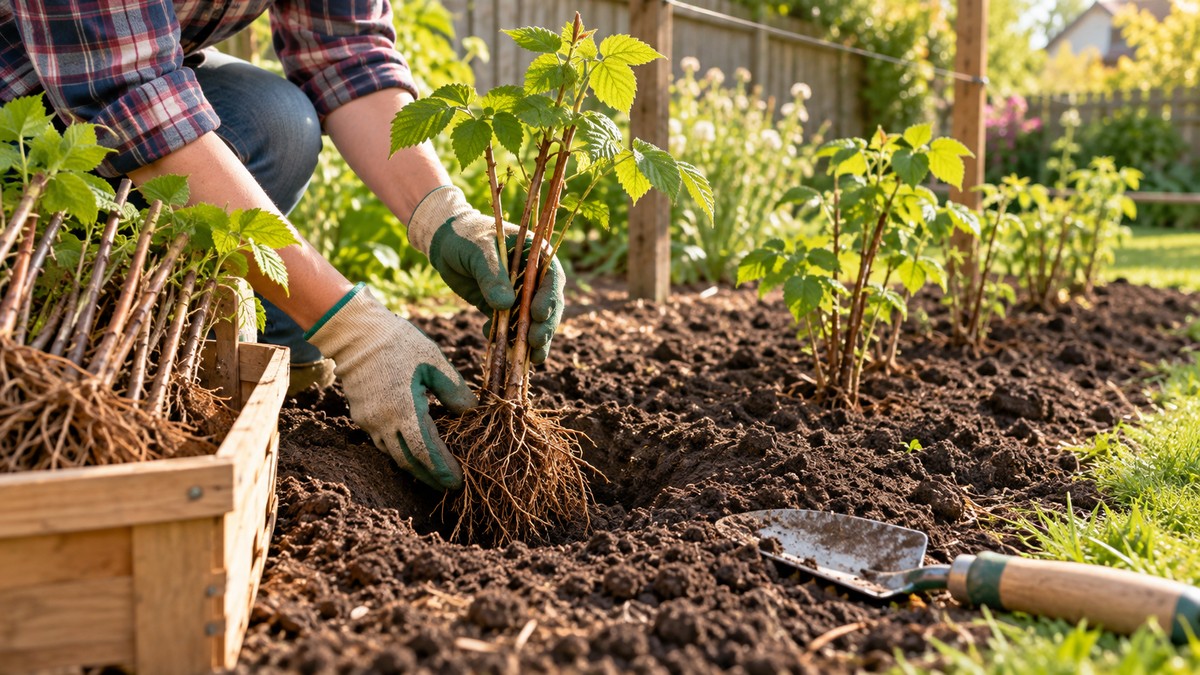
The planting itself is simple once the depth is right. Iowa State’s steps start with a hole that is generous: “Dig a hole slightly larger than the spread of the plant’s root system.” Then, “Position the plant in the center of the hole, spread out its roots, then backfill with soil.” Finally, “Water each plant thoroughly, then prune back the canes, leaving a maximum of 2 to 3 inches above the soil.”
Spacing and row layout
Spacing depends on the type. The table combines Iowa State’s spacing and depth figures for each group.
| Type | Spacing in the row | Spacing between rows | Extra planting depth, per Iowa State |
|---|---|---|---|
| Red and yellow | 1½ to 3 feet | 6 to 8 feet | 2 inches |
| Black and purple | 3 feet | 6 to 8 feet | 1 inch |
Black and purple raspberries “grow in clumps and remain in their original location” so each plant needs room to spread within its own space. Red and yellow types suit a different layout. Iowa State says that “For best results, maintain red and yellow raspberries in 1- to 2-foot-wide hedgerows.” A narrow hedgerow of canes is easier to manage than scattered plants, and it keeps the picking area clear.
Support, watering and mulch in the first year
Support matters for the summer crop. Oregon State says: “Summer-bearing raspberries need support to hold the cane upright.” Its training notes describe a trellis with one or two top wires and two lower wires, though there are many variations. A trellis keeps the canes off the ground and makes harvest easier to reach.
Watering is the other first-year task. Oregon State says to “Take care to water the root zone only while avoiding wetting the foliage.” The same guide gives established plants about 1 to 1½ inches of water a week from mid-June through late summer. New plantings need less of a push on fertilizer: “In new plantings, do not apply all the fertilizer at once.” Divide the total into portions and spread them through the season, following the guide’s schedule.
Weed and soil care is gentle. Oregon State says to “Cultivate no deeper than 1 to 2 inches to prevent root damage” and adds that “Mulch can be used to suppress weeds and maintain soil moisture.” Shallow hoeing and a layer of mulch are the two tools the sources name for this job, and both keep the roots undisturbed.
Pruning follows the cane type
The canes are the short-lived part of a raspberry planting. Oregon State’s home-garden guide says that “Canes are biennial (cane or cane portion dies after fruiting)”, while “Roots and crown (base of plant) are perennial”. The roots and crown stay, so a well-cared-for patch can keep producing for years. Oregon State’s 10-minute guide notes that “They also are long-lived: red & yellow raspberries can remain productive up to 15 years”.
For summer-bearing types, the same guide says to “Prune by removing dead floricanes in late fall.” Fall-bearing types need a different plan: “Fall-bearing raspberries either have two small crops or one big fall crop.” If you want only the one big fall crop, Oregon State says to “For a fall crop only, cut down all canes to ground level in late March.” The pruning choice therefore depends on the type you bought, which is why the first section of this guide matters.
Mistakes to avoid
- Planting in heavy clay or wet ground, where Iowa State says raspberries grow poorly.
- Planting in a bed where tomatoes, potatoes or other caneberries grew in the last three years.
- Buying canes from an old patch, which Iowa State says are often diseased.
- Leaving perennial weeds in the bed before planting.
- Planting in shade near large trees and shrubs.
- Leaving summer-bearing canes without support, so they fall over.
How we chose
We chose four university and extension publications that give planting steps for home gardens and that we could open and read. We kept a figure only when a publication states it in plain words. When two publications give different numbers, as with soil pH, we show both. The Iowa State article carries an April 12, 2013 date, so its figures are a starting point, and the local extension office is the place to check current timing.
What we could not verify
What the sources do not say
The sources we opened do not give frost dates for any region, a container size, or a rule for growing raspberries in pots. They do not give a fall planting window for purchased canes, and they do not name a single best type for beginners. The Iowa State timing is stated for Iowa. How the same steps apply in your climate is not stated in the sources, so treat the spring window as a default to check against local advice.
Frequently asked questions
Can you plant raspberries in the fall?
The sources we opened describe spring planting for bare-root canes. The New Mexico State publication mentions transplanting rooted suckers in early fall or spring, but none of the sources gives a fall planting rule for purchased canes. Ask your local extension office before planting late in the year.
Can you plant raspberries in a pot?
The sources we opened describe planting in the ground and in raised beds. They do not give a container size or a pot rule, so this guide does not give one.
Do raspberries need full sun?
Iowa State says the site should receive at least 6 hours of direct sun a day. Oregon State says raspberries can tolerate partial shade, but full sun yields best.
How far apart should raspberries be planted?
For black and purple types, Iowa State gives 3 feet apart in the row and rows 6 to 8 feet apart. For red and yellow types, it gives 1½ to 3 feet in the row, with the same row spacing.
Which type should a beginner choose?
The sources do not name one best type for beginners. The choice depends on whether you want one summer crop or a summer and fall crop, and on your climate, as the New Mexico State publication notes.
Bottom line
Plant healthy bare-root canes in spring, in sun and well-drained soil, and set them at the depth and spacing your type needs.
Sources
- https://extension.oregonstate.edu/sites/extd8/files/documents/12281/growingraspberries.pdf (opened 2026-10-22)
- https://extension.oregonstate.edu/sites/extd8/files/documents/1/raspberries-home-garden.pdf (opened 2026-10-22)
- https://yardandgarden.extension.iastate.edu/article/2013/04-12/raspberry.html (opened 2026-10-22)
- https://pubs.nmsu.edu/_h/H320/ (opened 2026-10-22)