How to Prune Fruit Trees
As an Amazon Associate we earn from qualifying purchases.
How to prune fruit trees depends mostly on the tree’s age. A young tree needs training, a mature one needs steady maintenance, and the cuts made in its first few years set its shape for much of its life. The three university extension guides we opened agree on the core rules: prune every year, prune lightly while the tree is young, and do most of the work in late winter or early spring. This guide covers the first years, the cut rules, and the mistakes that delay fruiting.
Quick answer
- Prune every year, in late winter or early spring, before the buds begin to swell.
- Train young trees lightly, and build a central leader with three to five well-spaced main branches at wide angles.
- Try not to remove more than about 10 percent of a tree’s live mass in any one year.
- Never top the tree or leave stubs. Make each cut close to the branch collar.
Why prune every year?
Pruning is about fruit more than looks. Montana State’s MontGuide says the main objective of pruning is to increase fruit production, even though pruning also keeps a tree in shape and removes dead or damaged wood. A well-pruned tree lets light and air move through the canopy, and Marinette County’s guide says light is required for quality fruit. Marinette also makes the point that the work should be done every year. Skipping a year, it says, puts tree health and production at risk.
Think of the early years as training rather than cutting. Marinette’s guide puts it plainly: think of your time spent as training, not pruning.
Pick the right time
The guides agree on the season and differ a little on the month. Montana State says to prune every year in late winter or early spring, in February or March. Marinette County, which writes for Wisconsin, says March and April are generally ideal, as long as the work happens before bud expansion begins. NMSU’s guide on training apples starts earlier, with training that begins immediately after planting. Whatever month you choose in your area, the common rule is the same: prune before the buds begin to swell.
Montana’s guide also notes the simplest point of all. The day a tree is planted is the day to begin to prune and train it for future production. Waiting several years is a common mistake, and the NMSU guide says it is a common one among home gardeners.
The first year: head the whip and set the framework
A bare, unbranched young tree is called a whip. Montana State’s guide says to head the top of a whip at 30 inches at planting to promote branching. NMSU advises heading it down to about 30 inches, which balances the size of the top against the damaged root system after digging and transport. NMSU also warns about the cut height. Cutting too low can make the growth too vigorous and push the branches too low on the trunk. Cutting at 36 inches can leave short branches with weak growth, which are hard to use as a framework. The cut should also leave several good buds below it. NMSU says to make sure there are five to seven good buds under the cut, and to adjust the height if buds near that level are damaged.
Once new shoots appear, the training work begins. Montana’s guide says to start training the tree when two to three inches of new growth have appeared, using limb spreaders to push the new growth outward and upward. The goal is a wide crotch angle, which the guide puts between about 45 and 60 degrees. Narrow angles are the weak point. NMSU says narrow crotch angles are very weak, and branches joined that way break easily from the trunk. Its practical fix is simple. If the branching angle is too narrow, use wooden clothespins to push the branches flat, and leave them on the young shoots for the season.
The vigorous upright shoot at the top becomes the central leader. NMSU defines it as the main leader, or dominant shoot, in the center of the tree. Keep it as the highest point of the tree. Remove shoots that compete with it, and keep the scaffolds that grow at good angles. By the end of the first season, the guides want three to five well-spaced scaffolds that sit evenly around the trunk, with the rest removed.
Years two to five: add tiers without crowding
Montana’s guide recommends leaving four or five main scaffold branches, spaced around the tree and about six inches apart vertically. In the second growing season, it says to develop a second layer of scaffolds two to three feet above the first. NMSU describes the same plan in a little more detail. Its second-season goal is a second layer of scaffolds 24 to 36 inches above the first layer, and it advises selecting branches that do not sit directly above the first-tier scaffolds but fill the spaces between them.
Branch spreaders, weights or ties can widen a narrow angle during this stage. NMSU says spreaders can stay in place for one or two years, until the branches can hold their own position, and it says not to push branches more than about 60 degrees. Montana’s guide says that wider crotches can produce vigorous suckers along the topside of a branch, so the gentler angle is the safer one. Marinette County adds that wooden spreaders can change the angle of a young branch to about 60 degrees, which gives stronger wood over time.
After the early seasons, the work becomes routine. Montana’s guide says to head back the new terminal growth by one-fourth each year, remove upright, broken or damaged limbs, and keep the central leader as the highest point on the tree. NMSU describes the goal for a mature young tree as a pyramid shape, with a dominant central leader and the strongest, longest branches at the bottom. Its winter pruning removes weak, hanging and overcrowded branches each year.
Size is set at planting
Many buyers hope that pruning will keep a fruit tree small. Montana’s guide is direct on this point. You cannot substantially control the height of a tree by pruning. If you plant a standard-sized fruit tree, it will be large no matter how much you cut the top. Montana notes that height can be somewhat limited by removing large branches from the upper side of the scaffolds, leaving only small fruit-producing shoots.
Stone fruit trees: open center and early spring
Montana’s guide treats stone fruits, including plums, cherries and peaches, differently. Those trees are trained to an open center, which gives a vase shape. An open center lets light and air reach the middle of the tree. At the first year after planting, Montana says to prune stone fruit trees in early spring, remove damaged branches first, and cut out vigorous upright shoots on the inside of the main scaffolds. Within a season, the tree should start to take on the vase shape, with three or four permanent scaffold limbs spread around the trunk about six inches apart vertically.
Mature trees: prune for light and manage the canopy
Mature fruit trees need pruning too, and the goal changes. Montana’s guide says you can modify the height and spread of mature trees of any species by selective pruning. Primary scaffold branches can be headed back to an outside-growing side branch, which encourages lateral shoot growth. Marinette County advises removing dense or long growth from the upper parts of the tree that shade lower limbs, and cutting out limbs and spurs that grow downward.
Light is the thread running through these rules. Marinette says light is required for quality fruit, and Montana warns about the opposite. Topping the tree results in a thicker, shade-producing canopy that causes fruit production to suffer, according to Montana.
Which wood to remove first
A clear order helps. Montana’s guide starts with dead, broken and damaged limbs. Then it moves to weak wood, water sprouts and suckers around the base of the trunk, which, in its words, sap the strength of the tree and interfere with fruit production. Marinette’s steps match that order. Remove broken branches, cut off water sprouts growing on the trunk and scaffold limbs, remove the weakest of crossing or closely growing parallel limbs, and then thin any dense growth.
When two limbs cross, Montana advises removing the weaker of the two, along with any limb that grows back toward the center of the tree. Thinning cuts that remove an entire limb or shoot can improve fruit set, according to the same guide. Marinette adds a practical reminder. Weak, spindly branches should go first when the tree needs more thinning.
How to make each cut
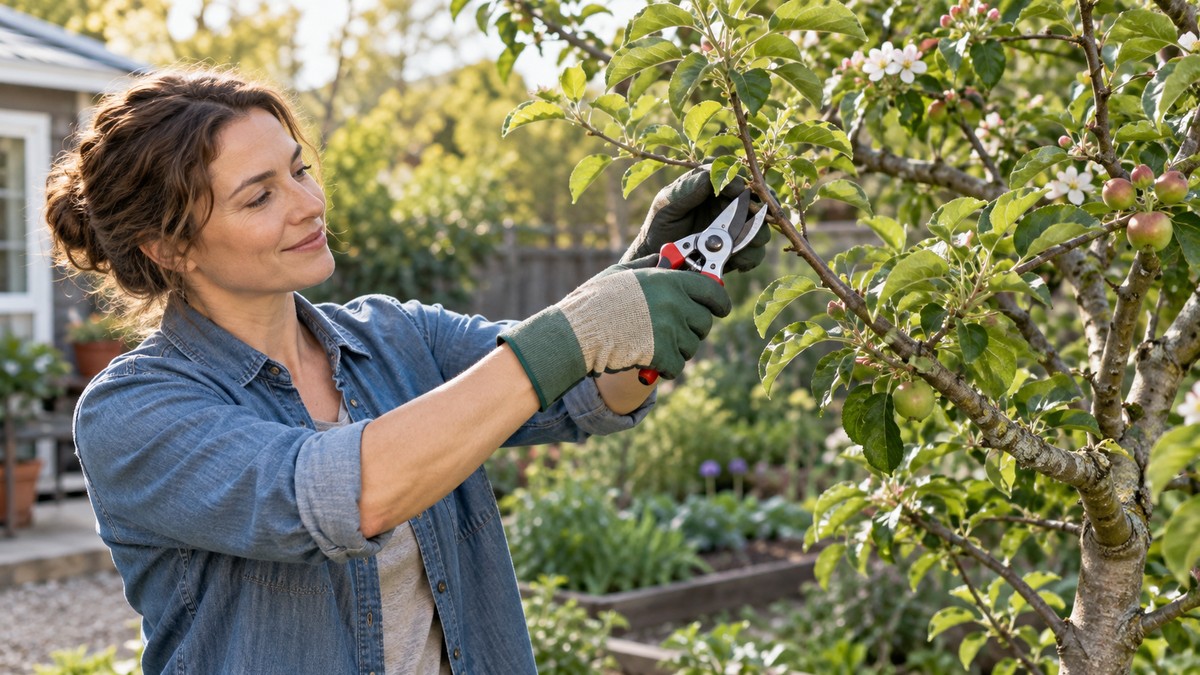
Clean cuts heal better. Montana says to remove the entire limb, cutting as close as possible to the branch collar, which is the ridge of bark where the branch meets the trunk. For large limbs, make the first cut from the bottom of the branch, so the weight does not tear the bark, and then finish the cut from above. Never leave stubs, and never top or hedge a tree to shorten it. Marinette repeats the stub rule: leave the branch collar, but not a stub. Make all cuts smooth and close.
Long, willowy branches need a different approach. Montana says to remove the outer third of such branches, making the cut just above an outward-pointing lateral branch or bud. That keeps the branch growing outward instead of back into the tree, and it thins the crown in the process.
How much to remove in one year
Marinette’s guide gives the clearest number. Use the 10 percent rule to guide how much pruning to do, and try not to remove more than 10 percent of the tree’s live mass in any one year. The guide also says that cultivars that bear heavily in alternate years can take heavier pruning just before the main bearing year. That schedule matters for trees that alternate between heavy and light crops.
Tools for fruit trees
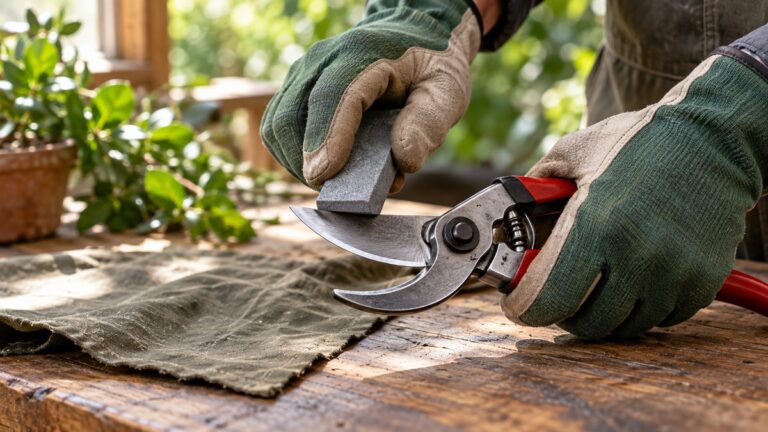
Marinette’s guide is direct about tools. Use tools made specifically for pruning, keep them sharp and clean, and never use a pruning implement that has only one cutting surface. Those points apply to the cuts described above. For thicker stems, see our guide to pruners for trees. To keep your blades in shape between seasons, see our guide to pruner sharpeners.
Common mistakes that delay fruit
- Leaving young trees untended. Montana says backyard growers often plant apple and pear trees and leave them alone for several years, which results in poor growth and delayed fruiting.
- Overpruning young trees. Montana says it is just as bad to overprune, because the tree becomes overly vigorous and its bearing starts later.
- Topping the tree. Montana says topping produces numerous water sprouts that shade the tree further.
Your first years at a glance
| Stage | What the guides say | Source |
|---|---|---|
| Planting day | Head a whip to about 30 inches to promote branching | Montana, NMSU |
| First season | Train new shoots with spreaders; keep a central leader; use clothespins on narrow angles; keep three or four well-spaced scaffolds | Montana, NMSU |
| Second season | Build a second layer of scaffolds 24 to 36 inches above the first; remove competing shoots | NMSU (Montana gives two to three feet) |
| Later years | Head back new terminal growth by one-fourth each year; keep the central leader highest; remove weak, hanging and overcrowded branches | Montana, NMSU |
| Stone fruit | Train to an open center; prune in early spring | Montana |
How we chose
This guide uses three university extension publications that we opened and read on 2026-10-22: Montana State University Extension’s MontGuide Pruning Fruit Trees in Montana, the University of Wisconsin-Extension Marinette County fruit tree pruning sheet, and New Mexico State University Cooperative Extension’s Guide H-333 on training young apple trees. We chose them because each one covers the training or pruning of fruit trees in a clear, step-by-step way, and because each names its extension author or office. Other fruit tree pages that came up in our searches were trade sites, archived bulletins or pages that could not be opened, so they are not used. We also opened an Arizona Cooperative Extension publication but did not cite it. We did not rank any products.
What we could not verify
The rules here come from extension guides written for apples, pears and stone fruits in their home regions. They are general, and they do not replace a look at the tree you have.
What the sources do not say
- The guides disagree on the month. Montana gives February or March, Marinette County gives March or April, and NMSU starts training at planting. Check the timing that fits your local climate.
- No page gives a number of years before a tree begins to bear fruit. Montana says overpruning delays bearing, but it does not say by how much.
- The sources do not cover ladder use or other safety steps for working in a tree. Follow the tool and ladder manuals, and local rules, before you climb.
- The guides focus on apples, pears and stone fruits. They say little about other fruit, such as figs or berries, so this guide does not cover them.
Frequently asked questions
When is the best time to prune a fruit tree?
Montana State says late winter or early spring, in February or March, and Marinette County says March and April. Both say to prune before the buds begin to swell. Pick the window that matches your local conditions.
How much can you cut from a young tree in one year?
Montana says to prune young trees, up to about 10 years of age, lightly. Marinette’s rule is to try not to remove more than 10 percent of the live mass in any one year. The sources do not give a separate number for young trees, so keep cuts small and spread the work across several seasons.
Should you prune a tree planted last year?
Yes. Montana’s guide says the day a tree is planted is the day to begin training it. A tree’s age is counted from the date of planting, so a tree planted last year is already in its first training stage.
Can pruning keep a fruit tree small?
Not by much. Montana says you cannot substantially control the height of a tree by pruning, and a standard-sized fruit tree will be large however much you cut the top. Pruning can shape the tree and keep it inside its space.
Which cuts should you make first?
Start with dead, broken and damaged limbs, as Montana advises. Next remove weak wood, water sprouts and suckers, and then thin crossing or downward limbs. Keep every cut close to the branch collar and avoid leaving stubs.
Sources
- Montana State University Extension, MontGuide, Pruning Fruit Trees in Montana: https://www.montana.edu/extension/powderriver/documents/fruits/MT199215AG.pdf (opened 2026-10-22)
- University of Wisconsin-Extension, Marinette County, Fruit Tree Pruning Basic Concepts to Consider: https://marinette.extension.wisc.edu/files/2020/03/2-PRUNEOUT-002.pdf (opened 2026-10-22)
- New Mexico State University Cooperative Extension Service, Guide H-333, Training Young Apple Trees to the Central Leader System: https://pubs.nmsu.edu/_h/H333/index.html (opened 2026-10-22)