How to Grow Blueberries in Containers
As an Amazon Associate we earn from qualifying purchases.
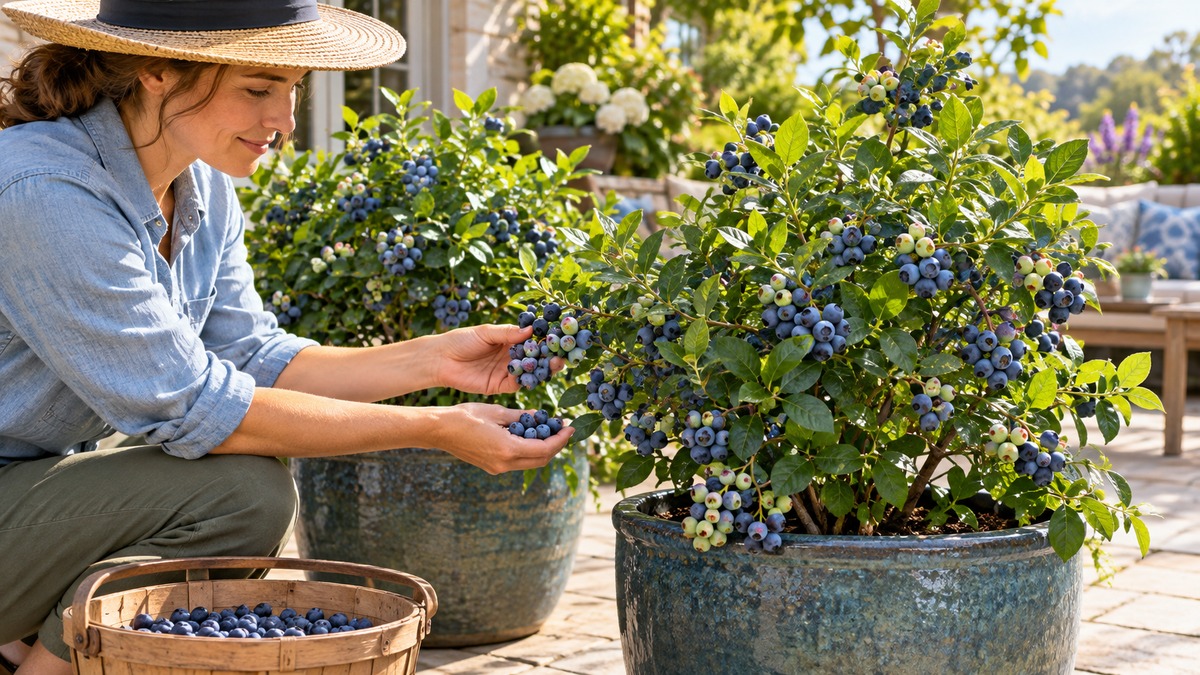
How to grow blueberries in containers begins with two decisions: a deep, wide pot and an acidic growing mix. Blueberries need acidic conditions, and Wisconsin Extension notes that many soils in its state are too alkaline for them. A container lets you control the mix. The three guides we opened agree on most of the steps, and they differ on the starting pot size and on how to protect the plant in winter.
Quick answer
- Use a large container at least 24 inches deep and 24 to 30 inches wide for a mature plant, as the University of Maryland Extension advises.
- Fill it with an acidic mix, such as a 50-50 blend of potting soil and peat moss, and keep the soil evenly moist.
- Expect no fruit in the first year. The Maryland guide says a full crop takes about five years.
- Plan winter protection. Maryland asks for a sheltered spot, and Wisconsin recommends burying containers in the ground.
Start with a pot that leaves room to grow
Maryland gives the target size for a mature plant. Its guide says “Mature blueberries need a container at least 24 inches deep and about 24-30 inches wide.” It also says a young plant does not need that size on day one: “When planting smaller shrubs, start with a smaller container and repot as it grows.” The guide adds a timing note: “Repot in late summer – early fall so roots have enough time to grow before winter.”
Wisconsin takes the same approach from the other end. Its guide says “Fill a five-gallon container with whichever mix you decide to use, and plant a single blueberry plant in the container.” It then says “As the plant matures, repot it in a larger container (e.g., a 16 or 20 inch pot) or in a barrel.” Both guides support starting modest and moving up as the plant grows.
The UF/IFAS publication HS1476, written for commercial growers, describes container-based farms that moved from large nursery pots to smaller containers of about 5 to 7 gallons. It cites research showing that large containers do not improve plant growth or productivity. It also notes that blueberry roots are shallow, so containers that are wider than they are tall suit the plant. Home growers can take the shape point without copying the commercial volumes.
Drainage is a shared requirement. Maryland says “If containers are placed on hard surfaces, place them on top of bricks for drainage.” The UF/IFAS publication says containers with abundant holes or grills for drainage are essential. Wisconsin adds a warning about color: “Avoid using black containers for planting blueberries as such containers absorb heat,” which means a light-colored pot is the safer choice in sunny spots.
Choose an acidic mix and check the pH
Acidity is the core requirement. Wisconsin Extension says “One of the most critical factors for successful blueberry production is providing an ideal soil pH in the range of 4.5 to 5.0.” It adds that “This is a challenge in many parts of Wisconsin where soils are typically too alkaline” to support blueberries well. Wisconsin presents the container as the workaround: “An alternate option for producing blueberries is to grow them in a container filled with an acidic soilless growing medium.” A pot solves that problem only if the mix stays acidic.
The two home guides give different recipes, and both are workable. Maryland says “Use a 50-50 mix of potting soil and peat moss as your planting media.” Wisconsin says “To prepare an acidic soilless growing medium, use a mix of one part sphagnum peat moss and one part shredded pine bark.” Wisconsin also describes a blend of coir, peat moss and perlite that works well. Pick one recipe and use it for the whole pot.
Wet the mix before you plant. Maryland says “Wet it thoroughly before placing it in the container.” Then check the pH over time. The UF/IFAS publication explains that soilless mixes have little pH buffering, so the pH can shift with the irrigation water and the fertilizer you use. It recommends a leachate pH of 4.5 to 5.5, and it notes that water alkalinity can push the pH up. Hard tap water is therefore a reason to watch the pH more closely.
For a wider look at soil made for pots, see using raised bed soil in pots, and for soil volume in a larger bed, see how much soil a raised bed garden needs.
Planting and the first years
Planting depth is simple. Maryland says “Place the blueberry into the potting media and plant it the same depth as it was in its container.” Plant it at the same depth it grew in its nursery pot, then water it in well.
Patience comes next. Maryland says “Don’t expect to harvest blueberries the first year.” It also says “It takes about 5 years for plants to produce a full crop of berries.” For a one-year-old plant, the guide gives a specific step: “If you purchase 1-year old plants, remove the flowers when they appear in spring so plants can concentrate their energy on root growth.” Removing the flowers is a way to put the plant’s effort into roots before fruit.
Pollination and cultivar choice
Maryland says that “Planting another variety in a separate container will encourage cross-pollination as long as they bloom at the same time.” It adds that the second plant increases yield. The two plants need to flower at the same time, so pick varieties with overlapping bloom periods.
Wisconsin’s advice on cultivars is about hardiness and size. It says growers should “choose half-high bush cultivars as they are hardier in Wisconsin, and are relatively short in stature.” That is a regional point, and the guide does not give a list for other states. Read it as a note on choosing plants for a cold climate, not as a general rule.
Sun, water and mulch
Maryland puts blueberries in full sun, with one caution: “Place containers in full sun, but protection from late afternoon sun may be necessary.” A spot that gets strong afternoon heat may need shade for part of the day.
Water is the constant task. Maryland says “Blueberries are very sensitive to dry conditions,” and it asks growers to “Keep the containers watered and soil evenly moist.” Wisconsin warns against the other extreme. It says “Frequent, light watering is ideal” and asks for a mix that stays moist but not wet or soggy.
Wisconsin puts the balance in one line: “Blueberries do not like to have ‘wet feet’, but insufficient moisture can also be a problem.” The practical reading is a mix that drains freely but never dries out, which is also why the pot’s drainage holes matter so much.
Mulch helps hold that moisture. Wisconsin says “Mulch the soil surface with two inches of pine bark or chipped hardwood bark to conserve moisture.” That step works with the acidic mix, since pine bark is also one of the mix ingredients in the Wisconsin recipe.
Feeding with acid fertilizer
Maryland gives the basic rule: “Blueberries need an acidic based fertilizer.” It adds “Avoid fertilizers containing nitrates or chlorides,” and “Fertilize containers in early spring before leaves expand.” That schedule ties feeding to the start of the growing season.
Wisconsin’s approach is a mix of two types. It says “A combination of supplemental liquid and slow-release acid fertilizers is recommended.” It warns that “Avoid overapplying fertilizers, as blueberry roots are sensitive to fertilizer salt injury.” For the first year, it suggests “Apply slow-release acid fertilizers (e.g., elemental sulfur) four weeks after planting in the first year.”
The two guides disagree on timing. Maryland points to early spring, while Wisconsin starts four weeks after planting in the first year. Both agree on an acid-forming product and on avoiding overapplication. Pick the schedule that matches your planting date and read the label on the product you buy.
Winter protection
Maryland’s requirement is clear: “During the winter months (December-March) containers need to be in a sheltered location, protected from winter winds.” That suits a pot kept against a wall or fence on a mild site.
Wisconsin gives a different reason and a different method. It says “Because containers do not provide adequate insulation from the cold, be sure to protect container-grown blueberries during the winter to prevent root damage.” Its method is to “bury containers in the ground at a site where snow is likely to accumulate” in mid to late October. The two approaches differ, and the guides do not say which one suits a given yard.
Protect the berries as they ripen
Once the fruit starts to form, Maryland’s guide adds a step for the ripening stage: “Cover bushes with bird netting or floating row cover when the berries just begin to ripen.” Netting is a physical barrier, and the guide does not describe any other protection for the fruit. The timing in the guide is tied to the start of ripening, so that is the point to set the netting up.
A year in the pot
Put the calendar on one page. In late summer or early fall, repot the plant so its roots can settle before winter, as Maryland advises. In early spring, fertilize before the leaves open, using an acid-forming product with no nitrates or chlorides. Through the growing season, keep the soil evenly moist and the pot out of late afternoon sun where you can. From December through March, shelter the pot from winter wind, or, following Wisconsin, bury it in mid to late October at a site where snow collects. Those two winter steps are the main difference between the guides, so choose one before the first hard freeze.
Mistakes to avoid
- Using a pot without drainage. Maryland suggests bricks under containers on hard surfaces, and the UF/IFAS publication calls drainage holes essential.
- Filling the pot with garden soil. Wisconsin says many soils are too alkaline for blueberries, and the mix must stay acidic.
- Using a fertilizer that contains nitrates or chlorides. Maryland says to avoid both.
- Expecting fruit in the first year. Maryland says not to expect a harvest that year.
- Leaving a pot exposed in winter. Wisconsin says containers do not insulate against cold.
How we chose
This article draws on three pages, each opened with curl on 2026-10-22 and each returning HTTP 200. Two are home-garden guides from the University of Maryland Extension and Wisconsin Extension. The third is UF/IFAS publication HS1476, which is written for commercial growers. The home guides supply most of the steps, and the UF/IFAS publication covers the pH and pot-shape points that the home guides do not. We left out gardening blogs and retailer guides, even where a search snippet looked useful. Where the guides differ on timing or winter method, we show both. We do not name a cultivar or a product.
What we could not verify
The guides agree on the core steps, but several practical questions stay open. These are the places where the pages we opened stop short.
What the sources do not say
The home guides give a starting size and a mature size, but not a size for the middle years. Neither gives a yield figure for a single pot. The UF/IFAS figures are for commercial plantings, and the publication does not say how they apply to one backyard pot. The guides also differ on winter, and neither says which method suits a given climate. A local extension office can answer those questions for your region.
Frequently asked questions
How big should a blueberry pot be?
Maryland gives 24 inches deep and 24 to 30 inches wide for a mature plant, and says to start smaller and repot as the plant grows. Wisconsin starts with a five-gallon container and moves up to a 16 or 20 inch pot or a barrel. The UF/IFAS publication reports that commercial container farms commonly use 5 to 7 gallons.
How long until a container blueberry bears fruit?
Maryland says not to expect fruit in the first year and that a full crop takes about five years. It also says that removing flowers from a one-year-old plant in spring lets it put energy into root growth.
Do blueberries in pots need acidic soil?
Yes. Wisconsin Extension calls soil pH one of the most critical factors for blueberry production, and gives a range of 4.5 to 5.0. The UF/IFAS publication gives a leachate target of 4.5 to 5.5 for commercial substrates. Both point to a mix that stays acidic after you water it.
Can you use a general-purpose fertilizer on a blueberry pot?
Maryland says to avoid fertilizers containing nitrates or chlorides, and to use an acidic-based product. Wisconsin recommends a combination of liquid and slow-release acid fertilizers, and warns against overapplying. A general-purpose product may not match that description, so read the label before you use it.
How should you protect a blueberry pot in winter?
Maryland asks for a sheltered location, protected from winter winds, from December through March. Wisconsin says containers do not insulate well, and it advises burying them in the ground in mid to late October at a site where snow is likely to accumulate. The guides differ, so choose the method that fits your climate.
Sources
- https://extension.umd.edu/resource/growing-blueberries-containers (opened 2026-10-22)
- https://hort.extension.wisc.edu/articles/growing-blueberries-containers/ (opened 2026-10-22)
- https://journals.flvc.org/edis/article/download/134373/139317/257128 (opened 2026-10-22)