Using Raised Bed Soil in Pots: What to Check First
As an Amazon Associate we earn from qualifying purchases. Details
Using raised bed soil in pots is a reasonable question, and the answer depends on the pot, the plant and how you water. Raised bed soil is sold for a bed, and a pot has a different volume, depth and drainage. Those differences decide whether the soil works in a container. This guide explains the questions to ask before you fill a pot, compares two self-watering planters with trellises, and shows how container size changes the soil volume you need. It does not say any soil mix suits every plant, and it leaves pesticide and disease choices to the product label.
Quick answer
Raised bed soil can work in a pot when the pot is large enough, drains well and is not too heavy to move. Start with the pot. Check its capacity, its depth, whether it has a reservoir, and whether it has drainage. The first pick is a self-watering rectangular planter with a listed capacity of 9.6 liters. The second pick is a tall plastic planter with a trellis that can be set up in several layers, although its level details conflict.
If you need a bed-sized volume, a raised bed is the right kind of product, not a pot. Use a container only when you can fill it to a size that suits the plant. Read the pot’s listing before you buy, and do not assume that bed soil and pot soil behave the same way.
Why a pot and a raised bed are different
A raised bed is a bed. A pot is a container with a volume you can measure. The first pick’s listing gives a capacity of 9.6 liters, and that is the figure to plan around. A bed’s capacity is stated in cubic feet on a different listing, so do not compare the two numbers directly without converting them.
Water is the bigger question in a small container. The EPA’s composting guidance says compost enables soil to absorb and hold water better, which helps reduce erosion and flooding in heavy rains and helps retain water during droughts. That property is one reason gardeners mix compost into soil. In a pot, though, you control the water more closely, so the reservoir, the drainage and the watering habit matter more than the label on the soil bag.
Compost also produces a soil amendment that can reduce the need for fertilizer and pesticide, according to the same guidance. Read that as a general benefit, not as a promise for your soil. A container may need a different mix from a bed, and the listing of the soil you buy is the place to check its exact contents.
What matters when you use bed soil in a pot
People who search for using raised bed soil in pots usually want to know whether the soil will fit into a container and whether the container will hold up. These five points decide the answer.
- Container volume. The first pick’s capacity is 9.6 liters. The second pick’s listing gives its outside dimensions, 9.8 by 9.8 by 57 inches, but it does not state a capacity. Without a capacity figure, plan the soil volume from the dimensions and the shape, and check the listing again before you fill it.
- Drainage. Neither listing states whether the planter has drainage holes. That is the first thing to confirm, because a pot that holds water with no way out can waste the soil and the roots. Ask the seller before you buy, and check the pot in person if you can.
- Water handling. The first pick uses a reservoir. Its bullets say the reservoir reduces how often you need to water, and it gives a fill limit marked by wavy lines. The second pick’s bottom grid is described as using a siphon effect, which the listing presents as a manufacturer claim.
- Weight and movement. The first pick’s item weight is 2.04 kilograms. The second pick’s listing does not state its weight, so weigh the pot with soil before you move it to a new spot.
- Material and support. The second pick lists a plastic material, which its bullets describe as PP. The first pick does not list a material. Both come with a trellis or cage, so they suit climbing plants such as tomatoes and beans.
Two of the first planter at 9.6 liters each hold 2 times 9.6 = 19.2 liters of soil.
That number is a rough figure, not a filling rule. Leave room at the top for watering and for the root ball of the plant, and do not fill past the reservoir’s fill limit. If you add compost to the mix, subtract that volume from the soil you buy so you do not overbuy.
Mistakes that cost plants or time
- Filling a pot without a drainage plan. Neither listing states drainage holes. Confirm the drainage before you put soil in, not after the first watering.
- Overfilling the reservoir. The first pick’s listing says to fill only to the first wavy line from the minimum water level, and not above the second line.
- Trusting the stability claim. The first pick’s bullets describe an anti-tipping structure. The listing does not state a weight rating, so check the pot’s base when it is loaded with soil.
- Assuming the tall planter stacks cleanly. The second pick’s number of levels reads 1, but its bullets describe stacking up to four layers. Confirm the layout before you buy.
- Treating a manufacturer’s claim as a result. The second pick’s siphon-effect description is the seller’s wording. It is not a measured result.
- Choosing a pot for a bed-sized job. A bed is the right product for a large planting area. A pot, even a large one, will not hold a bed’s volume.
- Adding pesticide to the soil by habit. This guide gives no pesticide advice. Follow the label of any product you use, and only for the plant it names.
How to choose
Use the rules below, then read the cards. Each card lists the specs its listing states, with pros, cons and who should skip the planter.
- Choose the first pick for one small tomato or pepper that you want to water less often, and fill it under its listed 9.6 liter capacity.
- Choose the second pick if you want a tall planter with a trellis for climbing vegetables, and you can confirm the number of levels and the mounting before you buy.
- Skip both if you cannot confirm a drainage plan, since neither listing states one.
- If you need a bed-sized volume, use a raised bed instead. The raised bed how much soil guide covers that question in more depth.
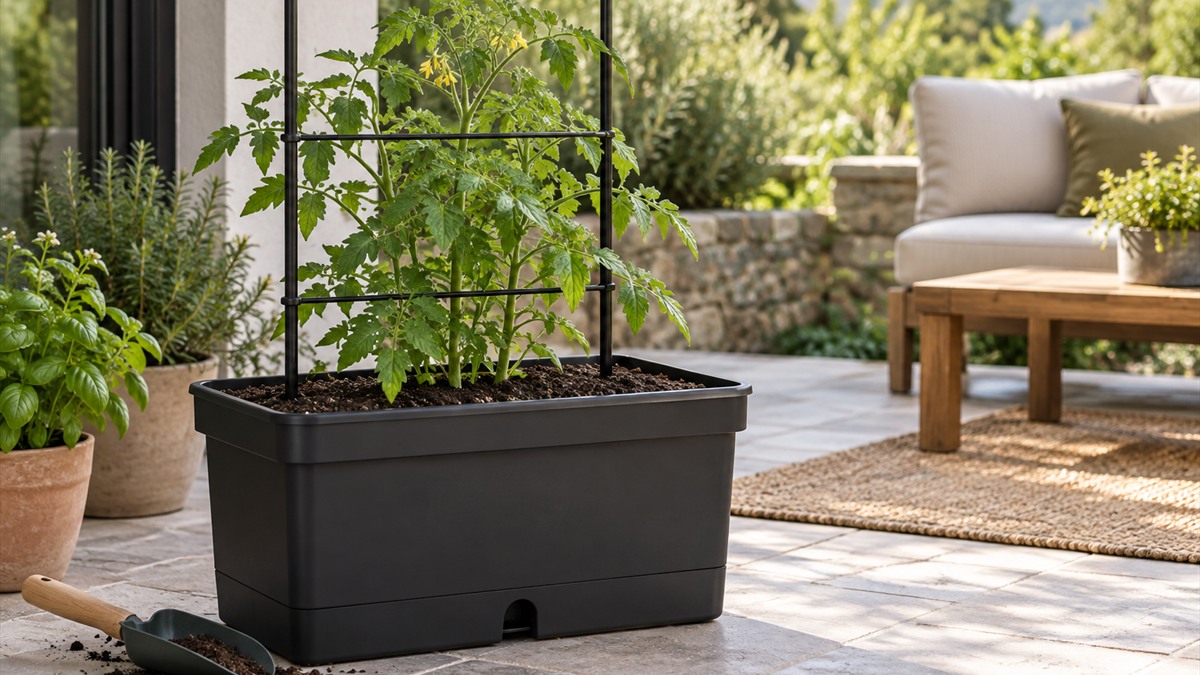
1. Self Watering Tomato Planter with Trellis, Rectangular Tomato Cages Trellis for Raised Garden Bed (Self-watering rectangular planter with cage)
Specs from the listing (checked 2026-10-14):
- Capacity: 9.6 liters
- Item Weight: 2.04 kg
- Item Dimensions: 16.54 x 9.06 x 4.72 inches
- Planter Form: Raised Bed
Pros
- Listing gives a capacity of 9.6 liters and outside dimensions of 16.54 x 9.06 x 4.72 inches
- Listing describes a water reservoir that reduces how often you need to water
- Listing says it assembles without tools and includes clips, gloves and plant ties
Cons
- The listing says to fill the reservoir only to the first wavy line, and not above the second line
- The listing does not state whether the planter has drainage holes, so confirm that before filling it
- The listing does not give a weight rating, although its bullets describe an anti-tipping structure
Best for: Someone growing one tomato or pepper in a small container who wants a self-watering reservoir.
Skip if: You need a container for a large planting volume, since its listed capacity is 9.6 liters.
View on Amazon (affiliate link)
2. MQFORU 2 Packs Raised Garden Bed Tomato Planter with Trellis, 57″ Tomato Cages for Climbing (Tall plastic planter with trellis)
Specs from the listing (checked 2026-10-14):
- Material: Plastic
- Mounting Type: Wall Mount
- Item Dimensions D x W x H: 9.8″D x 9.8″W x 57″H
- Number of Levels: 1
Pros
- Listing describes a self-watering reservoir with a bottom grid design
- Listing says the planter can be used as a planter, a trellis, or both
- Listing describes a buckle design that assembles without tools
Cons
- Its number of levels reads 1, while its bullets describe stacking up to four layers, so confirm the layout
- Its mounting type reads wall mount, which does not match a free-standing planter, so check how it sits
- The listing says its PP material does not cause chemical damage to plants, which is a manufacturer claim rather than a test result
Best for: Someone who wants a tall plastic planter with a trellis for climbing vegetables in a small space.
Skip if: You need a single fixed level or a wall mount, since the listing gives conflicting level and mounting details.
View on Amazon (affiliate link)
The cards above hold each pick’s specs, pros, cons and who should skip it. The sections below cover what the listings leave open.
Limits of the listing data
Neither planter’s listing states drainage holes, a weight rating or a warranty length. The second pick’s level and mounting details conflict, so confirm them with the seller. The first pick does not list a material, and the second lists plastic without a test result for its long-term performance.
Neither listing describes the soil that should go in the pot, so this guide does not recommend a particular mix. Read the soil label for its contents, and treat any growth claim as the seller’s claim.
Reading a soil label before you buy
A soil label tells you more than the bag’s name. Look for the listed ingredients, the volume of the bag and any notes on drainage or intended use. If the label names the mix as made for raised beds, that describes the use the maker intends, not the container you have. Ask whether the mix contains compost, and check the label’s own wording on drainage before you assume the bag suits a pot.
Compare the bag volume against the pot’s capacity before you carry anything home. The planter listing gives its capacity, and the soil label gives the bag’s volume, so a quick division shows how many bags a pot needs. Do that check at the store, because a half-empty bag in the trunk is a poor reason to buy a second pot.
Soil for two planters
Two of the first planter at the listed 9.6 liter capacity need 19.2 liters of soil (2 times 9.6). The second planter’s base measures 9.8 by 9.8 inches, a footprint of 96.04 square inches (9.8 times 9.8), and its height is 57 inches.
Filling and watering in a container
Start by filling the pot to the level your planting needs, leaving room at the top for watering. Firm the soil lightly, but do not pack it, since packed soil drains poorly and holds less air around the roots. Water the soil until the water runs out at the base, if the pot has a base opening, and check the reservoir fill limit before you fill it.
Keep the container out of standing water, and check the soil with your finger before each watering. A self-watering reservoir reduces how often you need to water, but it does not remove the need to check the soil. Empty the reservoir if the plant shows signs of too much water, and refill only to the listed line.
Compost mixed into the soil can help it hold water, as the EPA’s guidance describes. Add it in a small share, and check how the mix drains before you commit the whole pot. The best way to start a compost bin guide covers how to make your own compost for the soil. If you are filling a bed rather than a pot, the best way to fill raised beds guide covers that larger job.
Check the weight before you move a finished pot to a deck or balcony. Fill it, water it, and then lift one corner to judge the load before you carry the whole thing. A pot that is hard to move while empty will be harder once the soil is wet, so plan the spot before you fill it.
FAQ
Can I use raised bed soil in any pot?
Not automatically. Check the pot’s capacity, its drainage and its weight before you fill it. A large planter with no drainage plan is a poor fit, however good the soil is.
How much soil does the first pick hold?
The listing states a capacity of 9.6 liters. Plan your soil volume against that figure, and leave room at the top for watering.
Does a self-watering planter need drainage?
The listing does not state whether it has drainage holes. Confirm drainage with the seller before you buy, because a reservoir does not replace an outlet for excess water.
How full should the reservoir be?
Fill it to the first wavy line from the minimum water level, and do not fill above the second line. The listing gives that limit directly.
Is compost a good addition to pot soil?
The EPA’s composting guidance says compost helps soil absorb and hold water and can reduce fertilizer and pesticide use. Add it in a small share, and check how the mix drains before you fill the whole container.
Can I stack the tall planter?
The listing’s bullets describe stacking up to four layers, but its number of levels field reads 1. Confirm the layout with the seller before you assume you can stack it.
Should I add pesticide to the soil?
This guide gives no pesticide advice. If you use a product, follow its label for the plant and the use it names, and do not rely on a general rule.
Bottom line
Raised bed soil can go into a pot, but only when the pot’s capacity, drainage and weight suit the plant. If you want one small container with a reservoir, choose the first pick and fill it under its listed capacity. If you want a tall planter with a trellis, choose the second pick only after you confirm its level and mounting details.
For a bed-sized planting area, use a raised bed instead of a pot, and confirm drainage before you fill any container.
Sources
- EPA: composting at home: compost helps soil absorb and hold water, and can reduce fertilizer and pesticide use.