How to Keep Indoor Plants Alive in Winter
As an Amazon Associate we earn from qualifying purchases.
How to keep indoor plants alive in winter comes down to the changes a warm, dry house brings. Light drops, the air loses moisture, and plants need less water than they did in summer. The extension pages used here point to the same fixes: give plants the most light you can, water less and let most of the soil dry between waterings, raise humidity without soaking the roots, and check plants near heat sources and drafty windows. The reasons behind each step are in the sources below.
Quick answer
- Move plants to the brightest window you have, and check whether a north or east window has become too shady in winter.
- Water less, and let most houseplants dry out between waterings instead of keeping a summer schedule.
- Raise humidity with a humidifier or a tray of pebbles, keeping the pot bottoms above any water.
- Water from the bottom of the pot when you can, and watch for yellow leaves caused by cold air or low light.
Why winter is hard on houseplants
Winter changes several conditions at once. The Buncombe County Extension page describes the typical indoor winter as low light, low humidity and air that is either cool or very warm. The University of Nebraska-Lincoln NebGuide names high temperatures, low humidity, lack of sunlight, poor soil conditions and improper watering as the usual causes of most houseplant problems. Winter brings several of those stresses together.
Water needs shift too. The Lancaster County Extension page explains that houseplants use large amounts of water outdoors because of higher light, heat and wind evaporation. Once they come indoors in fall, temperatures drop and wind evaporation stops, so the page says their water requirements are drastically reduced. A watering routine built for summer is a poor guide for winter.
Give plants the best light you can
Light is the first thing to check. The Richmond County Extension page says that even in the best windows, light tends to be the greatest limiting factor. Light also falls off through the season. The Lancaster page notes that when houseplants come back indoors in fall, seasonal light levels have already fallen from their midsummer peak, and that light drops even more inside the house. The Richmond page adds that winter days are short and the sun sits lower in the sky, so the light reaching a plant can change a great deal from one month to the next.
Position matters as much as the window itself. The Richmond page warns that north and east facing windows can give good indirect light in summer and then become too shady in the winter months. Its advice is to move plants to a sunny location or to supplement with grow lights. The Nebraska guide notes that homes vary in the amount of light they offer, so check each plant’s spot rather than assuming the old one still works.
If a grow light is part of the plan, follow the manual that comes with the light, and use it only as the manual directs. If you are weighing a stand with lights, see our guide to indoor plant stands with grow lights. For a plain wooden option, see wooden stands for indoor plants.
Water less, and water from the bottom
Winter watering is mostly about restraint. The Buncombe page calls over or under watering a common issue, so the goal is a steady middle rather than a fixed schedule. The Richmond page says that while houseplants have a wide range of water needs, in general winter watering can be cut back significantly. Growth slows in winter, so plants take up less water, and the page says most indoor plants do best when the soil nearly dries out between waterings.
The Buncombe County page offers a simple test that does not require digging into the soil. Lift the potted plant after a thorough watering to feel its weight, then lift it again later. If it feels light, the plant needs water. Comparing the two weights tells you more than a schedule does.
When you can, water from the bottom. The Washington State University PDF says plants need less water in winter, and that this is best done by watering from the bottom of the pot. The same page adds that the pot should sit above the water level to avoid soil saturation and root rot, so the roots are not left sitting in standing water.
Raise humidity without soaking the roots
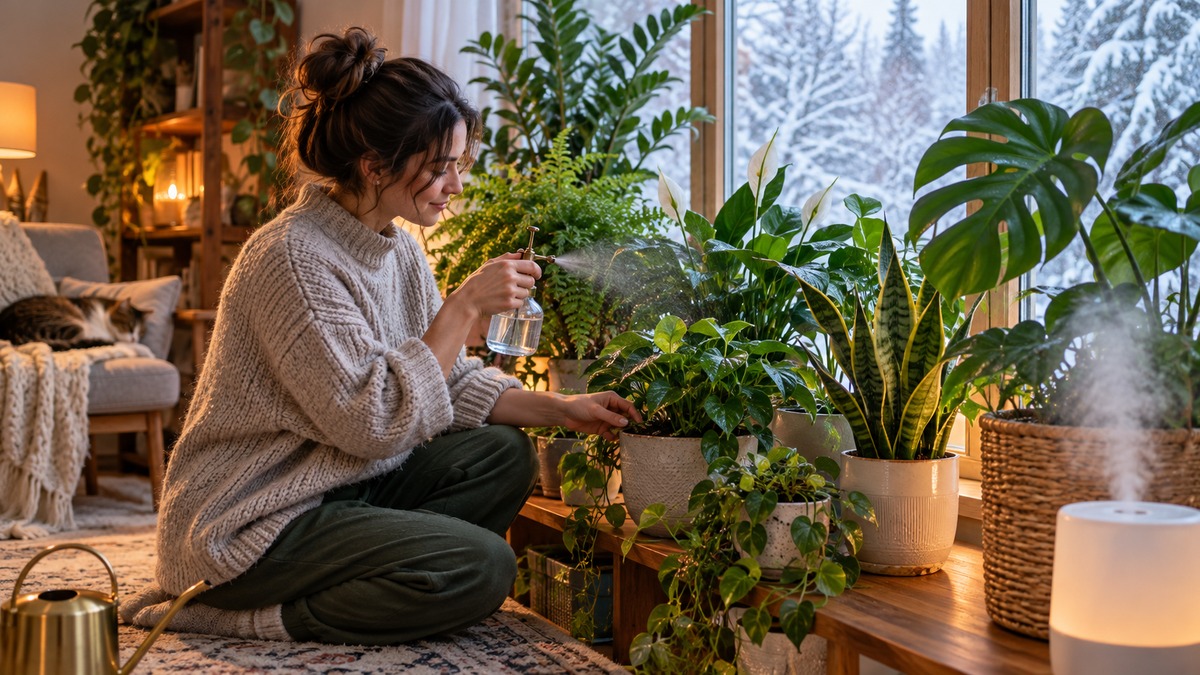
Winter air is dry. The Richmond page warns that indoor humidity tends to fall sharply in winter, sometimes below 20 percent, and that most houseplants prefer roughly 40 to 50 percent. The Nebraska guide notes that greenhouses are more humid than most living areas, and that a humidifier helps plants as well as the people in the room.
The WSU PDF explains that as homes are heated in the fall, the air becomes drier, and indoor houseplants need more moisture. A tray of pebbles is a common fix, and the same PDF describes one. It suggests a large bowl or tray with pebbles or gravel, or a capillary mat in a sturdy, leak-proof tray. In either setup the pot should sit above the water, as the WSU page advises.
Humidity matters most where plants lose the most moisture. The WSU page says plants appreciate the added humidity, especially those near heat sources and drafty windows, because they consume less water in winter. The Richmond page also notes that bathrooms tend to have higher humidity, which makes them good places for plants when there is enough light and space.
Plants that came in from outside
Plants that spent the warm months on a patio or in a bed face a bigger change when they come in. The WSU page says an ideal place to winter plants over is a heated sun porch, a sunny guest room or a garage. The Lancaster page explains why: the light, heat and wind that outdoor plants enjoyed are gone once they come inside, so their water needs shrink.
Before you bring a plant in, check it for the signs of trouble that the sources name. Cold air and insufficient light can both cause yellowed leaves. A plant that has been outside will need a light check in its new spot, and the Richmond page suggests moving it to a sunnier place if the room is dim.
Flush the soil and step the light down
The Nebraska guide describes the steps below for newly obtained plants rather than for winter specifically. One step is to leach the growing medium, letting water filter down through the soil and escape through the drainage hole. The guide says this removes excess fertilizer or salts, and that those salts can cause leaf drop when light intensities are low.
A second step is to lower the light gradually. The guide suggests reducing the available light over four weeks until it matches the spot the plant will live in. That fits a plant moving from a bright summer window into a dimmer winter room, which is the common case in a home.
Watch for warning signs
Yellow leaves are the sign the WSU page names most directly. It says that exposure to cold air or insufficient light can cause yellowed leaves. That gives you two suspects to check: a cold window or draft, and a dim corner. Check both before you change the watering.
Overwatering is the other common problem. The Nebraska guide lists improper watering among the causes of most houseplant problems, and the Richmond page says most indoor plants do best with soil that nearly dries out between waterings. The Richmond page’s advice to let the soil nearly dry points the same way.
Slow growth in winter is often normal. The WSU page says most plants are in a resting, or dormant, phase in winter, brought on by lower light levels.
Mistakes that cost plants in winter
- Keeping the summer watering schedule, when the Lancaster page says water requirements are drastically reduced indoors.
- Leaving a plant in a window that was bright in summer but has become too shady, as the Richmond page warns for north and east windows.
- Letting pot bottoms sit in standing water on a humidity tray, which the WSU page warns against.
- Treating every yellow leaf as a watering problem, when cold air and low light can also cause it.
- Ignoring plants near heat sources or drafty windows, which the WSU page says need the added humidity.
A winter checklist
- Move each plant to the brightest suitable window, then check it for shade.
- Weigh each pot after a thorough watering, and water again when it feels light.
- Keep pot bottoms above any water in a tray or a pebble setup.
- Check plants near heat sources and drafty windows, since they need more moisture in the air.
- Follow the manual for any electric grow light, and keep the light where the manual says it belongs.
How we chose
We opened five extension pages on 2026-10-22: a University of Nebraska-Lincoln NebGuide, a University of Nebraska-Lincoln Extension page from Lancaster County, two NC State Extension county pages from Richmond and Buncombe counties, and a Washington State University Extension PDF. We kept statements about light, watering, humidity, placement and warning signs. We dropped general tips that none of the five pages stated, and we gave no fertilizer advice.
The Washington State University PDF carries a December 11, 2015 date in its text. We used it only for points that do not depend on the date, such as dormancy, watering from the bottom and yellowing leaves. The Richmond and Buncombe pages carry 2023 and 2024 dates in their URLs.
What we could not verify
The five pages agree on the general approach, but they do not give one set of numbers for every houseplant. We could not verify the light hours a grow light should provide, a watering interval in days, the temperature range for a named species, or the effect of any particular humidifier, lamp or stand.
What the sources do not say
The pages do not give a duration for supplemental lighting, and they do not give a watering interval in days. They do not list temperature ranges for named species or say which plants tolerate winter drafts best. They do not compare humidifier types or describe the effect of any particular humidifier. This guide names no product, and it makes no claim about any lamp, stand or humidifier brand.
Frequently asked questions
Why do houseplants decline in winter?
The Nebraska NebGuide names high temperatures, low humidity, lack of sunlight, poor soil conditions and improper watering as the usual causes of most houseplant problems. The Buncombe County page describes the typical indoor winter as low light, low humidity and air that is cool or very warm, so several stresses usually arrive together.
How often should houseplants be watered in winter?
The sources do not give a number of days. The Richmond page says most indoor plants do best when the soil nearly dries out between waterings, and the Buncombe page suggests weighing the pot after a thorough watering to judge when it needs more. Use the soil and the weight to decide, not the calendar.
What humidity do houseplants need in winter?
The Richmond County page says most houseplants prefer roughly 40 to 50 percent humidity, and that indoor humidity can fall below 20 percent in winter. The Nebraska guide says greenhouses are more humid than most living areas.
Do houseplants need grow lights in winter?
The Richmond page suggests moving plants to a sunnier spot or supplementing with grow lights if the room is dim. The Nebraska guide says homes vary in the light they offer, so check each spot. If you use an electric light, follow the manual that comes with it. The sources do not say how many hours a grow light should run.
Why are my houseplant leaves turning yellow in winter?
The WSU page says exposure to cold air or insufficient light can cause yellowed leaves. Check the spot for a cold draft and for dim light, and then check how much water the plant is getting, because overwatering is also a common cause in the Nebraska guide.
Bottom line
Give plants the most light you can, water less and let the soil dry between waterings, and raise humidity without soaking the roots.
Sources
- https://extensionpubs.unl.edu/publication/g2205/pdf/view (opened 2026-10-22)
- https://lancaster.unl.edu/winter-care-indoor-plants (opened 2026-10-22)
- https://richmond.ces.ncsu.edu/2023/12/winter-considerations-for-house-plants/ (opened 2026-10-22)
- https://buncombe.ces.ncsu.edu/2024/12/houseplant-winter-care/ (opened 2026-10-22)
- https://wpcdn.web.wsu.edu/extension/uploads/sites/57/2014/03/Winter-Plant-Care-Inside-Your-Home.pdf (opened 2026-10-22)