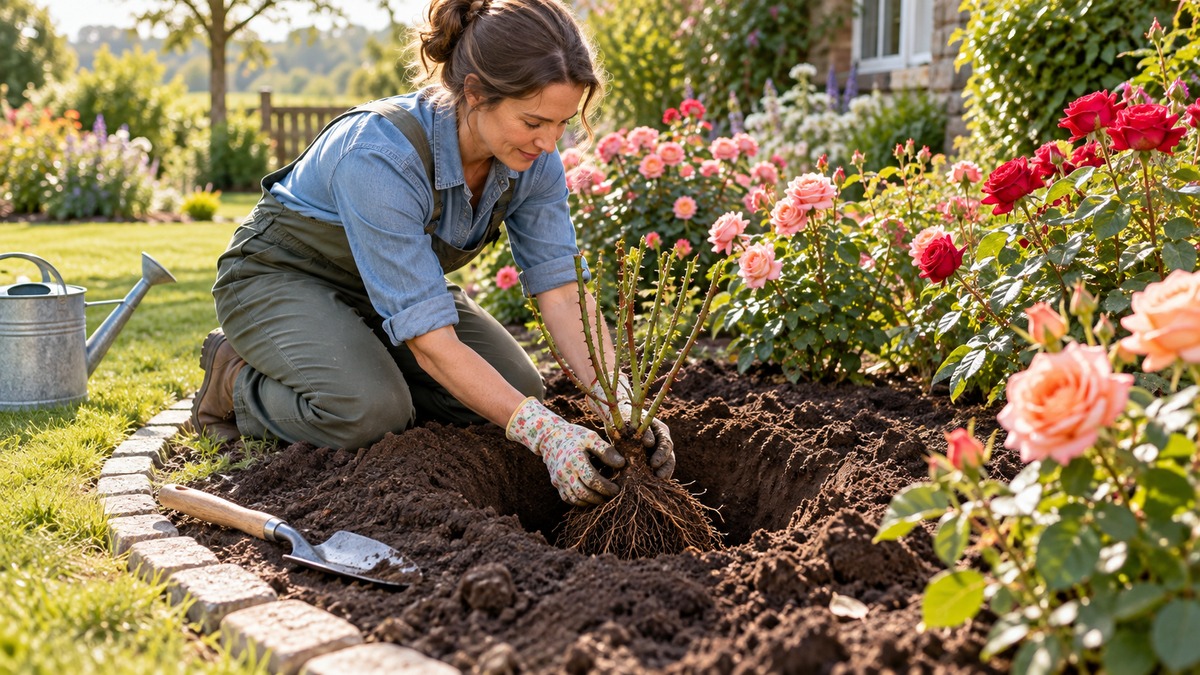
How to Plant a Rose Bed
As an Amazon Associate we earn from qualifying purchases.
If you are learning how to plant a rose bed, the decisions that matter most come before the first shovel of dirt: how much sun the spot gets, whether the soil drains, and how deep the plants sit. The university extension sources we opened agree on those points.
The sources differ in a few numbers, such as the minimum sun and the soil pH range, and the draft shows each figure with its source. Where the sources disagree, the guide says so instead of picking one figure quietly.
Quick answer
- Pick a spot with full sun. Illinois Extension says roses should get at least six hours of sun a day, and Colorado State gives five to six hours as a minimum.
- Check drainage before you dig, and improve the bed if water sits. Illinois describes a simple field check with an 18-inch hole.
- Dig a wide, deep hole and set the bud union or crown at the depth your climate and plant type call for.
- Water deeply at planting, keep the soil moist without waterlogging it, and mulch around the crown if the plant needs it.
Choose a site with enough sun and air
Sun is the first condition the sources name. Illinois Extension says that “Roses should receive at least six hours of sun a day.” Colorado State Extension asks for something similar: “Locate the plants so they receive a minimum of five to six hours of sunshine each day.” The two figures are close, but they are not the same, and a bed that gets exactly five hours sits at the low end of what Colorado State describes.
When the sun is limited, Illinois gives a clear order of preference: “If all-day sun is not available, a location where they get only morning sun is preferred to one where they get only afternoon sun.” Morning sun helps the foliage dry sooner, which the page presents as a siting reason. A bed that gets sun early in the day is a better choice than one that gets only the late afternoon.
Colorado State adds air movement to the list of basics. Its summary is short: “Roses prefer full sun, rich, well-drained soil, and good air circulation.” Look at the wider layout of the yard before you choose the spot.
Keep the bed clear of large trees and shrubs. The Illinois page says that the roots of roses do not compete well with the roots of trees and other shrubs, and it advises keeping roses away from them. Keep the bed away from the root zones of nearby trees and shrubs.
If you want the bigger picture of how a bed fits into a yard, see creating a flower bed from scratch, which covers the general steps for a new bed. If the bed will include climbing roses, see garden trellis options for climbing roses for supports.
Check the drainage before you dig
Drainage is the condition the sources treat most seriously. The Illinois page describes poorly drained soil as a serious problem for roses, and it offers a simple field check. Dig a hole 18 inches deep, fill it with water, and time how long it takes to drain. The page’s rule is direct: “If an 18-inch-deep hole filled with water drains in 5-6 hours, drainage is satisfactory.”
If the water stays for longer, the same page gives the response: “If drainage is suspect, improve it through soil amendments or by constructing raised beds.” A raised bed is one way out of a wet site, and it can be set up so the roses sit above the wet ground. The page does not give dimensions for such a bed, so the height and width are left to your plan.
Oregon State Extension supports the same caution in its bare-root planting guide, and it gives a clear rule for heavy soils: “For heavy clay soils, improve drainage by adding compost or other organic materials that are worked thoroughly into the native soil over a wide area.” The point is to change the soil over a wide area, not only inside the planting hole, which leads to the next section.
Prepare the soil across the bed
Soil preparation gives the roots a loose, fertile medium that drains. Oregon State Extension says that “The soil should be loose and rich in organic matter.” The same page gives the pH range that roses prefer: “Roses perform best in well-drained soils with a pH between 6.2–6.8.” Illinois Extension gives a slightly wider range, and says that “A soil pH of 6.0-7.0 is preferred by roses.” The two ranges overlap, so a soil that falls inside both is in good shape, and the draft does not claim one figure is the correct one.
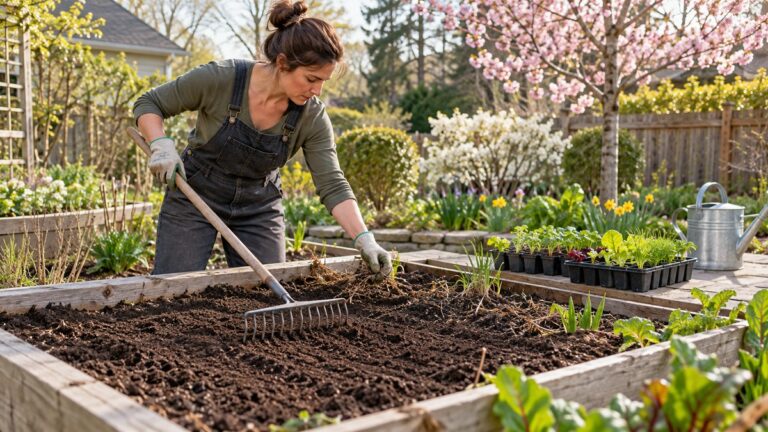
Illinois also describes how to add organic matter to a bed. Its advice is to spread organic matter over the area before the bed is tilled, and to use a depth range of about 2 to 4 inches. The page places this step during bed preparation.
The main mistake the Oregon State page warns about is adding amendments only to the hole. Its wording is precise: “Adding amendments only to the planting hole creates different soil textures that prevent proper water drainage and can cause water to pool around the roots.” When the bed has a hole of rich soil in the middle of heavy native soil, water can collect at the edge of the hole, and the roots sit in that wet pocket. The fix is to work the amendment into the wider bed, as the same page describes for heavy clay.
Dig the hole and set the plant at the right depth
The hole needs room for the roots. Oregon State Extension gives the dimensions it uses for bare-root roses: “Dig planting holes 18–24 inches in diameter and 18–20 inches deep.” Once the hole is dug, the plant should sit at the depth the next paragraph describes.
Depth depends on the type of rose. Colorado State Extension gives the rule for budded roses: “Budded roses need to be planted so that the bud union is below ground level, typically two to four inches.” For own-root roses it says: “Plant own-root roses so that the crown is 1 to 2 inches below the soil line.” Check which type you have before you set the plant, because the two rules differ.
Oregon State Extension ties the depth for grafted roses to climate. Its rule is: “For grafted roses, position the bud union 2–4 inches below the soil surface in cold climates (zones 3–6) or at soil level in warmer regions (zones 7–11).” If you live in a warm zone, the bud union sits at soil level, and if you live in a cold zone, it sits 2 to 4 inches down. The page gives zone ranges rather than a single rule, so check your local extension office for the zone your bed is in.
Oregon State’s guide also describes a temporary mound after planting: “Create a temporary soil mound 4–6 inches high around the plant to protect emerging buds from desiccation.” The mound is a step at planting, and the page does not say how long to keep it in place.
Fill and firm the hole
Once the plant is set, fill the hole gradually, and firm the soil as you go. The Oregon State page describes the aim: “Fill the hole gradually with amended soil, pressing firmly to remove air pockets without compacting the soil.” The page asks for firm pressing without compacting the soil, so the aim is to settle the soil without packing it.
Water and mulch the new bed
Watering comes early in the bed’s life. Colorado State Extension gives the planting-day instruction: “Water deeply at planting.” After that, Oregon State says to keep the soil evenly moist: “Water regularly to maintain soil moisture without creating waterlogged conditions.” The aim is steady moisture with no standing water, which matches the drainage points above.
Mulch around roses is covered by the UW-Madison Extension article on mulches for home gardens. The article gives a rule for roses and other perennials: “To mulch roses and other perennial plants, pile about 8 inches of straw, marsh hay, or similar material around the plant crown.” That is a deeper layer than the 3 inches the same article gives for most organic mulches around young plants. The article does not say when to add or remove this layer, so the timing is left open in this guide.
Common mistakes
- Planting in a shady spot. The Illinois and Colorado State pages both set sun as a basic need, with at least five to six hours in Colorado State’s wording.
- Amending only the planting hole. The Oregon State page warns that this creates textures that stop water from draining properly.
- Setting the plant too deep or too shallow. The depth rule depends on whether the rose is budded or own-root, and on the climate for grafted roses.
- Planting near large trees. The Illinois page says roses do not compete well with the roots of trees and shrubs.
- Letting the bed stay waterlogged. The Oregon State page says to keep moisture steady without creating waterlogged conditions.
Checks after you plant
Once the bed is planted, the sources give a short set of checks you can make against the plan. Confirm that the spot still gets the sun the plant needs, using the five to six hours in Colorado State’s wording as the low end. Confirm the depth: the bud union or crown should sit where the rule for its plant type puts it. Then look at the soil after a watering or a rain, and confirm that it is moist but not standing with water, as the Oregon State page describes.
The sources do not describe a set schedule for these checks, so how often you make them is your call.
How we chose
We chose these pages because each is a university extension publication that covers one part of planting a rose bed. Illinois Extension covers site, drainage and soil preparation; Colorado State Extension covers site, soil, depth and watering at planting; Oregon State Extension covers the hole, the soil amendment, depth by climate and watering; and the UW-Madison Extension article covers mulch for roses. We opened each page with curl on 2026-10-21, and each returned HTTP 200. Where two pages gave different figures, we show both and note the difference. We did not use retail pages, and this guide recommends no rose varieties or products.
What we could not verify
The four pages cover the basics of planting a rose bed, but several practical details fall outside them. Anything not in the sources is left open here.
What the sources do not say
The opened pages do not name rose varieties, sizes, or which ones suit a small bed. They do not give spacing between plants in a bed, so spacing is left to the plant tag and your layout. None gives a planting month for a rose bed in any region. The Oregon State page covers bare-root roses planted in spring, and the sources do not give a planting window for other seasons. The sources do not say how long the temporary mound should stay in place. The mulch article does not give the season for its deeper layer around roses. The sources do not give a fertilizer rate for the bed, and this guide does not add one. Local frost dates, rainfall and any local rules need to come from your local extension office.
Frequently asked questions
How much sun does a rose bed need?
Illinois Extension says that “Roses should receive at least six hours of sun a day.” Colorado State Extension gives a minimum of five to six hours. If the spot gets less, Illinois prefers a location with morning sun over one with only afternoon sun.
How deep should a rose be planted?
The depth depends on the type. Colorado State Extension says budded roses should sit with the bud union “below ground level, typically two to four inches.” Own-root roses should have the crown 1 to 2 inches below the soil line. For grafted roses, Oregon State Extension ties the depth to climate, with the bud union at soil level in warmer zones.
How can you tell if the bed drains well enough?
Illinois Extension describes a field check: dig an 18-inch-deep hole, fill it with water, and see how long it takes to drain. If it drains in 5 to 6 hours, the page calls drainage satisfactory. If it does not, the page suggests improving the soil or building raised beds.
Should compost go only in the planting hole?
The Oregon State page advises against it. It says that “Adding amendments only to the planting hole creates different soil textures that prevent proper water drainage and can cause water to pool around the roots.” For heavy clay, the page recommends working compost into the native soil over a wide area.
How much mulch should go around a rose?
The UW-Madison Extension article says to “pile about 8 inches of straw, marsh hay, or similar material around the plant crown” for roses and other perennials. The article does not say when to do this, so check the timing with your local extension office.
Sources
- https://extension.illinois.edu/roses/preparation (opened 2026-10-21)
- https://extension.colostate.edu/resource/selecting-and-planting-roses/ (opened 2026-10-21)
- https://extension.oregonstate.edu/catalog/em-9474-planting-bare-root-roses-spring (opened 2026-10-21)
- https://hort.extension.wisc.edu/articles/mulches-home-gardens-and-plantings/ (opened 2026-10-21)