Planting a Flower Bed With Weed Barrier
As an Amazon Associate we earn from qualifying purchases.
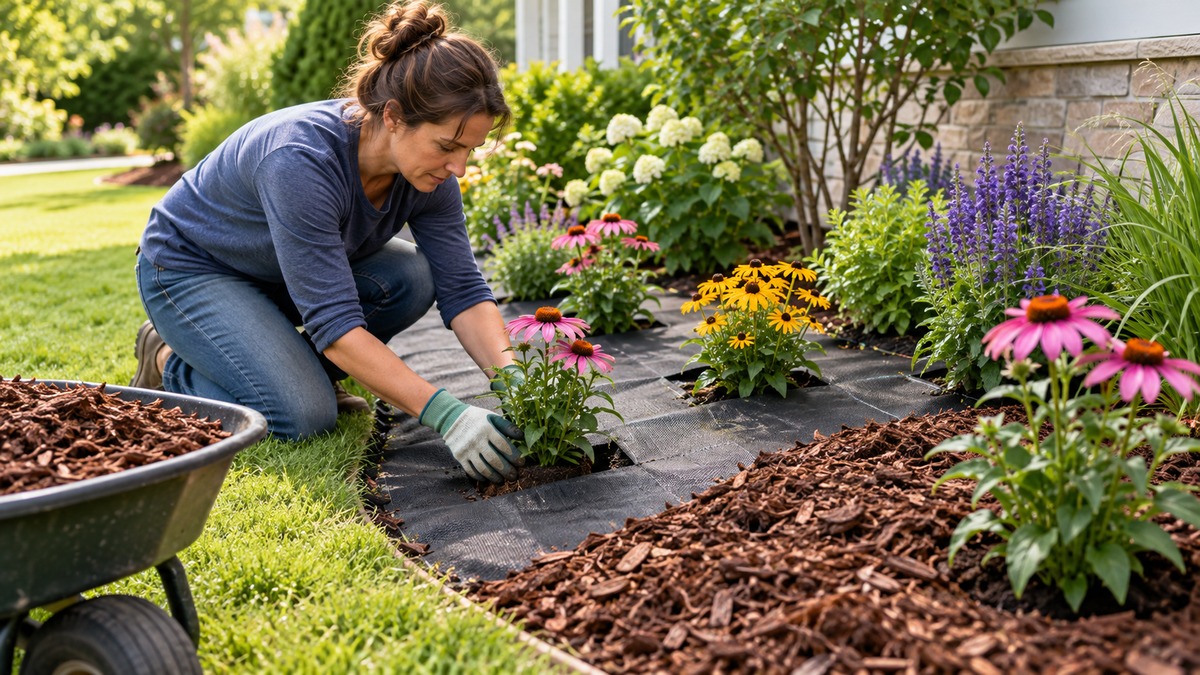
How to plant a flower bed with weed barrier has a short answer and a longer caveat. The short answer: clear the perennial weeds, lay the fabric flat, cover it with mulch, and plant through openings sized to each plant. The caveat is that the extension pages we opened treat landscape fabric as a short-term fix, not a permanent one.
This guide follows that order. It shows where the sources agree, where they warn you, and where they say little. The pages come from the University of New Hampshire, North Dakota State, Washington State, the University of California and South Dakota State.
Quick answer
- Treat weed barrier as a short-term tool. NDSU Extension says “Landscape fabric is not meant to be used as a long-term solution for weed control.”
- Remove perennial weeds before anything goes down. UC IPM says to “Control perennial weeds before planting”.
- Cover the fabric with mulch. UC IPM recommends a 3 to 4 inch layer of medium mulch.
- Expect to refresh the mulch and pull the weeds that get through. UC IPM says organic mulch “must be replenished once they break down.”
What the fabric is supposed to do
The idea is simple. “The idea behind using landscape fabric is that it will permanently eliminate the need to weed the garden by forming a barrier that blocks weed seeds from germinating, while still being porous enough to allow water to reach the roots of shrubs and perennials.” That promise is why gardeners buy it, and why the sources spend so much time on what happens after the first season.
The University of New Hampshire Extension answer is direct on the trade-off. “Although landscape fabric initially does a wonderful job of suppressing weeds, as time goes on, it can become a maintenance nightmare.” It also adds, “If that sounds too good to be true, that’s probably because it is.” UNH also notes that “tree, shrub, and perennial roots may also grow through the landscape fabric.”
NDSU Extension reaches the same conclusion from a different angle. Among common weed barriers, it writes, “Of these, landscape fabric has the worst reputation by far.” Its list of complaints is specific: “Claims of poor permeability for both water and air, difficult maintenance, removal issues, disposal problems and reduced soil fertility.” Those complaints are worth weighing before you spend an afternoon laying fabric.
NDSU also places fabric among the options. “There are many types of weed barriers: landscape fabric (woven and nonwoven), mulch and cardboard, just to name the most common.” That framing matters, because the rest of this guide treats mulch as the part of the job that carries the weight.
Decide whether a barrier fits the bed
The sources split the question by how long the bed will stay the same. For a permanent perennial or shrub bed, the warnings carry the most weight. For a bed that gets replanted, South Dakota State describes fabric as a reusable option, saying that “A durable alternative to plastic mulch is landscape fabric, which is permeable, may last longer than single-use plastic mulch depending on use, and is easy to install prior to planting flowers or vegetables.”
| Type of bed | What the sources say | Source |
|---|---|---|
| Long-lived perennial or shrub bed | Fabric becomes hard to maintain as roots grow into it, and removing it can damage plant roots | UNH Extension |
| Bed replanted each season | Fabric can be reused and is easy to install before planting | South Dakota State Extension |
| Any bed with exposed fabric | Fabric breaks down in sunlight unless mulch covers it | Washington State University Extension |
The Washington State article makes the sunlight point plainly: “Geotextiles break down, especially if they are exposed to sunlight.” Its second warning is about appearance as much as function: “Any areas of landscape fabric not covered by mulch will look tattered and frayed after the first summer.” Covering the fabric is therefore part of the planting job, not an optional extra. UNH adds that “Even if weeds are not an issue, landscape fabric seems to invariably become exposed.” Plan the cover from the start rather than as a repair.
Clear the bed before anything goes down
UC IPM gives the first step in one line: “Control perennial weeds before planting (although control may be possible after planting).” The word “before” matters, because perennial weeds are the hardest to deal with once the fabric is down. UNH notes that once weed roots reach the fabric, the weeds are very hard to remove.
The pages we opened say little about soil preparation. This guide keeps that step short. Clear the bed of weeds and loose debris, then check that the surface is even enough for the fabric to lie flat. The sources do not give a grade or a depth for the bed surface, so use your own judgment on that point.
Compare the cover options
The sources set fabric beside other covers, and that comparison is worth reading before you buy. Washington State raises a water concern that UNH does not: “the water will not penetrate to plant roots as efficiently as it would in the absence of the fabric.” For permanent plantings, the same article proposes arborist wood chips as the alternative to fabric.
| Cover | What the sources say | Source |
|---|---|---|
| Landscape fabric | Porous and long lasting, but how long it stays effective varies | UC IPM |
| Organic mulch (bark, chips, compost) | “must be replenished once they break down” | UC IPM |
| Inorganic mulch (sand, gravel, pebbles) | “more stable than organic mulches but difficult to keep weed-free” | UC IPM |
| Black plastic | “not preferred since it can restrict air and water movement and promote root rots” | UC IPM |
| Arborist wood chips | Proposed as the alternative to fabric in a permanent landscape | Washington State University |
Lay the fabric and cover it
UC IPM describes fabric as a product that varies. “Landscape fabrics are porous and long lasting and vary in how long they remain effective.” The useful part for planning is the cover. UC IPM says “Use geotextile fabrics with a shallow layer of mulch or use a thick layer of mulch without a geotextile base.” In both cases the mulch is doing much of the work, so it is not a step to skip.
UC IPM’s direct instruction for the cover is short: “Cover with mulch.” It gives a depth for the medium-sized mulch it recommends: “Choose a medium-sized mulch (3/4 inch) and keep at a depth of 3 to 4 inches.” Spread the mulch evenly over the fabric so no strip of plastic or cloth shows, which is the point the Washington State article makes about exposed fabric.
The choice of mulch also matters. UC IPM notes that “Natural inorganic mulches (e.g., sand, gravel, pebbles) are more stable than organic mulches but difficult to keep weed-free.” It also lists bark as a common choice, and says that “bark nuggets are larger in size (1/2 to 1 1/2 inches) and have excellent stability over time.” Stone and bark both suit a flower bed, but they wear differently, so pick the one you are willing to maintain.
For more on filling the bed beneath the fabric, see our guide to filling raised beds. For the layout of plants within the bed, see our page on raised bed companion planting and layout.
Make the planting openings
Openings are the step where planting meets fabric. South Dakota State describes them in one line: “One of the neat things about landscape fabric is that it is easy to create planting openings by burning holes into the fabric.” Burning involves a torch and open flame, so this guide does not describe that method. If you use any flame tool on fabric, follow the tool’s manual and your local fire rules.
The pages we opened do not give a cutting method for planting holes, so this guide does not describe one either. Plan the openings around the spacing you chose for the flowers before you cut anything. Keep the mulch layer in mind as you work, because UNH warns that “Any mulch or soil on top of the landscape fabric can support weed growth, a problem that is especially difficult to handle when weeds take root through it.”
Keep the bed going through the season
Maintenance is where most of the work sits. UC IPM says that organic mulches “must be replenished once they break down,” so add a layer when the old one has thinned out. Check the bed in spring and again in late summer, and top up the mulch wherever the fabric shows.
Pull weeds early. UC IPM advises that you “Remove young weeds by hand before they flower and set seed.” UNH’s warning about roots is the reason: weeds that root into fabric are much harder to remove than weeds caught on the surface. Pull them while they are still on the surface.
If the fabric tears, frays or fails, the sources describe a clear choice. UNH says “The best option at that point is to remove the landscape fabric entirely, which is no small task.” Removing it can also damage the roots of the plants in the bed, so weigh that cost before you let the fabric go on for years.
Common mistakes to avoid
- Treating fabric as a permanent fix. NDSU Extension says it is not meant to be a long-term solution.
- Skipping perennial weed control. UC IPM says to control perennial weeds before planting.
- Leaving fabric uncovered. The Washington State article says exposed fabric breaks down in sunlight.
- Spreading too little mulch. UC IPM recommends 3 to 4 inches for a medium mulch.
- Letting organic mulch run down. UC IPM says it must be replenished once it breaks down.
- Planning to remove the fabric later with no cost. UNH says removal is no small task.
How we chose
This guide is a planting method with a caveat, not a product list. The pages we opened on 2026-10-22 were UNH Extension’s question-of-the-week answer on landscape fabric in perennial gardens, NDSU Extension’s Dakota Gardener column on weed barriers, UC IPM’s publication on mulches, South Dakota State University Extension’s publication on landscape fabric for in-row weed control, and a Washington State University Extension weed control article from 2010.
We left out retail pages and blog posts from the search results. We kept only statements that a university page states in plain words. Where the sources disagree on fabric, we say so instead of picking one side.
What we could not verify
What the sources do not say
The pages do not give a cutting or spacing method for planting openings. The South Dakota State page describes a torch method, which involves fire, and this guide does not repeat it. The pages also do not say how long a given fabric lasts in a given bed. UC IPM says fabrics “vary in how long they remain effective,” and South Dakota State says durability “may last longer than single-use plastic mulch depending on use.”
The pages we opened do not compare fabric weights, brands or prices, so this guide names no product. They also do not give a mulch depth for every plant, only the general ranges above. Check the plant label and the bed’s conditions before you settle the depth.
Frequently asked questions
Is landscape fabric a good weed barrier for a flower bed?
Not as a permanent fix. NDSU Extension says fabric is not meant to be a long-term solution, and UNH describes it as a maintenance nightmare over time. It can still suit a bed you plan to replant often, since South Dakota State describes it as reusable.
Should landscape fabric go under mulch?
UC IPM says to use geotextile fabric with a shallow layer of mulch, or to use a thick layer of mulch without fabric. The Washington State article adds that fabric left uncovered looks tattered after the first summer.
How deep should mulch be over a flower bed?
UC IPM gives 3 to 4 inches for a medium-sized mulch of 3/4 inch. It also says natural inorganic mulches are more stable than organic ones but harder to keep free of weeds.
Can you plant through landscape fabric?
Yes, but the pages we opened describe openings without giving a cutting method. Plan the openings around the spacing you chose for the plants, and follow the tool manual and local rules for any method that uses flame.
What to do when weeds come up through the fabric?
UNH says that once weed roots penetrate the fabric, they are almost impossible to pull out. Pull the weeds early and top up the mulch. If the fabric itself has failed, the source says to remove it entirely, which is a larger job.
Bottom line
Use weed barrier only where you accept a shorter life and plan to refresh the mulch. For a flower bed you plan to keep for years, put your effort into clearing perennial weeds first and into a mulch layer you can top up.
Sources
- https://extension.unh.edu/blog/2019/05/should-i-use-landscape-fabric-keep-weeds-out-my-perennial-garden (opened 2026-10-22)
- https://www.ndsu.edu/agriculture/node/13466 (opened 2026-10-22)
- https://ipm.ucanr.edu/m/pn7441-6.html (opened 2026-10-22)
- https://extension.sdstate.edu/how-prepare-landscape-fabric-row-weed-control-flower-and-vegetable-production (opened 2026-10-22)
- https://wpcdn.web.wsu.edu/extension/uploads/sites/57/2014/03/021210.pdf (opened 2026-10-22)