How to Divide Perennials
As an Amazon Associate we earn from qualifying purchases.
Learning how to divide perennials is mostly about timing, technique and replanting. Penn State Extension calls division “the easiest and most common method of increasing perennials”, and it is also the simplest way to refresh a clump that has grown crowded or lost its centre.
The guides agree on the steps but not on the calendar. Iowa State, Penn State and Illinois Extension each give a different window for dividing, so the figures appear side by side below, with the reason each guide gives.
Quick answer
- Divide when the plant is growing but not in bloom, as Penn State advises.
- Lift the whole clump, cut it into sections with a sharp knife or spade, and keep several shoots and some roots on each piece.
- Replant right away, then water well through the first season.
- Divide when the signs appear, such as a dead center or smaller flowers, rather than on a fixed date.
Watch for the signs that a clump needs dividing
Illinois Extension says: “Perennials will send signals to let you know that they would like to be divided.” Those signals include the flowers getting smaller, and “the growth in the center of the plant dies out leaving a hole with all the growth around the edges”. A plant that “starts to flop or open up needing staking” is also ready. Illinois sums it up: “These are the signs to look for and not a date on the calendar.”
Iowa State Extension gives a rhythm by type. Vigorous growers “should be divided every 2 to 3 years”, and perennials that need rejuvenation “benefit from division every 3 to 5 years”. For clumps with dead centers, the advice is to “Divide these species when you notice the dead spot”. Iowa State also notes that “As long as plants are large and healthy enough to split into smaller pieces, they can be divided, whether that is every 2 years or every 20 years.”
Division also gives you more plants. Iowa State says: “One of the great benefits of propagation of any kind, including division, is that you get more plants”. It adds that “Division helps create new plants that are healthy and ready to grow, allowing you to fill empty spaces, start new perennial borders, and share with friends and neighbors.” Penn State agrees that “Dividing is a surefire way to expand and strengthen your stock.”
Some plants should be left alone. Iowa State says: “Some perennials, such as garden peonies (Peonia sp.), can be left undisturbed for 50 or more years.” It adds that “While most perennials are easy to divide, a few perennial species, like butterfly weed (Asclepias tuberosa) and false blue indigo (Baptisia australis), are difficult to divide because of deep taproots or extensive root systems.”
Pick the season, and note where the guides differ
Penn State gives the general rule: “The best seasons for dividing are autumn and spring.” It explains the autumn case: “Autumn planting allows plants to establish while the soil is still warm enough for good root growth.” Its spring case is different: “Spring planting is better for perennials not fully hardy or for those that dislike wet winter conditions.” For spring- and early-summer bloomers, Penn State says to “Divide spring- and early summer-blooming perennials in late summer to early fall.”
Iowa State and Illinois lean toward spring for most plants. Iowa State says: “In Iowa, many perennials are best divided in early spring, just as the foliage emerges from the ground (April).” It gives the reasons: “The small foliage does not get in the way of splitting the plants.” Illinois says: “If division is indicated, spring is the preferred time to divide.” Its exception is that “Some fleshy rooted perennials such as poppy, peony, and iris” are best divided “in the late summer to very early fall”.
These timings conflict for spring-blooming plants. Penn State puts them in late summer to early fall, while Iowa State puts many of them in spring. The guides do not explain the difference, so choose the window that suits your garden and check the table for your plant. Iowa State’s table lists bee balm as “Spring” and gives iris as “Late Summer”, for example.
If you do divide in late summer, Iowa State gives a clear limit: “Allow at least 4 to 6 weeks before the ground freezes for the plants to become established.” It then recommends a mulch: “A 4 to 6-inch layer of straw placed over the plants reduces the possibility of winter injury”, and says to “Remove the mulch in early April.”
Lift, divide and cut the clump
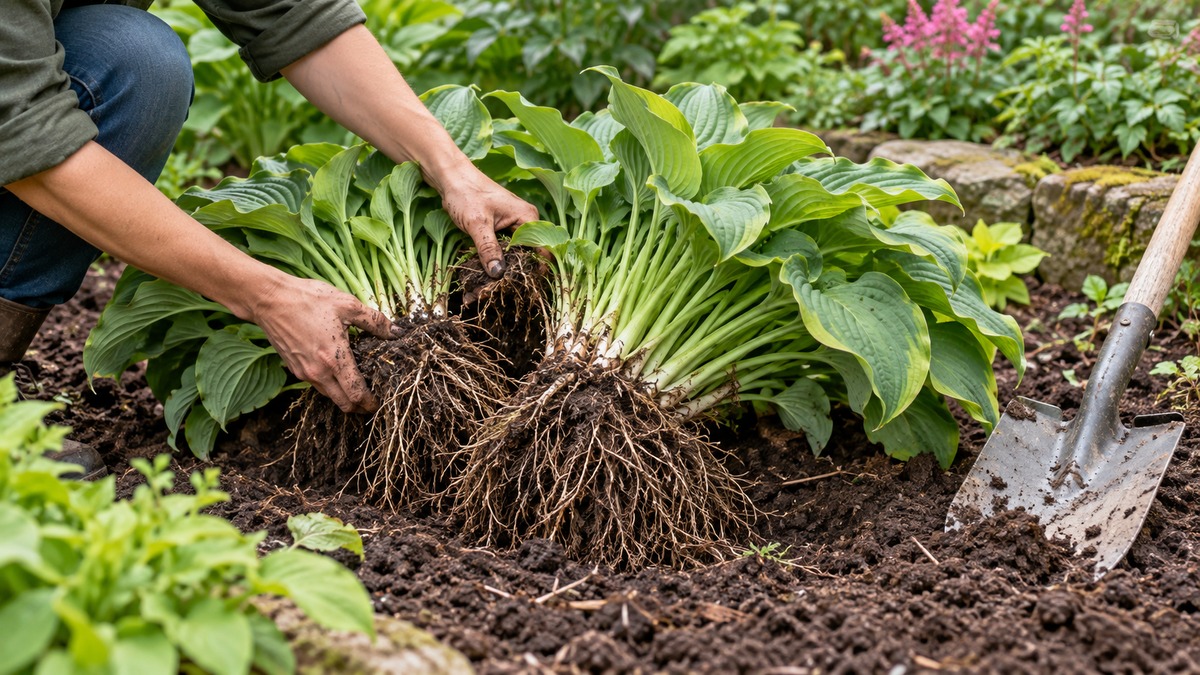
Illinois says: “Division is usually started when growth resumes in the spring.” Start by lifting the whole plant. Iowa State advises: “Dig the entire plant out of the ground making sure to get the entire root ball up out of the hole.” Penn State says to “lift the plant with a spade or fork, being careful not to damage the roots”, and then to “Shake off the soil and tease the sections of the clump apart.”
Then cut it. Iowa State says: “Separate the plant clump into sections with a sharp knife or spade.” Each piece should keep “several shoots and a portion of the root system.” Illinois says to cut the clump “so that each clump is the size of a quart or gallon sized perennial.” Penn State warns against going too small: “Do not divide perennials into very small pieces, as they will need several years to mature.” Iowa State makes the trade-off plain: “Larger divisions will establish and look nice quicker.” Smaller pieces “may take longer to recover but give you more propagules.”
Some clumps resist. Penn State says: “If the clumps have thick, entwined roots and resist separation, use an old butcher knife, an ax, or a sharp spade to cut the clump into pieces.” It adds: “Place your cuts so that each division has a lot of roots.” Iowa State notes that “A soil knife can be used to split a large root ball into two or more complete pieces.” Other clumps come apart by hand: “Species requiring careful handling can be gently teased apart with your hands.”
Old centers come out at this stage. Illinois says: “Discard the old, dead center and trim off any damaged roots.” Penn State gives the same step in other words: “If you have a plant in which the center has died out, cut away the woody center and divide the outer ring of healthy growth.”
Replant the same day and keep the divisions moist
Replant as soon as you can. Penn State says to “Replant those divisions that have strong, healthy root systems.” Iowa State says: “Replant the divisions immediately.” It advises: “Place the divisions at the same level in the ground as they were growing previously.” Penn State disagrees on depth: “Replant slightly higher to allow the plant to settle, firm the soil around the plant, water well, but do not wash soil from around roots.” The two pages give different instructions here, and neither explains why, so both are shown.
When the plants already have leaves, Penn State says: “If the plants have already produced full stems and leaves, remove 1/2 to 2/3 of the foliage before replanting.” Its reason is: “This is done because the reduced root system is now unable to replace the amount of water lost through the larger top plant growth.”
If the divisions must wait, Iowa State says to “Place the plants temporarily in a container” and to “Set containers in a protected shade to part-shade location.” Penn State advises: “If you can’t replant immediately, keep the divisions moist and protected from the hot sun and drying winds.” Illinois adds: “After replanting, water well and protect the divisions from drying out.”
Iowa State recommends mulch for the new plants: “Apply a layer of mulch to help conserve soil moisture and reduce weed growth.” It also warns about the first year’s bloom: “Most newly divided perennials do not bloom well until their second growing season.” For bed layout after the divisions go in, see companion planting layouts for raised beds.
Check the timing for your plant
The table in Iowa State’s guide makes the timing specific. Bee balm is listed as “Spring”, and its note says “divide approximately every third year”. Iris, bearded is listed as “Late Summer” with “divide every 3 to 4 years”. Hosta can be divided in “Spring or Late Summer/Fall”, and its note says “plants can be left undisturbed for years.” Daylilies are listed as “Spring or Late Summer/Fall”, so either window works for them. Several other common perennials carry a division interval of three or four years in the same table, including garden phlox, purple coneflower and black-eyed Susan.
Mistakes to avoid
- Dividing a plant in full bloom, which Penn State says to avoid.
- Cutting the clump into very small pieces that take years to mature.
- Leaving the divisions out of the ground to dry before they are replanted.
- Dividing plants that can stay put for years, such as garden peonies.
- Forcing a taproot plant apart. Iowa State says butterfly weed is difficult to divide because of its taproot.
Frequently asked questions
Do perennials always need dividing?
Not always. Illinois says there is “no set rule as to when to divide perennials”, and some plants may need it “every 3-5 years, some 8-10 years and some would rather you not bother them at all.” The signs in the clump tell you when to act.
When is the best time to divide perennials?
It depends on the plant and the guide. Penn State gives autumn and spring as the best seasons. Iowa State and Illinois favor spring for most plants, with late summer for some. The guides do not agree on spring-blooming plants, so check the table for your species.
How often should perennials be divided?
Iowa State gives the rhythm: vigorous growers every 2 to 3 years, and plants that need rejuvenation every 3 to 5 years. Illinois notes that some need division only every 8 to 10 years.
How are perennials divided in spring?
Divide when the foliage is starting to emerge. Dig the whole plant, separate the clump into sections with a sharp knife or spade, and replant the pieces right away. Penn State says to remove some foliage first if the plant already has full stems and leaves.
Can a perennial in bloom be divided?
Penn State advises dividing while the plant is growing but not flowering. Iowa State’s table notes that some spring-blooming plants, such as Lenten rose, are divided immediately after flowering, so the timing depends on the species.
How we chose
Three university extension pages form the basis of this guide, all opened on 2026-10-22: Iowa State University Extension’s How to Divide and Transplant Perennials, Penn State Extension’s Chester County Master Gardener page Dividing Perennials, and Illinois Extension’s Dividing Perennials. Each one covers why to divide, when, how to lift and cut the clump, and how to replant. Commercial pages from the search results were left out. Where the three pages agree, the guide says so, and where they differ, both figures appear.
What we could not verify
The three pages cover common garden perennials, but none of them gives a timing rule for every species, and this guide does not invent one. None of the pages names a product as a recommendation, and this guide does not either. The pages do not say how many divisions a clump yields, and they do not give a soil depth for the replanted sections.
What the sources do not say
- The sources do not explain why Penn State puts spring-blooming plants in late summer while Iowa State puts many of them in spring.
- They do not agree on replanting depth. Iowa State says same level, and Penn State says slightly higher.
- Iowa State gives a clump-division interval, but Illinois says some plants need none, and the guides do not give a single rule for when a clump is too big.
Bottom line
Divide when the plant is growing but not in bloom, cut the clump into sections that each keep several shoots and roots, and replant at once with water. For the next step, plan the new bed with how to fill raised beds.
Sources
- https://yardandgarden.extension.iastate.edu/how-to/how-divide-and-transplant-perennials (opened 2026-10-22)
- https://extension.psu.edu/programs/master-gardener/counties/chester/how-to-gardening-brochures/dividing-perennials-1 (opened 2026-10-22)
- https://extension.illinois.edu/flowers/dividing-perennials (opened 2026-10-22)