Using a Soaker Hose in a Flower Bed
As an Amazon Associate we earn from qualifying purchases.
How to use a soaker hose in a flower bed comes down to three choices: how long the run is, how much pressure reaches it, and where the hose sits in the bed. The extension publications we opened are written mainly for vegetable gardens, so this guide adapts their advice to flowers and says where that adaptation stops.
Clemson Extension calls soaker hoses the simplest drip option to install and best for small areas. Washington State University and two University of California documents add run-length, pressure and mulch guidance. Where the sources say nothing about flowers, this guide says so.
Quick answer
- Keep the run short. WSU Extension says the recommended length is “100 feet or less from water source to the end.”
- Use low pressure and a longer run, not high pressure. WSU calls low pressure for an extended time its preferred method.
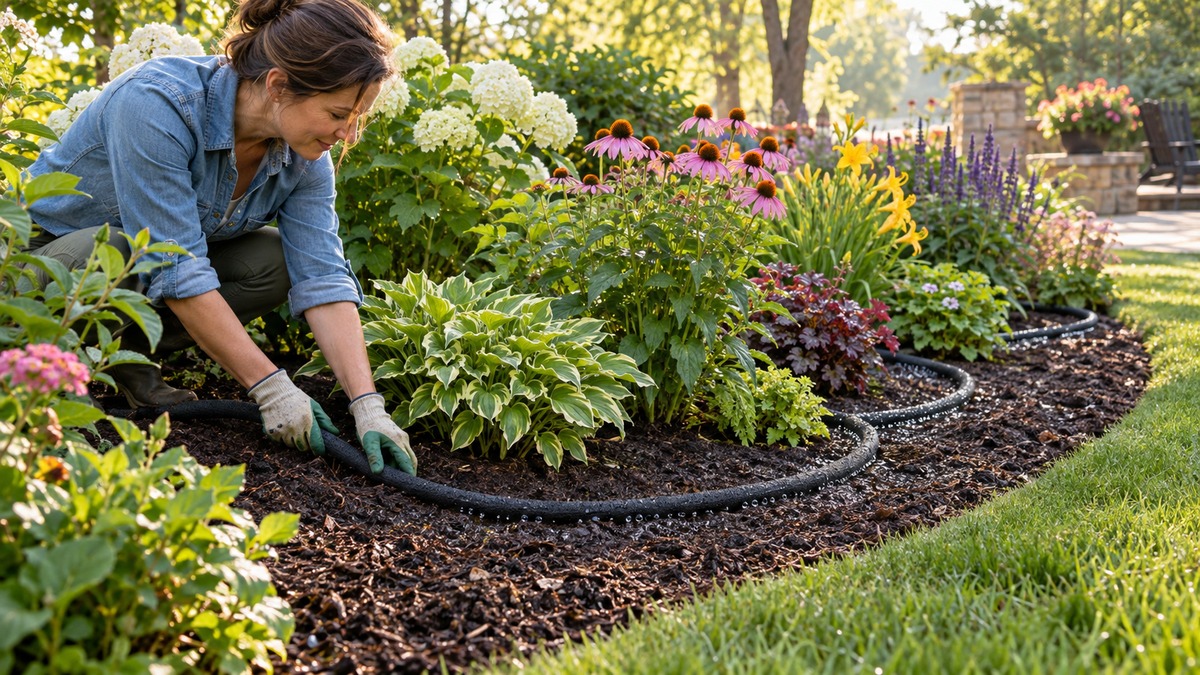
- Lay the hose under the mulch. UC Master Gardener guidance says to “Place soaker hoses or drip irrigation under the mulch.”
- Group plants with similar water needs on one line, and expect short runs of about 10 to 15 minutes, per a UC document.
Know what a soaker hose does
Clemson describes the mechanism in one sentence: “Soaker hoses slowly release water through pores along the length of the hose.” That slow release is the reason a soaker hose suits a bed, where the goal is to wet the soil around the roots rather than spray the foliage. Clemson also says that “Soaker hoses are less precise than other systems, but are the simplest to install as they attach easily to water spigots and other hoses.”
Clemson adds the scope question that matters most for a flower bed: “Soaker hoses are best for irrigating small areas.” A single bed fits that description. A long border, or a bed that stretches along a fence, may need a plan with more than one run.
| Bed situation | What the sources say |
|---|---|
| Small single bed | Soaker hoses are best for small areas (Clemson Extension) |
| Long border | Total hose length from the source should stay near 100 feet or less (WSU) |
| Mulched bed | Lay the hose under the mulch (UC Master Gardener) |
| Plants with mixed water needs | Group plants with similar water needs on the same hose (UC Master Gardener) |
| Hose that does not fill before it runs out | Try a shorter hose (WSU) |
The fifth row matters when the far end stays dry. A hose that cannot fill before the water runs out points to length or pressure, not to the plants, so address the tap before you add another hose.
Measure the run before you lay it
Length is the first limit to check. WSU’s article says that “The recommended length of a soaker hose is 100 feet or less from water source to the end.” WSU describes garden hoses as “lengths typically from 25 to 100 feet long.” A 100-foot hose therefore sits at the top of the range the sources describe.
A serpentine layout adds length that is easy to forget. Our own arithmetic shows how turns change the total. The table assumes each turn between rows adds 3 feet, which is our assumption and not a figure from the sources.
| Layout | Row length and count | Total hose length (feet) | Within 100 feet? |
|---|---|---|---|
| One straight row | 1 row of 12 feet | 12 | Yes |
| Three rows, serpentine | 3 rows of 15 feet, 2 turns at 3 feet each: 45 + 6 | 51 | Yes |
| Four rows, serpentine | 4 rows of 24 feet, 3 turns at 3 feet each: 96 + 9 | 105 | No, so split into two runs |
The four-row case is close enough to matter. A bed that looks modest on the ground can exceed the WSU limit once the rows and turns are counted. Measure the whole path, including the turns, before you buy the hose.
Pressure is the second check. WSU says that “Some issues to look for if water isn’t flowing are the length of the hose and your water pressure.” Its fix is direct: “If your water pressure isn’t sufficient to fill the hose before it runs out, try a shorter hose.” If the far end of a bed stays dry, look at both causes before you assume the plants need more water.
For the connector between the tap and the line, see our page on garden hose to drip irrigation adapters. For attachments that help with watering plants, see our page on hose attachments for watering plants.
Set the pressure and cap the line
Clemson notes that “Many soaker hoses come with a flow restrictor plate inside the hose’s female end.” The plate matters because it controls how much water enters the line. Clemson’s instruction is specific: “Ensure the restrictor plate is in place before attaching the soaker hose to the timer, spigot, or distribution line.”
WSU describes the pressure you want. “The preferred method of watering with a soaker hose is to leave it at low water pressure for an extended time.” To check the result, WSU suggests putting a container under the hose and watching how evenly water collects along its length. Once the seepage looks even, note the faucet setting so you can repeat it.
Clemson’s regulator guidance gives a number for soaker hoses: “Use regulators appropriate for the type of system being installed (25psi for soaker hose/drip emitters, 10 to 12psi for drip tape).” If you use a regulator, that setting gives you a fixed reference point.
The far end needs closing. Clemson says, “Be sure to cap the end of the soaker hose.” An open end wastes water and lowers the pressure along the rest of the line.
Lay the hose through the bed
Layout follows the shape of the plantings. Clemson’s installation notes say to “Lay the soaker hose in a serpentine pattern throughout the garden to evenly water the plants,” and that “The hose may be staked in place using landscape staples.” In a flower bed, let the hose follow the planting areas rather than cutting straight across them.
Plant grouping carries over from vegetables to flowers. UC Master Gardener guidance says to “Group plants with similar water needs together on the same soaker hose.” Put the thirstiest flowers on one run, and keep drought-tolerant plants on another if your layout allows it. The sources give no list of flowers that fit either group, so check each plant’s label.
Cover the hose with mulch
Mulch is the step the sources repeat most. Clemson says that “It’s a good idea to cover the soaker hose with mulch or straw.” UC Master Gardener guidance is more specific about placement: “Place soaker hoses or drip irrigation under the mulch used in the vegetable garden.” Its reason is the water itself: “This is especially important if using mulch, where water can be held in the soil for longer periods of time.”
The sources do not give a mulch depth for a soaker line, so pick a layer that covers the hose and still lets you see the bed. Replenish mulch as it breaks down, and check the hose after each refresh so that the cover does not hide a leak.
Set the run time and check the bed
A UC Master Gardener document gives a run length: soaker hoses “typically run, at low pressure, for only 10 to 15 minutes per irrigation.” That is a starting point, not a schedule, because soil and weather change the need. Clemson describes timer work as a process of adjustment: “Adjusting irrigation timers is largely a trial-and-error process and may take a little time to get right.”
Clemson’s goal is a steady balance. For annual fruit and vegetable crops, it says to “aim to keep the soil moist, but not saturated, so that plants will not wilt in the heat of the day.” Clemson’s guidance for perennial plants is looser: “Perennial fruits, shrubs, and trees may only need water once or twice per week.” Flower beds are not on that list, so the flower plant labels should set the frequency. Use the soil and the plants to adjust it.
Weigh the trade-offs
Soaker hoses are easy to use and inexpensive, and UC’s vegetable guidance calls the soaker hose “probably the least expensive and easiest to use in a vegetable garden setting.” The same guidance links efficient systems with savings: “Drip or trickle irrigation is ideal in the vegetable garden, reducing water usage by about 50%.” Those are vegetable-garden figures, and this guide does not transfer them to flowers as a number.
UC ANR’s food-garden guide takes a more cautious view. It says “But we discourage the use of drip tape and soaker hoses as they are notorious for breaking and leak more water than drip emitters.” That warning is written for food gardens. A flower bed falls outside its scope, but the breakage and leakage points still apply to any hose, so check the line for splits and loose fittings through the season.
Common mistakes to avoid
- Running a line past about 100 feet from the source. WSU sets that limit.
- Skipping the restrictor plate. Clemson says to make sure it is in place.
- Leaving the far end open. Clemson says to cap the end of the hose.
- Running the hose at high pressure. WSU prefers low pressure for a longer time.
- Mixing thirsty and dry plants on one line. UC Master Gardener guidance says to group similar needs together.
- Leaving the hose uncovered. Clemson suggests covering it with mulch or straw.
How we chose
This guide is a method for one kind of bed, not a list of hoses or brands. The pages we opened on 2026-10-22 were Washington State University’s Master Gardener article on soaker hoses, Clemson Extension’s factsheet on drip irrigation in home gardens, a UC Master Gardener document hosted on ucanr.edu (348791), another UC document hosted on class.ucanr.edu (181961), and the UC ANR food-garden drip guide.
We kept the statements that each page makes in plain words. Where the sources describe vegetable gardens and we apply them to flowers, we say so in the text. We left out brand names, prices and hose comparisons.
What we could not verify
What the sources do not say
The pages are written for vegetable gardens and home gardens, and none addresses flower beds directly. None gives a run time for a flower bed, a mulch depth for flowers, or a spacing for flower plants. No source here compares soaker hoses with drip systems for ornamental plants, so this guide does not make that comparison.
The layout table uses our own assumption of 3 feet for each turn, because the sources do not give a turn allowance. Check the hose label for its own length limits, since the sources cite general figures and a product may state its own. The sources also say nothing about winter storage of soaker hoses.
Frequently asked questions
How long can a soaker hose be in a flower bed?
WSU recommends 100 feet or less from the water source to the end. If the water does not fill the hose before it runs out, WSU advises a shorter hose. Count the turns when you measure a serpentine layout.
Should a soaker hose sit on top of the mulch?
No. UC Master Gardener guidance says to place soaker hoses under the mulch, and Clemson suggests covering the hose with mulch or straw. Keep the hose under the cover so water can move into the soil.
How long should a soaker hose run?
A UC document says soaker hoses typically run for 10 to 15 minutes per irrigation at low pressure. Treat that as a starting point. Clemson describes timer adjustment as trial and error, and the sources give no run time for a flower bed.
Do soaker hoses need a flow restrictor plate?
Many do. Clemson notes that many soaker hoses come with a flow restrictor plate inside the female end, and it says to make sure the plate is in place before you connect the hose to the timer, spigot or distribution line.
Are soaker hoses a good choice for a flower bed?
Clemson calls soaker hoses best for small areas, and a single flower bed fits that description. UC ANR’s warning about breakage and leakage is written for food gardens, but the same points about checking the line still apply to flowers.
Bottom line
Keep the run under about 100 feet from the tap, use low pressure for a longer time, cover the hose with mulch, and group plants with similar water needs on the same line. Adjust the run time from the soil and the plants, not from a fixed number.
Sources
- https://wpcdn.web.wsu.edu/extension/uploads/sites/74/2016/07/MG.Article.pdf (opened 2026-10-22)
- https://hgic.clemson.edu/factsheet/installing-drip-irrigation-in-home-gardens/ (opened 2026-10-22)
- https://ucanr.edu/sites/mgslo/files/348791.pdf (opened 2026-10-22)
- https://class.ucanr.edu/sites/default/files/2014-01/181961.pdf (opened 2026-10-22)
- https://innovate.ucanr.edu/sites/default/files/2025-11/Drip-irrigation-in-the-food-garden-204865.pdf (opened 2026-10-22)