How to Plant Spring Bulbs in Fall
As an Amazon Associate we earn from qualifying purchases.
The person typing how to plant spring bulbs in the fall wants three answers: when to plant, how deep to set each bulb, and what the soil needs first. Fall is the normal planting season for tulips, daffodils, crocus and similar spring bloomers. These bulbs need a cold period, and they need enough time to grow roots before the ground freezes. The extension pages we opened agree on the main steps. They differ on exact dates and on how to measure depth, so this guide shows where they agree and where they do not.
Quick answer
- Plant in fall, once the soil has cooled. Iowa State Extension calls October the ideal month in Iowa, and Oklahoma State Extension names late September through mid-November as the best window there.
- Set each bulb two to three times as deep as it is tall, or two to three times its diameter, depending on which source you follow. Large bulbs such as tulips and daffodils go about 6 to 8 inches down, and small bulbs go 3 to 4 inches down.
- Plant in well-drained soil that has compost worked in first. Wet ground can cause bulbs to decline and rot.
- Water the bed after planting and mulch it, except for the small early bloomers, which should not be mulched.
Know when fall planting works where you live
Iowa State Extension gives the clearest reason for a fall date. It says “October is the ideal time to plant spring-flowering bulbs in Iowa.” The same page explains why: “This allows bulbs to establish and develop good roots before winter.” The planting date is really a root-growth date, because the bulbs need roots in place before the ground freezes. Oklahoma State Extension names a different window, and its page is written for Oklahoma. It says “In Oklahoma, late September through the middle of November is the best time to get those bulbs in the ground.” The windows differ by state, so use the one for your own region.
Illinois Extension is more flexible about the end of the season. It says “Most bulbs can be planted until the ground is frozen.” Iowa State Extension makes the same point from the late end, noting that “Procrastinators can plant spring-flowering bulbs as late as December if the ground remains unfrozen.” Both pages still warn against planting too early. Iowa State says that planting in September, “when soil temperatures have not yet cooled,” can cause some bulbs such as tulips to emerge in the fall.
Purdue Extension in Indiana gives a soil-temperature figure, but its page is dated October 23, 1999, so treat it as older guidance. It says “As long as the soil temperatures are above 40 degrees F., the bulbs should continue their root development.” It also says “it is better to plant now rather than try to store the bulbs over winter.” For a current local date, Purdue advises contacting a county extension office.
Pick a site that drains well
Drainage is the one condition every source we opened treats as essential. Illinois Extension puts it plainly: “Good soil drainage is essential in raising bulbs.” Iowa State Extension says “Nearly all bulbs require well-drained soils.” It adds that “Poorly drained or wet soils often cause decline and rot, making them short-lived in the garden.” Oklahoma State Extension gives the same advice for a planting spot: “When choosing a planting site, select an area with good drainage.” It also warns that bulbs “don’t fare well in soggy conditions” in the clay soils common there.
Sun matters too. Oklahoma State Extension says “The site also needs to be in an area with at least six hours of direct sunlight each day.” Choose the sunniest part of the yard that also drains well. Those two requirements can pull in different directions in low spots, so check drainage after a rain before you commit the bed to bulbs.
If your soil is heavy, the fix is organic matter. Illinois Extension says “If you have a soil with a high clay content, it can be improved by adding compost, peat moss or some other source of organic material.” It then gives a depth: “The organic material should be worked in the top twelve inches of soil (eighteen inches is even better).” Wisconsin’s Chippewa Valley Extension says “Before planting, it is always a good idea to amend the soil with organic matter such as compost.” It adds that “This will also help with drainage.” Purdue makes the same point for beds in general, advising growers to prepare the bed “by adding organic matter such as peat moss, well-rotted manure, or compost.”
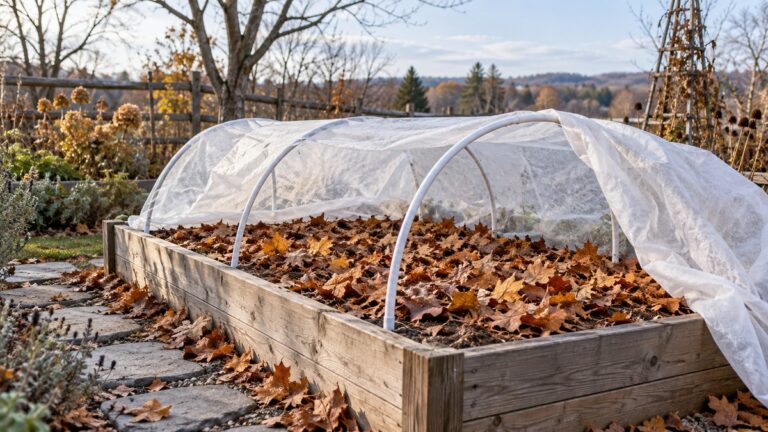
For a raised bed, the separate guide on preparing raised beds for winter is a useful companion. The sources we opened do not address raised beds directly, so treat it as a route to bed prep rather than as a bulb rule.
Feed the bulbs only if you need to
The sources disagree on fertilizer at planting. Chippewa Valley Extension says “It is not necessary to fertilize when planting bulbs.” Iowa State Extension takes a middle position: “While not typically necessary, fertilizers can be used at planting.” It adds that fertilizer matters more for next year’s bulb than for the spring flowers. Illinois Extension makes a different point, about time in the bed rather than the planting day. It says “If bulbs are going to be maintained in a planting bed more than one year, it is important to supply additional fertilizer.”
In practice, a bed you plan to keep for several seasons has a stronger case for fertilizer than a one-season display. Whichever you choose, mix any fertilizer into the soil before planting, not on top of the bulbs after they are set. Follow the label of any product you use. The sources we opened do not compare brands, and this guide does not recommend one.
Set each bulb at the right depth
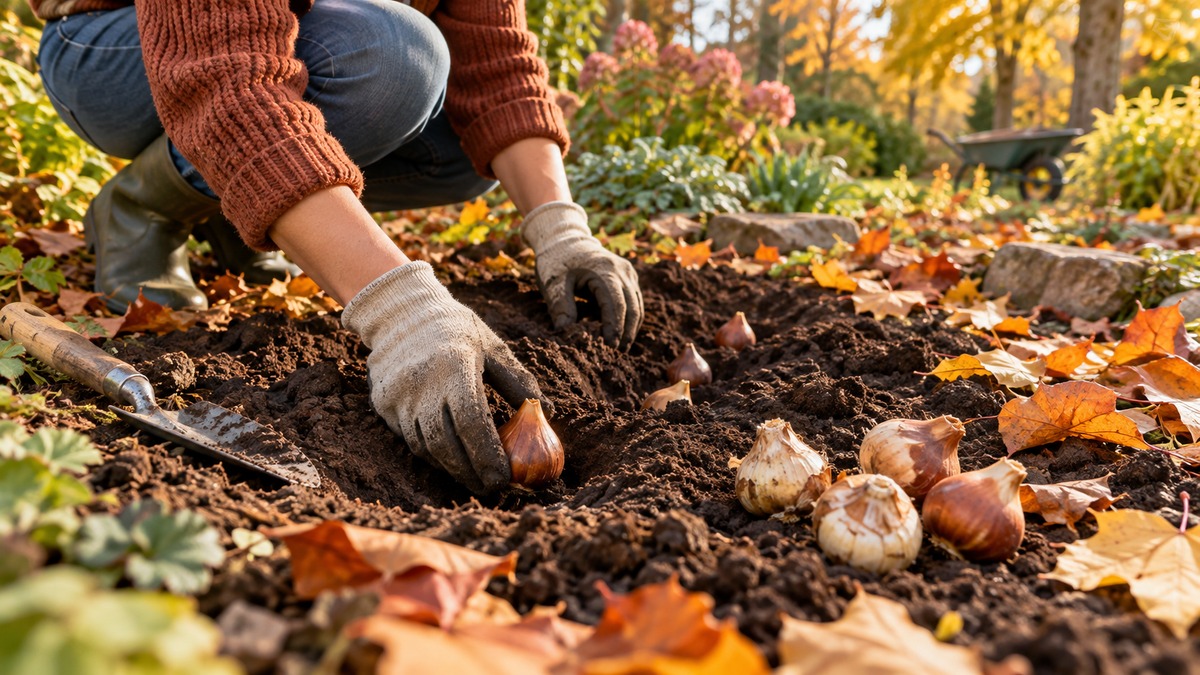
Illinois Extension gives the rule most often quoted: “The general rule of thumb for planting spring bulbs is to plant two to three times as deep as the bulbs is tall.” It translates the rule into sizes: “This means most large bulbs like tulips or daffodils will be planted about 8 inches deep while smaller bulbs will be planted 3-4 inches deep.” It also fixes the starting point: “Planting depth is measured from the bottom of the bulb.”
Iowa State Extension measures by diameter instead. It says “Plant bulbs at a depth equal to two or three times their maximum bulb diameter.” Its ranges are close to Illinois’s. It states that “Larger bulbs like tulips, daffodils, and hyacinths are often planted 6-8 inches deep” and that “The smaller bulbs like squill, snowdrops, and crocus are often planted 3 to 4 inches deep.” On its footnote it adds that “Planting depth is measured from the base of the bulb to the soil surface.”
Oklahoma State Extension uses the diameter rule too: “Bulbs should be planted no more than two to three times the diameter of the bulb.” It gives a worked example: “So, if a bulb is 1 inch in diameter, it should be planted at a depth of 2 to 3 inches.” It also warns against going too deep: “Be sure not to plant the bulbs too deep, even tulips.” Chippewa Valley Extension states the rule as “2-3 times as deep as they are wide.” It advises “Plant the bulb tip up.”
The sources measure height or diameter, so the rules give different answers for a bulb that is much taller than it is wide. Purdue’s page points to the packet for that case, saying to check “the planting instructions specific to each particular flower.” If a packet gives a depth, follow it. If not, measure the bulb in your hand and apply the rule that fits its shape.
Plant, water and mulch the bed
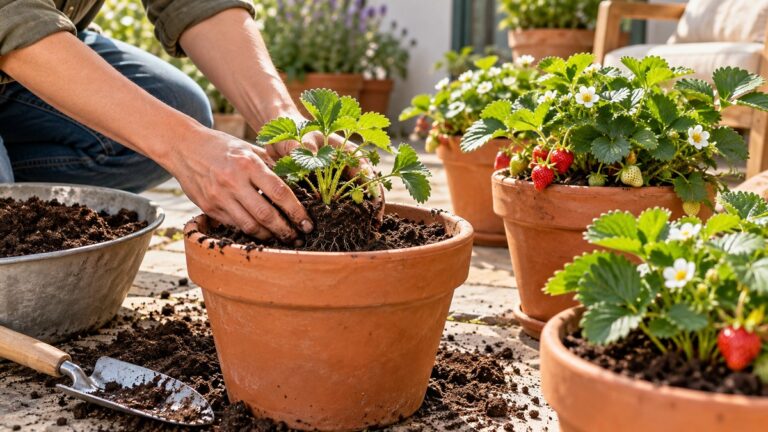
Illinois Extension says “Tulips, daffodils and hyacinths should be planted with the nose of the bulb upward and the root plate downward.” For a bed rather than a few scattered bulbs, Iowa State Extension recommends digging out the whole area: “For a mass planting of bulbs, remove the soil in the entire planting area to the proper depth with a shovel.” It then says to “Place the bulbs in the desired arrangement or pattern and then carefully backfill the entire area with soil.”
Water once the bulbs are in. Illinois Extension says “Water the bulbs following planting. This will help settle the soil in the planting bed plus provide needed moisture for the bulbs to start rooting.” It warns against overdoing it: “Avoid over-watering at planting time since this can result in bulb rot.” Water enough to settle the soil and wet the root zone, then stop.
Mulch comes next. Illinois Extension says “The bulb bed should be covered with two or three inches of mulch.” It adds that mulch “will help minimize temperature fluctuation and maintain an optimal moisture level in the planting bed.” The same page makes one exception: “The small, early booming bulbs should not be mulched.” If your bed holds both kinds, keep mulch off the area where the small bloomers are planted.
Iowa State Extension has a planting idea for a bed with many bulbs. It says “Bulbs with different bloom times can be mixed together for a long-lasting display.” Mixing early, middle and late bloomers keeps color in the bed for longer than a single type would.
Protect the bulbs from animals
Animals are a common reason fall-planted bulbs fail to show in spring. Iowa State Extension says “Some spring-blooming bulbs are highly desirable to rabbits, deer, chipmunks, voles, mice, gophers, and other animals.” It adds “This is especially true for tulips and crocus.” The same page explains the risk, since animals “can dig and eat newly planted bulbs in the fall” and planting time is therefore also the period of greatest risk.
The pages we opened do not name a deterrent that works, and they do not say which products to use. If animals are a known problem, ask your county extension office for locally tested options before you plant.
Common mistakes to avoid
- Planting too early. Iowa State Extension says September planting, before the soil has cooled, can make some bulbs such as tulips come up in the fall.
- Planting in soggy ground. Oklahoma State Extension warns that bulbs “don’t fare well in soggy conditions”, so keep them out of wet spots.
- Planting too deep. Oklahoma State Extension says “Be sure not to plant the bulbs too deep, even tulips.”
- Watering heavily at planting time. Illinois Extension says over-watering can result in bulb rot.
- Mulching the small early bloomers. Illinois Extension says those bulbs should not be mulched.
- Skipping the planting instructions. Purdue points growers to the instructions for each flower.
For the organic matter itself, a home pile is one option, and how to make a compost pile covers building one. Whatever the source, Illinois Extension says the organic material should be worked into the top twelve inches of soil before planting.
How we chose
We chose pages from university and county extension programs, plus one older Purdue Extension page, because each one names a planting window, a depth or a soil step a reader can act on. We opened each page with curl and kept only pages that returned HTTP 200 and could be read as text. Pages that returned 403 or 404 are not counted. We did not use retail listings, product pages or general blogs for any step. Every claim traces to a sentence on one of the pages in the source list at the end, and every quoted sentence was checked against the text of its page. The pages cover Iowa, Oklahoma, Illinois and Wisconsin, plus one Indiana page, so the guidance is general rather than local.
What we could not verify
The pages we opened do not give one planting date for the whole country, and they do not give a soil temperature for every bulb type. The Purdue soil temperature figure comes from a 1999 page. We did not check any bulb variety, supplier or packet, so the exact depth for a specific bulb is a gap this guide cannot close. No product is recommended.
What the sources do not say
None of the pages we opened gives a compost amount per square foot for a bulb bed. The Illinois fertilizer advice does not say which area its figure covers in the text we read, so this guide does not repeat that figure. The pages do not name a deterrent that protects bulbs from animals, and they do not say whether any deterrent works. They also do not say how many seasons a planting will last in a given bed.
Frequently asked questions
Can spring bulbs still go in during late fall?
Often yes, as long as the ground has not frozen. Illinois Extension says “Most bulbs can be planted until the ground is frozen.” Iowa State Extension says bulbs can go in as late as December if the ground stays unfrozen. Both pages stress that bulbs need time to root before cold weather, so an earlier planting in the window gives them the best start.
How deep do tulips go?
Illinois Extension says large bulbs such as tulips are planted about 8 inches deep. Iowa State Extension gives 6 to 8 inches for larger bulbs. Both measure from the base of the bulb, and Chippewa Valley Extension advises planting the bulb tip up. Use the packet depth if it gives one.
Do bulbs need fertilizer at planting time?
The sources disagree. Chippewa Valley Extension says it is not necessary when planting. Iowa State Extension says fertilizer is not typically necessary but can be used at planting. Illinois Extension says additional fertilizer matters when bulbs stay in the bed for more than one year.
Does a newly planted bulb bed need mulch?
Illinois Extension recommends two or three inches of mulch on the bulb bed, because it keeps temperature and moisture steadier. The same page says the small early bloomers should not be mulched. If your bed has both kinds, keep the mulch off the area where they are planted.
What works if the soil is heavy clay?
Illinois Extension recommends working compost or other organic material into the top twelve inches of soil, or eighteen inches if you can. Oklahoma State Extension notes that clay soils can stay soggy, and bulbs do not fare well in soggy conditions. Choose the best-drained spot you have, and check it after a rain.
Sources
- https://extension.illinois.edu/flowers/planting-bulbs (opened 2026-10-22)
- https://yardandgarden.extension.iastate.edu/how-to/selecting-and-planting-spring-blooming-bulbs (opened 2026-10-22)
- https://extension.okstate.edu/programs/gardening/grow-gardening-columns/grow-columns-2020/sept-20-2020-spring-bulbs.html (opened 2026-10-22)
- https://chippewa.extension.wisc.edu/2023/10/05/treat-yourself-to-early-spring-blooms-by-planting-hardy-bulbs-now (opened 2026-10-22)
- https://www.purdue.edu/hla/sites/yardandgarden/still-time-to-plant-spring-flowering-bulbs-this-fall/?cat=19 (opened 2026-10-22)