How to Plant Garlic in Fall
As an Amazon Associate we earn from qualifying purchases.
Learning how to plant garlic in fall is mostly a matter of timing and clove choice. Plant large, healthy cloves so their roots form before the ground freezes, and the plants can grow quickly once spring arrives. The planting window depends on where you live, so the four university extension guides below give different dates and figures.
This guide sets out the steps those guides share and shows the figures where they disagree. When a number differs between sources, both numbers appear, and the sources do not say which one fits your own garden.
Quick answer
- Buy cloves from a garden center, a local grower or a catalog, and skip grocery store garlic, which may have been treated to prevent sprouting.
- Plant in autumn. The four guides give windows from late September to early November, depending on the region.
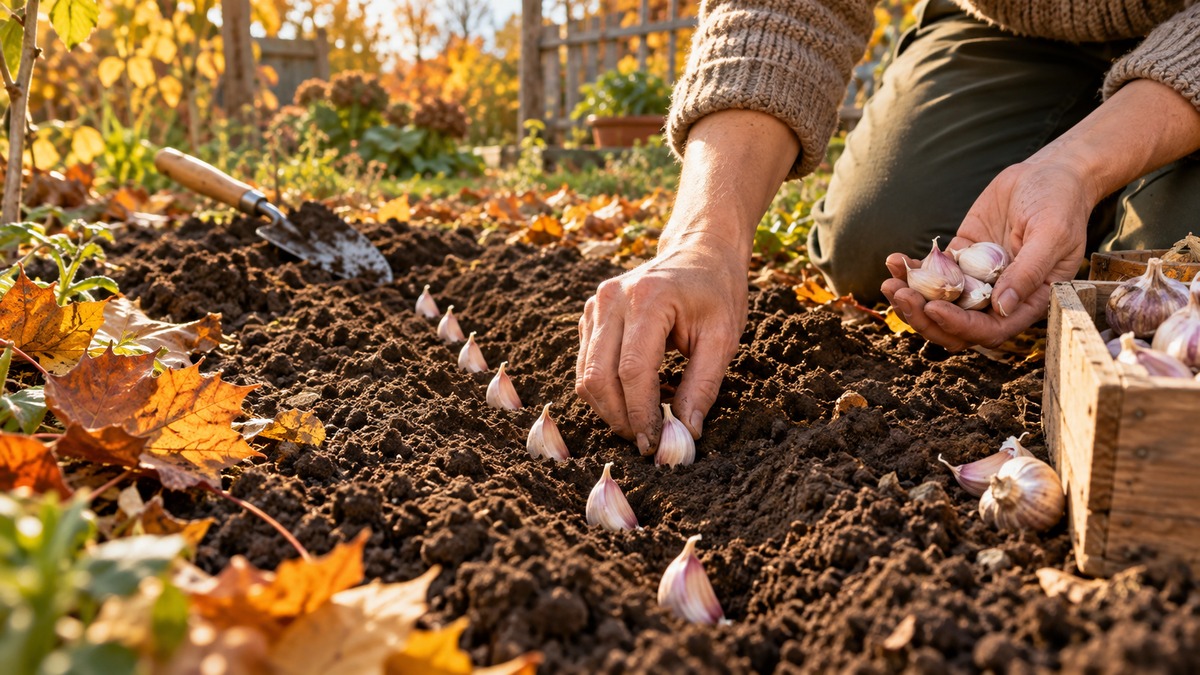
- Three of the four guides say to set cloves pointed end up. Depth runs from 1 to 3 inches and spacing from 2 to 7 inches across the guides.
- Mulch with straw before winter. Iowa State Extension advises moving the straw between the rows in early spring.
Why fall planting works
Oregon State University Extension says: “Garlic roots develop in the fall and winter.” It adds that the roots “can support the rapid leaf growth needed to form large bulbs” by early spring. University of Vermont Extension ties the timing to its cold climate, saying garlic needs a dormant period of two months below 40 degrees Fahrenheit. Iowa State Extension says: “The highest yields are obtained from the largest cloves planted in the fall.”
Choose healthy, large cloves
Iowa State Extension advises: “Plant cloves obtained from garden centers or mail-order companies in the fall (October to early November).” University of Vermont Extension says: “Purchase garlic from growers in your area or from catalogues that are focused on the Northeast.” Penn State Extension explains that garlic seed bulbs are whole bulbs that break into individual cloves for planting, so the cloves are what goes in the ground.
Size matters. University of Vermont Extension says: “Whatever your source, plant the largest cloves from the biggest bulbs available to you and save any small cloves for cooking.” Iowa State adds: “Start with large cloves, as they produce larger bulbs.” Before planting, Iowa State also says to “Discard any infected or bruised cloves because they will decay in the soil.”
Skip grocery store garlic. Iowa State says: “Do not plant garlic cloves purchased from grocery stores,” and notes that “Most garlic in stores is treated to prevent sprouting.” University of Vermont Extension says the garlic “may have been treated to prevent growth.” Penn State and Oregon State do not discuss grocery garlic.
Variety matters too. Penn State says: “Stiffneck (hardneck) varieties grow best.” Iowa State says the hardneck types “grow well in Iowa but do not store as well as softneck cultivars.” Elephant garlic is a different crop, and Iowa State says it “is not a true garlic.” If you grow your own, University of Vermont Extension says: “Because garlic retains the genetics of the mother clove, you can plant garlic grown in your own garden and get excellent results.”
Pick the planting window for your region
Iowa State gives October to early November, and it also allows spring planting when “the ground can be worked in the spring”. Penn State gives mid to late October. Oregon State gives the widest span: “September through November is the best time to plant garlic.” University of Vermont Extension gives the window for its colder climate: “Plant your garlic in late September to mid-October.” None of the four pages covers every region, so ask a local extension office for the window in your area.
Prepare the bed
Garlic does best in “well-drained, fertile soils high in organic matter.” Iowa State warns that garlic grown in heavy clay “often produces misshapen bulbs.” It adds that heavy clay soils “can be improved by incorporating organic matter, such as compost or well-rotted manure.” Oregon State says: “Plant garlic in full sun in well-drained soil.” For heavier ground it suggests: “In heavier soil, use raised beds 2 to 3 feet wide and at least 10 to 12 inches tall.” For the bed itself, see preparing raised beds for winter, and for other crops that suit the same beds, see vegetables to plant in raised beds.
Fertilizer amounts differ. Iowa State says: “Garlic requires more fertilizer than many vegetables.” It advises 1 to 2 pounds of an all-purpose garden fertilizer such as 10-10-10 per 100 square feet before planting. Oregon State says to work “a couple tablespoons of 5-10-10 fertilizer, bone meal or fish meal several inches below where the garlic base will rest.” The sources use different units, and they do not reconcile them.
Plant the cloves at the right depth and spacing
The guides differ most on this step, so their figures appear side by side.
- Iowa State: “Plant large cloves 1 to 1.5 inches deep with the pointed side up, 3 to 5 inches apart within rows spaced 18 to 24 inches apart.”
- Penn State: cloves go in 1 to 2 inches deep, pointy end up, and “Space cloves 6 to 7 inches apart in rows, and allow 1 foot between rows.”
- Oregon State: “Plant cloves root side down, 2 inches deep and 2 to 4 inches apart in rows 10 to 14 inches apart.”
- University of Vermont Extension: “Plant unpeeled garlic cloves 3 inches deep with the point up, root down.” It adds that some gardeners “plant cloves 4 inches apart in rows about 8 inches apart for cultivating ease.”
Across the four, depth runs from 1 to 3 inches and spacing from 2 to 7 inches. Three of the guides say the pointed end goes up, and Oregon State gives a root-side-down instruction. The sources do not explain the gap between their figures.
Mulch before the ground freezes
Iowa State gives the most specific rule: “Fall-planted garlic should be mulched in November with a 4- to 6-inch layer of weed-seed-free straw to help prevent winter injury.” In spring it says: “In early spring, move the straw between the rows to allow the garlic foliage to emerge.”
Penn State says: “Lightly mulch the bed with straw to prevent winter heaving and to suppress weeds during the growing season.” Oregon State says: “Lightly mulch to improve soil structure and reduce weeds.” University of Vermont Extension describes heavier mulch, which may need to come off in spring if the soil stays very wet.
Early growth and spring care
Garlic has a shallow root system. Iowa State says: “Control weeds with shallow cultivation or by applying mulch, such as straw or grass clippings, between rows.” Oregon State adds: “Weed regularly; garlic does not tolerate competition.”
Watering differs between the guides. Iowa State says: “Garlic requires 1 inch of water each week.” It also says: “Stop irrigating in late July to allow the foliage to die down prior to harvest.” Oregon State says: “Water only if soils are very sandy, or if May and June are especially dry.” Penn State gives the spring feeding rule: “Fertilize in March and control weeds throughout the growing season.”
Iowa State notes that a blanket of snow helps: “A blanket of snow is especially helpful.” It advises removing the mulch only once spring growth is steady, when “temperatures are consistently warmer and spring growth is appropriate and expected.”
Scapes on hardneck garlic
Iowa State explains that hardneck garlic “will produce a scape or flower stalk from the center of the leaves in mid-to-late May.” It advises removing the scape, since doing so “will help the bulb grow larger”. Oregon State gives the timing: “For hardneck varieties, remove floral stems in May or early June to increase bulb size.” Penn State advises removing the scapes “while they are young by cutting or snapping them off where they emerge from the top leaves.”
Harvest, cure and store
Iowa State says: “In Iowa, garlic is usually harvested in July or August.” Penn State says: “The garlic bulbs are ready to be harvested from early to mid-July.” Oregon State suggests a check first: “Start checking in late June by pulling one plant and cutting it crosswise.”
Oregon State says: “Dig and dry mature bulbs in a shady, warm, well-ventilated place for several days.” Penn State warns: “If harvested too late, the bulb will split.” It also says: “Do not pull the stem to harvest. Instead, use a spade or shovel to lift the bulb from the ground.” For curing, it advises: “To cure, allow them to dry and harden in a well-ventilated, shaded area for a few weeks.”
Storage time differs. Iowa State says: “Garlic can be stored for three to six months if properly dried and stored.” It suggests a mesh bag or open crate in a cool, dry area, with 32 to 40 degrees Fahrenheit and 65 to 70 percent relative humidity. Oregon State says: “Properly stored garlic should last until the next harvest the following summer.” Oregon State also says: “Do not refrigerate, since moisture and cool temperatures trigger sprouting.”
Mistakes to avoid
- Planting grocery store garlic, which Iowa State says is usually treated to prevent sprouting.
- Planting elephant garlic as if it were true garlic, since Iowa State says it “is not a true garlic.”
- Planting into soggy ground. University of Vermont Extension says: “Too much moisture can cause garlic to rot.”
- Using small cloves or planting late. Iowa State links unsegmented bulbs to “planting cloves that are too small, planting in late spring, or poor growing conditions during the growing season.”
- Leaving scapes on hardneck plants when you want bigger bulbs.
- Harvesting late. Penn State says the bulb will split.
- Refrigerating cured garlic, which Oregon State advises against.
Frequently asked questions
Can grocery store garlic be planted in fall?
The guides advise against it. University of Vermont Extension says grocery garlic may have been treated to stop growth, and Iowa State notes that it is usually a softneck type from warmer regions.
When is the best time to plant garlic in fall?
It depends on your region. The guides give October to early November in Iowa, mid to late October in Penn State’s guide, September through November in Oregon, and late September to mid-October in Vermont. Ask your local extension office for the window in your area.
How deep should garlic cloves be planted?
The guides say 1 to 1.5 inches (Iowa State), 1 to 2 inches (Penn State), 2 inches (Oregon State) and 3 inches (University of Vermont Extension). The sources do not say which depth suits which soil, so follow one guide closely and note the depth you used.
Should fall-planted garlic be mulched?
Every guide mentions mulch. Iowa State gives 4 to 6 inches of weed-seed-free straw in November, moved between the rows in early spring. Penn State and Oregon State say to mulch lightly, and University of Vermont Extension describes heavier mulch that may need removing in spring.
Why did my garlic come up early in winter?
Iowa State Extension says: “While the premature emergence of garlic foliage is undesirable, the danger is not as great as it may seem.” The guide adds that snow often returns and slows growth, and that an extra layer of mulch helps if snow cover is poor.
How we chose
Four university extension pages, all opened on 2026-10-22, form the basis of this guide: Iowa State, Penn State, Oregon State and the University of Vermont. Each one gives planting steps for garlic in the fall, and we read each page in full. Commercial and hobby pages from the search results were left out, because they are not extension or agency pages.
What we could not verify
None of the four pages covers your region, so the planting date for your garden is not confirmed here. This guide gives no frost date, hardiness zone or product recommendation, because the sources do not give them.
What the sources do not say
- The sources do not give one depth or spacing that suits every soil, and they do not explain why their figures differ.
- They do not agree on spring watering or on storage time.
- Oregon State estimates that “A single 10-foot row should yield about 5 pounds of bulbs.” The other three pages give no yield figure.
Bottom line
Plant large, healthy cloves in the autumn window for your region, and mulch before the ground freezes. Where the guides disagree, check a local extension office before choosing one figure.
Sources
- https://yardandgarden.extension.iastate.edu/how-to/growing-garlic-home-garden (opened 2026-10-22)
- https://extension.psu.edu/growing-and-using-garlic (opened 2026-10-22)
- https://extension.oregonstate.edu/news/fall-best-time-plant-garlic-oregon (opened 2026-10-22)
- https://uvm.edu/news/extension/its-time-plant-garlic (opened 2026-10-22)