How to Clean Garden Tools After Use
As an Amazon Associate we earn from qualifying purchases.
Learning how to clean garden tools after use is a short routine that you repeat every time: knock off the soil, wipe off sap and rust, dry the metal, and then oil it. The extension pages we opened agree on that order, and Oregon State University Extension says to clean tools “After every use”. The pages differ on how to remove sap, on which oil to use, and on where long-handled tools belong, so this guide keeps the shared steps in order and shows where the pages part ways.
Quick answer
- Brush off the soil first, then wipe with a dry rag. Wash only what the brush cannot clear, and dry each tool right away.
- Remove rust with steel wool or sandpaper, dry every tool fully, then wipe the metal with a light oil before storing it.
- Store tools off the ground in a dry place, and hang long-handled tools on a rack so their edges stay protected.
Start with soil and loose dirt
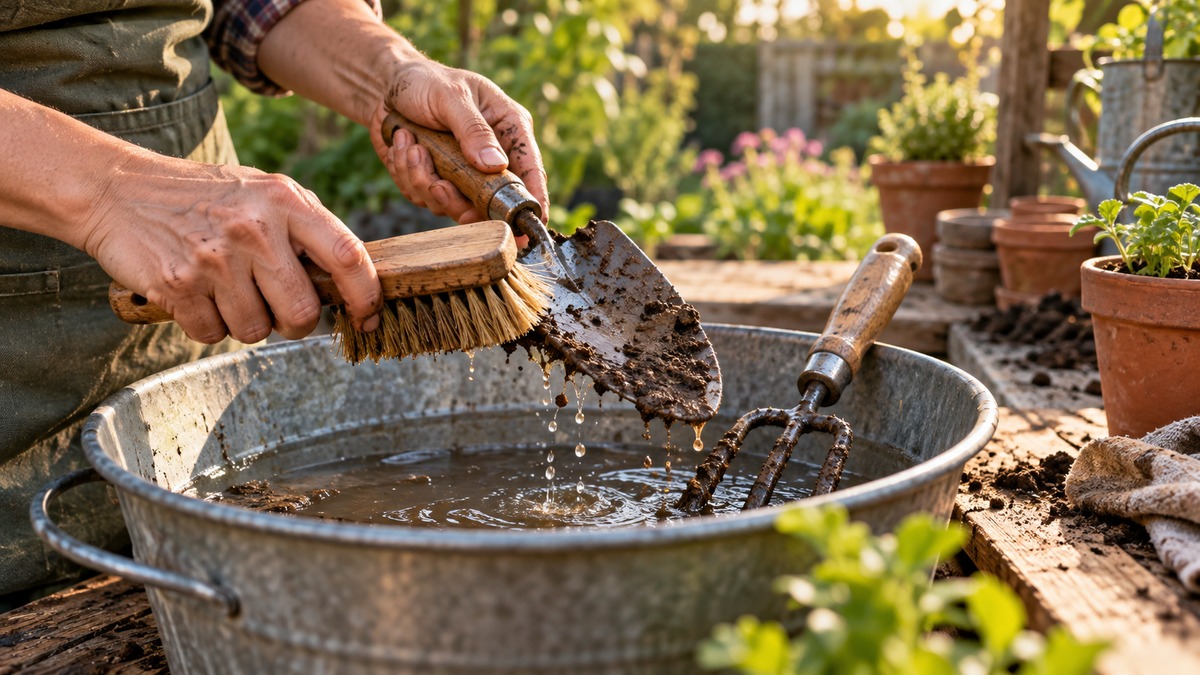
Begin by getting the soil off while it is still loose. The University of Illinois Extension lists the options: “Remove any soil with a wire brush, paint scraper, stiff brush, or strong blast from a hose”. Oregon State gives the usual order: “Use a brush to clean off any dirt, then a dry rag.” If the soil is stubborn, it adds, “follow up with a damp rag, then dry the tool.” Vermont adds that “Stubborn, dried-on soil can be removed using a stiff-bristled brush.”
Water is an easy first step for digging implements. North Carolina Cooperative Extension says: “Water is an easy way to remove most of the dirt from shovels, spades, and other digging implements.” It also recommends a stiff brush for anything stuck on: “A wire brush or a brush with stiff bristles is great for removing anything that is stuck on your tools.” Vermont agrees that “For most, spraying with water will get the job done.” Dry the tool once the soil is off.
Clean off sap and rust
Sap is where the pages part ways. The University of Vermont Extension recommends soap: “Use warm water with a bit of dish soap to remove sap residue.” The University of Illinois Extension takes a more abrasive route for pruners, saying: “Scrub away dirt, rust, and sap from pruner blades with a wire brush, sandpaper, or steel wool.” Both pages work, so start with the gentler step, the warm water and soap, and move to the brush only if the sap does not lift.
Rust needs abrasion. Vermont says: “Rust spots can be dealt with using steel wool or sandpaper.” Oregon State gives the same tool for rust: “Remove rust with sandpaper.” For pruners, the University of New Hampshire Extension is more specific: “After wiping pruners dry, use coarse steel wool to work off any rust.” Use the coarsest material that clears the rust, and then clean off the residue before drying.
Dry every tool before you oil it
Drying comes before oil. The University of Vermont Extension says: “Once clean, be sure to dry garden tools thoroughly.” North Carolina Cooperative Extension gives the reason in plain words: “tools should be fully dry before you store them in order to prevent rust”. The University of Illinois Extension sets the same goal: “To preserve tools and keep them in proper working order, they must be clean and dry before storage.”
Once a tool is dry, oil it lightly. Oregon State says: “When the blade is clean, wipe all metal surfaces with a lightly oiled rag.” North Carolina Cooperative Extension says: “Applying a light oil to your tools is another way to avoid rust.” The pages name several oils, including a light oil, mineral oil and clean lightweight motor oil, and none of them ranks one over another.
Use a sand bucket during the season
For long-handled metal tools during the growing season, Oregon State describes a bucket method: “After each day’s use plunge the tool into the bucket a few times to help clean the blade and coat it with oil.” The same idea appears in North Carolina Cooperative Extension’s guide: “For larger tools such as shovels and spades, try filling a 5 gallon bucket with sand mixed with oil.” Oregon State’s version ends by wiping the tool with “a lightly oiled rag”, so the bucket does the cleaning and the rag finishes the job.
At the end of the season, the job gets longer. Oregon State says: “Give tools a good cleaning before storing them for the winter.” It adds: “Scrape off soil, using a stiff wire brush if necessary.” For the metal, it suggests a light protective coating and names clean lightweight motor oil as one option. Apply that coating to every metal surface before the tools go into winter storage.
Inspect each tool as you clean it
Cleaning is also the moment to check each tool. The University of Vermont Extension says: “While cleaning each garden tool, take the opportunity to inspect it for damage and needed maintenance.” Its questions are practical: “Is a blade bent or a screw in need of tightening? A handle loose or cracked?” The University of Illinois Extension asks for the same check at the end of the season: “When you are done with tools at the end of the growing season, thoroughly clean and inspect them.” Its next step is to “Determine what needs to be repaired or replaced.”
Oregon State’s guide adds two checks. The first is simple: “Examine the tool for loose parts.” The second is for pruners that will not cut cleanly: “If your pruners are sharp but the object cut is not smooth, tears or leaves a little heel, your pruner is out of alignment.”
Handles and pruners
Wooden handles need their own care. The University of Vermont Extension warns: “Save yourself from splinters caused by rough wooden handles: smooth the surface with sandpaper then wipe on a light coating of mineral oil.” North Carolina Cooperative Extension says: “Use sandpaper to smooth the handles”. It adds that “Applying oil, such as linseed or mineral oil, to tool handles is also beneficial.” Oregon State gives the winter rule: “Clean thoroughly and restore handle finishes before storing over the winter.”
Pruners need the most attention. The University of New Hampshire Extension starts with a practical step: “If your pruners are easy to disassemble, start there.” It explains why: “It is much easier to clean and sharpen a detached blade.” After the rust is off, it says: “Finish by oiling your pruners to lubricate the moving parts and prevent the steel from rusting.” Once you have cleaned the blades, check whether they need an edge too. Our guide to the best pruner sharpener options is the next step if the cut is no longer clean.
Store tools dry and off the ground
Storage is where cleaning pays off. The University of Illinois Extension says: “Store tools off the ground and away from the elements in a shed, garage, or barn.” It explains why: “Tools that are left outside can absorb moisture from wet grass and dew.” For short-handled tools, it suggests: “Short-handled tools can be stored using a pegboard system.” Outlining each tool on the board “can help identify any missing tools”. For long-handled tools, it says they “should be stored on a hanging rack or tool holder to prevent damage to edges.”
Oregon State gives more than one method. It says: “Tools can be stored on shelves or in racks, or simply leaned up against a wall.” It also warns about wood: “Do not store tools that have wooden parts with the wood in contact with soil or concrete.” If you are still deciding where the tools will live, our guide to garden tool storage covers racks, organizers and wall hooks in one place. North Carolina Cooperative Extension adds a point about the floor: “Hanging tools so they are not in contact with the ground may also help prevent rust”.
Common mistakes to avoid
- Leaving tools outside overnight. The University of Illinois Extension says tools left out can absorb moisture from wet grass and dew.
- Putting tools away damp. North Carolina Cooperative Extension says they should be fully dry before storage.
- Skipping the oil on pruners. The University of New Hampshire Extension says the oil keeps the steel from rusting.
- Leaving rough wooden handles unsanded. The University of Vermont Extension says rough handles cause splinters.
- Storing wooden handles against soil or concrete. Oregon State says to avoid that contact.
How we chose
We started with university and county extension pages that came up in a search for cleaning hand tools. We kept five of them: an Oregon State University Extension guide written with the Oregon Master Gardener Association, a North Carolina Cooperative Extension county article, a University of Illinois Extension guide, a University of Vermont Extension article and a University of New Hampshire Extension article. We opened each one on 2026-10-22 and read it in full before quoting. We kept pages that name specific steps for cleaning, drying, oiling or storing hand tools, and we did not quote from sections on powered equipment. We did not rank the pages. Several other results were left out: a Georgia page that returned HTTP 403, a television program page, and commercial product pages, because none of them is an extension guide that we could open and quote.
What we could not verify
The pages agree on the order of the steps, but they do not agree on how to remove sap or which oil to choose. They do not rank oils, give a cleaning interval for a particular climate, or explain how often a shovel’s wooden handle needs sanding. They do not cover powered equipment, and this guide does not cover it either. Nothing in this guide is a product recommendation, and no product is named as a best choice.
What the sources do not say
The sources do not say how long a sand-and-oil bucket stays useful before it needs fresh sand, and they do not give a number of cleanings per week. Oregon State names car engine oil for its bucket, while North Carolina Cooperative Extension says any light oil will help, so the pages do not agree on the best oil for the bucket. The sources also do not say how to sharpen a shovel or spade, which is outside the scope of this article.
Frequently asked questions
Do garden tools need cleaning after every use?
Clean the soil off after each use. North Carolina Cooperative Extension says it is best to remove soil “after each use”, and Oregon State says to clean off dirt or rust “After every use”. Save the longer cleaning for the end of the season, when Oregon State says to give tools “a good cleaning before storing them for the winter.”
Is water enough to clean garden tools?
For soil, often yes. The University of Vermont Extension says that “For most, spraying with water will get the job done.” North Carolina Cooperative Extension calls water “an easy way to remove most of the dirt” from digging tools. For sap, the Vermont page adds warm water with dish soap, and for stuck-on soil it recommends a stiff brush.
Which oil works on garden tools?
The pages name several oils and do not rank them. North Carolina Cooperative Extension says “Applying a light oil to your tools is another way to avoid rust.” Vermont recommends mineral oil for metal parts and for handles. Oregon State names clean lightweight motor oil for metal. For wooden handles, North Carolina Cooperative Extension says linseed or mineral oil is beneficial.
How is rust removed from garden tools?
Use steel wool or sandpaper. The University of Vermont Extension says rust spots “can be dealt with using steel wool or sandpaper”, Oregon State says to “Remove rust with sandpaper”, and the University of New Hampshire Extension suggests coarse steel wool for pruners. Dry the tool and oil it after the rust is gone.
Where should long-handled tools go?
On a hanging rack or tool holder. The University of Illinois Extension says long-handled tools “should be stored on a hanging rack or tool holder to prevent damage to edges.” Oregon State allows racks, shelves, or simply leaning the tools against a wall, so a wall spot works too if the tools stay dry and off the ground.
Sources
- https://extension.oregonstate.edu/sites/extd8/files/documents/12281/gardentoolscare.pdf (opened 2026-10-22)
- https://forsyth.ces.ncsu.edu/2022/12/winter-is-a-great-time-for-garden-tool-care (opened 2026-10-22)
- https://extension.illinois.edu/sites/default/files/garden_tool_maintenance.pdf (opened 2026-10-22)
- https://www.uvm.edu/extension/news/smart-garden-tool-storage (opened 2026-10-22)
- https://extension.unh.edu/blog/2018/01/how-clean-sharpen-your-pruners (opened 2026-10-22)