How to Test Garden Soil pH at Home
As an Amazon Associate we earn from qualifying purchases.
The person typing how to test garden soil ph at home wants a reading they can act on without guessing. A home kit or meter gives a quick answer, and the extension pages we opened agree it can show whether the pH is in a workable range. They also agree that a home kit is less precise than a laboratory. The laboratory result is what tells you how much lime or sulfur to add, so this guide covers the reading, the sampling, the limits of kits and the next step.
Quick answer
- A home kit or meter is a quick check. UNH Extension says kits can help decide whether pH is within a reasonable margin for the crops you grow.
- Sample the bed to about 6 to 8 inches down, and take several cores so the sample represents the whole area. Purdue Extension gives that depth.
- UNH Extension gives 6.5 to 6.8 as the best range for most vegetables, while Purdue Extension gives 6.0 to 6.8 for most horticultural plants.
- Add lime to raise pH or sulfur to lower it only after a test. Purdue Extension warns that lime can hurt where pH is already near neutral.
What a pH reading tells you
UNH Extension explains why pH matters for nutrients. It says “Soil pH affects nutrient availability, soil microbe activity and heavy metal mobility.” It also says “Soil nutrients are most available when the soil pH is between 6.5 and 7.5”, and that “many garden plants grow best when the pH is around 6.5.” The page gives the practical range for food crops in these words: “most vegetable plants will perform their best when the pH is between 6.5 and 6.8”.
Oregon State University Extension puts the general picture the same way. It says “In general, most plants grow best in a neutral soil pH, although there are important exceptions.” It gives blueberries as one exception, noting they “do well in soil pH between 4.5 and 5.5.” The lesson is that a single pH target does not suit every bed, so decide what you plan to grow before you read the result.
Purdue Extension explains how the scale works. It says “changing the pH from 7 to 6 is ten times more acidic than neutral”. That is also why a reading close to the target calls for care, since Purdue Extension notes that “Changing a soil’s pH can be difficult”.
Home kits and meters: what they can and cannot do
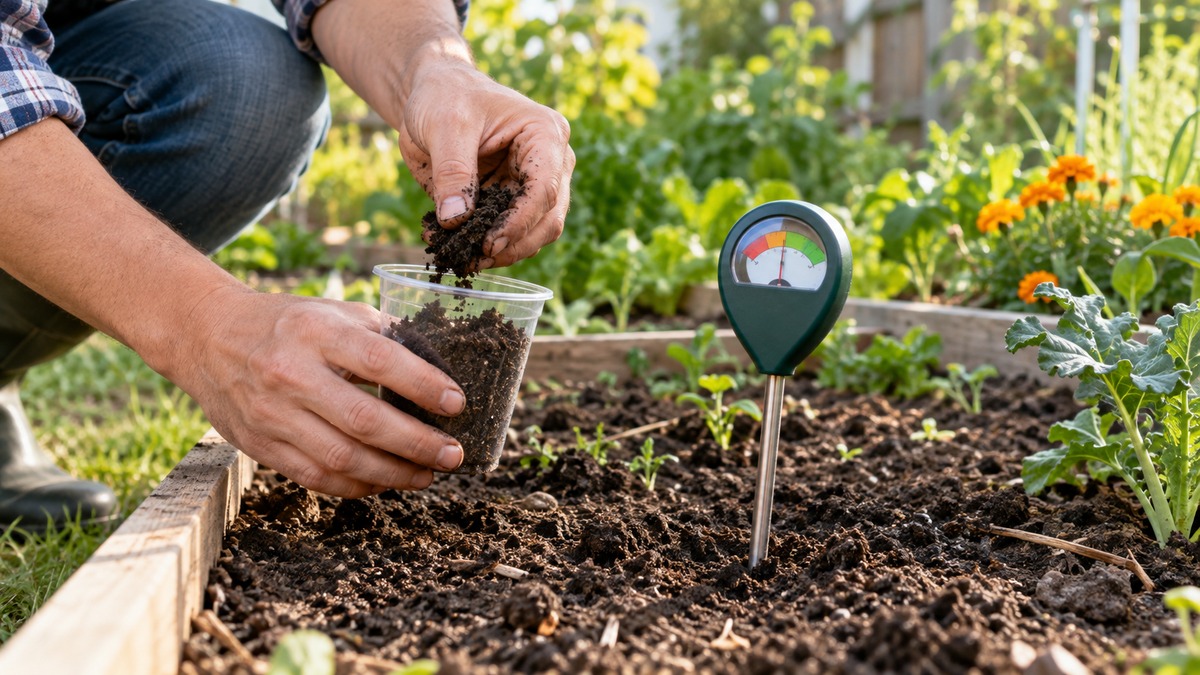
Oregon State University Extension says “Soil pH can be checked at home using a simple kit.” UNH Extension agrees that a kit has a place, saying garden kits “can help determine if the pH is within a reasonable margin for the crops being grown, and whether lime or sulfur need to be added.” That makes a kit useful for a first look, as long as you read it as a direction rather than a final number.
The limits are just as clear. UNH Extension says “Though these test kits and meters may seem like the perfect alternative to lab testing, they typically aren’t as accurate.” It adds that “some are more accurate than others,” and that accuracy can vary by nutrient. Montana State University Extension explains the difference in method. It says “Most soil test kits require combining the soil sample with water to make a slurry.” By contrast, “In contrast, soil testing laboratories dry, sort, grind and sieve soils to remove rocks and residue.”
Kits can also miss the phosphorus picture. Montana State University Extension says “Soil test kits may not include the correct phosphorus test.” Its press release adds that when you send a sample to a lab, “it is important to request the Olsen P test”. If you only care about pH, a kit may be enough for a rough check, but a lab report is the better basis for fertilizer decisions.
UNH Extension closes with a practical point. It says “it is still worth planning to have your soil lab tested in the future.” A kit reading is a useful first step, and a lab sample is the check that confirms it before you spend money on lime or sulfur.
How to take a sample that represents the bed
The most important rule is representation. Purdue Extension says “Since your sample will use only a small portion of the soil, it is very important the sample represents the area.” It suggests collecting cores from several spots and mixing them, using about 10 to 15 cores for a large area such as a yard and 4 to 6 cores for a narrow border. A single scoop from one corner is not a sample of the whole bed.
Depth also matters. Purdue Extension says to “Take samples to a depth of 6-8 inches.” Oregon State University Extension gives a vegetable-specific depth: for vegetable gardens, samples should come from the surface to about 8 inches deep. The two ranges overlap, so a sample from the top 6 to 8 inches is consistent with both pages, and it reaches the root zone of most vegetables.
Oregon State University Extension adds two handling rules. First, each area of the yard should have its own sample, and the page says to label each one with its location, such as a rose bed or a west lawn. Second, the page says to “Avoid taking samples from unusual areas such as compost or manure piles, or burned areas, because they do not represent the soil in your garden.” Keep the vegetable bed separate from the lawn and from any pile, so each result matches one bed.
Use clean containers and label them before you fill them. Oregon State University Extension recommends clean plastic or glass containers for the samples. Keeping each sample in its own container until you send it or test it reduces mix-ups, which matter when two beds have different histories or amendments.
Map the sample areas first
Purdue Extension starts with a plan. It says “The first step of gathering a good soil sample is to draw a diagram of your property and indicate where you will take soil samples from.” The page also advises sampling “light, and dark-colored areas” separately, and it says limed and unlimed areas should be sampled separately too. The idea is that areas with different histories should not share one reading.
Oregon State University Extension explains what the result looks like. It says “Each sample will yield a pH reading.” It then explains the scale in plain words: “Low numbers indicate acid soil, and higher numbers, alkaline soil.” Keep the map and the readings together, so every number can be matched to the bed it came from.
Adjust only after a test
Once you have a reading, the two directions are simple. Oregon State University Extension says “To raise soil pH, add lime.” It adds that “Doing so in the fall produces optimal results.” For lowering pH it says “To lower soil pH, add elemental sulfur.” Purdue Extension describes the same two options in plain terms: lime raises pH, and sulfur or acidifying nitrogen lowers it. Oregon State University Extension adds a timing note: “Like lime, sulfur is best added in the fall.” It also says “Granular or pelletized lime is easier to spread.”
The amount depends on the test. Oregon State University Extension gives a rate for mixing lime into soil before planting: 5 to 10 pounds per 100 square feet. Use the test, not the rate alone, to decide whether any lime is needed. Purdue Extension gives a warning that matters here: “Some gardening books advise a general lime application to garden plants.” Its reply is that “Yet most Indiana gardens have a soil pH that is already near neutral, if not slightly alkaline.” For those gardens, lime “will not help (and may hurt) nutrient availability”.
Purdue Extension also suggests a schedule. It says “You should test your soil every three to five years.” If a bed holds plants with specific pH needs, test it more often, because those plants will show a problem before the general schedule does.
Regional patterns matter as well. Oregon State University Extension says “Soil pH greater than 7.0 is uncommon west of the Cascades, so gardeners in this area typically acidify their soil only for growing acid-loving plants.” A regional pattern is a reason to test, not a substitute for the test.
Common mistakes to avoid
- Adding lime because a general book says to. Purdue Extension warns that many gardens are already near neutral.
- Mixing samples from different beds. Oregon State University Extension says each area should have its own sample.
- Sampling a compost or manure pile. Oregon State University Extension says those piles do not represent the garden soil.
- Treating one kit reading as the final answer. UNH Extension recommends a lab test in the future.
- Trusting a kit for phosphorus. Montana State University Extension says a kit may not include the correct phosphorus test.
For a bed where you are also checking nutrients, the guide to soil testers for the garden covers the pH and nutrient kit options that are available, though it does not replace a lab report. After you adjust a raised bed, the steps in the best way to fill raised beds are the next job.
How we chose
We chose four university extension pages because each one addresses a different part of the question. Oregon State University Extension covers sampling and adjustment. Purdue Extension covers depth, the number of cores and the testing schedule. UNH Extension covers kit accuracy and the target range, and Montana State University Extension covers kit method and phosphorus. We opened each page with curl and kept only the pages that returned HTTP 200 and could be read as text. Pages that returned any other status are not counted. We did not use retail listings or product pages, and every quoted sentence was checked against the text of its page before publication.
What we could not verify
The pages we opened do not name a kit brand or rank kits by brand. They do not say how quickly a given amendment changes pH in a given soil, and they do not give a lime rate for every soil type. The target ranges come from the pages listed in the source list and may not match a crop that has its own needs. Nothing in this guide is a product claim.
What the sources do not say
None of the pages gives a single pH that suits every vegetable, so the 6.0 to 6.8 and 6.5 to 6.8 figures are general ranges. The pages do not say how often a home kit should be re-read on the same bed, or how a kit performs on sandy versus clay soil. They also do not say how much a single kit reading can differ from a lab result for the same sample, beyond the general point that kits are less accurate.
Frequently asked questions
Is a home pH kit accurate enough?
A kit is accurate enough for a rough direction, but not for a final decision. UNH Extension says kits “typically aren’t as accurate” as lab testing, and that some kits are more accurate than others. Use the kit to see whether lime or sulfur might be needed, then confirm with a lab before you buy amendments.
What pH do vegetables need?
UNH Extension gives 6.5 to 6.8 as the best range for most vegetable plants. Purdue Extension gives 6.0 to 6.8 for most horticultural plants. Both are general figures, so check the needs of the specific crops you plan to grow.
How deep should a garden sample go?
Purdue Extension says to sample gardens to a depth of 6 to 8 inches. Oregon State University Extension says vegetable garden samples should come from the surface to about 8 inches. Take several cores from across the bed and mix them into one sample.
Does a low reading call for lime?
Only after a test confirms it. Oregon State University Extension says lime raises pH and that doing so in the fall produces optimal results. Purdue Extension warns that lime “will not help (and may hurt)” a garden that is already near neutral, so the reading comes first.
How often does garden soil need testing?
Purdue Extension says “You should test your soil every three to five years.” It adds that you should test more often if you grow plants with specific pH needs. A bed that is changing quickly, or one you have amended heavily, is a reason to test sooner.
Sources
- https://extension.oregonstate.edu/sites/default/files/documents/12281/testingsoilph.pdf (opened 2026-10-22)
- https://www.extension.purdue.edu/extmedia/HO/HO-71-W.pdf (opened 2026-10-22)
- https://extension.unh.edu/node/5199 (opened 2026-10-22)
- https://landresources.montana.edu/soilfertility/html/PR_SoilTestKits.html (opened 2026-10-22)