How to Improve Clay Soil Over Time
As an Amazon Associate we earn from qualifying purchases.
The person typing how to improve clay soil over time wants a plan that works across seasons rather than a one-time fix. The three sources we opened agree that organic matter is the main tool and that it has to be added again and again. They disagree on sand, gypsum and peat moss, which is where many gardeners get stuck. This guide sets out the steps the sources share, then shows where they conflict, so the decision about those materials rests on the evidence rather than on habit.
Quick answer
- Add compost every season, not once. Ask Extension says “You can’t really overdo the amount of compost added to clay soils”, and suggests 3 to 4 inches at minimum.
- Work organic matter deeply before planting. In later years, work only the surface, since the deeper material keeps breaking down.
- Work clay when it is dry, not wet. Ask Extension notes that working wet clay compacts it further.
- Check drainage with a simple hole test, and treat sand and gypsum as disputed rather than settled.
Why clay behaves the way it does
Ask Extension explains the particle size first. Sand is the largest particle and clay the smallest, and because clay particles are so small they pack together tightly, leaving little room for water and air. That packing is why the soil feels sticky when wet and hard when dry. North Carolina’s Durham County Extension puts it in plain words: “When wet, the clay is slippery muck; when dry, it cracks and hardens into concrete.”
The same page also gives clay a fair hearing. It says “clay holds many plant nutrients extremely well,” which is a real advantage. The problem is structure rather than nutrients. Improving clay means creating space between the particles so water can move through, and organic matter does that job better than any single additive.
Add organic matter every year
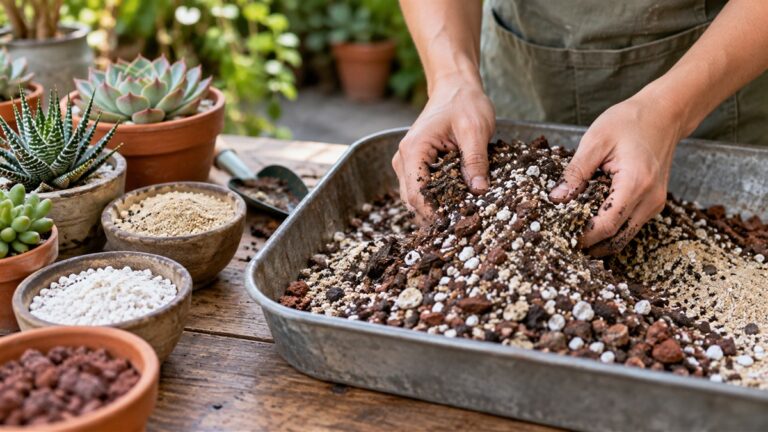
Ask Extension gives the short version: “The short answer is to add more organic material, particularly compost but there is more to the story.” It explains that “Best is to add organic matter, particularly compost.”
Ask Extension gives an amount: “Adding 3 to 4 inches at minimum is recommended.” It also says “You can’t really overdo the amount of compost added to clay soils.” Durham County’s page supports the yearly habit, saying “Established beds will need yearly additions of soil amendments because our warm temperatures allow soil organisms to break down organic matter quickly.” Clay gardens therefore need a repeating schedule, not a single large load. Ask Extension also offers a practical tip on sourcing: “If you have a local compost facility, check to see if you can have a bulk load delivered.”
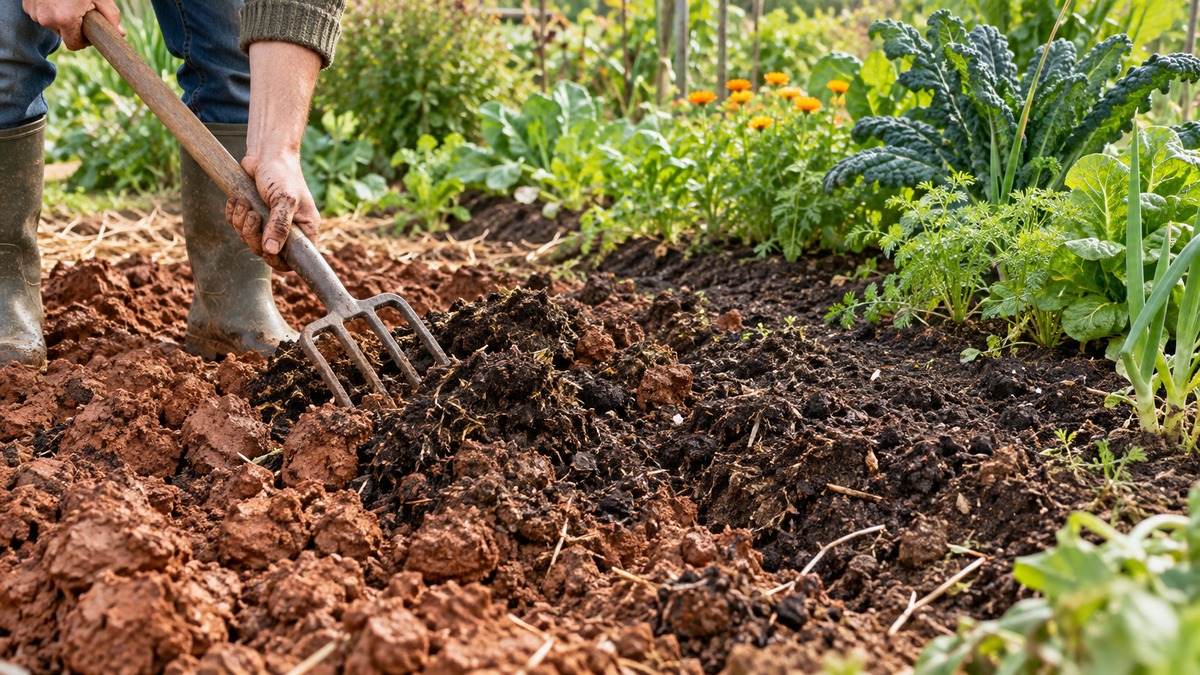
For a new bed or a neglected one, Ask Extension recommends a deeper first pass. It says “Best is to work organic matter deeply into the soil as roots will eventually end up there, and do so prior to planting.” It suggests digging “sections of a bed at a time to a foot deep,” adding compost and replacing the soil, one section after another. Once that deep work is done, the later years are lighter. In those years Ask Extension says to “just work the surface”, because organic matter “you’ve worked in deeply will decompose quickly”.
Cover crops are another route. Ask Extension says that “Another method to increase organic matter in clay soils is with cover crops.” The examples it gives are “small grains and grasses like buckwheat, ryegrass, and oats.” A cover crop grown through the off-season adds organic matter without buying bags of compost, though it does need space and time before the planting date.
If the bed is raised, the clay problem is different, and the guide to how much soil a raised bed garden needs covers the soil volume side. For a compost source, how to make a compost pile explains building one at home.
Work the soil when it is dry
Ask Extension is direct about timing: “Be sure and add when your clay soil is dry, as working in wet clay is not only quite messy but will compact it even further.” The compaction is the real cost. Digging a wet bed squeezes out the air spaces that the organic matter is meant to build, so a day of digging can undo a season of compost.
Texas A&M University agrees that moisture decides the timing. Its page says “Till soil when it is moist but not wet.” Durham County suggests a hole test for drainage. It says “Dig a hole in your yard about 12 inches deep, and fill it with water”, then “Let the water drain completely and fill the hole again.” The time the water takes to empty sorts the result: 3 to 4 hours is good, 5 to 12 hours is moderate, and 12 to 24 hours is poor. For moderate drainage the page says “Some plants will tolerate this situation, but many will drown.”
For poor drainage, Durham County says “Drainage can be improved by tilling or spading the soil 8-10 inches deep, and by adding organic soil amendments.” That is deeper work than the hole test itself. The hole test is worth repeating after a season of amendments, so you can see whether the bed is moving toward good drainage.
Where the sources disagree: sand, gypsum and peat
Sand is the first disagreement. Texas A&M University recommends it directly: “Add sand and organic matter to clay soil to make it more workable.” Its page suggests mixing 2 inches of clean sand and 3 inches of organic matter into the soil over the winter. Ask Extension is much more cautious. It says “Some recommend adding sand, but unless it is coarse sand, and you add about 3 parts to each part clay soil, the soil structure will likely just get worse.” Durham County goes further against sand, saying “Peat moss and sand are NOT recommended for improving clay soil”.
Gypsum is the second disagreement. Texas A&M says “Most heavy clay soils benefit from the addition of gypsum.” It says gypsum adds some nutrients and loosens clay, and it gives a rate per 100 square feet for the winter application. Ask Extension gives the opposing view. It says “Another recommendation is to add gypsum, similar to lime, but this may increase calcium and pH levels too high (clay soils tend to be alkaline).” The two pages cannot both be the whole story for every yard.
Peat moss is the third point. Durham County says peat moss is not recommended for clay. Ask Extension says “Peat moss is sometimes recommended as an addition, but this breaks down quickly in wet and clay soils”. Both pages point away from peat as the main amendment, so compost stays the safer default.
This guide does not settle these disagreements. Since the sources conflict on sand and gypsum, the most reliable check is a soil test of your own bed, along with the drainage hole test. If you choose to try either material, change one thing at a time and keep notes, so you can tell what the bed is doing.
Mulch the surface as well
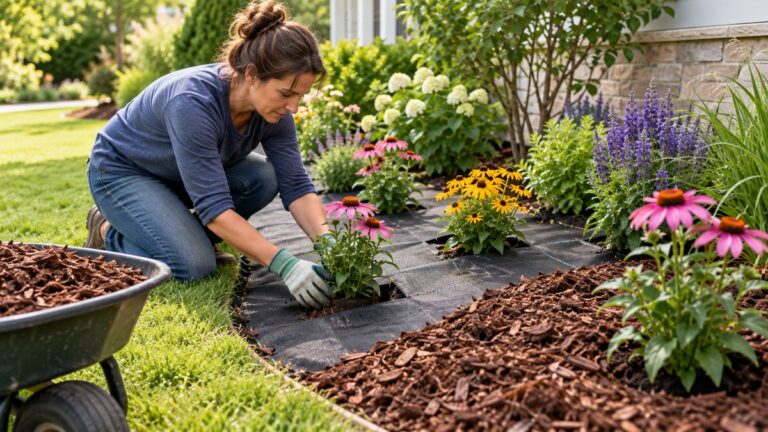
Surface mulch also helps clay. Durham County’s page says “A 3-4 inch thick layer of mulch on top of your garden will benefit the soil in many ways.” The same page adds that mulch keeps roots cool and conserves moisture in the soil.
Plant high and open the planting area
Ask Extension gives advice for planting directly into clay. It suggests breaking up the ground first: “If planting large plants, break up an area around where you’ll plant (out to as wide as the plants will eventually grow) with a long spade or fork.” It then says “Add organic matter on top of this area which, over time, will work into these cracks you made.” The method is slow, and it works best on ground that is dry enough to dig, as the earlier section explains.
Durham County’s page describes a related approach, planting high. It says “Poor drainage is responsible for many of our planting failures.” It adds that “Raised beds work on the principle of planting high,” which means a raised bed lifts the root zone above wet ground. That is why a raised bed can be one answer for a yard that stays wet, while the same page keeps adding organic soil amendments as the long-term fix.
Mistakes to avoid
- Adding one large load and stopping. Durham County says established beds need yearly additions.
- Digging wet clay. Ask Extension says working wet clay compacts it further.
- Assuming sand will fix clay. Ask Extension warns that unsuitable sand makes the structure worse.
- Reaching for peat moss. Durham County says peat moss and sand are not recommended for clay.
- Adding gypsum without checking calcium. Ask Extension warns it may raise calcium and pH too high.
How we chose
We chose three extension sources because each brings a different angle. Ask Extension gives a detailed answer on clay soil. Durham County Extension gives the North Carolina view on drainage and amendments. Texas A&M University gives the Texas view on sand, gypsum and moisture timing. We opened each page with curl and kept only pages that returned HTTP 200 and could be read as text. Pages that returned any other status are not counted. We did not use retail listings or general blogs for any step, and every quoted sentence was checked against the text of its page.
What we could not verify
The pages we opened do not give a number of years for clay to change, and they do not give one amount of compost that works in every yard. The gypsum and sand rates come from one Texas page, and the drainage thresholds come from one North Carolina page, so they may not match your region. Clay varies from yard to yard, and the sources do not describe any single clay type in detail.
What the sources do not say
No source we opened gives a number of years for clay soil to improve, though Ask Extension says that improvement comes over time and that you can work the soil a section at a time. The pages do not give one sand rule or one gypsum rule that applies everywhere, and they do not say how the hole test translates to a specific soil texture. The sources also do not discuss clay subsoil under a lawn in detail, so treat the general steps as a plan to adapt.
Frequently asked questions
How long does it take to improve clay soil?
The sources do not give a number of years. Ask Extension says “You can add organic matter over time, and you can deal with small areas or beds at a time.” That suggests steady progress rather than a finish line, with the drainage hole test showing whether the bed is moving in the right direction.
How much compost should go on the bed each year?
Ask Extension says “Adding 3 to 4 inches at minimum is recommended”, and that you cannot really overdo it. Durham County recommends repeating the work each year. Texas A&M gives a 4-inch limit for organic material in one layer, so keep each application within that limit.
Is sand a good addition to clay?
The sources disagree. Texas A&M recommends sand with organic matter. Ask Extension says sand only helps if it is coarse and used in large ratio, and that otherwise the structure will get worse. Durham County does not recommend sand. Use a soil test and the hole test to decide, and do not add sand on the strength of one page alone.
Is gypsum worth adding to clay soil?
The sources disagree. Texas A&M says most heavy clay soils benefit from gypsum. Ask Extension warns that gypsum may raise calcium and pH too high, since clay soils tend to be alkaline. A soil test that shows calcium and pH is the best way to decide.
Should clay be dug when it is wet?
No, not if you want to keep the structure. Ask Extension says working wet clay is messy and compacts it further, and Texas A&M says to till when the soil is moist but not wet. Wait for the bed to dry to a workable state, then dig.
Sources
- https://ask.extension.org/kb/faq.php?id=742541 (opened 2026-10-22)
- https://durham.ces.ncsu.edu/2020/04/making-the-most-of-your-gardens-soil/ (opened 2026-10-22)
- https://aggie-horticulture.tamu.edu/vegetable/wp-content/uploads/sites/10/2013/09/EHT-076.pdf (opened 2026-10-22)