How to Make a Potting Mix for Succulents
As an Amazon Associate we earn from qualifying purchases.
If you want to know how to make a potting mix for succulents, the four recipe sources we opened agree on one thing: the mix has to drain well. They do not agree on one recipe. Two extension sheets, an extension answer and a botanical garden library answer each give different proportions, so the practical job is to pick a starting recipe, mix it, and then check how fast water moves through the pot. This guide compares the recipes, explains each ingredient, and covers the watering habits that matter most.
Quick answer
- Start with one of the recipes in the table below. The sources do not agree on a single ratio.
- Pick ingredients that drain fast. Perlite, coarse sand and small gravel are the materials the sources name.
- Use a container with drainage holes, and water only after the soil has dried.
Why drainage matters more than the recipe
Cornell Cooperative Extension in Nassau County puts it plainly in its fact sheet on cacti and other succulents: “Over-watering is the principal reason for failure in growing these plants and a well-drained soil is essential.” The University of Illinois Extension sheet on succulent container gardens makes the same point from the watering side. “Overwatering is the easiest way to kill a succulent or cacti plant, so prior to watering, check the soil with your finger to judge the amount of moisture still left.”
The eXtension answer, written by a Master Gardener Diagnostician in Oregon, frames the goal as a balance: “The key to growing succulents in pots is to use a media that retains sufficient moisture while draining well.” The botanical garden library at the New York Botanical Garden leans toward the drainage end. Its answer says a proper cactus soil should drain in less than a minute after watering, and it warns that many commercial mixes rely too heavily on peat, which holds moisture in the soil longer than is desirable. The same answer explains the stakes: “In the constricted space of a pot, compacted roots and poor drainage will quickly lead to root rot.”
Three recipes the sources give
The table lists each recipe in the form the source gives it. Treat the rows as starting points, not one correct answer.
| Source | Recipe as the source states it | Notes in the source |
|---|---|---|
| Cornell Cooperative Extension, Nassau County | 1 part garden soil, 1 part coarse builders sand, 1 part peat moss | Written for cactus; the sheet recommends a clay pot with drainage holes |
| University of Illinois Extension | One part peat moss or basic potting mix, or one part perlite or coarse sand | Given as alternatives; no full ratio stated |
| eXtension (Ask Extension answer) | 2 parts potting soil, 1 part perlite, 1 part small gravel; or a 1:1 mix of potting soil and perlite | Gravel examples: pumice, turface or crushed granite |
| New York Botanical Garden library | 3 parts grit or sand, 1 part potting soil, 1 part coir, peat or shredded bark | Described as suitable for most cacti |
The recipes differ more than they agree. Cornell is the only source that includes garden soil, and it uses equal parts of three ingredients. Most of the New York Botanical Garden blend is grit or sand: three parts out of five. The eXtension blend puts two parts of potting soil against one part perlite and one part gravel. The sources do not say why the ratios differ.
What each ingredient does
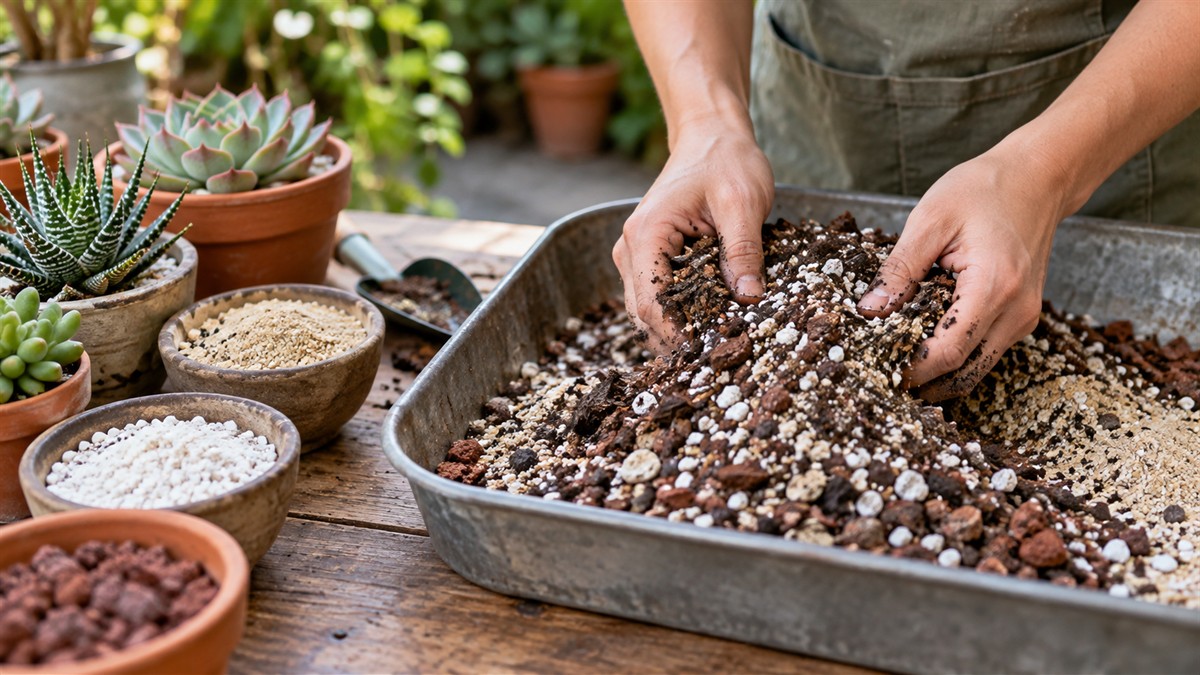
Sand and grit do most of the drainage work in these recipes. Illinois notes that cacti and succulent plants “prefer soils which are well-drained” and that “so a sandy soil mix is usually recommended.” The eXtension answer adds a detail on the kind of sand: “If sand is added to a mix, it should be coarse grained such as builders sand.” Cornell’s recipe also calls for coarse builders sand.
Peat, coir and bark form the organic part of the mix. The New York Botanical Garden answer gives that part a job: structure. The eXtension answer takes the opposite view and says “Addition of organic material is not necessary since in their native habitats most succulents live in weathered soils which are very low in humus.” The sources split on whether organic material is needed at all.
Gravel is the third option. The eXtension answer suggests “small size gravel,” with examples “e.g., pumice, turface, or crushed granite”, and warns “Do not use quarter-minus gravel!” Garden soil is the ingredient the sources disagree about most. Cornell includes it in the cactus blend, but eXtension advises against it for indoor succulents: “avoid using garden soil if the succulent is an indoor plant because of the potential for disease.”
Mixing the soil step by step
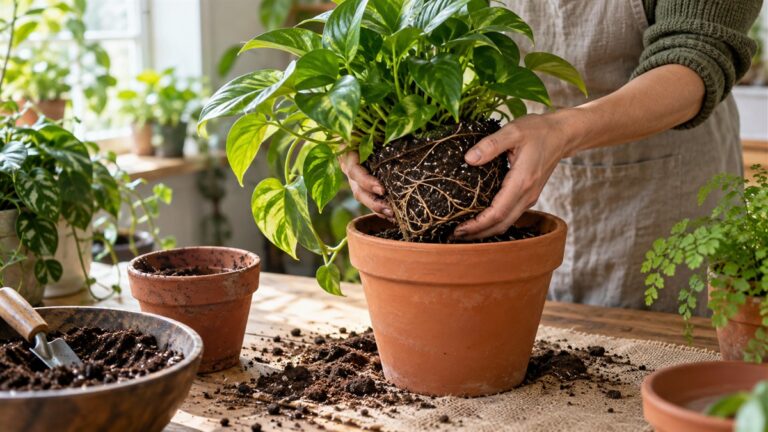
The Illinois Extension container steps are the clearest guide for a first pot. Buy a pre-mixed cactus and succulent soil, or blend your own from one of the recipes above. Fill the container with soil up to a few inches from the top edge. Remove the plants from their pots and arrange them, mixing shapes, colors and heights. Add soil until the root balls are covered, “making sure to leave about 1 inch of space below the top edge of the container to allow for easy watering.” Finish with moss, rocks or decorative pieces if you like.
If you are starting cuttings, Cornell says “Builders sand and perlite can be used as a starting medium.” The same sheet adds that cuttings should dry for several days before they go into soil. Those two steps are separate from a planted pot, so do not mix them up.
Premixed bag or your own blend
A premixed bag saves the measuring. Illinois says you can buy a pre-mixed bag from a garden center or mix your own. Montana State Extension says “Premixed potting soil is available and made from different media for different plants.” It adds that “Cacti, orchids, and succulents have special soil requirements.” Its other point favors blending your own: “You can make your own soil mix to save money if repotting many plants or to tailor soil to the plant.” The eXtension answer keeps it simple: “Obtain a commercially prepared potting mix for cacti and succulents.” The choice depends on how many pots you are filling and how closely you want to control the recipe.
Watering a homemade mix
The two sheets that give a watering rule are not identical. Illinois says to “Wait until the soil completely dries out before watering again.” Cornell gives a shallower test: “Wait until the top 1/2 inch of soil is dry before watering again.” Both say to water thoroughly once you do. Illinois adds that when you water, you should “soak the container thoroughly, allowing excess water to drain away.”
Neither sheet gives a calendar. Cornell says the amount of water depends on the time of year, the size of the plants, the type of potting mixture and the size of the pot. Illinois says plants “can’t be watered on a set schedule” and points to the soil instead. The New York Botanical Garden answer explains the stakes: “Like other succulents, cacti need soil to dry out between waterings or their delicate roots will rot.”
Pot choice and drainage holes
Cornell recommends a pot that is “preferably clay, with drainage holes”. Illinois lists “A container with drainage holes” among the supplies and says the container “should provide adequate drainage so that the roots are not standing in water.” Holes are the starting point. The roots must not sit in water after a watering. For a larger planter, see our guide to DIY planter boxes for deck railings.
Light, feeding and the mix
Light and feeding are not part of the recipe, but they shape how a mix performs. Cornell says a south or western exposure is preferred for cacti and succulents. Illinois says a southern or western facing window gives the most ideal bright light for succulents indoors, and that supplemental lighting can work when the ideal spot is not available.
Feeding follows the growing season. Illinois says to feed monthly with a standard houseplant fertilizer, and only during the active growing season, which it puts “usually between March and October.” Cornell advises a monthly feeding of 15-30-15 during the active season, and it notes that a high-nitrogen fertilizer would encourage soft, flabby growth. Its firm rule is “Never feed during the winter dormancy.”
Common mistakes to avoid
- Garden soil in an indoor pot. The eXtension answer advises against it, and the Cornell blend is the only recipe in this set that includes it.
- The wrong gravel. eXtension warns against quarter-minus gravel and does not explain why.
- Skipping drainage holes. Both Cornell and Illinois make drainage holes part of the pot requirement.
When to repot a succulent
Cornell advises checking once every two years. “Every two years, in the early spring, before new growth begins, slip the plant out of the pot to see if it is potbound.” If it is, the sheet says to “repot using fresh soil” and to increase “the pot size by 1 inch only.” The sheet is about cacti and other succulents, so the same check applies to a homemade mix.
How we chose
We opened each page with curl on 2026-10-22 and read the text that came back. Each source had to be a university or cooperative extension sheet or answer, or a botanical garden library answer. The Montana State page is a houseplant repotting question, so we used it only for the premixed-soil points. We kept only pages that returned HTTP 200 and held the recipe text itself. A Central Texas gardening resource returned HTTP 200, but the HTML we fetched held no recipe, so we left it out. The Cornell sheet’s last review is dated January 2003, and the eXtension answer was asked in 2018. Every quoted sentence was checked word for word against the fetched text.
What we could not verify
The sources cover the recipe well, but several practical questions remain open.
What the sources do not say
- No source gives one ratio that suits every succulent or every pot.
- None of the four gives a total batch size, so the sources do not say how much mix a given pot needs.
- The sources do not explain why the recipes differ or why quarter-minus gravel should be avoided.
- Only the Cornell sheet gives a pH range, 6.0 to 6.9, and it describes succulents in general rather than any one blend.
- The New York Botanical Garden time figure of less than a minute applies to cactus soil. No source gives a drainage test for a blend you make yourself.
Frequently asked questions
Can garden soil go into a succulent mix?
The sources disagree. Cornell’s cactus blend includes one part garden soil. The eXtension answer advises against it for indoor succulents because of the potential for disease, and it suggests buying a commercially prepared cactus and succulent mix as the easiest route.
Is perlite or coarse sand better for drainage?
The sources do not rank them. Illinois lists one part perlite or one part coarse sand as alternatives, and eXtension uses perlite in its 1:1 blend. If you use sand, the sources ask for coarse grain. The eXtension and Cornell examples both name coarse builders sand.
How often should succulents in this mix be watered?
There is no fixed schedule in these sources. Illinois says to wait until the soil completely dries out, and Cornell says to wait until the top half inch is dry. Soak the pot when you water, let the extra drain away, and check again before the next watering.
Does a succulent mix need peat moss?
The sources split on this. Cornell includes one part peat moss, and Illinois lists peat moss as one option. The eXtension answer says organic material is not necessary. The New York Botanical Garden warns that peat can hold moisture longer than desirable, so a blend with peat and one without both have support.
Which pot works best with a homemade mix?
Cornell recommends a pot, preferably clay, with drainage holes. Illinois says the container should provide adequate drainage so the roots are not standing in water. When you move a plant up, Cornell suggests increasing the pot size by 1 inch only. If you are filling a bigger space, see our raised bed soil amounts guide.
Sources
- https://ccenassau.org/resources/cacti-and-other-succulents (opened 2026-10-22, HTTP 200)
- https://extension.illinois.edu/sites/default/files/succulent_container_gardens_.pdf (opened 2026-10-22, HTTP 200)
- https://ask.extension.org/kb/faq.php?id=538684 (opened 2026-10-22, HTTP 200)
- https://libanswers.nybg.org/faq/222654 (opened 2026-10-22, HTTP 200)
- https://www.montana.edu/extension/lila_extn/askstewardrepothouseplant.html (opened 2026-10-22, HTTP 200)