How to Grow Vegetables in Containers
As an Amazon Associate we earn from qualifying purchases.
If you want to know how to grow vegetables in containers, the answer comes down to four jobs: pick a pot big enough for the crop, make sure water can leave it, fill it with a growing mix that drains well, and then water and feed by checking the plants and the mix rather than following a habit. Three university extension publications cover these jobs in detail. They agree on most basics, and where they differ, this guide says so.
Quick answer
- Use a container big enough for the crop. The Texas A&M table lists 5-gallon containers for tomatoes, peppers and eggplant.
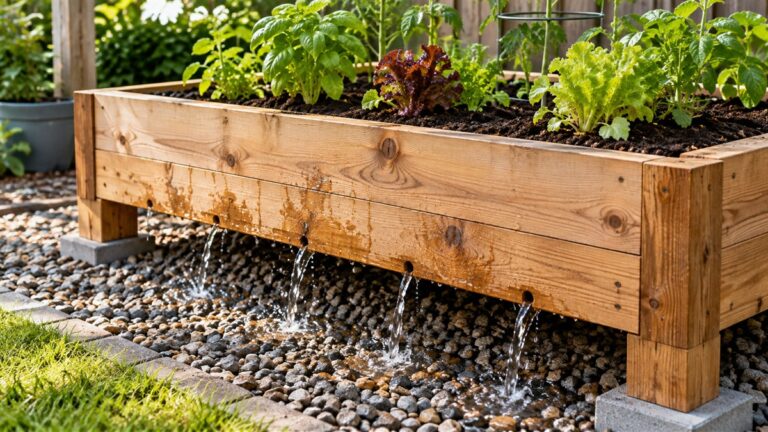
- Make sure every container drains. Virginia Tech says there must be holes in the bottom so plant roots do not stand in water.
- Use a mix that drains well. UNL suggests a homemade mix of equal parts peat moss, potting soil and perlite.
- Check the mix before you water. UNL says to check moisture with a finger or a screwdriver a few inches down.
Pick a container that fits the crop
Almost any container can work. Texas A&M says: “Almost any type of container can be used for growing vegetable plants.” Virginia Tech sets the requirements: the container must be big enough to support the plant when it is fully grown, hold soil without spilling, have adequate drainage, and never have held products that would be toxic to plants or people.
Size matters more than shape. Texas A&M states: “For most vegetable crops such as tomatoes, peppers, and eggplant, you will find that 5 gallon containers are the most suitable size, while 1 to 2 gallon containers are best for chard and dwarf tomatoes.” The same publication adds: “Smaller container sizes are appropriate for herbs, lettuce, and radish crops.” Virginia Tech also says: “Most plants need containers at least 6 to 8 inches deep for adequate root growth.”
Container sizes for common crops
The Texas A&M table gives one container size and one plant count for each crop. It does not explain how those numbers were chosen, so use them as starting points.
| Crop | Container size (Texas A&M table) | Plants per container |
|---|---|---|
| Tomato | 5 gallons | 1 |
| Pepper | 5 gallons | 1 to 2 |
| Eggplant | 5 gallons | 1 |
| Leaf lettuce | 1 gallon | 2 |
| Spinach | 1 gallon | 2 |
| Radish | 1 gallon | 3 |
| Parsley | 1 gallon | 3 |
Vining crops need more room than the table suggests. Texas A&M says: “Pole beans and cucumbers also do well in this type of garden, but they do require considerably more space because of their vining growth habit.” Its table lists one gallon for a single cucumber plant, so the table and the text do not match. For a crop that handles tight spaces, see the easiest vegetables to grow in raised beds.
Drainage comes first
Drainage is the point the three publications repeat most. UNL says: “All containers require drainage holes punched or drilled in the sides near the bottom of the container.” Virginia Tech places the holes in the bottom: “Whatever type of container you use, be sure that there are holes in the bottom for drainage so plant roots do not stand in water.” The sources differ on hole placement, but they agree on the goal. Texas A&M states the general rule: “Regardless of the type or size of container used it must drain adequately for successful yields.”
Pot material changes how water leaves. UNL says: “Containers are either porous or nonporous, which affects drainage in container gardens,” and that “Moisture can escape through the sides and bottom of clay containers.” Texas A&M lists the nonporous group: “Glazed, plastic, metal, and glass containers are nonporous.” Poor drainage is the failure to avoid. Texas A&M says: “However, poor drainage will slowly kill the plants.”
Choose the growing mix
A container needs a medium that holds water, feeds the roots and still lets air reach them. Texas A&M says: “Any growing media must provide water, nutrients, and a physical support in order to grow healthy plants. A good growing media must also drain well.” UNL notes that packaged mixes can be expensive for large plantings: “Prepackaged and soil-less growing media can become expensive if large container gardens are desired.” UNL suggests “equal parts of peat moss, potting soil, and perlite” for a homemade mix. Virginia Tech’s recipe is different: “one part peat moss; one part garden loam; one part clean, coarse (builder’s) sand or perlite; and a slow-release fertilizer (14-14-14) according to container size.” The two recipes disagree on garden loam, and the sources do not say whether loam helps or hurts.
Virginia Tech adds two checks for a homemade mix. “Lime may also be needed to bring the pH to around 6.5,” and “a soil test is helpful in determining nutrient and pH needs, just as in a large garden.” To work out how much mix a pot needs, see how much soil a raised bed needs.
Feed on a plan
Feeding is where container gardens need the most care. UNL explains: “Unlike traditional in-ground gardens, container gardens do not have enough media volume to buffer larger amounts of fertilizer.” It also warns: “Over-application can burn plant roots and kill plants.”
Slow-release and water-soluble fertilizer
A slow-release product goes into the mix at planting: “Balanced slow-release formulations with equal parts of nitrogen, phosphorus, and potassium, such as 10-10-10 or 14-14-14, can be incorporated into the growing media.” A water-soluble product acts faster: “Water-soluble fertilizers release nutrients immediately to the plants, compared with slow-release formulations.” UNL adds that slower-release fertilizer “easily leaches out of most types of packaged or soil-less growing media.”
Timing depends on the product. Virginia Tech says: “If you use a soil mix with fertilizer added, then your plants will have enough nutrients for eight to ten weeks.” After that, “add a water-soluble fertilizer at the recommended rate. Repeat every two to three weeks.” UNL gives a similar window: “a supplemental application of water-soluble fertilizer should be added about eight weeks after starting the container garden.” UNL also says: “Always follow the label directions when applying fertilizers.”
Check the moisture before you water
Containers dry out differently from garden beds. UNL says: “Containers are exposed to greater soil temperature fluctuations and moisture level extremes than traditional in-ground gardens.” It adds: “Wind and light exposure will increase the need for watering.” Small and metal pots need extra attention: “Small containers and metal containers will warm up, cool down, and dry out more quickly than containers made of other materials.”
UNL’s check is simple: “Check moisture levels in containers by sticking a finger or a screwdriver a few inches into the growing media.” It explains the reading: “If the growing media sticks to the “sensor,” the moisture is adequate.” Texas A&M gives a rule of thumb instead: “one watering per day is usually adequate.” The two approaches are not the same schedule. Use the check first, and treat one watering a day as a starting point you adjust for the weather. UNL also tells growers to “Know the water and light needs of each vegetable to be planted in containers.”
Water-holding gels can be a trap. UNL warns that such media “may need to be watered once, or even twice, a day,” and that “Feeder roots, seeking water in the gels, can be easily damaged.”
Mulch and surface care
Mulch can reduce moisture loss. UNL says: “Mulch can be placed on the surface of the container to reduce moisture loss.” Keep the layer thin: “Do not apply more than 1 inch of mulch on the top of the growing media and around the plant.” Keep it “away from the stem” too.
Give the crop enough sun
Most vegetables want full sun. UNL says: “A number of vegetable crops need a minimum of six hours of direct sun to thrive and be productive.” Virginia Tech adds: “Generally, root crops and leaf crops can tolerate partial shade, but vegetables grown for their fruits generally need at least six hours of full, direct sunlight each day and perform better with eight to ten hours.”
Leafy crops handle more shade. Texas A&M says: “Nearly all vegetable plants will grow better in full sunlight than in shade. However, leafy crops such as lettuce, cabbage, greens, spinach, and parsley can tolerate more shade than root crops such as radishes, beets, turnips, and onions.” Put fruiting crops in the sunniest spot and leafy crops where light is softer.
Plant, thin and support
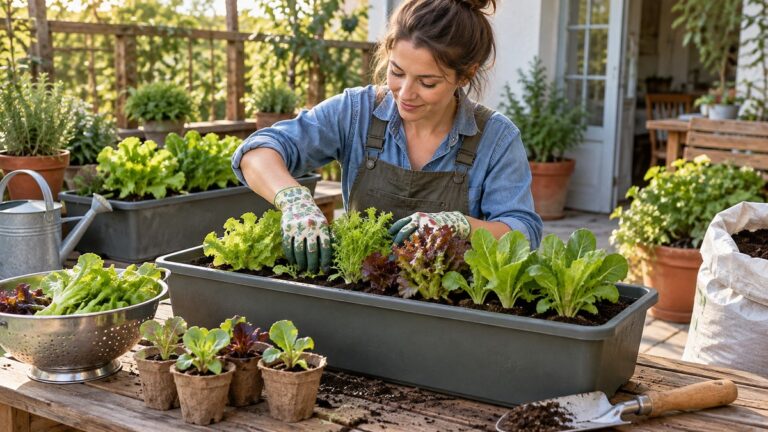
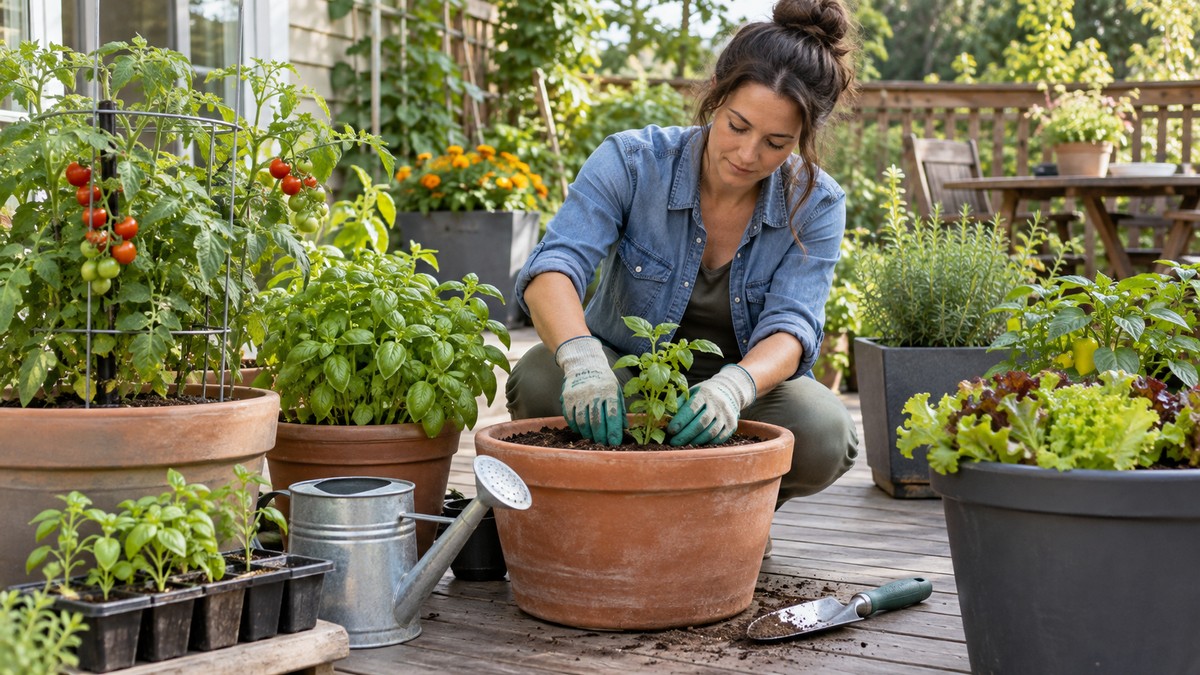
Virginia Tech gives a simple order. Fill the container first: “Fill a clean container to within 1 to 2 inches of the top (depending on the size of the container) with the slightly damp soil mixture.” Then plant on the usual schedule: “Plant container crops at the same time you would if you were planting a regular garden.” Thin later: “Thin seedlings to obtain proper spacing when they have two or three true leaves.”
Put supports in early. Virginia Tech says: “If cages, stakes, or other supports are needed, provide them when the plants are very small to avoid root damage later.”
Common mistakes to avoid
- Skipping drainage. Texas A&M warns that poor drainage “will slowly kill the plants,” and Virginia Tech requires holes so roots do not stand in water.
- Choosing a pot that is too small. Virginia Tech says the container must be big enough when the plant is fully grown, and the Texas A&M table lists 5 gallons for tomatoes, peppers and eggplant.
- Feeding too heavily. UNL says over-application “can burn plant roots and kill plants.”
- Watering by habit. UNL asks growers to check the mix before watering.
- Piling mulch against the stem. UNL says to keep mulch away from the stem and no more than 1 inch deep.
- Crowding vining crops. Texas A&M says cucumbers and pole beans need “considerably more space.”
Timing and season
None of the three publications gives a planting date for any region. Virginia Tech points growers to their usual garden schedule. For winter growing, it says: “As mentioned before, a sunny, south-facing window is a must for indoor vegetable growing.”
How we chose
We chose three university extension publications that together cover container choice, growing mix, feeding, watering, light and planting. We opened each one on 2026-10-21 and read the relevant sections in full. A claim went into this guide only when a publication stated it in its own words, and every quotation was checked against the text we read. Where the publications differ, this guide says so. The three are University of Nebraska-Lincoln NebGuide G2263, Texas A&M publication HORT-PU-090 (marked 05/14), and Virginia Tech publication 426-336. We left out pest, disease and pesticide advice, since this guide does not give plant-disease treatment advice.
What we could not verify
What the sources do not say
The three publications do not give a planting calendar, a frost date or a schedule for any region. They do not give one watering frequency for every container. The sources we opened do not say which watering approach fits a particular climate or pot material.
The UNL copy we read has a fertilizer amount with a fraction that did not come through, so this guide does not quote it. Read the product label for the dose. The publications also give container sizes only for the crops in their own tables. The sources we opened do not cover any product, brand or container model.
Frequently asked questions
How big should a container be for tomatoes?
Texas A&M lists 5 gallons as the most suitable size for tomatoes, peppers and eggplant, with one plant per container for tomatoes. Virginia Tech says the container must be big enough to support the plant when it is fully grown.
Can I use garden soil in a container?
The sources point to a mix rather than straight garden soil. Virginia Tech’s homemade recipe includes garden loam, so its guidance does not rule loam out. UNL’s homemade recipe leaves loam out. The publications do not say how much loam a container can hold before drainage suffers.
How often should I water container vegetables?
UNL says to check the mix a few inches down and adjust for weather and rain. Texas A&M says one watering a day is usually adequate. Check the mix before following either rule, and remember that Texas A&M also says poor drainage will slowly kill the plants.
Do container vegetables need full sun?
Most do. UNL says a number of vegetable crops need a minimum of six hours of direct sun. Virginia Tech says fruiting crops generally need at least six hours of full, direct sunlight and perform better with eight to ten hours. Texas A&M says leafy crops such as lettuce and spinach can tolerate more shade.
Can I grow vegetables in containers indoors?
Virginia Tech says a sunny, south-facing window is a must for indoor vegetable growing. It adds that fruiting crops need supplemental light during the winter months, and that “Insufficient light will result in tall, spindly plants and failure to flower and set fruit.” For a smaller setup that gets less sun, see using raised bed soil in pots.
Sources
- https://extensionpubs.unl.edu/publication/g2263/na/pdf/view (opened 2026-10-21)
- https://cdn-de.agrilife.org/extension/departments/hort/hort-pu-090/publications/files/Vegetable-gardening-in-containers.pdf (opened 2026-10-21)
- https://www.pubs.ext.vt.edu/content/dam/pubs_ext_vt_edu/426/426-336/SPES-796.pdf (opened 2026-10-21)