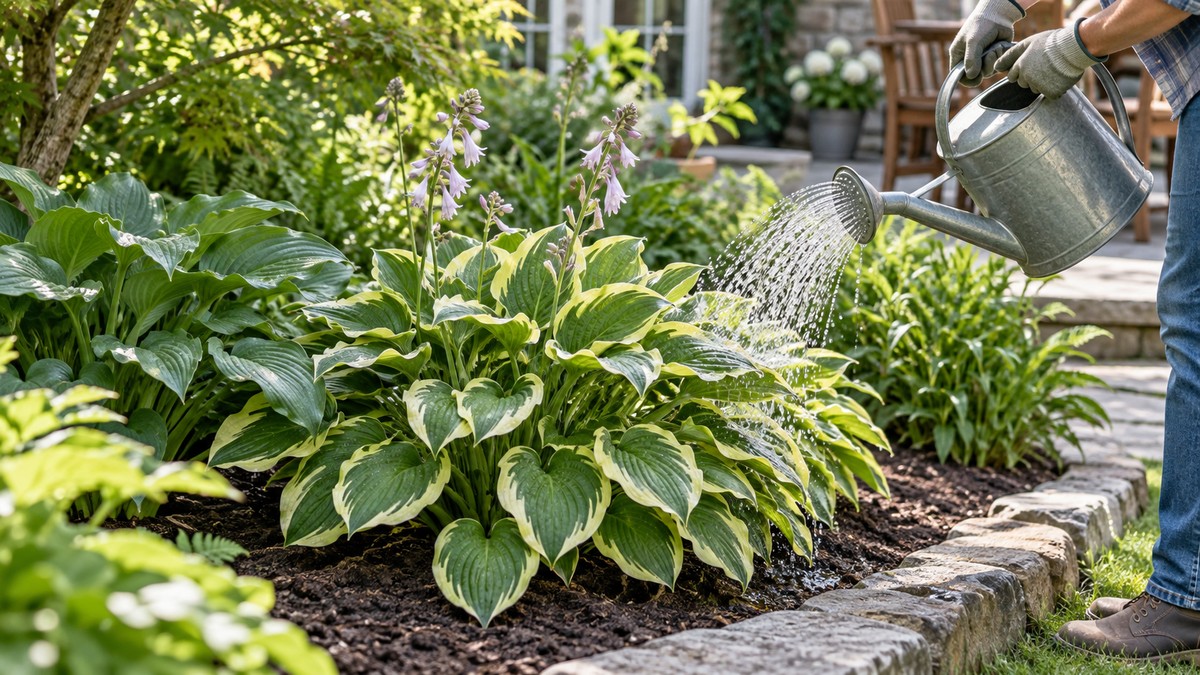
How to Care for Hostas
As an Amazon Associate we earn from qualifying purchases.
How to care for hostas is mostly a matter of getting the light right, keeping the soil steady, dividing clumps when they crowd, and protecting crowns and pots from winter and from pests. The extension answers we opened agree on those basics. Hostas prefer shade to sun, do best in moist but well-drained soil, and can be grown in the ground or in pots. This guide follows the plant through the year and marks where the sources stop.
Quick answer
- Give hostas shade or dappled light. Several hours of morning sun suit some varieties, but too much sun can scorch the leaves.
- Keep the soil moist but well-drained, and give potted hostas a good morning soaking in summer.
- Divide clumps in spring when they crowd, keeping at least two or three buds and plenty of roots on each piece.
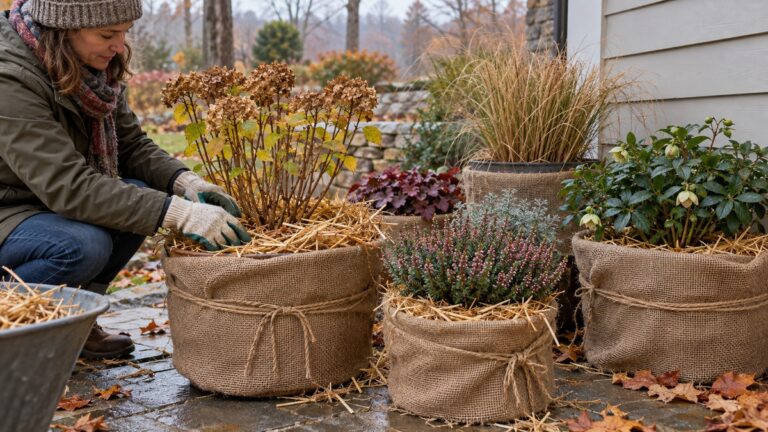
- Overwinter potted hostas by sinking the pots into the ground and covering them with leaves or loose mulch.
Choose the light and soil
Light sets the limits. An Ask Extension answer from Maryland says that “Hosta prefer a location with some amount of shade in the summer, either from a building shadow or tree canopy.” The same answer says that “They will tolerate several hours of direct sun,” but they do best with shade or dappled light during the hottest part of the day. A Minnesota answer puts the point more briefly: “Hostas prefer shade to lots of sun.”
Sun tolerance depends on the variety. The Minnesota answer notes that “Depending on the variety, they may like a few hours of morning sun, but too much sun can scorch the leaves or leaf tips.” The UC Master Gardeners in El Dorado County are firmer: “Remember, hostas can’t tolerate full sun, so place them in a shady spot.” Read the two together. Morning sun suits some varieties, and full sun does not suit any of them.
Soil should be moist but drain well. The Maryland answer puts it in those words: “Soil should be moist but well-drained.” It adds that established hostas are fairly drought tolerant, to a point, so the roots do not need to stay constantly damp. That is useful for a bed that dries out between rains, and it is a reason not to over-water a plant that is already settled.
Plant in the ground or in a pot
Get plants into the soil promptly. The Maryland answer advises that if the supplier sent no instructions, the plant should go in “as soon as possible so the roots don’t dry out and so they can resume growth.” Ground planting gives the best winter hardiness, according to the same answer, which says hostas “will have the best winter-hardiness in the ground compared to in a container, but sometimes they do admirably well in a pot if the container is large enough.”
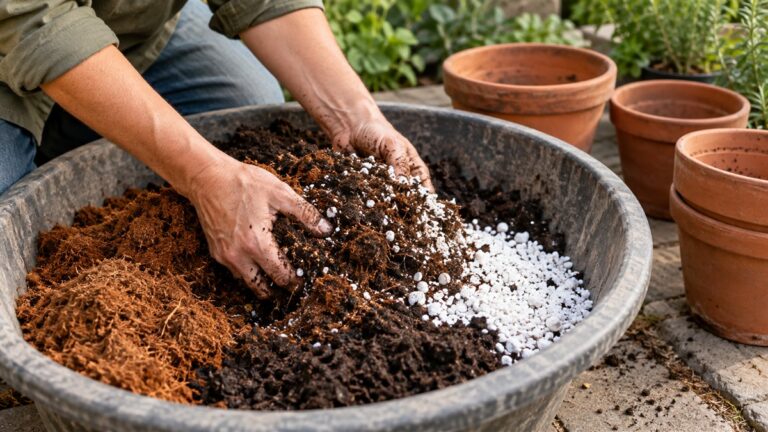
Pots are a workable choice, and the UC Master Gardeners give a three-step method. First, buy a small hosta and “select a somewhat larger pot.” Second, combine a slow-release fertilizer with a light, organic potting mix, and follow the package rate for the container size. Third, set the plant so that “the crown is 1-2 inches below the soil line, and 2 inches beneath the pot rim.” Water it in and move on to the next step.
Drainage and pot material matter more in a container. The UC page says to “Make sure the pot has adequate drainage,” and it warns to “Avoid metal and small pots that retain heat and dry out too quickly.” Plastic pots are fine, according to the same page. The Minnesota answer adds that hostas will grow in containers “as long as adequate water is provided and the pot has good drainage.”
Water and feed
Potted hostas need steady water. The UC page recommends that you “Give your pots a good morning soaking in summer.” Feeding is built into planting. The UC method mixes a slow-release fertilizer into the potting soil and uses the package rate for the container. The page does not give a schedule for feeding after that, so the sources cannot tell you how often to feed a pot later in the season.
Divide clumps that crowd
Division renews a hosta and makes new plants. The UC page calls it easy: “Propagation by division is easy and will supply you with new plants to keep or share.” The Oregon answer says that hostas “can be divided any time of year,” and it names spring as the better time because less foliage gets in the way and is less likely to be damaged.
Keep the pieces healthy. The Oregon answer says to “Make sure each division has at least two or three buds and plenty of roots and plant it with the buds just below soil level.” The UC page adds that you should “Make sure each new plant has a viable root system.” Do not skip the root check, because a piece without roots will struggle to establish.
Timing is partly up to the gardener. The Oregon answer says that “The signal to divide is basically up to the gardener, unless the clump is declining and/or losing vigor.” A clump that is declining or losing vigor is the clearest cue. Crowding alone is a reason to consider dividing, but the answer makes clear that a healthy clump does not have to be divided on a schedule.
Plan the replanting before you dig. The Oregon answer says that “They won’t survive if stored.” Its fallback is “If nothing else, put them in pots temporarily.” The answer also says divisions need to be replanted within a day or two, so keep the pieces moist and in the shade until they go in.
Slugs, snails, deer and rabbits
Pests are the main hazard once a plant is established. The UC page is direct: “As far as pests go, slugs, snails, deer and rabbits like hostas almost as much as people do.” The Maryland answer names deer and rabbits specifically: “Deer love to eat Hosta, and rabbits might nibble on them as well.” It says that where deer visit, the plants need protection, such as netting or a chemical repellent, and it notes that a repellent is not foolproof.
The fetched sources do not give a method for controlling slugs or snails. The UC page names them as pests and nothing more. Read that gap as a question for your local extension office, not as a sign that slugs are harmless to hostas.
Winter care for hostas
In the ground, the plants take care of most of their own winter. The Maryland answer says that hostas “will shed their leaves in autumn and regrow them every spring.” The UC page gives the cold limit: “Hostas are hardy in zones 3-9.” Hardy perennials do not need to be dug up. Illinois Extension puts the mechanism plainly: “Hardy perennials have roots that sleep until the following spring, when they grow again.”
Pots are the harder case. Iowa State University Extension says that “Container-grown plants should not be left outdoors above ground over the winter months.” The same page explains that the potting mix in an above-ground pot can get very cold because the soil volume is small, so a pot on the surface is exposed in a way that a planted hosta is not.
The Chippewa County answer gives the most direct method. It says the safest thing is to “sink the potted plants into the ground, right up to the lip of the pot, give them some water, and let leaves cover them.” It explains the reason: “Burying the pot minimizes freezing and thawing that can kill perennials.” Iowa State describes the same approach as one of the most reliable ways to overwinter containers, and says to “dig holes in a garden area and set the pots in the ground.”
Illinois Extension reports a version of this from one Master Gardener who wintered close to 1,000 pots. The pots were tipped on their sides so water would not collect in them, and then covered with “about a foot of heavily shredded leaves.” Most of the pots survived, according to the account. That is one gardener’s report rather than a trial, but it matches the burial advice from the other pages.
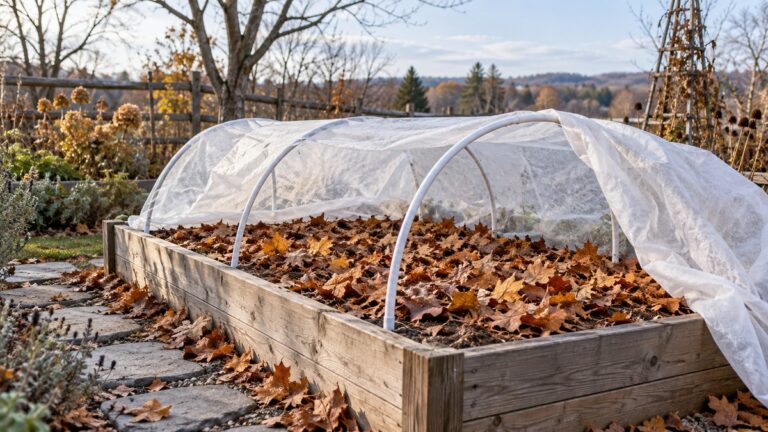
Iowa State adds two finishing steps. Once the plants have gone dormant, it says to “place 6 to 12 inches of straw, pine needles, or other loose mulch over the buried containerized plants.” In spring, “Pull containers out of the soil in spring when the extreme temperatures of winter have passed and the soil thaws.” The page also warns that drainage changes when containers are buried, so keep an eye on the moisture level. For the bed-side steps that come before winter, see our guide to preparing raised beds for winter.
Pick a size for the space
Size varies a lot between varieties. The Maryland answer says “How large the Hosta will mature greatly depends on what variety it is.” It advises checking the expected mature height and width before planting, so that a large variety does not crowd neighboring plants or hide the ones you want to see. The UC page makes the same point with some color: hostas “range in size from giant elephant ears to tiny mouse ears.” For a planting plan that keeps tall and low plants in the right places, see our guide to companion planting and layout for raised beds.
Mistakes to avoid
- Planting in full sun. The UC page says hostas can’t tolerate full sun, and the Minnesota answer warns of scorched leaves.
- Using a pot with poor drainage. The UC page says to make sure the pot has adequate drainage.
- Storing divisions. The Oregon answer says divisions won’t survive if stored.
- Leaving a potted hosta above ground all winter. Iowa State says containers should not be left outdoors above ground over the winter months.
- Ignoring deer and rabbits. The Maryland answer says deer love hostas and rabbits might nibble on them.
How we chose
This guide rests on seven pages, each opened with curl on 2026-10-22: one UC Master Gardener article, four Ask Extension expert answers, one University of Illinois Extension blog, and one Iowa State University Extension page on overwintering plants. We chose them because each covers hostas or overwintering containers and gives details we could quote. Two hosta pages from Minnesota and Georgia returned HTTP 403, and a Kansas State file returned 404, so none of those was counted. Retail and plant-seller pages were not used.
What we could not verify
The seven pages describe hosta care well, but several practical questions stay open. The list below names them.
What the sources do not say
- How to control slugs and snails. The UC page names them as pests, and no other fetched page gives a control method.
- How far apart to space hostas in a bed. None of the pages gives a spacing.
- A fertilizer schedule after planting. The UC page gives a package rate for the potting mix only.
- How many years a clump takes to become crowded. The Oregon answer ties the decision to the clump’s health, not to a calendar.
- Which varieties tolerate the most sun. The UC page names several cultivars but does not compare their sun tolerance.
Frequently asked questions
Can hostas grow in pots all year?
They can grow in pots, provided water is adequate and the pot drains well, according to the Minnesota answer. Winter is the harder part. Iowa State advises against leaving containers above ground, and the Chippewa County answer recommends sinking the pot into the ground instead.
Do hostas need full shade?
No. The sources describe a balance rather than deep shade. Some varieties tolerate a few hours of direct sun, but the hottest part of the day calls for shade or dappled light. The UC page rules out full sun.
When is the best time to divide hostas?
Division can happen at any time of year, according to the Oregon answer. Spring is the better season because less foliage gets in the way. The clearest sign to divide is a clump that is declining or losing vigor.
What eats hostas in the garden?
The UC page lists slugs, snails, deer and rabbits. The Maryland answer adds that deer love hostas and suggests netting or a repellent where deer visit. None of the pages gives a slug control method.
Should a potted hosta go into an unheated garage for winter?
The Chippewa County answer does not discuss an unheated garage. It recommends sinking the pot into the ground instead. Iowa State says containers should not be left above ground through winter, so the sources point toward burial rather than storage above ground.
Sources
- UCCE Master Gardeners of El Dorado County, “Hostas: Made for Shade! Growing Hostas in Pots in the Sierra Foothills”: https://ucanr.edu/sites/default/files/2020-07/330782.pdf (opened 2026-10-22)
- Ask Extension, expert answer, Lane County, Oregon, “dividing and moving Hostas”: https://ask.extension.org/kb/faq.php?id=626724 (opened 2026-10-22)
- Ask Extension, expert answer, University of Maryland Extension Home and Garden Information Center, “Planting Hosta”: https://ask.extension.org/kb/faq.php?id=864910 (opened 2026-10-22)
- Ask Extension, expert answer, Anoka County, Minnesota, “Potting Hostas”: https://ask.extension.org/kb/faq.php?id=873329 (opened 2026-10-22)
- Ask Extension, expert answer, Chippewa County, Minnesota, “Wintering potted hostas in Zone 4”: https://ask.extension.org/kb/faq.php?id=888486 (opened 2026-10-22)
- University of Illinois Extension, ILRiverHort blog, “Successfully Overwintering Hostas in Pots”: https://extension.illinois.edu/blogs/ilriverhort/2024-09-26-successfully-overwintering-hostas-pots (opened 2026-10-22)
- Iowa State University Extension and Outreach, Yard and Garden, “Overwintering Unplanted Trees, Shrubs and Perennials”: https://yardandgarden.extension.iastate.edu/how-to/overwintering-unplanted-trees-shrubs-and-perennials (opened 2026-10-22)