How to Plant a Shrub
As an Amazon Associate we earn from qualifying purchases.
Knowing how to plant a shrub is mostly about depth, hole shape and the first few weeks of water. Three extension publications we opened on 2026-10-22 agree on the core steps: find the root flare, set it at the soil line, keep mulch off the trunk, and water until the plant settles in. They differ on whether to add compost to the hole, and this article shows both sides.
The sections below cover checking the site and drainage, choosing and handling the plant, setting the root flare, backfilling, mulching and watering.
Quick answer
- Find the root flare, the point where the first main root meets the trunk, and set it at or just above the soil line.
- Dig a hole that is wide and shallow, no deeper than the root ball.
- Keep mulch off the root ball, and at least 4 inches from the trunk, according to the K-State guide.
- Water at planting, then on a regular schedule until the shrub is established.
Check utilities and prepare the bed
The UF/IFAS Extension publication starts with a warning: call the underground utility companies before you dig deep holes. Its ten steps exist because many of them get skipped, and the publication says skipping them leads to poor shrub health, eventual death and the cost of replacing the plant. It also says quick establishment conserves water and other resources.
Give the shrub room. UF/IFAS says the spot needs enough soil for root expansion and enough space for the top growth, along with adequate soil water, drainage and nutrition. The Arizona guide adds that the plant should be chosen for the climate zone and microclimate of the spot, and that its final size has to fit the space both above ground and below it.
Compacted soil slows roots. UF/IFAS suggests spading or tilling the whole bed to a depth of 8 to 12 inches, not just the planting hole, and notes that loose soil for several feet around each plant lets roots spread the way they do in nature. Some roots then grow deeper, which can make the shrub more drought tolerant. UF/IFAS adds that softening the planting area this way allows rapid root growth into the landscape. The Arizona guide gives a similar figure of 8 to 10 inches for cultivating compacted soil.
Check the depth of the soil as well. The Arizona guide says the native soil should be free of construction materials, weeds and other debris, and that a soil depth of at least 18 to 24 inches supports healthy root growth. The Arizona guide also says imported soil should match the texture of the native soil, because placing sandy soil on top of clay, or the reverse, can cause drainage problems or obstruct root growth. If the soil is shallow or heavy clay, it is worth testing the drainage before you plant.
Test drainage before you plant
Poor drainage damages roots. The Arizona guide gives a simple test. Dig the planting hole about one foot deep in dry soil, fill it with water twice during the day, and check whether any water is still standing 24 hours after the second filling. Standing water after that long means drainage is poor.
The K-State guide offers a quicker check, although it is written for trees. Fill the hole from a gently running hose and notice how long the water takes to soak in. If it takes longer than 10 minutes, the guide says, that indicates poor drainage, and the spot needs attention before you plant.
Where a shallow, thin hardpan blocks drainage, the Arizona guide describes chimney holes dug besides the root ball, not beneath it, and filled with the same soil used in the planting hole rather than gravel. The same guide notes that chimneys may not be practical where a thick hardpan or caliche layer is present, because its depth cannot be known in advance.
Choose a healthy shrub and handle it correctly
The Arizona guide says to select strong, healthy plant material, with the size of the plant matched to its container or root system. A well-developed root system holds a firm root ball when it comes out of the container. It has no root girdling and no heavy matting at the outside of the container.
Handle the shrub by the container or the root ball, never by the trunk or branches. The Arizona guide says to lift the plant out with as little disturbance to the root ball as possible. For a large container, lay it on its side and tap the sides and bottom so the root ball slides out. Remove the nursery stake, the labels and the ties before planting, and do not prune branches unnecessarily. Remove only dead or broken branches.
Root balls can be shaved. UF/IFAS describes removing roots at the edge of the root ball with a shovel, a hand pruning saw, pruning shears or another sharp blade. This can be done before or immediately after the shrub goes into its hole, and it encourages roots to grow away from the root ball into the soil.
Find the root flare and set the plant
The root flare is the point where the first main root meets the trunk. UF/IFAS asks you to locate it, and to remove any soil or growing medium above that first main root. The K-State guide describes the flare as the area at the base of the trunk where roots and trunk merge, and says it is slightly thicker on most trees.
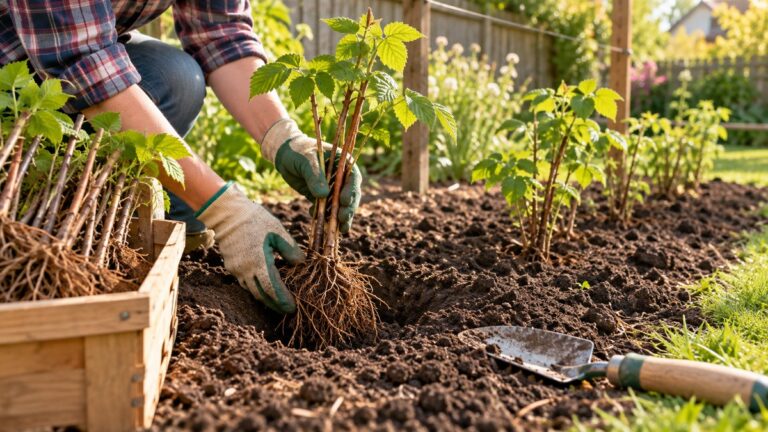
Dig the hole shallow and wide. The K-State guide advises a saucer-shaped hole two to three times the diameter of the root ball, wide enough for root growth but no deeper than the root flare. The Arizona guide says to dig a hole slightly wider than the root ball and no deeper than the root ball, with the sides rough and sloping outward. UF/IFAS says that once the bed is prepared, the root ball can sit in a hole a little wider than itself. The K-State guide also says to save the soil you remove, because you will use it to backfill the hole.
Set the root ball so the flare sits at the soil line. UF/IFAS checks that the first main root is just above the soil line. The K-State guide says not to bury the root flare when you backfill, and the Arizona guide says not to plant deeper than the root ball. Used together, the three checks point the same way: the flare should be visible, not covered.
For a balled-and-burlapped root ball, the K-State guide says that once the plant is in place, you should remove the balling ropes and the top one-third to one-half of the burlap and wire basket.
Backfill and decide on amendments
This is the one question where the sources disagree. UF/IFAS says there may be benefits to amending the entire bed with compost or other organic amendments, because some researchers found greater root growth in amended beds. It advises choosing material that is well decomposed, with little recognizable content and an earthy, non-offensive smell, and working it into the top 12 inches of soil before planting.
The Arizona and K-State guides disagree. The Arizona guide says not to add organic amendments such as manure, compost or wood chips to the soil at planting, because they do not improve the soil and may inhibit the plant’s growth. The K-State guide says not to amend with organic matter, because it may change how water moves into and out of the root ball and does not help root establishment.
This article does not pick a side. If you amend a whole bed, the UF/IFAS method applies to the bed as a whole. If you dig a single hole, the Arizona and K-State guides both advise against amending the backfill, and the K-State guide says to backfill with the soil you removed, without burying the root flare.
Build a soil ring and mulch
K-State says to build a soil ring around the outer edge of the root ball from the remaining backfill. The ring is a donut-shaped enclosure that prevents runoff and holds water until the root ball absorbs it.
Mulch comes next. UF/IFAS says to mulch around the outside of the root ball and to keep mulch off the root ball itself. The K-State guide says to keep mulch at least 4 inches from the trunk and not to pile it into a volcano shape, which can harm a tree. The Arizona guide lists shredded bark, wood chips and coarse compost as suitable surface mulches.
Stake only when needed. The Arizona guide says staking is used if necessary, with wood or metal stakes and tie material that is smooth, wide and flexible, so the trunk is protected from physical damage.
Water at planting and afterward
UF/IFAS says to water at planting and then on a regular schedule until the shrub is established. It adds that planting under hot, sunny, dry conditions can reduce vigor and slow establishment unless regular irrigation occurs. Its note on season is that shrubs can be planted in any season in Florida, though local conditions in temperature and rainfall can change how well they establish.
Check the soil before each watering. The K-State guide says to probe the soil with a finger, and to water deeply only when it is dry. It also says watering frequency depends on conditions, and it warns against overwatering during establishment. Its advice is written for trees, so treat its schedule as a starting point for a shrub.
Timing the planting helps too. The Arizona guide says transplanting is best when temperatures are above freezing and conditions are not too hot and dry, because that minimizes stress and allows faster recovery. If you must plant in hot weather, the UF/IFAS warning about sunny, dry conditions applies, and regular irrigation becomes more important.
Feeding can wait. The Arizona guide says nitrogen is usually lacking in desert soils and is effectively applied to the soil surface a year after planting, if it is needed. Other nutrients can be added at recommended rates to correct a deficiency.
For more on watering young plants, see the hose attachment for watering plants guide. A hose nozzle for watering plants is covered in a separate garden hose nozzle for watering plants post.
How we chose
We kept extension publications on planting shrubs or trees that returned HTTP 200 to curl and gave step-by-step planting guidance. We opened three on 2026-10-22: the UF/IFAS publication ENH1129, the University of Arizona planting guidelines for container trees and shrubs, and the K-State tree planting guide. A UF/IFAS Alachua County PDF returned 404, and a Virginia Tech repository record opened only as a catalog entry, so neither was used. The K-State guide is written for trees, so its steps appear only where they apply to any woody plant. Where the three guides differ, both positions are shown.
What we could not verify
This section covers what the sources do not settle, so you know where the advice stops.
What the sources do not say
The sources disagree on whether to amend the planting hole, and on the depth rule: UF/IFAS places the flare just above the soil line, K-State says no deeper than the flare, and Arizona says no deeper than the root ball. None of the three gives a number of weeks for establishment or a watering schedule for a shrub in a particular climate. They do not name shrub species for any region. The K-State guide is written for trees, so its staking and watering advice may not carry over to shrubs.
Frequently asked questions
How deep should the root flare sit?
At the soil line or just above it, according to UF/IFAS. The K-State guide says not to bury it, and the Arizona guide says not to plant deeper than the root ball. Find the flare before you set the plant, since UF/IFAS tells you to remove any soil or growing medium above it.
Should compost go into the planting hole?
The sources disagree. UF/IFAS says amending the whole bed may help root growth. The Arizona and K-State guides say not to add organic amendments to the backfill at planting. Pick the approach that fits your soil and the guidance you follow.
How long should watering continue after planting?
UF/IFAS says to keep watering on a regular schedule until the shrub is established, but it does not give a number of weeks. The K-State guide says to water deeply when the soil is dry and to avoid overwatering.
How big should the planting hole be?
K-State advises two to three times the diameter of the root ball, and no deeper than the root flare. The Arizona guide says slightly wider than the root ball and no deeper than the root ball. UF/IFAS says a little wider than the root ball.
Is hot weather a bad time to plant a shrub?
It can be. UF/IFAS says hot, sunny, dry conditions can reduce vigor and slow establishment unless the shrub is irrigated regularly. The Arizona guide says transplanting is best when temperatures are above freezing and conditions are not too hot and dry.
Sources
- https://edis.ifas.ufl.edu/publication/EP390/pdf (opened 2026-10-22)
- https://www.extension.arizona.edu/publication/planting-guidelines-container-trees-and-shrubs (opened 2026-10-22)
- https://bookstore.ksre.ksu.edu/pubs/MF3313.pdf (opened 2026-10-22)