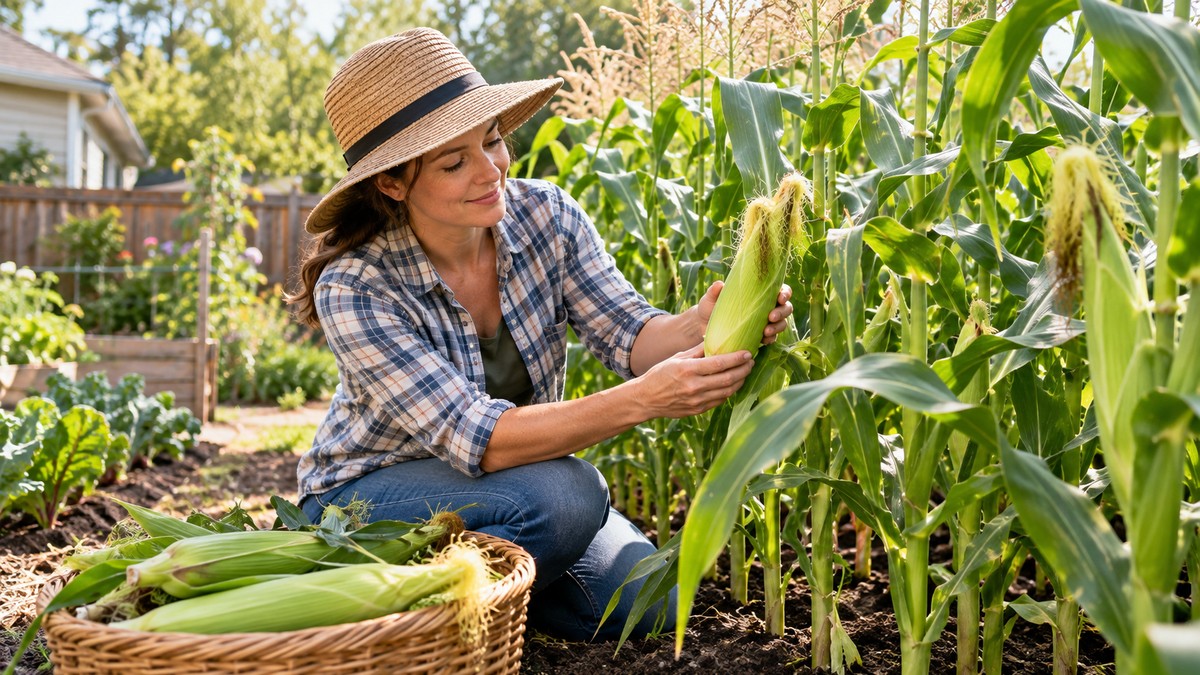
How to Grow Sweet Corn
As an Amazon Associate we earn from qualifying purchases.
Knowing how to grow sweet corn comes down to warm soil, the right spacing, steady water and picking at the right moment. Sweet corn is a warm-weather crop that wants full sun and well-drained, fertile soil. Three university extension pages we opened on 2026-10-22 agree on those basics, but they do not agree on every number, so this article shows where they differ.
Sweet corn also works best in succession, because a single planting is ready for only about a week. The sections below cover timing, spacing, feeding, water, weeds, varieties and harvest.
Quick answer
- Plant once the soil is warm. The Utah planting page advises at least 60 °F, and the UNH sheet gives 50°F as a minimum with 60 to 85°F as ideal.
- Plant in blocks of three or more short rows, not one long row, so that pollen can reach the silks.
- Water steadily, and take extra care around tasseling and silking, the period the sources name as most sensitive to dry conditions.
- Pick when the silks are dry and brown and the kernels release milky juice when punctured.
Start when the soil is warm
The Utah planting page describes sweet corn as a warm-weather vegetable. It says germination and growth start at 55 °F, with an optimum range of 70 °F to 86 °F. It advises that soil at planting time should be at least 60 °F to avoid seed rot and maximize germination. The Utah yard-and-garden page puts it another way: soil and air should be above 60ºF for best germination and growth, and you should plant after the last frost-free date for your area.
The UNH sheet sets a lower floor. It says soil temperature must be at least 50°F for germination and growth, and that 60 to 85°F is ideal. It also notes that corn which has already germinated can withstand light frosts, because the growing point is protected by the outer leaves, while the soil must still be warm enough for the seed to germinate.
This article uses 60 °F as the planting point, the highest figure in the sources. The sources agree that warmer soil gives better germination, and the UNH sheet adds that light soils warm up faster than heavy soils, so seed in them germinates more readily.
Corn can also be transplanted. The UNH sheet says to sow one or two seeds in cells large enough that the plant does not become root-bound, and to move the plants outdoors within 10 to 14 days of sowing. The Utah yard page adds that sweet corn may be transplanted, or seeded under clear plastic for an early crop.
Spacing, rows and blocks
The three pages give different numbers, so read the ranges together rather than picking one. The Utah planting page says to space rows 28 to 32 inches apart, put seeds 7 to 8 inches apart in the row, and plant about 1 inch deep. It adds that rows 36 inches apart, with seeds 7.5 to 8.5 inches apart in the row, maximize ear size. The Utah yard page gives rows 24 to 30 inches apart and seeds 7 to 9 inches apart, planted 1 inch deep. The UNH sheet uses wider rows, 2½ to 3 feet apart, with plants 8 to 10 inches apart. Seed quantity follows the spacing: the Utah yard page says 100 feet of row takes about 3 to 4 ounces of seed.
Blocks matter more than exact spacing. The Utah yard page says planting in blocks of three or more rows improves pollination and ear production. The UNH sheet explains why. Corn is pollinated when wind currents carry pollen from the tassel to the silk, and each kernel develops only when a pollen grain lands on the silk attached to it. A single row can be pollinated, but several short rows in a block make successful pollination more likely.
Depth follows the season. The UNH sheet says early plantings should go no deeper than 1 inch, while later plantings can go 1 to 2 inches deep to reach moisture. If you grow in a raised bed, the vegetables to plant in raised beds guide covers other crops for the same kind of bed.
Prepare the soil and feed the plants
The Utah yard page recommends fertile, well-drained soil in full sun, with plenty of organic matter and a complete fertilizer worked in before planting. The UNH sheet adds that the ideal soil is well drained and fertile, with a pH between 6.0 and 6.8. It recommends a soil test before planting to learn how much lime and fertilizer the bed needs, and it notes that UNH Cooperative Extension offers that testing.
According to UNH, aged manure or compost worked in the fall before planting supplies nutrients and holds more water. Light soil warms faster in spring, which helps early plantings germinate, while heavier soil holds more moisture through hot midsummer weather. The sheet’s general rule is to plant early corn in light soil and later corn in heavier soil, when there is a choice.
Feeding continues after planting. The Utah yard page says to side-dress with nitrogen fertilizer when the plants have 8 to 10 leaves, and again near silking. The UNH sheet gives an amount by row length. When the plants are 15 to 18 inches tall, spread about 2.5 pounds of a 10 percent nitrogen fertilizer, or an equivalent, per 100 feet of row, and work it lightly into the soil. The two pages cue the timing differently, by leaf count and by height, so either marker can serve as a reminder.
Water through tasseling and silking
Sweet corn needs regular water from germination to harvest. The Utah yard page says to keep the soil near field capacity, and it names tasseling, silking and ear formation as the periods when water is most critical. Drought during ear development lowers the yield, weakens kernel quality and changes flavor. The UNH sheet points to a similar window. It says the most critical period is about two weeks before silks form, and it suggests aiming for about 1 inch of water per week, with irrigation filling in when rain falls short.
The two sources describe the same stretch of the season from different ends. One counts from tasseling through ear formation, and the other counts back from silking. For a home bed, the weeks just before and during silking are the ones to watch most closely.
Mulch and control weeds
Weeds are the other main competitor. The UNH sheet lists broad-leaf weeds such as lambsquarter, pigweed, purslane and galinsoga, and grasses such as quackgrass and crabgrass, as strong competitors of sweet corn. The Utah yard page says to control weeds with regular cultivation, especially while the plants are small, and to avoid root damage when you cultivate. Once the corn grows vigorously, it outcompetes most weeds, the page says.
Organic mulches such as grass clippings, straw and shredded newspaper help control weeds and reduce soil water loss, according to the Utah yard page. Clear plastic mulch conserves water, gives some frost protection and allows earlier planting and maturity. It also stimulates weed growth under the plastic, so it is not a complete answer.
UNH describes black plastic laid before planting. You punch small holes through it and push the seed down to the right depth, and the plants grow up through the holes. Straw is the other option the sheet describes. Each mulch has a trade-off, so choose the one that fits your bed and your weeding routine.
Choose varieties and sugar types
Sweet corn varieties differ in maturity and in sugar type. The Utah yard page says maturity ranges from 60 to 90 days from planting, depending on the variety. Early varieties give smaller ears that are less sweet than later types. They suit short seasons with cool temperatures, while late varieties suit long, warm seasons.
The Utah yard page and the UNH sheet both describe three sugar groups: standard sugary (su), sugary enhanced (se) and super sweet (sh2). The UNH sheet explains that the sugar in standard kernels turns to starch quickly after harvest, that sugary-enhanced types hold more sugar, and that super sweet types are the sweetest because their sugar converts to starch much more slowly.
Cross-pollination affects taste. If super sweet corn pollinates other types, the quality of both is reduced. The UNH sheet says you can prevent this with distance, with windbreaks, or by planting varieties with very different maturity dates so they do not tassel at the same time. It also says sugary and sugary-enhanced types do not need to be isolated from each other. The Utah yard page adds that mixing types which tassel together costs the extra sweetness of the se and sh2 types.
For a raised-bed layout, the easiest vegetables to grow in raised beds guide is the next read.
Succession planting for a longer harvest
A single planting is ready for a short window. The UNH sheet says each planting is mature for only seven to ten days. To keep ears coming, it recommends planting a small amount of the same variety every seven to ten days, or planting varieties with different maturity dates at the same time. Its photo example shows groups of four rows planted seven to ten days apart, which gives a steady harvest from late July through mid-October.
The Utah yard page gives a different interval: plant the same variety or type every 10 to 14 days until early July. It also suggests planting a 65, 70, 75 and 80 day variety of the same type at the same time, which spreads the harvest over a longer period.
The Utah planting page lists four ways to time each new planting: the calendar, with every 10 days suggested when temperatures are warmer; the first leaf unfurling; the days to maturity on the seed packet; or growing degree units. Growing degree units add up the heat each day above a base temperature, which the page sets at 50°F for sweet corn. In its formula the page caps the daily high at 86°F and the daily low at 50°F. Seed companies state heat units either from planting to maturity or from seedling emergence to maturity, so check which measure your seed supplier uses before you plan the calendar.
Telling when the ears are ready
The Utah yard page says ears mature 17 to 24 days after silk emergence, depending on the temperature. A ready ear has dry, brown silks. The husks look moist and green. Kernels near the tip are plump, and they release a milky juice when you puncture them. Ears can be picked over a window of five to seven days.
Grasp the ear and snap it downward while twisting, the Utah yard page says, and use it right away for the best quality and flavor. The UNH sheet explains the reason for speed. After harvest, the sugar in standard sweet corn turns to starch, so the kernels become tougher and less sweet. That is why the old advice is to get the pot of water boiling before you pick.
Pests and disease
The Utah guides also cover insect pests, corn smut and other diseases, and they name chemical controls. This article gives no pesticide, fungicide or treatment advice. For pest or disease problems in your bed, ask your county extension office which controls suit where you live.
How we chose
We kept university extension pages on sweet corn that returned HTTP 200 to curl and gave details on planting, spacing, feeding, watering, weeds, varieties or harvest. We opened three on 2026-10-22: the Utah planting page, the Utah yard-and-garden page and the UNH sheet. A page that returned 403, or gave only partial text when extracted, was left out. A claim appears here only when the sentence it rests on is in the text pulled from that page. Where the pages disagree, both figures are shown.
What we could not verify
This section covers what the sources do not settle, so you know where the advice stops.
What the sources do not say
The three pages disagree on soil temperature, row spacing and planting interval, so this article gives each range rather than picking one as correct. None of them gives a single row spacing that holds in every climate. They give a maturity range of 60 to 90 days, but no days-to-harvest figure for any named variety in a named place. They do not say how many plants one person needs for a season. The Utah pages are written for Utah conditions and the UNH sheet for New England gardens, so match the calendar to your own weather.
Frequently asked questions
How warm does the soil need to be for sweet corn?
The sources differ. The Utah planting page says at least 60 °F at planting. The UNH sheet says at least 50°F, with 60 to 85°F ideal. The Utah yard page says above 60ºF. This article uses 60 °F as the planting point, and it notes that light soil warms faster than heavy soil.
How far apart should sweet corn be planted?
Rows run 24 to 36 inches apart depending on the source, and plants go 7 to 10 inches apart in the row. The Utah planting page says rows 36 inches apart, with seeds 7.5 to 8.5 inches apart, maximize ear size. The UNH sheet uses rows 2½ to 3 feet apart. Check the spacing section before you mark out the bed.
Why plant sweet corn in blocks?
Wind carries pollen from the tassel to the silk, and each kernel needs its own pollen grain to develop. Several short rows in a block make it more likely that every silk gets pollinated. The Utah yard page says blocks of three or more rows also improve ear production.
Can different sweet corn types be planted next to each other?
Sugary and sugary-enhanced types do not need to be isolated from one another, according to UNH. Super sweet types need more care, because if they cross-pollinate other types, the quality of both drops. Keep them apart by distance or a windbreak, or choose varieties with very different maturity dates.
How can you tell when sweet corn is ready to pick?
Look for dry, brown silks and husks that look moist and green. Puncture a kernel near the tip: a ready ear releases milky juice, and the kernels are plump. The Utah yard page says ears mature 17 to 24 days after silk emergence, and that you can harvest over five to seven days.
Sources
- https://extension.usu.edu/vegetableguide/sweet-corn/planting.php (opened 2026-10-22)
- https://extension.usu.edu/yardandgarden/research/sweet-corn-in-the-garden.php (opened 2026-10-22)
- https://extension.unh.edu/resources/files/Resource006093_Rep8599.pdf (opened 2026-10-22)