How to Overwinter Potted Plants
As an Amazon Associate we earn from qualifying purchases.
How to overwinter potted plants starts with one honest question: is the plant hardy enough to survive winter outdoors when its roots sit in a pot instead of the ground? Potted perennials, shrubs and small trees often can get through the cold when the plant is hardy and the container is protected. The three overwintering pages used here agree on the main steps for hardy pots: choose hardy plants, pot them up early, insulate the pots, keep the soil from drying out, and pick a sheltered spot or a cold but protected space. Tender plants need a different route, indoors, which the third option covers.
Quick answer
- Choose plants hardy at least two zones colder than your own, because Penn State Extension advises that margin for containers.
- Pot up herbaceous perennials in early fall so they have several weeks to settle in before the cold arrives.
- Water thoroughly before the soil freezes, then insulate the pot or move it to an unheated garage or shed. Tender herbs such as basil need a warm room indoors instead.
- Check the pots through the winter and water when the soil needs it, as the Colorado State page advises.
Start with plants that can handle the cold
Not every container plant is worth saving. Penn State Extension says that many potted perennials, shrubs and small trees can be maintained over the winter, while annuals grown in containers are discarded at the end of the season. The extension page says the more cold-hardy the plant, the more likely it is to survive.
Plan on checking each plant before you decide, not after. A tag or a local plant list gives a starting point. Penn State’s safety advice for containers is to go two zones colder than your own, use larger pots for insulation and give some protection. That margin matters because a pot exposes roots more than the ground does.
Plants that are already weak do worse. The UMass Amherst fact sheet says that poorly established and pot-bound plants tend to overwinter poorly. A plant that struggled all season or has circled its pot is a poor candidate for an outdoor winter, and the sources offer no autumn fix for that.
Tender plants are a separate case. Penn State says most herbs can survive the mid to low 40s, but basil cannot survive temperatures lower than 50°F, so basil belongs indoors, as the third option explains.
Why the roots of container plants need extra help
In the ground, soil buffers roots from temperature swings. UMass Amherst explains that the roots of container-grown plants are not buffered from cold temperatures by the soil. The same page says roots are much less cold-hardy than shoots, so a plant can look sound above the surface while its roots are at risk. Penn State adds that the roots of above-ground container plants can be the same temperature as the winter air.
Root tolerance varies by species, and that drives the method. UMass Amherst says the overwintering technique is determined by the plant species and by the ability of its roots to withstand cold during winter. Plants with tougher roots may only need to be grouped together, with the outside edge protected by bales of hay or bags of leaves. Plants with less tolerant roots need the fuller protection described in the next sections.
Pot up perennials early and water before the freeze
Timing gives a plant time to settle into its container. UMass Amherst advises potting up herbaceous perennials by late September or early October, so they can establish for several weeks before cold temperatures arrive in late November. Those dates come from a Massachusetts page, so compare them with the first hard frost in your own area and count back from there.
Water is the other half of the job. The UMass Amherst page says to water everything well to prevent desiccation, and to let foliage and branches dry thoroughly.
Water the pots well before the soil freezes, as Penn State Extension advises. A waterlogged pot in a freezing spell is a different problem, and the sources we opened do not explain how to handle it.
Option one: keep the pots outdoors in a protected spot
If the pots must stay outdoors, the sources describe a few ways to protect them. Colorado State University Extension suggests choosing a protected area in the garden in November, or when the soil has cooled. For large pots, its method is to sink the pot and all into the soil, water it well, then mulch six to twelve inches deep with straw, leaves, hay or shredded bark. Penn State Extension offers a similar idea for smaller containers: bury the entire pot in the ground and cover it with soil or mulch. For strawberries, Iowa State says leaves are not a good winter mulch, while Oregon State warns that straw promotes rot where winter rain is heavy. Iowa State also advises letting strawberries harden in cool fall weather before mulching, since prematurely mulched plants suffer more winter injury. In spring, it advises leaving the mulch on as long as possible to reduce late-frost damage, because removing it in March can bring blooms before the frost danger is past.
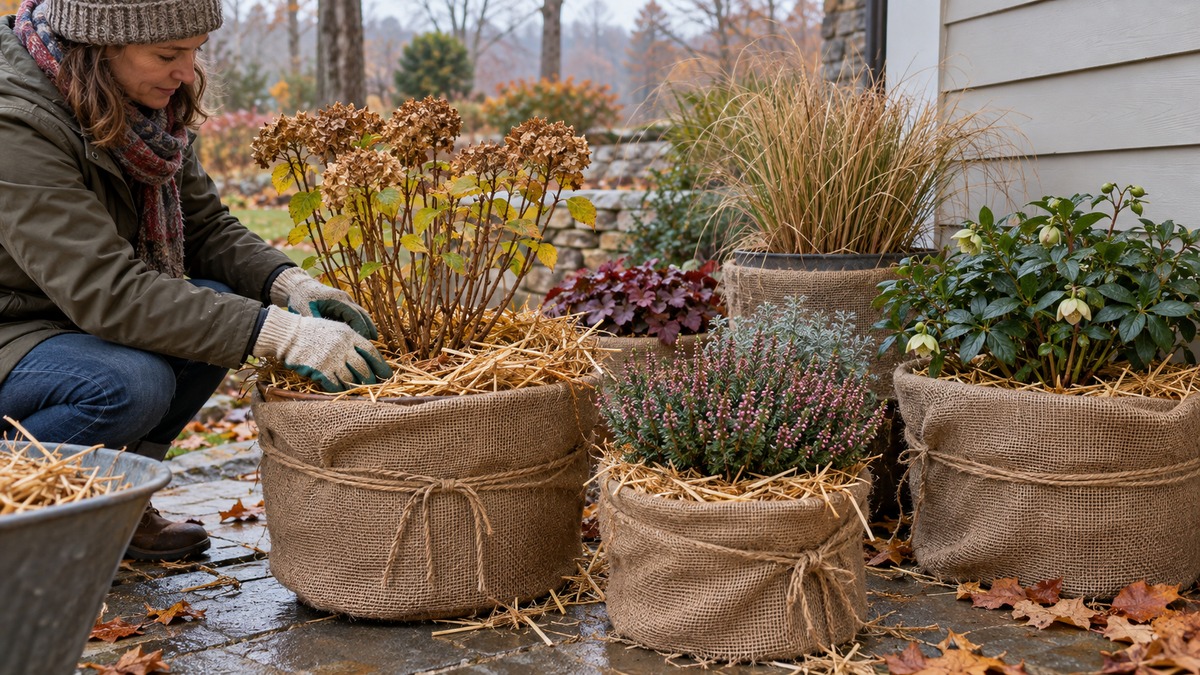
Penn State also describes placing one or a few pots inside a box, a larger pot or a wire enclosure lined with insulation. The listed materials include bark mulch, straw, packing peanuts and bubble wrap. That gives a container a second layer of protection without burying it.
The UMass Amherst method for plants with tougher roots is simpler. Group the plants together and protect the outside edge with bales of hay or bags of leaves. The page presents grouping as part of the method, but it does not say how many plants a group should hold, so fit the grouping to the space you have.
Option two: move the pots into an unheated space
Colorado State University Extension lists an unheated garage or shed as another overwintering option, which suits hardy plants but not tender herbs such as basil. Moving pots into a space like that changes their exposure, but it does not end the need to check them. The same page says to check the pots monthly through the winter and to water if they need it. For strawberries in containers, Oregon State says to move pots inside when forecasts call for temperatures below 15°F.
Pot material matters if the pots stay out. Penn State Extension advises against leaving clay, ceramic or glazed pottery exposed, because those pots may crack. If a pot of that material must stay outdoors, wrap it in bubble wrap or another insulating material, then cover it with plastic, as the Penn State page suggests. The page does not address plastic over the leaves of a plant, so keep plastic for the pot itself.
If some of your plants live in beds rather than pots, see our guide to raised beds for winter for the ground-level side of the same season. For planters that need to hold up outdoors through the cold months, see outdoor planters for winter.
Option three: bring tender pots indoors
Tender plants such as basil come indoors before a frost. Maryland advises bringing herbs in before a frost, with one exception: mint, chives and tarragon grown in containers benefit from a light frost first. Penn State’s indoor target is at least 65 to 70°F during the day and 55 to 60°F at night.
Indoors, light is often the limit. Iowa State says ideally plants get four to six hours of direct sunlight a day, and Penn State says most herbs need six hours. When a window falls short, Iowa State advises a grow light on a timer for 12 to 16 hours a day. Penn State also advises rotating pots so each side gets enough light for uniform growth.
Forced-air heat dries the air. Penn State says homes with central, forced-air heating tend to have the driest winter conditions for indoor plants, and it suggests grouping containers, setting them on a pan of moist pebbles, or placing them near a humidifier.
Water the potting mix when it starts to dry out. Penn State says bay, marjoram, oregano, sage, thyme and rosemary can dry out slightly between waterings, but basil should never dry out completely. Maryland cautions against overwatering any of the containers. Iowa State notes that clay or terracotta pots are more porous and let the mix dry well between waterings, and Penn State asks for containers with a drainage hole.
Keep the soil moist, not soggy
UMass Amherst names soil moisture, temperature fluctuations and root development inside the container as factors that affect survival. Watering keeps the root ball from drying out, and a regular check gives you a chance to catch a dry spell.
The Colorado State University page recommends checking the pots every month through the winter and watering if needed to prevent desiccation.
When you water in winter, water thoroughly and then let the foliage and branches dry, as the UMass Amherst page advises.
Mistakes that cost plants over winter
- Leaving clay, ceramic or glazed pottery fully exposed, since Penn State Extension says those pots may crack.
- Waiting for the first hard freeze before potting up perennials, when UMass Amherst says they need several weeks to establish first.
- Choosing plants that are not hardy at least two zones colder than yours, which is the margin Penn State Extension gives for containers.
- Bringing pot-bound or poorly established plants into winter, which the UMass Amherst page says tend to overwinter poorly.
- Letting the soil dry out for long stretches, when the Colorado State page calls for monthly checks.
- Skipping the mulch on pots sunk in the ground, when the Colorado State page specifies six to twelve inches.
- Leaving basil in an unheated garage or shed, since Penn State says it cannot survive temperatures lower than 50°F.
A simple fall checklist
- Sort the plants by how cold their roots can take, and set aside any that are weak or pot-bound.
- Pot up perennials early in the fall so they can establish before the cold.
- Water each pot thoroughly and let the foliage dry before the first freeze.
- Pick a protected spot in the garden, or move the pots into an unheated garage or shed.
- Wrap or mulch any pot that stays outdoors, and keep clay or ceramic pots out of the open.
- Schedule a look every few weeks, and water when the soil shows it needs it.
How we chose
We opened eight pages on 2026-10-22. Three cover pots outdoors: the UMass Amherst fact sheet on overwintering container-grown ornamentals, the Penn State Extension page on overwintering plants in containers (update date October 12, 2026), and the Colorado State University PlantTalk article. Three cover herbs indoors: Penn State Extension, Iowa State Extension and the University of Maryland Extension. Two cover container strawberries: Oregon State Extension and an Iowa State Extension page on overwintering strawberries. We kept only statements about container roots, plant choice, timing, watering, insulation, mulching, light, warmth, humidity and strawberry cold thresholds. An Illinois container page with little detail and a UMass greenhouse fact sheet that returned an error did not shape the advice.
Where the pages give different methods, we show each method and name its source instead of picking one for you. The burying, mulching and unheated-storage guidance comes from the overwintering pages, the warm indoor option from the herb pages, and the strawberry thresholds and mulch timing from the strawberry pages. If a point could not be traced to an opened page, it did not go into the advice.
What we could not verify
The three pages give a good base, but they do not settle every question a gardener will face. We could not verify the hardiness of any named plant, the dates for your region, the lowest temperature a given perennial or shrub can survive, or the timing of spring uncovering. Treat the numbers in this guide as the figures each page gives, not as a forecast for your yard.
What the sources do not say
The overwintering pages do not list the hardiness of named plants, so check the plant tag or a local extension list for each one. They do not give a temperature at which a pot needs covering, a minimum size for a cold frame, or a date to remove mulch in spring. The Colorado State page gives six to twelve inches of mulch for sunk pots, but it does not say how deep to mulch an above-ground pot. The Penn State page describes bubble wrap and plastic for pots left outdoors, but it does not say how long those covers can stay on. This guide recommends no product, and it makes no claim about any named container or brand. The herb pages differ slightly on daylight, with Iowa State at four to six hours and Penn State at six, and none of them gives a calendar date for moving pots indoors.
Frequently asked questions
Which potted plants can overwinter outside?
Penn State Extension says that many potted perennials, shrubs and small trees can be maintained over winter, while annuals grown in containers are usually discarded at the end of the season. Cold tolerance decides the rest, so check each plant’s hardiness before you decide.
Is burying the pot or moving it indoors better?
Both are options in the sources. Colorado State University Extension suggests sinking the pot in the garden and mulching it, or moving it into an unheated garage or shed. Penn State Extension describes burying the whole pot in soil or mulch. Tender plants such as basil need the warm indoor option, because they cannot take temperatures below 50°F. Otherwise, pick the method that fits your space and the plant’s tolerance.
When should perennials be potted up for winter?
The UMass Amherst fact sheet advises potting up herbaceous perennials by late September or early October. That gives them several weeks to establish before cold temperatures arrive in late November, using the dates that page gives for its own climate.
How often should potted plants be checked in winter?
Colorado State University Extension recommends a check every month through the winter, with water added if the plant needs it.
Is it safe to cover pots with plastic?
Penn State Extension suggests wrapping pots in bubble wrap or another insulating material and then covering them with plastic if they must stay outdoors. The same page says clay, ceramic and glazed pots should not be left exposed because they may crack. The sources we opened do not address plastic over the leaves of a plant, so that question remains open.
Bottom line
Pick plants that are hardy enough, pot perennials early, water well before the freeze, and give every hardy pot a layer of protection or a cold but sheltered space. Bring tender pots such as basil indoors to a warm room.
Sources
- https://www.umass.edu/agriculture-food-environment/landscape/fact-sheets/overwintering-container-grown-ornamentals (opened 2026-10-22)
- https://extension.psu.edu/overwintering-plants-in-containers (opened 2026-10-22)
- https://planttalk.colostate.edu/topics/miscellaneous/2028-overwintering-container-plants/ (opened 2026-10-22)
- https://extension.psu.edu/growing-herbs-indoors (opened 2026-10-22)
- https://yardandgarden.extension.iastate.edu/faq/can-i-grow-herbs-indoors-over-winter (opened 2026-10-22)
- https://extension.umd.edu/resource/growing-herbs-containers-and-indoors (opened 2026-10-22)
- https://extension.oregonstate.edu/catalog/ec-1307-growing-strawberries-your-home-garden (opened 2026-10-22)
- https://yardandgarden.extension.iastate.edu/how-to/how-overwinter-strawberries (opened 2026-10-22)