How to Assess Soil Drainage
As an Amazon Associate we earn from qualifying purchases.
How to assess soil drainage comes down to one simple test: dig a hole, fill it with water, and measure how fast the water leaves. The extension pages we opened describe the same method and agree on most of the numbers. This guide walks through the test, shows how to read the result, and lists what to change when a spot drains poorly.
The stakes are real. North Carolina State University Extension’s Durham County page puts it bluntly: “Poor drainage is responsible for many of our planting failures.” A test before planting takes little time and tells you which plants suit the spot.
Quick answer
- Dig a test hole at least 12 inches deep and 4 to 12 inches wide, fill it with water, and let it drain.
- Refill it once the water is gone, measure the drop after 15 minutes, and multiply by 4 to get an hourly rate.
- Iowa State and Illinois Extension both treat 1 to 3 inches per hour as desirable for most plants, and less than 1 inch per hour as poor.
- If the soil drains poorly, add organic matter such as compost rather than sand, and avoid working the ground while it is wet.
Why drainage decides plant health
Drainage is about how long water stays in the soil after rain or watering. Iowa State University Extension explains the mechanism: “When soil is not well-drained, it has smaller pores and retains water for longer periods of time.” Smaller pores hold water, and roots need air as well as water to work.
The North Carolina page also says that “Some plants will tolerate this situation, but many will drown.” That is why a test is worth doing before you plant rather than after the plants begin to decline. It tells you whether a spot suits a wide range of plants or only the ones that tolerate wet feet.
What makes soil drain well or poorly
Soil texture sets the baseline. Illinois Extension notes that “Soils that are primarily sand tend to have more pore space and are more quickly drained; while clay soils have less pore space which slows water movement through the soil profile and holds the water for extended periods.” Sand drains quickly and clay holds water. The North Carolina page adds a practical observation about clay. “When wet, the clay is slippery muck; when dry, it cracks and hardens into concrete.”
Structure matters as much as texture. Iowa State says that “Heavily compacted soils can lead to poor drainage.” Illinois Extension explains the effect: “Compaction compresses the soil pores and limits oxygen and water space in the soil.” Tilling can backfire, too. Iowa State warns that “Tilling too much or too frequently can break down soil aggregates reducing its ability to drain well.”
Location can override a good soil. Iowa State lists the spots that drain slowly even when the texture looks fine: “Depressions, low areas, sites with high water tables, and those that have underlying rock layers can also be slow to drain.” It also cautions that “Locations with high clay percentages or those with hard pans can still be poorly drained, even when sloped.” A slope is not a guarantee, so test the spot itself.
How to run a perk test
The test is called a percolation test, or perk test. Iowa State calls it the best way to find out “how well-drained the soil is, even on the side of a slope.” The steps below combine the three pages, and the sentences in quotation marks come straight from them.
Pick the right day
Timing changes the result. Iowa State warns that “Avoid working in overly wet soils as it may glaze the side of the test hole, which can give false test results.” North Carolina advises testing when the soil is neither extremely dry nor extremely wet. Follow both rules and the reading means something.
Dig the hole
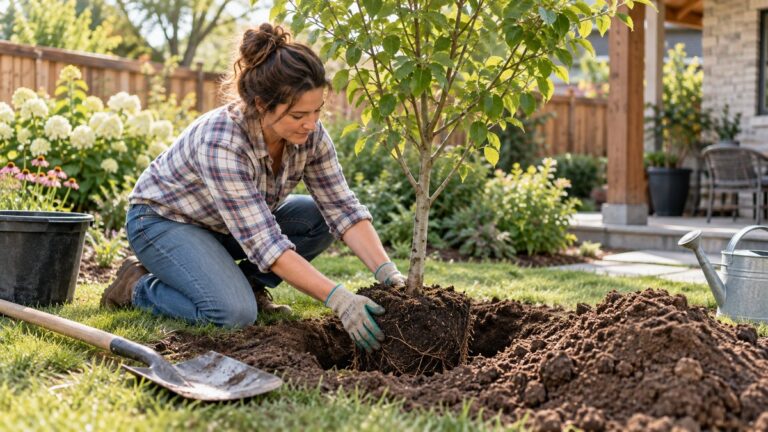
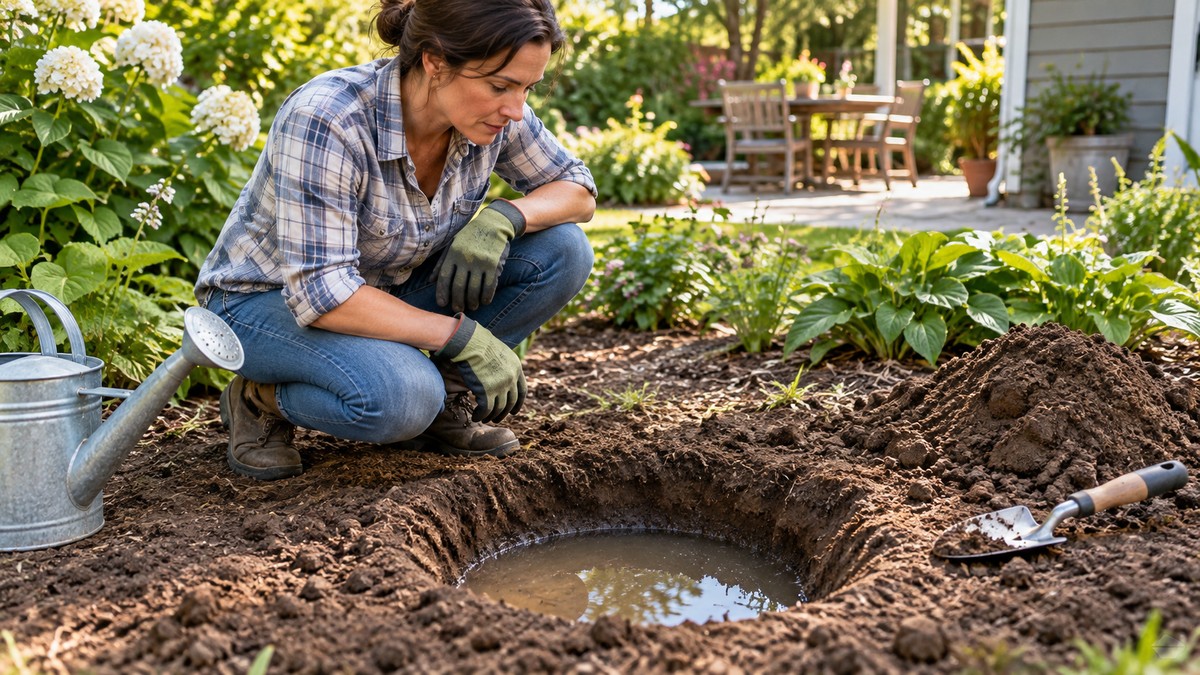
Iowa State says to “use a shovel or post-hole digger to dig a hole at least 12 inches down and 4 to 12 inches wide.” Illinois Extension lists a hand auger as another option. If you are about to plant, the planting hole can do double duty, and Iowa State notes that “A planting hole can be used for this test to avoid excess digging.”
Fill, refill and watch
Fill the hole and let it drain. Illinois Extension says that “Once the hole is dug, fill it with water and let it drain completely; this could take anywhere from a short period of time to an entire day.” Refill right after the first drain. Illinois says the refill should be measured: “Immediately after the water has drained, refill the hole with water and measure the depth of the water with a ruler.” North Carolina’s version adds a longer watch: “Check it regularly for the next 24 hours.”
Turn the drop into a rate
Measure how far the water falls in 15 minutes, then multiply. Illinois Extension uses that 15-minute reading and multiplies the drop by 4 to get an hourly rate. Iowa State gives the same multiplier and states it this way: “Multiply this number by 4 to calculate how much water drains in an hour.” Write down the figure in inches per hour, because that is the unit the benchmarks use.
Read the result
The benchmarks line up across these pages, with one gap. Iowa State puts the desirable band this way: “Soils that drain 1 to 3 inches an hour are desirable for most plants.” The table below lists the bands each page gives.
| Rate (inches per hour) | What the sources say |
|---|---|
| Less than 1 | Poor drainage (Iowa State and Illinois) |
| 1 to 3 | Desirable for most plants (Iowa State and Illinois) |
| 3 to 4 | Not stated in the pages we opened |
| More than 4 | Very well-drained (Iowa State) |
The gap between 3 and 4 inches per hour is real, and the pages do not fill it. Treat a reading in that band with care, and check the plants you plan to grow against their own care notes.
North Carolina uses a different yardstick. Its page says that a refilled hole that empties in 3 to 4 hours shows good drainage, 5 to 12 hours shows moderate drainage, and 12 to 24 hours shows poor drainage. Those time bands come from the same test, but they are not the same as the inches-per-hour figures. Pick one method and stick with it when you compare spots.
What to do if drainage is poor
Organic matter is the fix the sources repeat most. Iowa State says to “Add organic matter (not sand) to improve drainage in poorly drained soils.” Illinois Extension explains why it works: “Incorporating organic matter into poorly drained soil improves nutrient, water, and air holding capacity.” The North Carolina page is more forceful about depth: “Drainage can be improved by tilling or spading the soil 8-10 inches deep, and by adding organic soil amendments.”
Amendments have to reach the root zone. North Carolina defines them this way: “Soil amendments are materials that are worked into the top several inches of soil, to improve drainage and loosen the soil where plants grow.” Mixing compost into the top layer is the practical reading of that definition.
Cover crops are another option. Illinois Extension says that “The use of cover crops can also introduce organic matter to soil especially in areas such as annual flower beds or vegetable gardens.” Iowa State makes a similar point about vegetable gardens and annual beds.
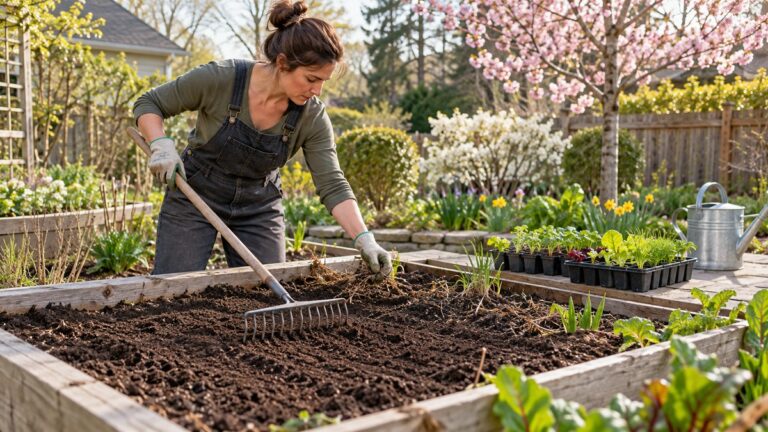
Raised beds are a larger change. Iowa State says that “Constructing a raised bed or berm is a great way to create soil conditions that are just right for the plants you wish to grow.” Illinois Extension adds that “Raised beds can provide an alternative option for growing vegetables, annual, or perennial plants.” Iowa State also notes that raised beds work best for smaller plants such as vegetables, perennials and small shrubs. If the test points you toward a new bed, our guide on how to fill raised beds covers the layers to build.
Keep compaction in check, both before and after the test. Illinois Extension lists a simple habit: “Other ideas to reduce compaction include avoid driving, walking, or working wet soils.” Compacted soil is one of the most common reasons a spot drains poorly, so the habit matters for the whole bed.
Plant choice helps too. Illinois Extension offers this tip: “Good Growing Tip: When it comes to planting in areas of poor drainage, different plant species will tolerate wet conditions better than others, so be aware of this before planting.” Choose plants that suit a wet spot rather than fighting the soil all season.
Mistakes to avoid
- Testing wet soil. Iowa State says doing so can glaze the walls of the hole and give false results.
- Reaching for sand. Iowa State says to add organic matter instead, and North Carolina says sand is not recommended for improving clay soil.
- Tilling again and again. Iowa State warns that too much or too frequent tilling breaks down soil aggregates and reduces drainage.
- Assuming a slope drains well. Iowa State warns that clay or hard pans can still drain poorly on a slope.
- Working a wet bed. Illinois Extension lists avoiding wet soil as a way to reduce compaction.
For how much soil a raised bed needs once you have decided on one, see our guide to how much soil a raised bed needs. The depth of the bed interacts with the drainage you measured.
How we chose
This guide uses three extension pages, each opened with curl on 2026-10-22 and read as text: Iowa State University Extension and Outreach, University of Illinois Extension, and North Carolina State University Extension, Durham County Center. We chose them because each describes the same percolation test in its own words, and each gives drainage benchmarks or steps that can be quoted directly. Commercial pages and stormwater sites that came up in searches were left out, because they sell products or set rain-garden limits rather than planting-bed limits.
What we could not verify
The three pages agree on the core method and most benchmarks. They do not settle the questions below, so read them as open items.
What the sources do not say
- What to do with a reading between 3 and 4 inches per hour. None of the pages states a band for that range.
- How much compost to add to a bed. The pages say to add organic matter but give no rate.
- How long a bed takes to improve after amendments. The pages give no timeline.
- How a test pit relates to a whole bed. Each page describes one hole, not a survey of the bed.
- Whether the time-based and rate-based methods agree in every soil. The pages give separate benchmarks for each and do not compare them.
Frequently asked questions
How long does a drainage test take?
The first drain can be quick or slow. Illinois Extension says draining can take a short time or a full day. After that, North Carolina’s version keeps checking the refilled hole for 24 hours.
Does a test right after heavy rain give a fair reading?
It is better to wait for conditions that are neither extremely dry nor extremely wet. Iowa State warns that overly wet soil can glaze the test hole and give false readings, so a test right after heavy rain may mislead you.
Is sand a good fix for heavy clay?
The sources say no. North Carolina states that “Peat moss and sand are NOT recommended for improving clay soil.” Iowa State also tells gardeners to add organic matter instead of sand. Compost is the amendment both pages point to.
What if the water drains very fast?
Iowa State describes soil that drains more than 4 inches per hour as very well-drained, and it says adding organic matter is also ideal for improving very well-drained soils. The pages we opened do not describe a separate fix for fast drainage beyond that.
Does the planting hole work as the test hole?
Yes. Iowa State says a planting hole works for the test, which saves digging a second one. Make sure the hole is at least 12 inches deep, and avoid testing it while the soil is overly wet.
Sources
- Iowa State University Extension and Outreach, Yard and Garden, “Testing and Improving Soil Drainage”: https://yardandgarden.extension.iastate.edu/how-to/testing-and-improving-soil-drainage (opened 2026-10-22)
- University of Illinois Extension, Good Growing blog, “Improving Soil Drainage”: https://extension.illinois.edu/blogs/good-growing/2022-05-13-improving-soil-drainage (opened 2026-10-22)
- North Carolina State University Extension, Durham County Center, “Making the Most of Your Garden’s Soil”: https://durham.ces.ncsu.edu/2020/04/making-the-most-of-your-gardens-soil/ (opened 2026-10-22)