How to Grow Dill
As an Amazon Associate we earn from qualifying purchases.
Learning how to grow dill is simpler than most herbs, but three choices decide the result: where you sow, when you start picking, and how you keep a supply coming. The three university extension pages we opened agree on the basics. Dill grows best from seed sown in place, in full sun and soil that drains well. Where the pages differ, we show both figures.
The three pages come from North Dakota State University, Utah State University and Texas A&M AgriLife Extension. Each was opened on 2026-10-22. Their timing and spacing figures are not identical, and the sections below say which numbers come from which page.
Quick answer
- Sow seed where the plants will grow, in full sun and soil that drains well without being overly rich. Dill does not handle transplanting well.
- Sow again every few weeks for a steady supply, since flavor peaks around flowering.
- Water once or twice a week once the plants are established, and avoid soggy soil.
- Pick leaves at any time after the seedlings develop, and cut seed heads once they turn brown.
Choose a sunny spot with modest soil
All three pages want full sun. North Dakota State asks for soil that drains well and is not overly rich. Utah State advises a site with full sun and says most Utah soils suit dill if they are well drained and moderately fertile. Texas A&M adds that the plant should be protected from strong gusts of wind, and that it survives temperatures down to 25 degrees Fahrenheit.
Test before you feed. Utah State recommends a soil test before planting, and says to follow the report’s advice. If fertilizer is warranted, the page says to work it into the top six inches of soil. For compost, it caps the rate at one inch of fully composted material for every 100 square feet of planting area, and it notes that dill does not need a rich bed.
Texas A&M gives a pH target of 5.8 to 6.5 and describes the best soil as well-drained, sandy or loamy, and slightly acidic. The same page says dill tolerates poor soil reasonably well, which fits the other two pages’ caution about richness.
Sow in place, because dill does not transplant well
North Dakota State says dill does not grow well when transplanted, and Texas A&M tells gardeners not to transplant it. Utah State says to plant dill from seed. The simplest route is to sow where the plants will stay and thin them in place. The table sets the three pages side by side.
| Source | Seed depth | Spacing | Emergence and timing |
|---|---|---|---|
| North Dakota State (FN1934) | About ¾ inch | 18 inches apart | Seedlings in 10 to 14 days |
| Utah State (How to Grow Dill) | Cover lightly with soil | Thin to 9 inches; rows 12 inches apart | Seedlings in 7 to 21 days, depending on soil temperature |
| Texas A&M (EHT-053) | About ¾ to 1 inch | 12 to 15 inches apart | Sow April through May, after frost; germination in 10 to 14 days |
The spacing figures range from 9 inches to 18 inches, and the sources do not agree on one number. Pick the figure from the page that matches your climate and your harvest plan. If the bed will hold other vegetables too, our list of vegetables to grow in raised beds shows how dill fits beside them.
Sow again for a steady supply
Utah State says to sow every four to six weeks for a continuous supply of dill weed. Its page also says flavor peaks once flowering starts, so staggered plantings matter. North Dakota State adds that dill left undisturbed in the soil will grow again the following season.
That self-seeding habit has a downside. Utah State warns that dill can become weedy because it self-seeds regularly, so control weeds while the plants are small. The same page describes rows two to three feet long, planted regularly, as enough for daily use, storage and seed production.
If you are laying out a bed with several plants that share space, our guide to companion planting in a raised bed layout helps you plan where the dill rows go.
Water moderately and keep fertilizer light
North Dakota State suggests watering dill one or two times per week. Utah State says dill is not a big water user, needs one or two irrigations a week once established, and can tolerate drier soil, especially after seed set. The same page says no additional nutrients are needed if the soil was amended at planting.
If you do fertilize, Texas A&M recommends a 20-20-20 formulation once in late spring at 0.70 pound per 100 square feet. It also offers 15-5-10 at 1 pound per 100 square feet as a better choice because it adds less phosphorus. The page says to broadcast the fertilizer or side-dress it, and not to apply it directly with the seed.
Grow dill in a container
Texas A&M says dill grows well in containers, indoors or out. Pick a deep pot with room for the height and the long roots, fill it with ordinary potting compost, and keep the plants well watered. Indoors, the plants need at least five to six hours of direct sunlight each day, and a stake may be needed to hold up the stems.
Heat, bolting and seed set
Utah State explains that the oil content of the leaves rises with longer day lengths and higher temperatures. The same page says hot temperatures above 95 degrees Fahrenheit reduce seed production, and it describes dill as hardy enough to tolerate cold winters.
The Utah State answer on early bolting names two causes: high heat and overcrowding. Thinning seedlings and succession planting help, the page says, so the same habits that keep a supply going also protect against early seed set.
Pick leaves early, and let seed heads dry
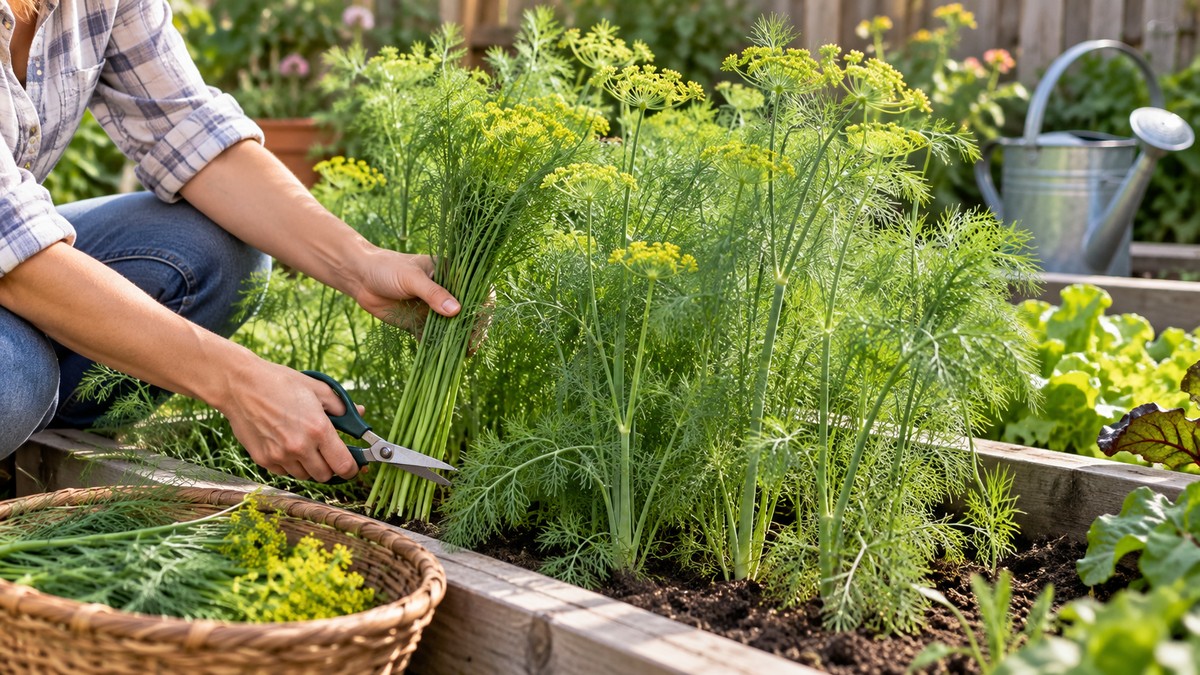
North Dakota State says the leaves and seeds are edible and can be harvested at any time after the seedlings develop. Cut the leaves at the stem and discard the thick, tough stems. Utah State describes clipping at the stem, or cutting a stem just above the soil line.
Texas A&M says the leaves contain the most flavor when picked before flowering begins, and it advises cutting near the stem early in the day or in the evening. Utah State gives a different timing: for the best flavor, harvest when the flowers begin to open.
Maturity timing also differs. Texas A&M says outdoor dill matures about 90 days after seeding. The Utah State FAQ says harvest generally comes six to eight weeks after sowing.
Save seed the traditional way
Utah State says to harvest seed after the flower heads turn brown. Hang the mature heads in a paper bag, then crush and sift them to separate the seed, and store the dry seed in a cool, dark place.
Texas A&M says to cut seed heads two to three weeks after flowering, bag them in paper or plastic, and let them dry. The seeds drop from the heads when they are ready, so the bag catches them.
Preserve dill by drying, freezing and storing
North Dakota State gives the most detailed preservation steps of the three pages. For air-drying, cut the plant when it is about six inches tall, tie the stems in a small bundle, and place the bundle in a brown paper bag in a cool, dark room for about two weeks. Store the dried herb in an airtight container.
The same page describes oven drying at 100 degrees Fahrenheit until the herb is brittle, with frequent checks to avoid burning. Microwave drying takes about one to three minutes on high between paper towels, then short 30-second bursts until the plant is brittle.
For freezing, North Dakota State suggests placing dill in an airtight freezer bag, or chopping it into an ice cube tray, covering it with water and freezing the cubes in a labeled bag. Utah State suggests freezing fresh sprigs in plastic sandwich bags. The North Dakota page says fresh leaves keep best when they are lightly wrapped in a damp paper towel and then placed in a plastic bag, and that seed and dried leaves should be used within a year for the best flavor.
Common problems the sources describe
- Weeds. Control them while the plants are small, because dill self-seeds and can become weedy (Utah State).
- Overwatering. Dill is susceptible to powdery mildew if it is overwatered (Utah State).
- Aphids. They can be a problem when the plant flowers and the seeds ripen (Utah State).
- Caterpillars. Parsley worms become swallowtail butterflies, and the Utah State page says to leave them on the plants.
Use dill fresh, and add it late
North Dakota State says dill is mostly used fresh as a garnish. Stir fresh dill in near the finish of cooking so its flavor survives, and in cold dishes add it several hours ahead so the flavors blend. One tablespoon of fresh dill equals one teaspoon dried, according to the same page.
Utah State warns that heat strips away dill’s flavor, so stir it into food that has already been cooked. Both fish dishes and dips are common uses named on that page.
Both pages touch on pickling. North Dakota State refers readers to its separate pickling publication. Utah State says to use the whole plant, including stems, leaves, flowers and seeds, when growing dill for pickles.
How we chose
Three university extension publications carried usable text when fetched with curl on 2026-10-22, and each returned HTTP 200. They are North Dakota State University’s FN1934 Field to Fork Dill, which shows a review date of January 2025, Utah State University Extension’s How to Grow Dill in Your Garden, which shows a publication date of March 2020, and Texas A&M AgriLife’s Easy Gardening EHT-053, which is dated 5/14.
We left out the AgriLife web catalogue page for the same factsheet, because it held only a summary. We did not use a Minnesota Extension page, which returned HTTP 403, or the commercial pages that dominated the search results. We also left out the recipes and the health comments on the Utah State page, so this guide makes no health claims.
What we could not verify
This section lists where the sources are silent or disagree.
What the sources do not say
The native range is described three ways. North Dakota State says the Mediterranean region and southern Russia, Utah State says southwest Asia and southern Europe, and Texas A&M lists southern Russia, western Africa and the Mediterranean. We did not resolve that difference.
Harvest timing conflicts. Texas A&M gives about 90 days to maturity outdoors, while the Utah State FAQ gives six to eight weeks to harvest. The two numbers may describe different stages, but the pages do not say so.
Flavor timing conflicts as well. Texas A&M says the most flavor comes before flowering, and Utah State says the best flavor comes when the flowers begin to open. North Dakota State does not name a stage.
Only the Texas page gives calendar dates. The Utah State page gives seasons that depend on USDA zone, and the North Dakota page gives no sowing time at all.
The pages do not give a shelf life for air-dried leaves beyond the one-year guidance for airtight storage. This guide also leaves pest control aside.
Frequently asked questions
What soil pH does dill prefer?
The Utah State FAQ gives 5.5 to 6.5 as the ideal range. Texas A&M gives 5.8 to 6.5 as its preferred range for well-drained sandy or loamy soil.
When should dill be sown for a fall harvest?
The Utah State FAQ says spring and late summer are the windows for a fall harvest, depending on USDA zone. The Texas page gives April through May, after frost, which is a spring window for that state.
How long does dill take to harvest?
North Dakota State says leaves can be taken any time after the seedlings develop. The Utah State FAQ says germination takes 7 to 21 days and harvest generally comes six to eight weeks after sowing. Texas A&M puts maturity outdoors at roughly 90 days.
Why did my dill bolt early?
The Utah State FAQ lists high heat and overcrowding as the causes. Thinning seedlings and succession planting help, according to the page.
Can dill be dried or frozen at home?
Yes. North Dakota State describes air-drying for about two weeks, oven drying at 100 degrees Fahrenheit, microwave drying, and freezing either sprigs or chopped dill in ice cube trays. Utah State describes freezing sprigs in sandwich bags.
Sources
- https://www.ndsu.edu/agriculture/extension/publications/field-fork-dill (opened 2026-10-22)
- https://extension.usu.edu/yardandgarden/research/dill-in-the-garden.php (opened 2026-10-22)
- https://aggie-horticulture.tamu.edu/wp-content/uploads/2017/09/dill_053.pdf (opened 2026-10-22)