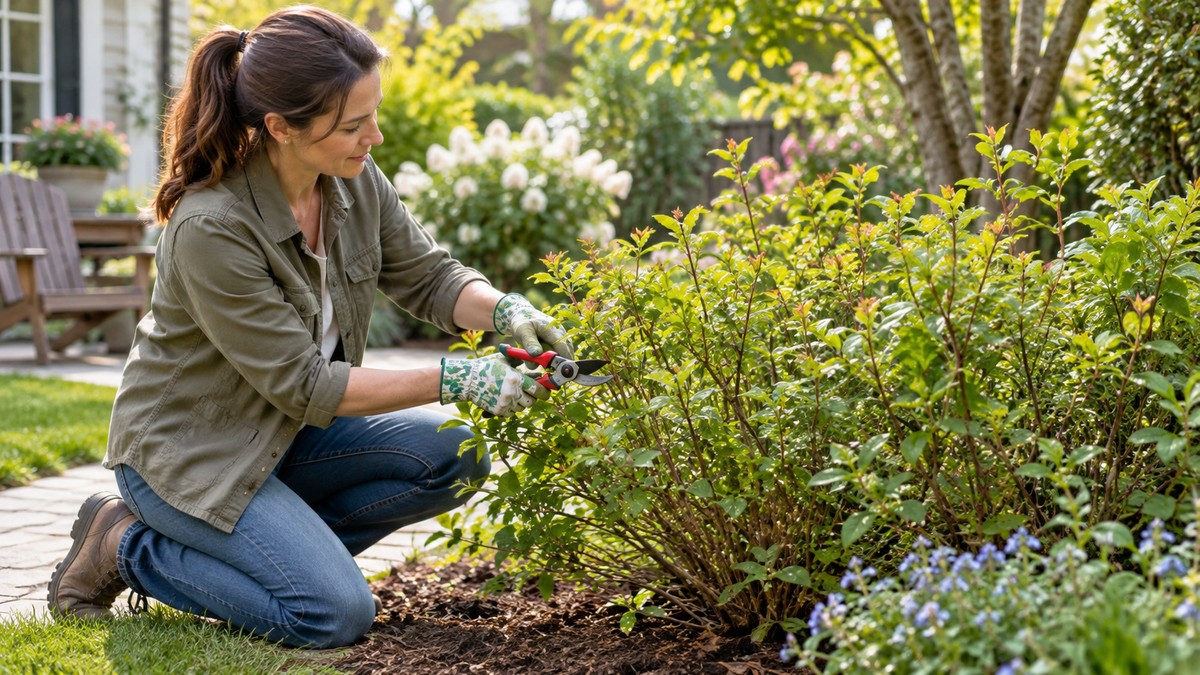
How to Prune Shrubs in Spring
As an Amazon Associate we earn from qualifying purchases.
How to prune shrubs in spring depends on one question: when does the shrub set its flower buds? Some shrubs bloom on last year’s growth and should be cut right after they flower, which is often in spring. Others bloom on the current season’s growth and are pruned in early spring. Get the bloom time right, and spring pruning helps the shrub. Get it wrong, and you can cut off the year’s flowers.
Quick answer
- Prune spring-flowering shrubs right after they bloom. Cutting them in late winter or early spring removes many of the flower buds.
- Prune summer-flowering shrubs in early spring, before growth starts.
- Remove dead, dying or broken branches at any time, as the Illinois Extension page says.
- For an old shrub, thin out the oldest stems in early spring, when the branches are still leafless.
Check bloom time before you cut
Penn State Extension calls pruning “an important horticultural technique to maintain the health and appearance of flowering shrubs.” The timing question decides whether that technique helps the shrub or costs it a season of flowers.
Penn State Extension gives a rough rule of thumb: prune spring-blooming shrubs “soon after they finish flowering” because most bloom on old wood, which means they set next year’s flower buds soon after this year’s flowers fade. Shrubs that bloom later in summer and fall are different. Penn State says they “should be pruned in late winter or very early spring before they develop new foliage.”
Colorado State University Extension uses the same split, described by wood age. Spring-flowering shrubs “bloom on one-year-old wood (new twigs that grew the previous summer).” Summer-flowering shrubs “bloom on new wood that grew earlier in the current growing season.” The wood that carries the flowers is the thing to protect, so ask which group your shrub is in before you pick up the shears.
Spring bloomers: prune after the flowers
Forsythia and lilac are the usual examples of spring bloomers. Iowa State Extension says “The best time to prune healthy, well-maintained spring-flowering shrubs is immediately after flowering.” That gives the shrub time to set buds for next year before the next cut.
The timing mistake is easy to make. Penn State warns that “If you wait too long to prune them, you will remove many of next year’s blooms when you prune.” The University of Wisconsin page puts the window in one line: prune these shrubs “AFTER they have flowered in spring, but before the next year’s flower buds are set.” Pruning in winter or early spring, as many gardeners do, “will remove many of the flower buds.”
Light pruning right after flowering keeps the display intact. Colorado State University Extension also recommends that gardeners “deadhead” spent blooms on spring-flowering shrubs, meaning they remove flowers after they fade. It notes that “deadheading conserves the plant’s energy, which would otherwise be spent on seedpod and seed development.” Heavy pruning is a different job. Iowa State Extension says “Heavy pruning in late winter or early spring will reduce or eliminate the flower display on spring-flowering shrubs for 2 or 3 years.” Plan a heavy cut for a year when you can accept a season with few or no flowers.
Summer bloomers: early spring is the window
Summer-flowering shrubs are the easier group in spring. The Wisconsin page says that “Summer-flowering shrubs produce flower buds on new growth in the spring.” It advises that you “Prune these shrubs when they are dormant or in early spring before budbreak.” Iowa State Extension gives potentilla and Japanese spirea as examples and says “Prune summer-flowering shrubs in late winter or early spring.”
Illinois Extension draws the line at July 1: “Summer blooming shrubs, or those that bloom after July 1, produce blooms on the current year’s growth.”
The reason is the wood. A summer bloomer makes its flowers on this year’s new shoots, so an early spring cut does not remove the buds. Colorado State University Extension adds that summer bloomers “can be pruned by thinning or rejuvenation pruning in the early spring before growth starts.” A cut made after growth starts costs some of the new wood that would carry the flowers.
Iowa State Extension’s late-summer warning covers deciduous shrubs of every kind. It matters more than any single spring date, because the new growth from a late cut may not harden before cold weather.
Remove dead, dying and broken wood
Dead wood does not wait for the calendar. The Illinois Extension page says “Timing will depend on the species, but any time is a good time to remove dead, dying, or broken branches.” In spring, that means you can clear winter damage as soon as you see it, whether the shrub blooms before or after the spring cut.
Because the Illinois page says any time works, dead wood does not need to wait for the bloom-timing rule that governs the flowering cut.
Thin and renew in early spring
Thinning removes whole stems at their base, which opens the shrub to air and light. Penn State Extension says “Thinning cuts are preferable because they open the shrub up to sunlight and air circulation.” The method Colorado State describes for flowering shrubs is to “remove one-third of the oldest wood to the ground each year.” Colorado State says thinning is “more easily done before growth starts using leafless branches in early spring”, which is why the early spring window suits it.
Penn State Extension adds a separate case for suckering shrubs: “Shrubs with a suckering growth habit, such as forsythia and lilac, should periodically have the oldest, biggest stems removed at ground level.” It also says “This can be done all at once if the shrub is healthy and thriving.” Colorado State notes that “Removing older canes of flowering shrubs by thinning also allows for better sunlight penetration into the shrub.”
Rejuvenation is the heavier cut for an overgrown shrub. Colorado State says “The shrub is cut entirely to the ground in the early spring before growth starts.” That renews the plant from its roots, but it has a cost. Colorado State notes that “Spring-flowering shrubs will not bloom the year of rejuvenation.” Iowa State Extension gives the same warning about heavy spring cuts, with a longer gap of two or three years for the flower display to return.
The Penn State page adds a practical rule for hard pruning: “Hard pruning should always be done in early spring, before the shrub begins to develop new foliage.” With the branches leafless, you can see the stems and their positions before you cut.
Pinch for shape in spring
Pinching removes the tips of shoots so that the shrub branches more. The Wisconsin page says that “This type of pruning can be done on smaller shrubs in spring, or on certain evergreens.” The same page says “Pinching increases the bushiness of a shrub.” Pinching is a light way to shape a young shrub without a heavy cut.
What to avoid in the calendar
The late-summer cut is the one to skip. Iowa State Extension says “Do not prune deciduous shrubs in late summer.” It adds that “Pruning shrubs in August or early September may encourage a late flush of growth.” The Illinois page gives the reason: a late flush “will not have the opportunity to harden off before winter.”
Shaping a spring bloomer after midsummer is also a mistake. Colorado State University Extension notes that “Shaping spring-flowering shrubs after midsummer removes the new wood with next year’s blossoms.” Shearing a forsythia into a ball in July removes the buds it will flower from next spring, so keep the shape work for the right season.
Colorado State University Extension also warns about shearing as a habit. It notes that “Shearing shrubs to round balls or other desired shapes is a common pruning technique because it is quick and easy.” Over time, the plant “becomes thicker and bushier toward the exterior”, and the result can be “a thin shell of foliage with a woody interior and base.”
For a shearing tool, see our notes on hedge shears. For cleaning up and storing the cuttings and tools after a session, see our notes on garden tool storage.
Shrubs grown for bark or fruit
Some shrubs are grown for their colored bark or fruit rather than their flowers. Iowa State Extension says “Some deciduous shrubs don’t produce attractive flowers, such as burning bush.” It adds that “These shrubs may possess colorful bark, fruit, or foliage.” For that group, the page’s timing is to “Prune these shrubs in late winter or early spring before growth begins.”
Colorado State University Extension makes a related point about bark color. It says that on shrubs “noted for their bark color, like red-twig dogwood”, the new growth is brighter, and that “Routine pruning by thinning at the base encourages new shoots which have the desired red color.” For those shrubs, thinning at the base does the work that the flowers would otherwise do.
Exceptions this guide does not cover
This guide covers flowering shrubs. Evergreen shrubs, trees, roses and vines follow their own timing in the Iowa State and Illinois pages, and those rules are not part of this draft. The Iowa and Illinois pages also give oak timing tied to a disease concern. This guide does not address that concern, so oaks are outside its scope.
A quick checklist
| Shrub group | When to prune | Source |
|---|---|---|
| Spring bloomers (for example forsythia and lilac) | Right after flowering; not in late winter or early spring. | Penn State Extension; Iowa State Extension; Wisconsin Extension |
| Summer bloomers (for example potentilla and Japanese spirea) | Late winter or early spring, before growth starts. | Iowa State Extension; Wisconsin Extension |
| Dead, dying or broken wood | Any time. | Illinois Extension |
| Thinning an old shrub | Early spring, using leafless branches; remove one-third of the oldest wood each year. | Colorado State University Extension |
| Rejuvenation | Early spring before growth starts; no spring bloom that year. | Colorado State University Extension |
| Late summer | Avoid for deciduous shrubs. | Iowa State Extension; Illinois Extension |
How we chose
We opened extension pages from five universities and kept a page only when it states the timing rule in plain words. We checked each quoted sentence against the text of the page as fetched on 2026-10-22. Where pages differ, we say so and give the rule each one states.
We did not rank pruning tools or shrubs, and this guide does not recommend a product. Pages that returned errors when opened are not cited.
What we could not verify
Pruning timing depends on the shrub, the climate and the local season, and the pages we opened give rules rather than dates. The points below are either missing or stated only in general terms.
What the sources do not say
- No source we opened gives a calendar date for spring pruning. The rules depend on bloom time, and the pages do not match each rule to a date for every region.
- The sources do not list every shrub by bloom group. The examples given, such as forsythia, lilac, potentilla and Japanese spirea, are the ones the pages name.
- The pages do not say how much of a damaged shrub to remove in one spring session, beyond taking the dead and broken wood first.
- The Colorado and Iowa pages give rejuvenation timing, but neither says how many years a shrub takes to recover fully.
- The pages give no tool recommendations, and this guide makes none.
Frequently asked questions
Should a lilac be pruned in spring?
Lilac is a spring bloomer, and the sources say to prune spring bloomers right after they flower. Cutting in late winter or early spring removes many of the flower buds, according to the Wisconsin page.
When is the best time to prune a summer-flowering shrub?
Early spring, before growth starts. The Wisconsin page says to prune these shrubs when they are dormant or in early spring before budbreak, and Iowa State Extension gives the same window.
Can dead branches be cut in spring?
Yes. The Illinois Extension page says any time is a good time to remove dead, dying or broken branches.
How much of an old shrub should be cut back?
Colorado State University Extension describes annual thinning of one-third of the oldest wood. A full renewal cut to the ground is a heavier step, and it removes the year’s flowers for a spring-flowering shrub.
Is late summer a good time to prune a shrub?
No. Iowa State Extension says not to prune deciduous shrubs in late summer, because the new growth may not harden before cold weather.
Sources
- https://extension.psu.edu/pruning-flowering-shrubs (opened 2026-10-22)
- https://yardandgarden.extension.iastate.edu/how-to/proper-time-prune-trees-and-shrubs (opened 2026-10-22)
- https://extension.illinois.edu/news-releases/trim-trees-shrubs-dormant-season-stronger-healthier-plants (opened 2026-10-22)
- https://extension.colostate.edu/resource/pruning-flowering-shrubs/ (opened 2026-10-22)
- https://hort.extension.wisc.edu/articles/pruning-deciduous-shrubs/ (opened 2026-10-22)