How to Plant a Tree in the Ground
As an Amazon Associate we earn from qualifying purchases.
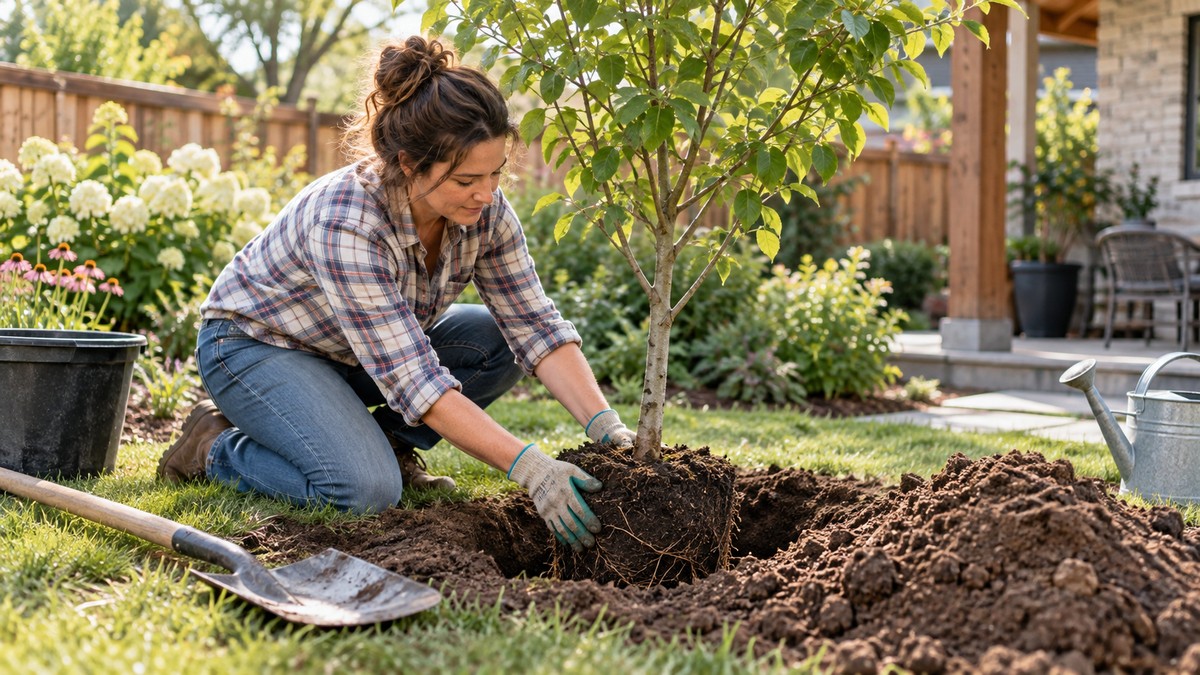
How to plant a tree in the ground starts before the shovel comes out. Four extension pages agree that the first job is finding the root flare, the spot where the trunk widens into roots, and planting so that the flare sits at or just above the soil line. The hole, the backfill, the mulch and the first season of watering all follow from that. This guide sets out the steps from the Colorado State, Clemson and Kansas State pages and marks where they differ.
Quick answer
- Find the root flare before you dig, and remove soil from the trunk until you can see it.
- Dig a hole about two to three times the width of the root ball, with its depth set from the bottom of the root ball to the flare.
- Set the flare at or just above the ground, backfill without amendments, and water deeply during the first season.
- Call 811 at least two full working days before you dig.
Find the root flare first
The Colorado State Forest Service page puts the flare first: “This flare is what must be located before digging a hole and planting the tree.” It explains the problem: “Container trees often have too much soil over their root system”, because nurseries pot up young trees as they grow. Kansas State says to “Gently remove excess soil to expose the root flare”, and the Colorado State University page warns “Be careful not to mistake the swollen graft union as the root flare.”
Work with your hands first. The Forest Service page advises: “Use your fingers and hand tools to gently remove soil from around the trunk to find the root flare.” Roots that sprout from the trunk above the flare are a separate matter. That page says they “can be left exposed and will dry out and die or you can remove them with a sharp pruning tool.”
Call 811 before you dig. The Kansas State guide says “Call 811 at least two full working days before digging to find out where underground utility lines are buried.” The Colorado State University page also points to a state locate service, so check your own state’s system before the first cut.
Measure the hole and compare the figures
The pages agree on the principle but not on every number. The table lists what each page states, and it marks a missing figure as Not stated.
| Extension page | Hole width | Root flare or root ball top | Mulch | Wrap at planting |
|---|---|---|---|---|
| Colorado State Forest Service | At least 3 times the root ball width | Root flare 1 to 2 inches above ground | 3 to 4 inches, kept off the root ball and trunk | Not stated |
| Clemson Extension | Not stated | Root collar no more than 2 inches above grade | Not stated | Remove labels, ties and trunk wrap |
| Kansas State Research and Extension (MF3313) | 2 to 3 times the root ball diameter | Flare slightly above or even with the ground | 2 to 4 inches, at least 4 inches from the trunk | Remove the top third to one half of burlap and wire basket |
| Colorado State University Extension | 3 times the root ball width | Top of root ball 1 to 2 inches above grade | Four to five inches of arborist chips, not on the root ball | Remove the upper 12 inches or upper two-thirds, whichever is greater |
Depth matters most. The Forest Service page says the depth “should be measured from the bottom of the root ball to the root flare”, and that the flare “should sit slightly above ground level by 1-2 inches”, so the soil does not settle over it. The Colorado State University page makes the same point from the other side: “In tree planting, the root ball should sit on undug soil.” It adds: “This prevents the tree from sinking and tilting as the soil settles.”
Width is where the figures split. The Kansas State guide says “Dig a shallow, saucer-shaped hole two to three times the diameter of the root ball”, and it wants a hole “wide enough to encourage root growth but no deeper than the root flare.” The Forest Service and Colorado State University pages both say three times. The Forest Service page explains the reason: “New roots can grow into disturbed and loosened soil much easier than undisturbed and compacted soil.”
Remove circling and girdling roots
Circling roots need attention before the tree goes in. The Forest Service page says “It is critical to remove any roots that cross or circle the trunk.” The Kansas State guide explains the risk: “Left undisturbed, circling roots can restrict root growth and may girdle the stem.”
The methods differ. The Forest Service page calls the old practice ineffective: “The old recommendation to address girdling roots was to take something sharp and slice through the roots, but research proved that was ineffective.” Its replacement is “The new recommendation is to shave off about 1 inch of the outer periphery of the root system or until you no longer see circling roots.” The Clemson guide asks for slices instead, four vertical cuts along the outer edges of the root ball, about half an inch deep. The Colorado State University page says to shave the outer 1 to 1½ inches of the root ball with a saw or pruners. The pages do not agree on whether to slice or shave, so follow the one you use and note the difference.
Larger roots need a saw or heavy pruners. The Clemson guide says “Cut girdling roots using hand pruners, pruning saws or loppers.” The Forest Service page adds that “It is important to sanitize your pruning tools before cutting roots and between cuts to minimize the chance of introducing bacterial or fungal diseases.”
Set the tree and backfill
Check the tree’s position from more than one angle. The Clemson guide says “View tree from different angles; ask others to help you determine if centered and straight.” It also says “Be sure tree is in an upright position and is not leaning.”
Backfill with the soil you dug out, and do not bury the flare. The Kansas State guide says “Do not bury the root flare.” It also says “Do not amend with organic matter.” It explains why: “This may negatively influence water movement into or out of the root ball, and it does not help root establishment.”
Firm the soil as you go. The Clemson guide asks you to backfill gently and firmly, tamping out air pockets so that roots do not dry out. The Forest Service page says to water between additions: “After adding the backfill, water gently to allow the soil to settle, then add more backfill, water and repeat as necessary.” Kansas State builds a soil ring as well: “This donut-shaped enclosure prevents runoff and holds water until it is absorbed by the root ball.”
Handle burlap, wire baskets and containers
Container trees come out gently. The Clemson guide warns against yanking the tree by its trunk. Kansas State says “Squeeze the sides of the container to loosen the root ball.” For circling roots inside the pot, it says “Gently tease apart the root ball with your fingers or shave the outer edge with a sharp spade or knife to release roots from their containerized shape.”
Balled-and-burlapped trees need different handling. The Kansas State guide says “Once the tree is in place, remove balling ropes and the top one-third to one-half of the burlap and wire basket.” The Colorado State University page sets a rule based on research: remove the wrapping “from the upper twelve inches or 2/3 of the root ball, whichever is greater” It warns that “Leaving burlap, twine, and wire baskets on the sides of the root ball are not acceptable planting techniques.” It adds that “The materials left in the planting hole are not a concern since roots grow outward, not downward.”
The Clemson guide adds a general rule for all trees: “Remove all labels, tags, ties, trunk wrap and other supporting materials.” It says these “may interfere with proper development and growth.”
Water through the first season
Watering methods differ. The Forest Service page gives a volume rule: “The general rule for newly planted trees is to apply 1-2 gallons of water per inch of trunk diameter 3-4 days/week, depending on the temperature and wind.” The Kansas State guide uses a probe instead: “Keep the top 2 to 3 inches of the root ball moist.” It says to “Check soil moisture regularly by probing the soil with your finger”, and, when it is dry, “water deeply.” A gentler nozzle can help with that job, as covered in hose attachments for watering plants.
Each approach focuses on the first season. The Forest Service page says “For the first growing season, focus your watering on establishing healthy roots growing out into the site soil from the root ball.” Kansas State adds: “Be careful not to overwater during tree establishment.” Its drainage check is simple: “Notice how long it takes water to soak into surrounding soil. If it takes longer than 10 minutes, this indicates poor drainage.”
Only the Kansas State guide gives a winter figure: “During the winter, water monthly if less than an inch of rain or about 10 inches of snow is received.”
Mulch, stakes and pruning
Mulch the planting area, not the trunk. The Kansas State guide says “Apply 2 to 4 inches of mulch evenly around the tree”, and “Keep mulch at least 4 inches from the trunk.” It warns: “Do NOT mound or create a volcano-shaped pile that can harm the tree.” The Colorado State University page uses deeper arborist chips, “four to five inches”, and says “do NOT place mulch on top of the root ball.” The Forest Service page adds a reason to keep mulch off the flare: “Mulch on the root flare can increase the potential for adventitious roots which can later become circling roots.”
Stakes are optional. The Forest Service page says “They should be removed after one growing season (1-year).” It also says that for the most part a tree in a homeowner’s yard should not need staking. Kansas State says “Stake if necessary to keep the root ball in place”, and “Remove after one year.”
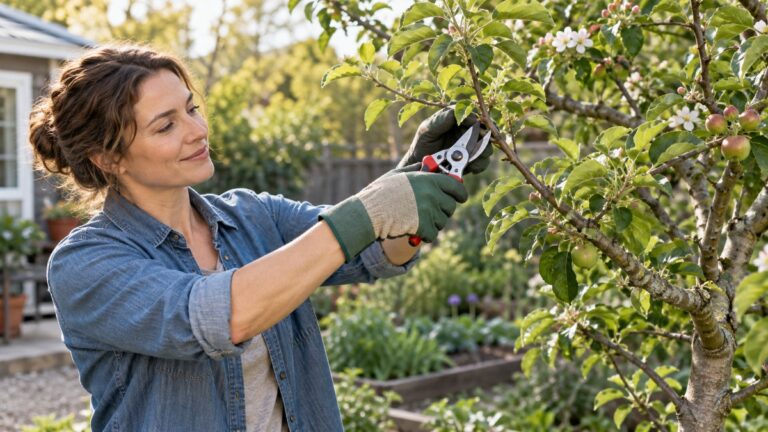
Prune lightly at planting. The Kansas State guide says “The tree should have one dominant stem (leader)”, and it advises that you “Prune competing stems back to their place of origin.” The Clemson guide asks for cuts “just outside forks (nodes), preserving branch collar (swollen area)”, and it adds “Do not leave branch stubs.”
How we chose
This guide uses four extension pages, from the Colorado State Forest Service, Colorado State University Extension, Clemson Extension and Kansas State Research and Extension, all opened on 2026-10-22. We kept a step only when a page states it in plain words, quoted the exact sentence where the wording matters, and showed both figures when two pages disagreed. Where a page was silent, the table says Not stated. We did not use retail listings or nursery sales copy.
What we could not verify
The four pages cover the planting steps well, but they leave gaps. None of them gives a planting season, so this guide cannot say whether spring or fall suits your area. The hole widths, mulch depths and wrap rules differ, and the pages do not say which figure fits your soil. This guide also does not name tree species or sizes, and it does not recommend a stake kit or any other product.
What the sources do not say
- None of the four pages gives a planting date, so the timing for your region is left open.
- No page gives a hole width that fits every soil, and the Kansas State and Colorado State University figures differ.
- The Clemson page gives no mulch depth and no hole width.
- No page covers planting on a slope or in heavy clay.
- Only the Kansas State guide gives a winter watering figure, and it does not say how long to keep that schedule.
Frequently asked questions
How deep should the hole be?
Measure from the bottom of the root ball to the root flare, and dig only as deep as that distance, so the flare sits at or just above the ground. The Forest Service page gives 1 to 2 inches above grade, and Kansas State says the flare should be slightly above or even with the ground.
Should compost go into the backfill?
The Kansas State guide says not to amend the backfill with organic matter, because it can change how water moves into and out of the root ball. The Forest Service page agrees that compost and other amendments are not needed in the backfill. For building organic matter elsewhere in the yard, see how to make a compost pile.
How much water does a new tree need?
The Forest Service page offers a volume rule of 1 to 2 gallons per inch of trunk diameter, three to four days a week, depending on temperature and wind. The Kansas State guide prefers checking the soil: probe the top 2 to 3 inches of the root ball and water deeply when it is dry.
Does burlap need to come off?
Remove the top part at least. The Kansas State guide says to remove the top third to one half, and the Colorado State University page says to remove the upper twelve inches or the upper two-thirds, whichever is greater. That page also says leaving the wrap on the sides is not acceptable, so cut it back from the top.
Does a new tree need a stake?
Often it does not. The Forest Service page says most trees in a homeowner’s yard should not need staking, and that stakes should go low on the trunk with fabric straps rather than tight wire. Both the Forest Service and Kansas State pages say to remove stakes after one growing season.
Sources
- https://csfs.colostate.edu/forests-trees/selecting-planting-and-caring-for-trees/how-to-plant-a-tree/ (opened 2026-10-22)
- https://www.clemson.edu/extension/bradford-pear/files/how-to-plant-a-tree-1page.pdf (opened 2026-10-22)
- https://bookstore.ksre.ksu.edu/pubs/MF3313.pdf (opened 2026-10-22)
- https://extension.colostate.edu/resource/tree-planting-steps (opened 2026-10-22)