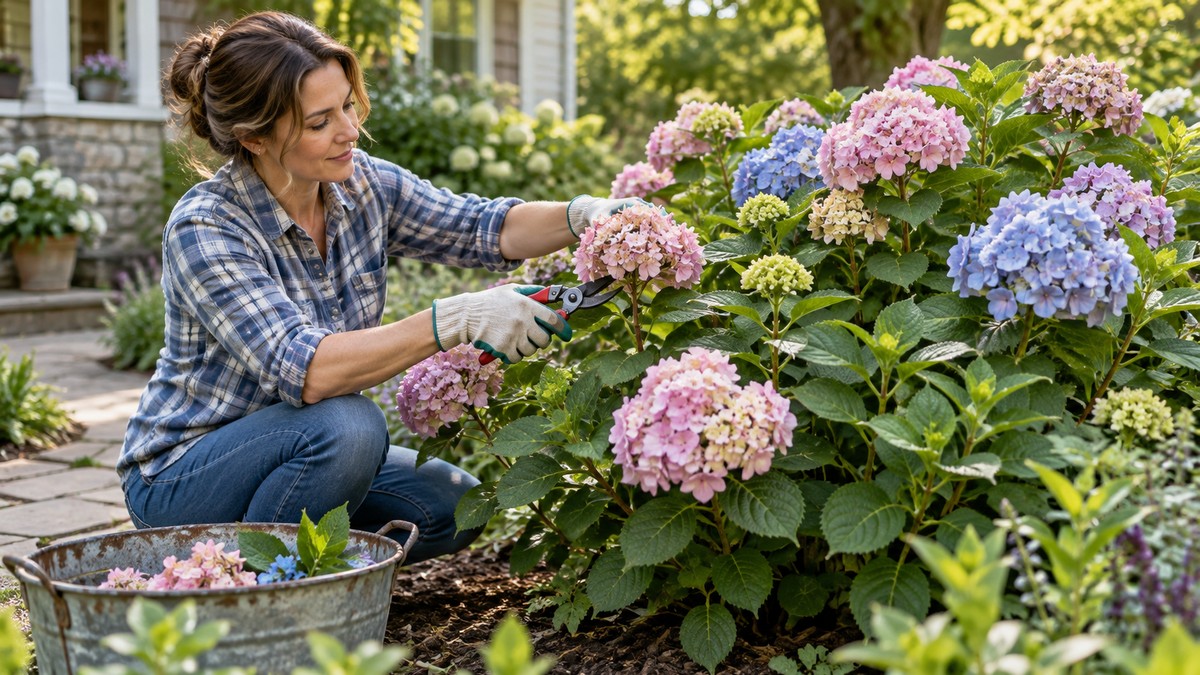
How to Prune Hydrangeas
As an Amazon Associate we earn from qualifying purchases.
Learning how to prune hydrangeas starts with one question: does your shrub set its flower buds on last year’s growth, or on the growth it makes this spring? Get that answer right and the cut is straightforward. Get it wrong and you can remove a whole season of blooms. The university extension pages we opened agree on the timing for each group, and they set a clear limit on how much to remove in a single year. This guide covers those rules, the exceptions, and the mistakes that most often stop a hydrangea from flowering.
Quick answer
- Bigleaf and oakleaf hydrangeas bloom on old wood, so prune them soon after the flowers fade in summer.
- Panicle and smooth hydrangeas bloom on new wood, so prune them in late winter or early spring, before new growth starts.
- Remove no more than about a third of a bigleaf plant’s growth in one year, and check for winter-damaged stems once new leaves appear.
Why prune at all?
Pruning is not only about looks. The Iowa State University guide says proper pruning helps maintain plant health, controls or shapes plant growth, and stimulates flower development. Those three goals pull in slightly different directions. Shape is the easiest to see, but flower production is the one most gardeners want, and it is the one that a badly timed cut can damage. That is why the timing question comes first.
Find out which type you have
The pruning rule depends on where the shrub makes its flowers. Old wood is the growth from last season, and new wood is the growth the plant produces this year. The Illinois Extension guide puts the choice in those terms: the timing depends on whether the hydrangea blooms on old wood or new wood. Some species bloom on one, some on the other, and a few cultivars do both. That is why guessing from the plant’s size can go wrong. If you do not know the type, the Illinois guide says a simple look at the leaves and the flowering pattern can help you decide.
The table below puts the timing from the four extension pages side by side. Where two pages differ, the table says so.
| Type | Blooms on | Best time to prune | What the sources add |
|---|---|---|---|
| Bigleaf (Hydrangea macrophylla) | Old wood | Right after flowering, in summer | Pruning after September removes flower buds (Cornell) |
| Oakleaf (Hydrangea quercifolia) | Old wood | Soon after flowering | Performs best with minimal pruning (Iowa State) |
| Mountain (Hydrangea serrata) | Mostly old wood | Immediately after blooming | Pruned in the same way as bigleaf (Iowa State) |
| Climbing (Hydrangea anomala subsp. petiolaris) | Old wood | After flowering, only if needed | Little or no pruning needed (Cornell) |
| Panicle (Hydrangea paniculata) | New wood | Late winter or early spring | Up to one-third to one-half of the shrub can be removed (Illinois) |
| Smooth (Hydrangea arborescens) | New wood | Late winter or early spring, before leaf-out | Cornell allows cutting to 6 to 12 inches above ground; Iowa State says it can go to the ground |
Bigleaf and mountain hydrangeas: prune right after bloom
Bigleaf hydrangeas set their flower buds on old wood in late summer and fall, according to the Clemson HGIC guide. That timing is the reason the cut belongs right after the flowers fade. Cornell’s sheet says to prune as soon as the flowers have faded, and it warns that early spring pruning in March sacrifices the bloom for that growing season. The Illinois guide reaches the same point: bigleaf blooms on old wood and should be pruned just after flowering.
Cornell also gives a practical rule for these plants. Keep several stems of old, productive wood, and make sure enough sturdy new stems are coming along to flower the following season. Clemson adds a limit: remove only about a third of the plant’s total growth in a year. Taken together, the two rules point toward gradual thinning rather than cutting the plant back hard in a single season.
Mountain hydrangeas follow the same logic. Cornell says any pruning should be done immediately after they bloom, and Iowa State says they are pruned in the same way as bigleaf types. Winter-killed branches are a separate matter. Cornell notes that they can be removed in spring once it is clear they are not alive.
Endless Summer and other reblooming bigleaf types
Some newer bigleaf cultivars change the rule. The Clemson guide notes that the first flush of flowers on the Endless Summer series usually forms on old wood, so any needed pruning still happens right after that first bloom. The flower buds then form on new wood, which is why these plants can bloom again through the summer. Cornell names other reblooming types, including ‘Red Sensation’ and ‘Double Pink’, and says they will bloom again on the current year’s growth if faded blooms are removed regularly.
Iowa State adds a local note. In its guide, older bigleaf cultivars such as ‘Nikko Blue’ do not bloom well in Iowa, because the plants often die back to the ground in winter. Newer types can bloom on last year’s growth after a mild winter. After a cold winter, the Endless Summer type and similar cultivars die back to ground level and bloom in late summer on the current year’s growth. That local pattern is a reason to check how your shrub came through the winter before you decide how much to cut.
Panicle and smooth hydrangeas: prune in late winter or early spring
Panicle and smooth hydrangeas make their flowers on the growth they produce in the current season. The Clemson guide says they can be pruned while dormant and before new growth begins, and the Illinois guide says panicle flowers develop on new wood, so pruning belongs in late winter or early spring. Because the buds that open this summer form on new growth, cutting the plant back in late winter does not remove them.
Panicle size can be managed in steps. Iowa State advises removing a few branches in March or early April to reduce the size of the shrub. It also notes that large, old panicle hydrangeas can be rejuvenated by removing several of the largest stems near ground level in late winter or early spring. Illinois says that for new-wood types you can remove as much as one-third to one-half of the shrub’s total mass. The guides differ in emphasis, so a lighter first cut lets you see how the plant responds before you take more.
Smooth hydrangeas tolerate harder cutting. Cornell’s chart allows cutting them back to between 6 and 12 inches above ground, and Iowa State says they can be pruned back to the ground in late winter or early spring. Cornell also notes that if you want a larger shrub, you should prune less severely. The sources agree on timing and differ on how low to cut, so choose the height you want the shrub to hold for the season.
Oakleaf and climbing hydrangeas: cut lightly after bloom
Oakleaf hydrangeas flower on old wood. The Clemson guide says to prune them soon after flowering to keep their height and shape, which gives the plant time to set buds for the next year. The Iowa State guide goes further and says the species performs best with minimal pruning. When a stem does need cutting, prune it back after flowering. Winter-damaged stems can be removed in early spring, once the new leaves appear, as Cornell and Iowa State both describe.
Climbing hydrangeas need the least attention of any type. Iowa State says the vine does best when it is not pruned at all, and that wayward stems can be pruned back after flowering. Cornell’s sheet adds that the climber requires very little or no pruning, and that shoots which have grown out of bounds can be shortened in summer right after blooming. Winter-damaged stems can be pruned out in spring, as with the other types.
Winter damage and missing blooms
Cold weather causes much of the trouble. The Cornell sheet lists three reasons a hydrangea may not bloom: too much shade, improper pruning by people or by deer, and winter injury to stems or frost damage to flower buds. Cornell says the winter and frost problem is especially likely with bigleaf and mountain hydrangeas. The Illinois guide names insufficient sun, an early frost and incorrect pruning as the usual causes of a season without flowers.
When bigleaf stems die back over winter, the timing of the cut matters. Iowa State advises waiting until the shrubs begin to leaf out before pruning bigleaf hydrangeas, and then removing all dead wood once growth appears. Cornell gives a similar rule for plants that were left unprotected. Delay pruning until the buds swell, so you can see which wood is dead, and then cut back to below the point of injury. Cornell also suggests that winter protection can help preserve buds for the following year, and it recommends tying the shoots together and wrapping them with burlap.
Late cutting in the fall costs flowers too. Cornell says that pruning bigleaf too late in the fall, after September, eliminates flower buds, and that any new growth will not develop enough maturity before winter. In practice, that means the fall tidy-up should leave bigleaf stems alone and wait for the summer window.
A seasonal plan for your shrubs
- Summer, after bloom: bigleaf, mountain, oakleaf and climbing types, and only as much as needed.
- After September: leave bigleaf types alone, since Cornell says late cutting removes flower buds.
- Late winter to early spring, before leaf-out: panicle and smooth types.
- Spring, after the new leaves appear: remove winter-damaged stems and any dead wood that shows.
Mistakes that cost blooms
- Cutting bigleaf or mountain types in March. Cornell says early spring pruning sacrifices that season’s bloom.
- Cutting bigleaf types after September. Cornell says the cut eliminates the flower buds.
- Letting the shrub stay too shaded. Cornell lists too much shade as one reason hydrangeas stop flowering.
- Cutting before checking winter damage. Iowa State and Cornell both say to wait until new growth shows so you can see which wood is dead.
A checklist before you cut
Before you pick up the pruners, run through these checks in order. Each step draws on the extension pages named above.
- Identify the type by its bloom wood, using the table above or the leaves and flowering pattern described by Illinois.
- Check the calendar. If the plant is bigleaf or mountain and the flowers have just faded, the window is open. If it is late fall or early March, wait.
- Look for winter damage. Dead stems on bigleaf plants may only show once leaves begin to open.
- Decide how much to remove. Clemson suggests a third for bigleaf, and Illinois allows up to one-half for panicle and smooth types.
- Keep the tools clean and sharp. The tree guides in this series advise pruning tools made for the job, kept sharp and clean.
For thicker stems, a larger pair of pruners may be the better choice. Our guide to pruners for heavier stems covers that option, and our guide to pruner sharpeners covers keeping the blades in good shape.
How we chose
This guide uses four university and extension pages that we opened and read on 2026-10-22: the Clemson Cooperative Extension HGIC guide, the Iowa State University Extension and Outreach guide, the University of Illinois Extension Good Growing post, and a Cornell Cooperative Extension Orange County sheet. We chose them because each one names the hydrangea types it covers and gives a timing for each. We checked each quoted sentence against the text of the page it came from. We left out gardening blogs, nursery pages and retail listings. Several other hydrangea pages returned errors or were not extension pages, so they are not used. We did not rank any products.
What we could not verify
The rules above come from species descriptions in extension guides, and they apply to the types those guides name. The points below mark the limits of what the sources say.
What the sources do not say
- The sources do not say how to tell a cultivar’s bloom habit from its name alone, so the pages cannot settle every label.
- No page gives a rule for cutting back a bigleaf hydrangea that died to the ground in winter beyond waiting for leaf-out and removing the dead wood.
- Smooth hydrangea cut heights differ between the Cornell chart and the Iowa State guide. Neither page explains the difference.
- The hydrangea pages are silent on cut angles, bud position and tool choice for shrubs. The tool advice in the checklist comes from a tree guide.
- The Illinois and Cornell pages do not give a date for when a late frost stops being a risk in a given region, so the timing relies on the bloom and leaf-out signs.
Frequently asked questions
Can you prune a hydrangea in the fall?
Not if it is a bigleaf type. Cornell says pruning after September eliminates the flower buds. For panicle and smooth types the guides name late winter or early spring, and none of the pages we opened gives a fall window for them.
Your hydrangea did not bloom last year. Did the pruning cause it?
It may be the pruning, but it may be something else. Cornell lists too much shade, improper pruning by people or by deer, and winter or frost damage to flower buds. The Illinois guide adds an early frost to the list of likely causes.
Should you cut back a bigleaf hydrangea that died to the ground in winter?
Wait until the shrub begins to leaf out, then remove the dead wood, according to Iowa State. Cornell suggests waiting until the buds swell so you can see which stems are dead, and then cutting back below the point of injury.
Is Endless Summer pruned the same way as other bigleaf hydrangeas?
The Clemson guide says the first flush of Endless Summer flowers forms on old wood, so pruning belongs right after that bloom. Later buds form on new wood, which is how the plant reblooms through the summer.
How much of the plant can you remove in one year?
For bigleaf types, Clemson advises removing only about a third of the total growth. For panicle and smooth types, Illinois says you can remove as much as one-third to one-half of the shrub’s total mass.
Sources
- Clemson Cooperative Extension, Home and Garden Information Center, Pruning Hydrangeas: https://hgic.clemson.edu/pruning-hydrangeas/ (opened 2026-10-22)
- Iowa State University Extension and Outreach, Yard and Garden, Pruning Hydrangeas: https://yardandgarden.extension.iastate.edu/how-to/pruning-hydrangeas (opened 2026-10-22)
- University of Illinois Extension, Good Growing, How to properly prune hydrangeas: https://extension.illinois.edu/blogs/good-growing/2022-03-10-how-properly-prune-hydrangeas (opened 2026-10-22)
- Cornell Cooperative Extension, Orange County, Hydrangeas: Types and How to Prune: https://dlc.cce.cornell.edu/pluginfile.php/376773/mod_resource/content/1/Hydrangeas%20-%20Types%20and%20How%20to%20Prune.pdf (opened 2026-10-22)