How to Prune Blackberries
As an Amazon Associate we earn from qualifying purchases.
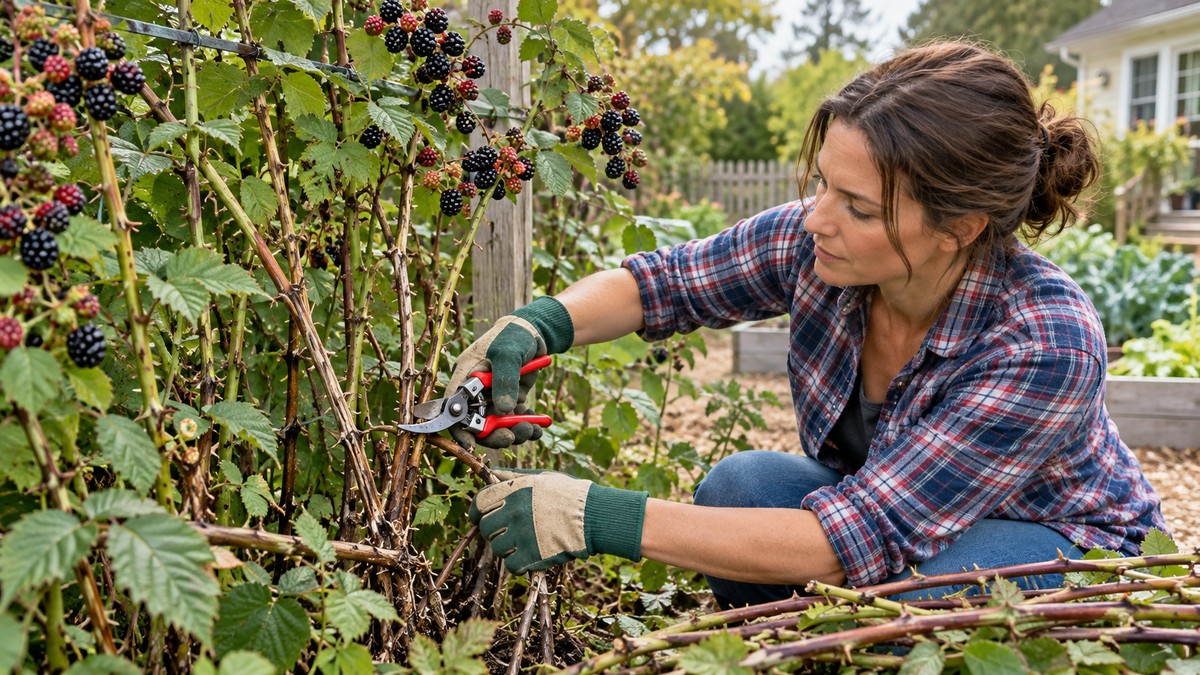
How to prune blackberries starts with knowing which canes bear fruit. Blackberry canes are short-lived. Illinois Extension says it plainly: “Brambles bear fruit on canes that live for two years.” The first-year canes, called primocanes, grow in summer and bear fruit in the following season as floricanes, and the floricanes die after harvest. Pruning is therefore about three jobs: removing the spent canes, tipping the new ones and keeping the right number for the plant.
Quick answer
- Remove spent floricanes after harvest, because they will not produce another crop.
- Tip new primocanes in early summer, at about 36 to 40 inches for the UConn guide or 4 to 5 feet on a trellis for the Florida guide.
- Thin erect types to about three or four canes per linear foot of row.
- Prune dormant canes in late winter or early spring, and tie trailing and semi-erect types to a trellis.
Learn the two cane types
The job starts with telling the canes apart. Illinois Extension describes the cycle: “The first year, these new shoots are called primocanes.” Then, “In the second season, the shoots are called floricanes” and “After harvest, the floricanes gradually dry up and die.” The University of Florida guide adds a practical way to tell them apart: “Primocanes are easily distinguished from floricanes by their light-green leaves.”
The fruit comes from the older canes. The Florida guide puts it this way: “Also, floricanes will bear fruit while primocanes will not.” Its description of the older wood is useful when you walk the bed: floricanes are “woodier, darker canes” that flower in spring, set fruit in midsummer and die back after harvest. A healthy planting carries both types at once, so the pruning plan has to handle both.
The UConn guide adds a point about the base of the plant. “All the new canes on black raspberries and blackberries will only develop from the originally planted crown.” The canes come from the crown you planted, so a clean crown and a well-spaced set of canes give the best return on each year’s pruning.
The Florida guide gives a bark test that works at a glance: “Primocanes (younger canes) have light-brown bark and do not break easily if bent, while floricanes (older canes) have dark-brown bark and tend to break more easily.” It also expects both types on one plant: “A mature plant should have primocanes and floricanes growing simultaneously” so each type needs its own pruning rule. The older canes can grow to several feet in height if left unpruned, which is why the removal step matters.
Know whether your type fruits twice
Some brambles fruit twice on the same cane, which Illinois Extension calls everbearing, fall bearing, double cropping or primocane flowering. The same guide adds: “At present, only red and yellow raspberries are available as primocane-bearing cultivars.” For blackberries, the two-year cycle described above is the one to plan around. The guide also notes that “Erect blackberries and red or yellow raspberries develop primocanes from both the crown and roots” so the first-year canes come from the base of the plant and from its roots.
Remove the spent floricanes after harvest
This is the core job. The UConn guide gives the rule in short form: “Remove all spent fruiting canes (floricanes).” Its reasoning is the cycle: “After the floricanes have produced a crop, the floricanes will not produce another crop, and will need to be removed.” Illinois Extension gives the same rule for erect types: “Fruited canes of black and purple raspberries and erect blackberries should be removed after harvest.”
Remove weak, broken or diseased canes at the same time. The UConn guide says: “Remove all weak, broken, diseased canes.” The Florida guide adds that pruning removes “dead, diseased, and dry canes (branches) within the plant canopy,” which lets the plant produce enough flowers and fruit the next season. For a place to put the cut canes, see how to make a compost pile.
Tip the new canes in summer
Summer tipping shapes the canes that will fruit next year. The Florida guide explains the purpose: “Because fruit is produced on lateral branches, early summer pruning or tipping of primocanes is important to improve fruit yield.” It defines the cut: “Tipping refers to removing the tip of the primocanes during early summer pruning.” Illinois Extension notes the same growth pattern, saying that “Black raspberries, purple raspberries, and erect blackberries develop strong lateral branches when the new shoot tips are cut back early in the growing season.”
The height to tip at differs between guides, so the table shows each one.
| Source | Tipping height or timing | Setting |
|---|---|---|
| UConn Extension | 36 to 40 inches | Purple raspberries and blackberries |
| UF/IFAS (Florida guide) | 4 to 5 feet, tipped so laterals can train on the top wire | Trellised floricane blackberries in Florida |
| Illinois Extension | Early in the growing season, not a fixed height | Erect blackberries |
The Florida guide gives the method: “Primocanes can be easily tipped by hand in early summer when they are tender, but a pruner should be used later in the summer when the canes are thicker.” It also gives the cut: “Always cut and remove the tip right above the leaf”. The guide describes three pruning events for floricane blackberries in Florida: early summer, late summer and winter. Use that schedule for Florida gardens only, and check your own region for the other two.
Thin and train the canes
A blackberry plant can send up too many canes, and the sources ask you to thin them. Illinois Extension says: “All weak canes should be cut out at the ground level, leaving four or five of the most vigorous canes (at least one-half-inch diameter) per plant.” For erect types, it adds: “Erect blackberries send up root suckers in addition to the new canes that grow from the crown.” Those suckers should be thinned at the dormant pruning, which the same guide puts at “about three to four canes per linear foot of row.” The guide adds that “The lateral branches on the remaining canes are thinned out and shortened.”
The UConn guide says that “Canes that emerge outside of the hedgerow need to be removed.” That keeps the planting in a row, where the canes can be reached and trained. A narrow, managed row also makes the summer tipping and the spring tie-up easier to do.
Choose a training system
Training depends on how the canes grow. Illinois Extension notes that “Many types of trellises and methods of training are in use by bramble growers.” For trailing blackberries and semi-erect thornless types, the guide describes one common layout: “The vertical trellis is used with trailing blackberries and semi-erect thornless blackberries.” It also describes a second layout: “The hill system of culture may be used for any of the bramble fruits.” In the hill system, the canes are gathered around a stake, and the guide says “Five to 8 canes are tied in one or more places to the stake in the spring following dormant pruning.”
Plan the layout before the first tie-up, because the layout sets how many canes the support has to carry. Cane count and layout belong together in the plan, so decide both at the same time.
Support the trailing and semi-erect types
Support depends on the type. The UConn guide says: “Erect blackberries can stand on their own and do not need a trellising system, like a blueberry bush.” It adds that “Semi-erect and trailing blackberries require the support of a trellis.” Illinois Extension is just as direct: “Trailing and semi-erect blackberries must be supported.”
Illinois Extension describes the spring tie-up for these types: “Spring pruning of these brambles consists simply of selecting the best canes or cane parts that have survived the winter, tying them to a trellis, and removing damaged and diseased canes.” It also warns against one common shortcut: “Pinching the new shoots as they develop is not practical and may lead to winter damage.” Summer tipping and the spring tie-up are separate jobs, so keep them apart on your calendar.
Support also pays off at harvest. Illinois Extension says that “Fruit on supported plants is clean, and a minimum of the crop is lost due to cane breakage by wind, cultivation, and picking.” A cane that is tied and off the ground is less likely to break, so the tie-up is part of the harvest plan as well as the pruning plan.
Prune in the dormant season
Dormant pruning is the winter job. For broader fall and winter bed care, see preparing raised beds for winter. Illinois Extension says: “Dormant pruning is best done in the late winter to early spring before the buds begin to swell.” The same guide notes a cold-weather detail for trailing types: “The tips of thornless trailing blackberry canes are the first to show winter kill.” Its advice follows from that point: leaving the canes unpruned into winter means the lower part of the cane may still be alive in spring, so the pruning plan should account for it.
The Florida schedule differs because it is written for that state. The guide’s three events, early summer, late summer and winter, include early and late summer tipping as well as winter work. The sources do not agree on one calendar for all regions, so the local schedule decides the date.
Mistakes to avoid
- Leaving spent floricanes on the plant, when the UConn guide says they will not produce another crop.
- Skipping summer tipping, which the Florida guide says is important for fruit yield.
- Leaving trailing or semi-erect canes without a trellis, when Illinois Extension says they must be supported.
- Letting too many suckers grow, instead of thinning to three or four canes per linear foot of row on erect types.
- Pinching new shoots early in the season, which Illinois Extension says may lead to winter damage.
How we chose
We chose three extension guides that cover blackberry pruning and that we could open and read: the University of Florida’s floricane pruning guide, the University of Connecticut’s brambles guide, and the Illinois Extension article on training and pruning blackberries. The Missouri guide returned an HTTP 403 when opened, so it is not cited. We kept a figure only when a guide states it in plain words, and where guides differ, as with tipping height, the table shows each figure.
What we could not verify
What the sources do not say
The Florida guide is written for floricane blackberries in Florida, so its schedule may not fit a colder yard. The sources do not agree on a single tipping height, and they do not give a fixed date for summer tipping. They do not say how many years a blackberry planting stays productive. They also do not give a single cane count for every type, so the thinning figures are for erect types as stated. Check your local extension office for the timing that fits your climate.
Frequently asked questions
When should blackberries be pruned?
Illinois Extension says dormant pruning is best done in late winter to early spring, before the buds swell. Summer tipping of new canes falls in early summer in the Florida guide and is also part of the work for erect types in Illinois. The Florida guide adds a late-summer and a winter pass for its own region.
Should all the old canes be removed?
Remove the spent floricanes, which have fruited and will not fruit again. Keep the primocanes, because they become next year’s fruiting canes. The UConn guide says spent fruiting canes need to be removed, and the Florida guide says floricanes die back after harvest.
Do erect blackberries need a trellis?
No. The UConn guide says erect blackberries can stand on their own without a trellis. Semi-erect and trailing types need the support of a trellis, as the UConn and Illinois guides both state.
What happens if summer tipping is skipped?
The Florida guide says early summer pruning or tipping of primocanes is important to improve fruit yield, because fruit is borne on lateral branches. Tipping encourages those laterals.
What tools are needed for tipping?
The Florida guide says new canes can be tipped by hand while they are tender, and that a pruner should be used later in the summer when the canes are thicker. That is the tool the Florida guide names for this job.
Bottom line
Remove spent floricanes after harvest, tip the new canes in summer, thin to three or four canes per linear foot of row, and tie trailing and semi-erect types to a trellis.
Sources
- https://edis.ifas.ufl.edu/publication/HS1458/pdf (opened 2026-10-22)
- https://extension.uconn.edu/publication/pruning-brambles/ (opened 2026-10-22)
- https://extension.illinois.edu/small-fruits/training-and-pruning-blackberries (opened 2026-10-22)