How to Choose Bird Feed
As an Amazon Associate we earn from qualifying purchases.
How to choose bird feed starts with the birds you want to see, because each seed draws a different crowd. The extension pages we opened agree on that first step. They also agree that seed has to stay dry and feeders have to stay clean, since moldy seed can spread disease among the birds that eat it. This guide covers the seed types those pages name, how to match them to birds, and the storage and cleaning routine that keeps the food safe to put out.
Quick answer
- Match the seed to the birds. Sunflower suits the widest range of backyard birds, and black oil sunflower is the easiest for smaller birds to open.
- Use single seeds for specific birds, such as safflower for cardinals and chickadees, nyjer for finches, and millet for ground-feeding birds.
- Avoid filler-heavy mixes, because the filler seed that birds leave behind can promote fungus and bacteria on the ground.
- Keep seed cool and dry, throw out any moldy seed, and clean feeders on a set schedule.
Start with the birds you want
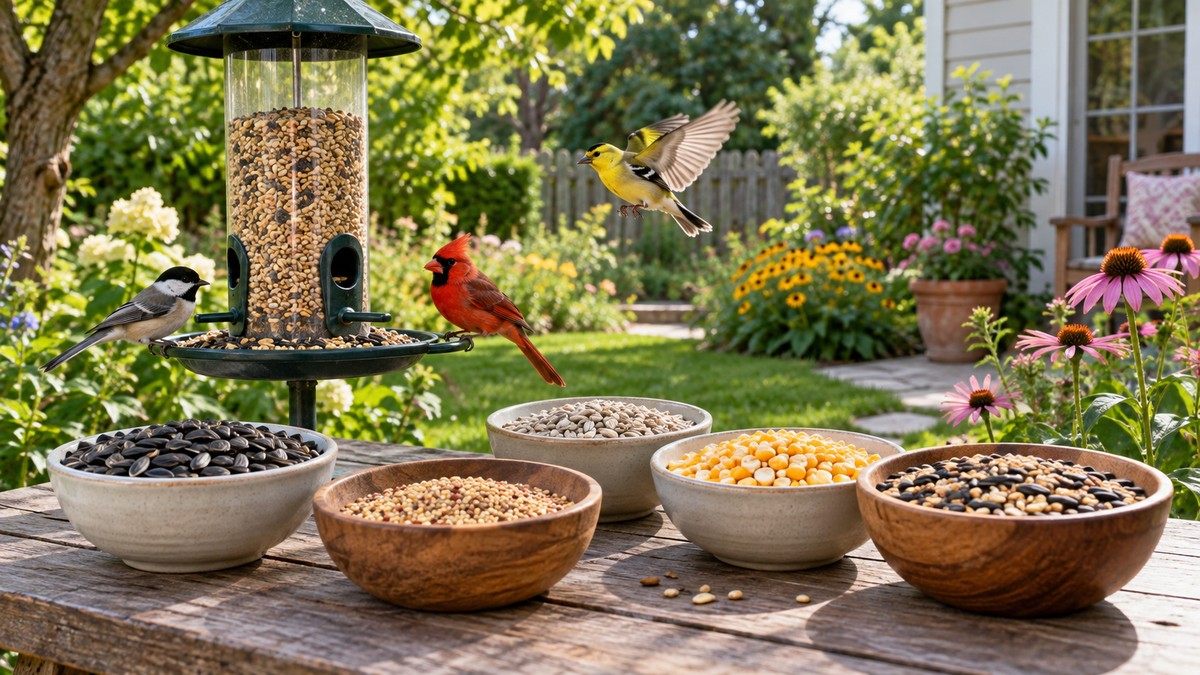
WVU Extension advises buyers to consider the native birds in their area and the birds they hope to attract. It also suggests a little food-preference research before buying, so the seed you choose is one your target birds actually eat. The UF/IFAS Extension Lake County blog gives a useful starting list. Cardinals take sunflower, safflower, suet and cracked corn. Chickadees and titmice take sunflower, peanuts, suet, safflower and mealworms. Goldfinches take nyjer and sunflower, and sparrows and doves take sunflower, cracked corn and millet.
The table below combines what the two extension pages say about each common seed. Where a page does not say something, the cell reads “not stated.”
| Seed | Birds the sources name | What the sources add |
|---|---|---|
| Black oil sunflower | Most backyard birds; smaller birds that crack seed | Thin shell, easy to open (WVU, UF/IFAS) |
| Striped sunflower | Not stated | Thicker shell, which may be harder for some exotic birds to open (WVU) |
| Shelled sunflower hearts | Not stated | More expensive, and unprotected seed spoils more quickly (WVU) |
| Safflower | Cardinals, chickadees and finches (UF/IFAS) | Bitter taste; UF/IFAS says it deters blackbirds, grackles and squirrels |
| Nyjer | Finches, especially goldfinches (UF/IFAS) | Heat-treated to disable weed seed; expensive; use a mesh or small-hole feeder (UF/IFAS) |
| White proso millet | Sparrows, doves and juncos (UF/IFAS) | Favorite of ground-feeding birds (UF/IFAS); listed as a good option by WVU |
| Cracked corn | Doves, jays and sparrows (UF/IFAS) | Broken pieces suit ground feeding (UF/IFAS); listed as a good option by WVU |
| Peanuts | Woodpeckers, chickadees, titmice, nuthatches, wrens and jays (UF/IFAS) | A great protein source (UF/IFAS); listed as a good option by WVU |
| Mixes with filler seed | Not stated | Filler seed is often raked out and spilled on the ground (WVU) |
Pick seed for the birds you want most
Sunflower is the default for a reason. WVU Extension says it is the most commonly used seed because it attracts the largest variety of birds and is readily available, and UF/IFAS calls it the universal seed for backyard birds. The two common kinds are black oil and striped. Black oil seed has a thinner shell that most birds can open. Striped seed has a thicker shell that may be harder for some exotic birds to open. Shelled sunflower hearts save the birds some work, but WVU notes that they cost more and that unprotected seed spoils more quickly.
Specialty seeds narrow the crowd. Safflower is the choice when you want cardinals and chickadees and fewer blackbirds. UF/IFAS says its bitter taste makes it a deterrent for blackbirds, grackles and squirrels. The sources do not say how well it works on squirrels in your yard, so treat that as a hope rather than a promise. Nyjer is a finch seed. UF/IFAS calls it an expensive seed, heat-treated to disable foreign weed seeds, and a favorite of goldfinches. White proso millet and cracked corn suit birds that feed on the ground, such as sparrows, doves and juncos.
Peanuts draw a different group. UF/IFAS lists woodpeckers, chickadees, titmice, nuthatches and wrens among the birds that eat them, and it calls peanuts a great protein source.
Two other foods appear often in the lists. Suet is a high-fat food that UF/IFAS says provides high energy for the winter season, and birds need to build fat reserves before cold weather arrives. The same page notes that suet blocks can sit in a small cage holder or hang from a hopper feeder. Mealworms are insects that UF/IFAS describes as a clean protein source, sold both dried and live. Neither food is a substitute for the seed the birds on your list prefer, so offer them as an addition.
Skip filler mixes unless you know your birds
Blends look like good value on the shelf. WVU Extension warns that many seed mixtures include filler seeds that are often raked out and spilled on the ground. That spillover, WVU says, promotes the growth of fungus and bacteria, and it can attract mice, squirrels, bears and deer. If you buy a mix, check what it contains and expect to see more seed on the ground than you would from a single seed type.
When you want nyjer or another very small seed, UF/IFAS recommends a mesh or small-holed cylinder feeder, which keeps the seed from pouring out and going to waste.
Choose a feeder that matches the seed
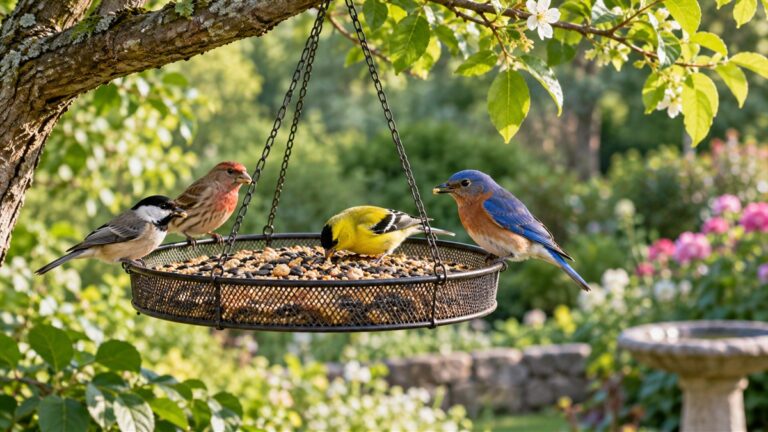
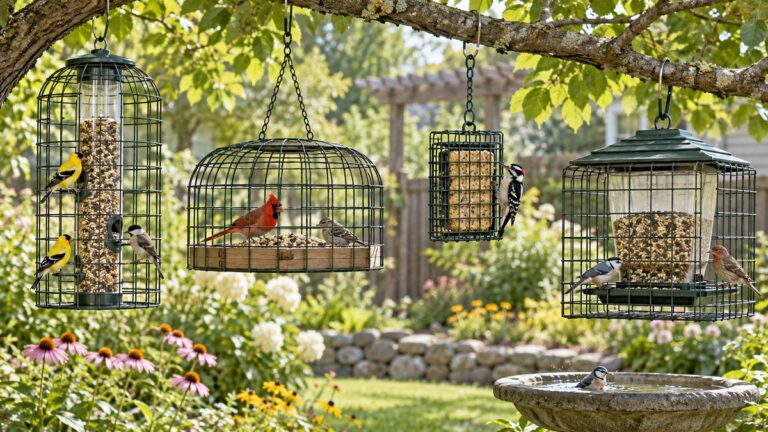
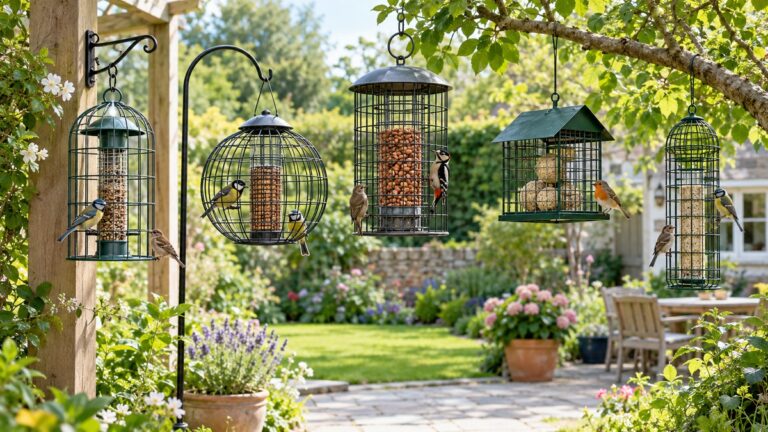
The feeder should suit the seed you are offering. UF/IFAS describes platform feeders with a porous base that present many kinds of seed, hopper feeders that hold a generous amount, tube feeders for small, easy-flow seed, and seed cylinders that birds cling to. Penn State Extension is practical about quantity. If you use a platform feeder or feed on a deck or balcony, feed only as much seed as birds can consume in a day. Our guide to platform feeders with a roof covers one common style.
WVU Extension adds two placement notes. Feeders should be placed where birds have some cover nearby, but squirrels must not be able to jump onto them. If you put a feeder near a window, WVU suggests placing it within three feet, which helps avoid a hard impact. For squirrel-specific ideas, see our guide to keeping squirrels off bird feeders.
Store seed so it stays dry
Storage is where many feeding problems begin. Penn State Extension says to store seed in a cool, dry place, and that seed which becomes moldy should not be used. WVU Extension tells feeders to remove decomposing or moldy feed. Clemson Extension explains the stakes. Moldy seed and droppings can grow mold, host bacteria and spread diseases among birds. The practical rule that follows from all three is to keep the bag closed in a dry place and to throw out any seed that shows mold. The sources do not give a shelf life for seed, so look at the seed before you put it out, not at the date on the bag.
Tube feeders need special attention. Penn State Extension warns that residue and mold can build up in the bottom of hanging tube feeders. The fix it describes is to empty the feeder and scrub the interior thoroughly, which is a job for the cleaning routine.
Clean feeders and the ground below
The sources agree that feeders need regular cleaning, but they do not agree on how often. Clemson Extension says seed feeders should be cleaned at least every two weeks, and more often when there are a lot of visitors, when it rains, or if you find dead birds around the yard. WVU Extension says to wash feeders every two weeks with hot soapy water. Penn State Extension advises scrubbing with soap and a disinfectant once a week. A weekly routine meets the minimum in all three guides, so it is the simplest schedule to follow.
For disinfecting, Clemson says a 10 percent bleach solution, one part bleach to nine parts water, is the most effective method against salmonella. Its method is to scrub off debris first, soak each section of the feeder for 10 minutes, rinse everything, and let the feeder dry completely before refilling. Clemson adds that soap and water also clean feeders, though less thoroughly than bleach.
The ground under a feeder needs its own routine. Penn State Extension says that if you feed on the ground, you should rotate the feeding area and rake up debris and droppings on a regular basis. Clemson recommends sweeping up spilled seed and empty hulls about once a month, and it notes that rodents and insects will feed on spilled food, which can be a sign that cleanup needs to happen more often. Both guides point the same way: spilled seed is a food source for pests, so do not let it pile up.
Penn State Extension also warns that a feeder can help spread disease when a sick bird comes to it. Its guide does not describe a full response plan, so check your state wildlife agency and local rules before you resume feeding after sick birds have been seen.
Why the feeder itself needs management
A feeder is a tool that can do good or harm, and WVU Extension is direct about the harm. Feeding stations supply birds with easy access to food during harsh weather and during migration, and they give bird watchers a good place to observe. When they are not properly maintained, though, feeders can spread disease, attract exotic species such as European Starlings and House Sparrows, and raise bird numbers beyond what the natural habitat can support. WVU also points out that windows cause millions of bird deaths each year, which is one more reason to think about where the feeder sits. Good seed choice reduces some of these problems, but it does not replace a routine of storage, cleaning and placement.
How we chose
This guide uses four extension and university pages that we opened and read on 2026-10-22: WVU Extension’s Backyard Feeding Basics page, Penn State Extension’s Reducing Disease Risk at Feeders, Clemson Cooperative Extension’s Washing Bird Feeders, and the UF/IFAS Extension Lake County blog on bird feeders and seed. We chose them because each one covers seed choice, storage or cleaning, and each is published by a university or extension office. Audubon pages, retail seed guides and several state agency pages came up in our searches. Some of those pages could not be opened, and the rest are not used here. We checked each quoted sentence against the page text before the draft was written.
What we could not verify
The seed advice in this guide is general. None of the pages compares seed brands, and this article does not rank any products.
What the sources do not say
- The sources give no price for any seed except UF/IFAS’s note that nyjer is expensive.
- No page sets a seed-to-bird ratio, so the table reflects each page’s list of birds rather than a complete list.
- The WVU page was last updated in 2017, while the Penn State and UF/IFAS pages were updated in 2025. The pages do not say what has changed since then.
- The sources do not give a current disease advisory for your state. Check your state wildlife agency and local rules before you resume feeding after a sick bird is seen.
- UF/IFAS lists safflower as a squirrel deterrent, but no page here measures how well it works.
Frequently asked questions
Is black oil sunflower the best all-round bird seed?
It is the closest thing to one. WVU Extension calls sunflower the most commonly used seed because it attracts the largest variety of birds, and UF/IFAS calls it the universal seed for backyard birds. Black oil seed has the thinner shell. It does not suit every bird, though, so add a second seed from the table if you want particular species.
Should you buy a seed mix or single seeds?
Single seeds give you more control. WVU Extension warns that many mixes contain filler seeds that get raked out and spilled, which promotes fungus and bacteria. If you do buy a mix, check its contents and watch how much ends up on the ground.
Why does my bird seed look moldy so quickly?
The sources point to wet conditions and leftover seed. Clemson says moldy seed and droppings can grow mold and spread disease, and that feeders need cleaning more often when it rains. WVU says to remove decomposing or moldy feed. The sources do not explain the moisture details, so the practical answer is to keep seed dry, clear out old seed, and clean the feeder before mold shows.
How often should you clean a bird feeder?
Clemson Extension says at least every two weeks, and more often with heavy visits or rain. Penn State Extension says once a week, with soap and a disinfectant. A weekly routine meets the minimum in every guide.
Will safflower keep squirrels away?
UF/IFAS says safflower is a deterrent for squirrels because of its bitter taste. It does not give a success rate, and WVU Extension notes that squirrels can still reach feeders unless you keep them from jumping on. Pair the seed choice with feeder placement for the best chance of results.
Sources
- WVU Extension, Backyard Feeding Basics: https://extension.wvu.edu/natural-resources/wildlife/birds/backyard-feeding-basics (opened 2026-10-22)
- Penn State Extension, Reducing Disease Risk at Feeders: https://extension.psu.edu/reducing-disease-risk-at-feeders (opened 2026-10-22)
- Clemson Cooperative Extension, HGIC, Washing Bird Feeders: https://hgic.clemson.edu/washing-bird-feeders/ (opened 2026-10-22)
- UF/IFAS Extension Lake County, Backyard Bird Attractors: Feeders and Seed: https://blogs.ifas.ufl.edu/lakeco/2025/11/25/backyard-bird-attractors-feeders-and-seed/ (opened 2026-10-22)