How to Prune Tomato Plants
As an Amazon Associate we earn from qualifying purchases.
Knowing how to prune tomato plants starts with one question: is your variety determinate or indeterminate? Four university extension publications from Wisconsin, Vermont, North Dakota and New Hampshire agree that the growth habit decides the method. Indeterminate types usually need suckers removed and sometimes their tops cut. Determinate types need little or no pruning. This guide sets out what those sources say, where they disagree, and what they leave out.
Quick answer
- Check the label first. Seed packets, plant tags and seed catalogs say whether a tomato is determinate or indeterminate.
- Wisconsin Extension says to prune indeterminate tomatoes only. Vermont Extension says determinates need only minimal pruning, mostly lower leaves.
- On indeterminates, pinch suckers while they are small, and then follow one sucker rule all season.
- Stop pruning one to two weeks before the first harvest, and remove the growing tips of indeterminates about a month before first frost.
Start with the growth habit
Tomato varieties are either determinate or indeterminate, and that difference drives everything else. Determinate tomatoes have a bush habit. They grow to a set size and then stop. The Vermont article puts that at a fixed height of about four to five feet. Their blossoms open at about the same time, so the harvest arrives in a short window.
Indeterminate tomatoes keep growing until frost. The University of New Hampshire article says they continue to set new flowers and fruit throughout the season. The North Dakota article agrees and adds that these vines keep producing suckers all season. Many cherry and heirloom varieties are indeterminate, according to the North Dakota article, so a cherry tomato may need the indeterminate method.
Names help, but they are not a full answer. The North Dakota article lists Celebrity, Defiant and Roma as determinate examples, along with bush types such as Bush Early Girl and Bush Goliath. It names Big Beef, Big Boy, Early Girl and Juliet as indeterminate examples. Wisconsin points to seed catalogs, seed packets and plant identification stakes. If you are still planning the bed, the guide to the best vegetables to plant in raised beds covers which crops suit a small space.
Why pruning helps, and what the sources promise
Pruning removes growth that competes with fruit. The Wisconsin fact sheet explains that removing extra growth sends energy back to the developing fruit and reduces shading, which helps fruit mature sooner. Pruning also opens the plant to more airflow. Airflow lowers humidity and speeds the drying of leftover leaves, and the article describes that drier setting as less favorable for fungal and bacterial disease.
Vermont makes a similar point about quality. It says, “Properly pruning tomato plants improves the quality of your fruit.” Its article adds that airflow helps keep diseases at bay and speeds ripening in cold climates. An open canopy also makes it easier to spot tomato hornworms and other pests.
The same Vermont article is clear that pruning is a choice. It says, “Although pruning tomato plants is not required, it is a good practice to adopt during the growing season.”
Suckers: what to remove and when
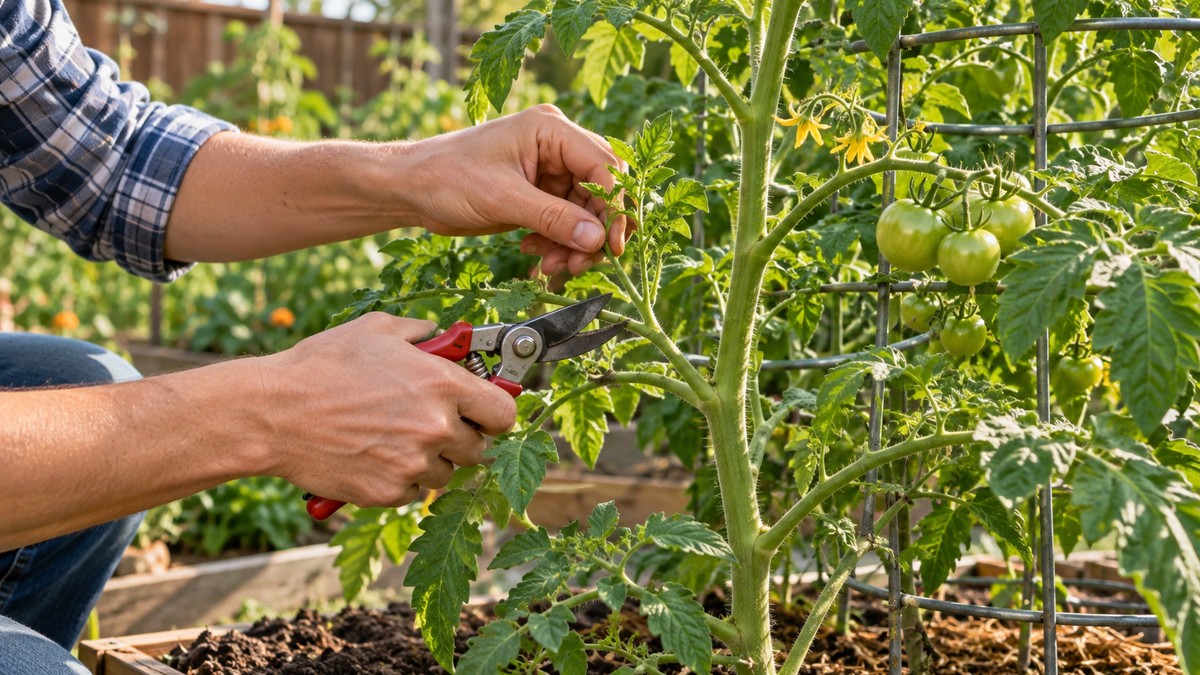
A sucker is a shoot that forms in the leaf axil, the joint where a leaf meets the main stem. Wisconsin describes suckers as branches that form in those junctions. Left alone, a sucker produces its own leaves, flowers and fruit, and even more suckers. That growth divides the plant’s energy, so Wisconsin says to remove suckers as soon as possible. Watch for root suckers at the base of the plant too, and remove those as the season goes on.
Size matters. Suckers are easier to remove when they are small, and the North Dakota article says small shoots also reduce the chance of damaging the plant. Vermont says suckers on indeterminates are best pinched off when they are small, using your fingers. Wisconsin says small suckers can be pinched close to the stem with a thumb and index finger, while larger ones need scissors or hand pruners. The University of New Hampshire article sets a rough limit of less than two inches for removal.
The sources disagree on which suckers to keep, so choose one rule and follow it. Wisconsin gives the most specific instruction. It says, “Remove every sucker from the plant except for the first one below the lowest flower / fruit cluster.” That sucker is the strongest on the plant, and it is left to grow as a second stem. North Dakota takes a different route. It says to remove all suckers above sucker No. 1, and it adds that you can leave a few suckers to help the plant fill in and produce more fruit.
The University of New Hampshire article describes two systems and does not use one rule for both. On the basket weave, it keeps the sucker just below the first flower cluster and lets the suckers above that cluster grow. On an overhead trellis, a single-leader plant has every sucker removed, while a two-leader plant keeps the sucker just below the first flower cluster. Because the sources give different rules, decide on one approach early and stick with it.
Pruning determinate tomatoes
Determinate tomatoes are the hard case, because the sources disagree most here. Wisconsin is firm. It says, “Prune indeterminate tomatoes only,” because determinates stop growing at a set size. Vermont agrees in practice, and says, “Only minimal pruning should be done on determinate tomatoes because this type sets a fixed amount of fruit.” For a determinate plant, Vermont recommends removing the lower leaves to increase air circulation, and pruning the leaves that touch the soil.
North Dakota offers a lighter method for determinates. Locate the first sucker below the first flower cluster, keep that one, remove any suckers below it, and the article says you are done. That goes further than the Wisconsin rule, which leaves determinates alone. The University of New Hampshire article says the basket weave system is best suited to determinate varieties. Put together, the practical starting point is narrow: remove the lowest leaves and any leaves touching the soil, and treat a sucker removal as an optional step rather than a requirement.
When to prune through the season
Wisconsin gives the most specific calendar. Start in late June or early July, when the first tomato flowers are open and easy to identify. Repeat the pruning every 10 to 14 days as needed. Stop one to two weeks before the expected first harvest, so the canopy can shade the fruit from sunscald, which the article describes as pale, injured areas caused by direct sun. Those dates reflect the Wisconsin climate, and the other sources come from northern states too. A warmer or cooler region may need a different calendar.
Vermont’s late-season step is different. About a month before the first expected frost, remove the growing tips of the main stems of indeterminates. The article says this signals the plant to stop making flowers and setting new fruit, so its energy goes into the fruit already set, which then ripens faster. Vermont also says to cut crowded leaves at the center of an indeterminate plant to improve airflow. It warns against removing the leaves above and below a fruit cluster, because those leaves shade the fruit and supply it with sugar.
North Dakota adds a timing rule for the day itself. Prune when the plants are dry and the shoots are small. The article says small shoots come off more easily without damaging the plant. Vermont agrees on the dry day.
Supports that go with pruning
Support matters because indeterminate plants grow past the top of a stake and can become top-heavy. The University of New Hampshire article describes a basket weave system for outdoor plants. Use sturdy wooden stakes four to five feet long, with double stakes at the end of each row. Use five-foot stakes if the plants are indeterminate. Set each stake at least six inches deep, with one stake for every two or three plants. Begin support once the seedlings have set their first flower clusters.
Tie sturdy, untreated twine at one end of the row, about 12 inches above the soil. Weave it in a figure-eight pattern between the plants, wrapping twice around each stake, and then weave it back up the row in the opposite direction. Each stem ends up with twine on both sides. Add another layer every six to eight inches. The article says four layers support most varieties. Indeterminate plants will reach the top of the stakes, and at that point you can cut the tops off to keep the row tidy and stop it from becoming top-heavy.
The overhead trellis is the other system the University of New Hampshire article covers. It suits indeterminate tomatoes, especially those grown in high tunnels where overhead support already exists. The article asks for a strong support at least eight feet above each row, because a plant may weigh 30 pounds or more at peak fruit set. Hang a length of twine from the support and attach it to the base of the plant with a tomato clip, without girdling the stem. As the plant grows, place clips every 12 to 18 inches, always beneath a leaf rather than beneath a fruit cluster.
On a trellis, the article recommends one leader in most cases. Remove every sucker if you keep one leader, and remove suckers while they are still small, under two inches. The article also suggests that when the plant reaches the overhead support, you can remove the top, or lower the vine and let it keep growing. If you want support that fits a cage rather than stakes or twine, the guide to the best tomato cages compares that option.
Clean your tools and keep the airflow open
Tool hygiene is one place where the sources do not match. Wisconsin says to decontaminate scissors and pruners before pruning and between each plant, by treating them for at least 30 seconds with rubbing alcohol. It also says to wash hands with soap and water or use an alcohol-based hand sanitizer. Vermont recommends disinfecting pruning shears with a 10 percent chlorine solution, one part chlorine to nine parts water, before you begin. Wisconsin says the goal is to prevent the spread of disease-causing fungi, bacteria and viruses. Pick one method and clean between plants.
Airflow is the common thread. The North Dakota and Vermont articles both tie pruning to airflow, which helps leaves dry faster after rain or watering. Wisconsin says removing the bottommost leaves serves a similar purpose, and the University of New Hampshire article says to remove the lower leaves for better airflow. The UNH rule is specific: keep the leaf just below the lowest fruit cluster, and keep all the leaves above that. Vermont warns against removing the leaves right beside a cluster, because they shade the fruit and feed it sugar. Those rules fit together. Clear the bottom of the plant, and keep the leaves that sit close to the fruit.
Mistakes to avoid
- Pruning a determinate hard. Wisconsin limits pruning to indeterminates, and Vermont keeps determinate pruning to a minimum.
- Stripping the leaves beside fruit clusters. Vermont says these leaves shade the fruit and supply it with sugar.
- Pruning on a wet day. Vermont advises a dry day, and North Dakota says to prune when the plants are dry.
- Leaving indeterminates unsupported. The University of New Hampshire article says to begin support once the first flower clusters set.
- Topping too early. Vermont times the cut about a month before first frost, because removing the tips stops new flowers and fruit.
How we chose
We chose four university extension publications that we opened on 2026-10-22 and read in full. They are the UW-Madison Division of Extension article, the University of Vermont Extension article, the NDSU Extension column, and the University of New Hampshire fact sheet. The UNH text is hosted on a Montana State URL, and its credit line names UNH Cooperative Extension. Each source had to be an extension publication that gives a pruning method or timing in plain words.A University of California PDF was left out because its text is adapted from the Wisconsin fact sheet, and commercial blogs were left out because they are not extension sources. We did not rank varieties or name a best one.
What we could not verify
The sources we opened do not agree on every point, so this guide reports the differences instead of picking a winner. All four come from northern states, which means the timing is a starting point for other regions rather than a fixed calendar. The sources we opened do not include a yield comparison, so the yield points here are the sources’ own statements and not measured results.
What the sources do not say
The sources do not give pruning dates for southern, coastal or high-altitude gardens. They do not say how many suckers give the best yield, and they give no yield numbers. Vermont times the late cut as about a month before first frost, but it does not give a date. The sources also do not explain how to judge a sucker’s strength beyond its size. One of the four is a copy hosted on a Montana State URL, and we did not find a dated version on the original UNH site.
Frequently asked questions
Should I prune determinate tomatoes?
Wisconsin says to prune indeterminate tomatoes only. Vermont allows minimal pruning, such as removing lower leaves and leaves that touch the soil. North Dakota describes one sucker removal for determinates, so the advice differs by source.
When should I stop pruning?
Wisconsin stops pruning one to two weeks before the expected first harvest. That gives the canopy time to shade the fruit from sunscald. Vermont’s cut on indeterminates comes about a month before first frost, and its purpose is to stop new flowers and fruit.
Can I cut the top off a tomato plant?
Yes. North Dakota says to trim back the tops of the vine if the plant gets unruly. The University of New Hampshire article says to cut the tops of indeterminates that reach the top of the stakes, or to lower a trellised vine as it grows.
Which cleaner should I use on pruning shears?
The sources do not agree. Wisconsin uses rubbing alcohol for at least 30 seconds, and says to clean between each plant. Vermont uses a 10 percent chlorine solution. Either way, clean the blades before you start and again between plants.
Do I have to prune at all?
No. Vermont says pruning is not required, but it is a good practice during the season. Wisconsin limits its pruning advice to indeterminate types, which keep growing until frost.
Sources
- https://hort.extension.wisc.edu/articles/tomato-pruning/ (opened 2026-10-22)
- https://www.uvm.edu/extension/news/how-prune-tomato-plants (opened 2026-10-22)
- https://www.ag.ndsu.edu/news/columns/dakota-gardener/dakota-gardener-pruning-tomatoes (opened 2026-10-22)
- https://www.montana.edu/extension/powderriver/documents/vegetablegarden/PruningTomatoes.pdf (opened 2026-10-22)