How to Amend Garden Soil for Containers
As an Amazon Associate we earn from qualifying purchases.
How to amend garden soil for containers is a question with a short answer: the three sources below advise against using garden soil as the base of a pot at all. They say it is too dense, holds too much water and can drown roots. What they recommend instead is a commercial soilless potting mix, with compost or topsoil added only in limited amounts. This guide sets out what each source says, where they disagree, and what they leave out.
Quick answer
- Do not start with garden soil. All three sources say it is too heavy or too dense for a container, and it can hold too much water.
- Start with a commercial soilless mix. NC State says that in most situations it is “faster, easier, and more precise to purchase a commercial soilless mix than to make your own mix.”
- If you add compost, keep it to a share of the mix. NC State suggests 15 to 40 percent, while UMD lists a 50/50 soilless and compost mix as an example, so the sources differ.
- Use topsoil only in very large containers, and keep it to no more than 10 percent of the volume, according to UMD.
Why garden soil fails in a pot
Garden soil is built for roots that can spread out. UMD notes that “Unlike their cousins growing in garden soil, containerized plant roots cannot grow around obstacles or mine the soil far and wide for nutrients and water.” NC State says that because container plants are “restricted to the limited amount of media available within each pot,” high-quality mixes are “essential to supply the roots with nutrients, air, and water.”
The main problem is pore space. NC State says “True soils are field soils that often retain too much water, have too little pore space (for oxygen), are too heavy, and potentially harbor harmful diseases, insects, and weeds.” UMD adds that garden soils “hold water very well in their small pore spaces and can drown roots- especially in shallow containers.”
Air is the other half of the problem. UMD says “Air and water also travel through these pore spaces”, and “If excess water cannot drain away, fresh air cannot enter and roots will suffocate.” OSU puts the rule briefly: “Avoid using garden soil or topsoil, which can be too heavy and may retain too much moisture.”
What the sources use instead
Commercial soilless mixes
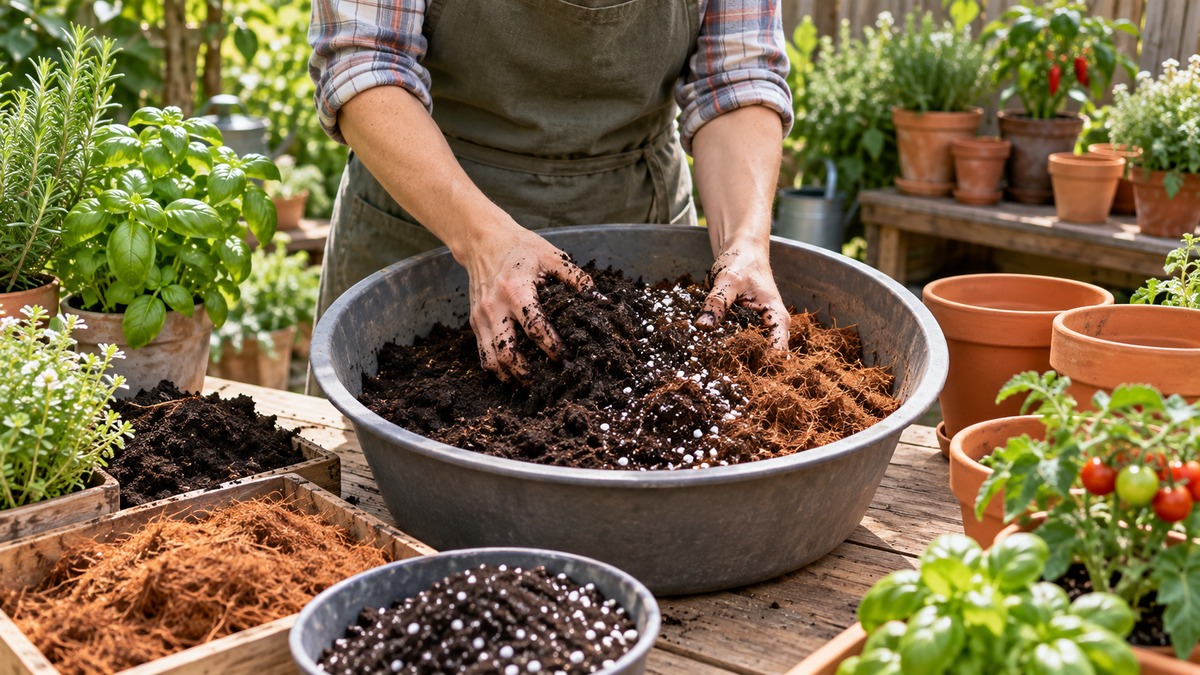
NC State says “Most soilless potting mixes are free of insects, diseases, and weeds and are ready to use immediately.” UMD calls soilless mixes “an excellent choice for containers”, and says they are “lightweight, drain well, hold water and nutrients, and are generally free of weeds, insects, and diseases.” OSU recommends “high-quality potting soil or composted soil purchased from a garden center.”
Read the label before you buy. UMD warns that products sold as “topsoil,” “planting soil”, “planting mix” or “potting soil” “vary a great deal in composition and quality.” Its advice is to avoid mixes that “feel heavy or gritty, have very fine particles, or appear clumped.” NC State adds a specific warning: sedge peat is a granular material, and “Avoid using this in containers as it compacts easily and drains poorly.”
Our guide to filling raised beds makes the same distinction for beds, since potting soil, planting mix and in-ground garden soil are not interchangeable.
Wet the mix before you pot it. UMD says to “Work water into the media with your hands”, because “Soilless mixes tend to be hydrophobic – they repel water.” Keep working water in until the mix is “thoroughly wetted.”
What the ingredients do
| Material | What the sources say | Limit or caution |
|---|---|---|
| Perlite | Expanded volcanic rock that improves drainage (NC State) | Avoid breathing the dust; wet it down or wear a dust mask (NC State) |
| Pine bark | Large particles that add aeration (NC State) | Bark fines and wood mulch are high in carbon and low in nutrients, and UMD does not recommend them for container vegetables |
| Sphagnum peat moss | Adds nutrient and water-holding capacity (NC State) | NC State says it is not a sustainable resource |
| Vermiculite | Absorbs water and attracts nutrients when wet (NC State) | NC State recommends it for plants with high water needs, such as tomatoes |
| Coarse builder sand | Adds porosity and weight (UMD) | Use coarse builder sand, not play sand (UMD); it holds little water (NC State) |
| Compost | Adds nutrients and organic matter (NC State, UMD) | Limit the share in the mix; see the compost section below |
| Topsoil | Accepted only in very large containers (UMD) | No more than 10 percent of the volume (UMD) |
How much compost, and where the sources differ
Compost is the addition the sources praise most. UMD says “Compost contains all the major and minor nutrients that plants need for good growth.” It also says “Vegetables, herbs, and flower plants can be successfully grown in 100% compost or leaf mold.” NC State says “The nutritional value of compost varies, depending on the plant matter or animal waste that was used to make it.” The sources do not say which compost is best.
NC State adds a limit: “Because many types of compost have a pH over 7.0, it is best to limit the amount of compost to between 15% and 40% of the total container mix.” UMD takes the opposite view on pH. It says “Many composts have a pH over 7.0 but research has shown that there is no benefit in reducing the pH to a more desirable level because nutrients in compost are available over a wide range of pH values.” UMD also lists a “50% soilless mix + 50% compost” blend among its examples of good media for container vegetables.
The two positions do not match. One caps compost at 15 to 40 percent, and the other offers a 50/50 example. The sources do not explain which is right for your plants, so the honest answer is that the compost share is a judgment call, and the limit NC State gives is the more cautious of the two.
Compost does not supply the whole diet. UMD says “However, fertilizing is still necessary because the nutrients in compost are released slowly and are usually not sufficient for an entire season.” Plan on feeding a container mix that contains compost, not relying on the compost alone.
Topsoil and sand: small roles
Topsoil is the one garden-soil product the sources accept, and only in a narrow role. UMD says “Topsoil should only be added to very large containers and not exceed 10% of the volume.” A pot of ordinary size does not qualify, so the rule keeps garden soil out of most containers.
Sand needs the right grade. UMD says “Use only coarse builder sand, not play sand”, and explains that “Sand increases porosity because of the large particles.” NC State is more cautious: sand “has low water-holding capacity and provides little aeration, but is useful (in moderate percentages) in providing a counterweight to top-heavy plants, preventing them from tipping over.”
Reusing last year’s mix
Reuse is allowed with limits. NC State says “Container media can be reused as long as no soilborne disease problems have occurred, such as Verticillium or Fusarium wilt, in the previous season.” If such a problem appeared, the chapter says to discard the media or use it only in an area where resistant plants grow.
Old mix loses structure. NC State explains that “When reusing container media from year to year, organic matter breaks down and decomposes, causing a decrease in the size of particles and pore space, resulting in reduced drainage and aeration.” UMD agrees that “Soilless growing media and compost lose nutrients and break down physically over time.”
Refresh it before the next season. NC State advises “Emptying out the container mix, breaking up the material and any old roots, and re-blending keep the media from getting too compacted.” Nutrients also need replacing: “Because many of the nutrients are used by plants or leached out during the previous growing season, add additional media, compost, and fertilizer.” UMD suggests mixing last year’s media about 50:50 with fresh media, compost, or both.
Drainage and filling the pot
Start with drainage. OSU says “Almost any container will work if it has good drainage”, and NC State says “Drainage holes are necessary in all containers to prevent plant roots from standing in water and developing root rot.”
Do not add gravel to fix drainage. NC State says “Never put a layer of gravel or rocks in the bottom of a container beneath the potting mix in an effort to improve drainage.” It explains that “Doing so causes the water to collect in the potting mix just above the gravel.”
Fill gently. NC State says “Potting media should be moist before potting”, and that moist mix should be “slightly damp to the touch but not wet, meaning no water is draining from the media.” Then loosely fill the pot, and “Do not pack down the media.” The chapter warns against “pressing the media down around the crown or tamping the container, which cause compaction.”
Depth matters too. NC State says shallow-rooted vegetables “need a minimum potting mix depth of 6 inches to 8 inches,” while carrots “grow better with a potting mix depth of 10 inches to 12 inches.” If you are working out how much mix to buy, our raised bed soil volume guide walks through the cubic-foot arithmetic. OSU gives a size guide too: “Ten-inch pots are suitable for herbs, parsley and green onions.”
Watering and feeding the amended mix
Containers dry out fast. OSU says “Soil in containers dries out quickly, especially on patios in full sun”, and “Daily watering is often necessary”. Keep the mix moist, not soggy. NC State offers a simple check: stick a finger into the mix, and “if the mix is dry, the plant should be watered.” It also warns that “avoid overwatering, as the water fills all of the pore space in the potting mix and the roots are unable to get enough oxygen.”
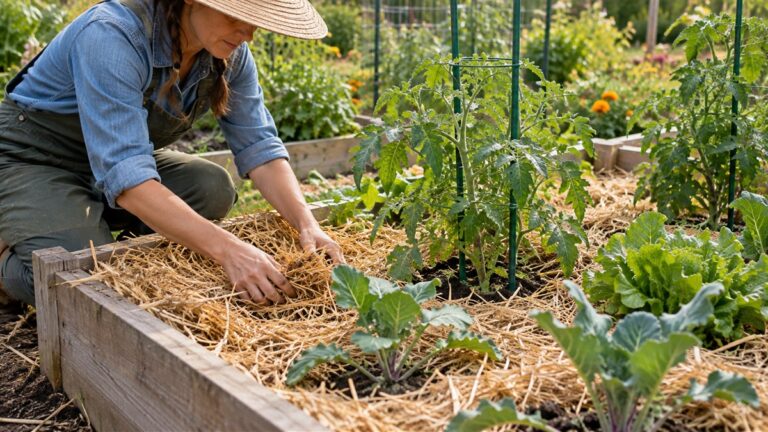
A top layer helps. NC State says “A top dressing of mulch over the potting mix surface significantly reduces moisture loss.”
Feeding is separate from the mix. OSU says “Vegetables in containers need frequent feeding”, and lists compost, aged manure, blood meal, greensand and rock phosphate as “effective” options. NC State notes that “these nutrients last only a couple of weeks” in a pre-fertilized mix, “so an on-going fertilizer regime is also necessary.”
Common mistakes to avoid
- Using garden soil or topsoil from a bed as the base. UMD and OSU both advise against it.
- Putting gravel in the bottom of the pot. NC State says the water then sits in the mix above the gravel instead of draining.
- Packing the mix down. NC State says firm packing causes compaction.
- Using play sand. UMD specifies coarse builder sand.
- Reusing mix after a soilborne disease problem. NC State says to discard it.
- Assuming compost replaces fertilizer. UMD says fertilizing is still necessary.
How we chose
We chose three sources from university or extension services that address container growing media directly: the NC State Extension Gardener Handbook chapter on plants grown in containers, the University of Maryland Extension page on growing media for containers (updated March 23, 2026), and the Oregon State University Extension article on growing vegetables in containers (March 2025). Each was opened on 2026-10-21 and read in full.
The criteria were a university or extension source that answers the soil question for containers. Retail listings and product pages were not used for any fact. Where the sources disagree, as they do on compost, we show both figures. We do not rank or recommend products.
What we could not verify
The sources do not give a recipe for amending garden soil, so this guide does not offer one. They do not say what share of garden soil a container mix can hold without a drainage problem, beyond the topsoil limit. They do not say how to adjust the pH of a finished container mix, and they do not compare bagged products. Nothing here names a brand.
What the sources do not say
Neither UMD nor OSU gives a ratio for mixing garden soil with a soilless mix. NC State gives a compost range and a sand note, but no ratio for garden soil. The compost figures conflict, and the sources do not say which applies to a given crop. The UMD and OSU pages are written for their own regions, and the sources do not adjust their advice for climate.
Frequently asked questions
Can you put garden soil straight into a container?
The sources advise against it. UMD says “Soils are too dense to allow for good air and water movement when added to a container garden.” UMD also warns that garden soil can “drown roots- especially in shallow containers”.
Can you mix garden soil into potting mix?
The sources give no ratio for garden soil. UMD allows topsoil only in very large containers and at no more than 10 percent of the volume. OSU’s starting point is high-quality potting soil or composted soil from a garden center.
How much compost should go into a container mix?
NC State suggests 15 to 40 percent of the total container mix. UMD gives a 50/50 soilless and compost blend as one example of a good mix for container vegetables. The sources disagree, so start at the lower end and watch how the plants do.
Can you reuse container mix next year?
Yes, unless soilborne disease problems occurred in the previous season. NC State advises breaking up the old mix and adding fresh media, compost and fertilizer, because nutrients are used up and the mix compacts over time.
Do you still need fertilizer if you add compost?
Yes. UMD says “fertilizing is still necessary because the nutrients in compost are released slowly and are usually not sufficient for an entire season.” OSU adds that vegetables in containers “need frequent feeding.”
Sources
- https://content.ces.ncsu.edu/extension-gardener-handbook/18-plants-grown-in-containers (opened 2026-10-21)
- https://extension.umd.edu/resource/growing-media-potting-soil-containers (opened 2026-10-21)
- https://extension.oregonstate.edu/news/container-gardening-grow-vegetables-even-without-yard-space (opened 2026-10-21)
As an Amazon Associate we earn from qualifying purchases.