How to Grow Peonies
As an Amazon Associate we earn from qualifying purchases.
How to grow peonies comes down to three things: a sunny, well-drained spot, buds set shallow in the soil, and patience while the plant settles in. Peonies are long-lived perennials, and the extension pages we opened agree on most of the basics. Where they differ, this guide shows both figures rather than picking one.
Six sources sit behind the advice. Iowa State University Extension and Outreach supplies three pages on planting, bloom and dividing. The University of Wisconsin-Madison Division of Extension, Penn State Extension and Ask Extension add the rest.
Quick answer
- Plant in full sun and well-drained soil. Iowa State says most peonies need well-drained soils and full sun for best flowering.
- Set the buds 1 to 2 inches below the soil surface. Deep planting and too much shade are the most common causes of poor bloom, according to Iowa State.
- Leave room for the mature plant. Iowa State gives 3 to 4 feet of spacing, and Wisconsin gives 3 to 5 feet.
- Expect little bloom for a while after a move, and leave the foliage on through summer, since removing it in July or August weakens the plant.
Pick a sunny spot with good drainage
Iowa State gives the sun target as “Plants need at least six hours of direct sunlight per day”. Another Iowa State page gives a lower bloom range, saying that “Peonies need at least 4-6 hours of direct sun to bloom well.” Both figures come from the same extension service, and they are not identical. Penn State adds that “Peonies prefer full sun, especially the herbaceous species”. The sources do not say how much bloom a spot with four hours of sun will give, so that case is left open here.
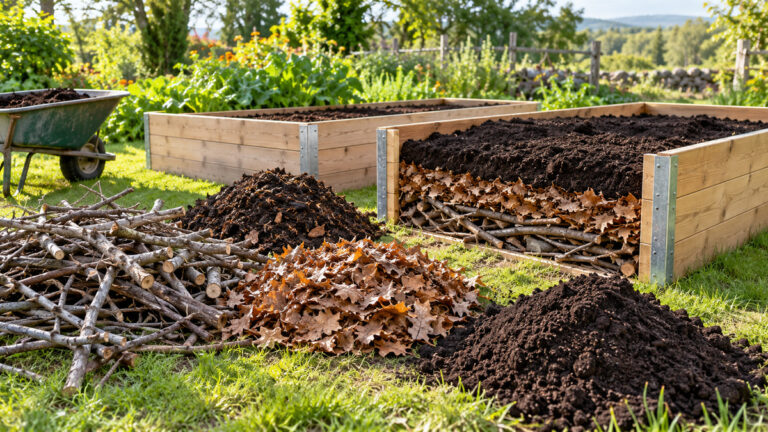
Drainage is the second requirement, and it matters as much as light. Penn State puts it bluntly: “Peonies need good fertility and require excellent drainage; they do not tolerate wet feet.” Wisconsin explains the risk: “poor drainage will cause root rot”. Iowa State offers a fix for a heavy spot, saying that “Poorly drained soils can often be improved by incorporating compost into the soil.” For a compost choice, see compost for raised garden beds.
Shade is the other site problem. Iowa State advises to “Avoid shady areas near large trees and shrubs.” It also says that “Peonies in partial shade need to be moved to a sunny location to improve flowering.”
Soil pH and feeding
Penn State gives the soil target as a band: “Peonies prefer a neutral to slightly alkaline pH.” The same page recommends a first step: “Begin with a soil test.” The sources do not give a single pH number, so treat the neutral-to-slightly-alkaline band as the working range. Soil choices for a planting bed are covered in soil for raised planters.
Feeding is where peonies are most often overdone. Iowa State warns that “Peonies that receive excessive nitrogen rarely flower well, regardless of site.” Its reason is simple: “Nitrogen promotes foliar growth at the expense of flowers.” Wisconsin makes the same point in its own words, advising to “Avoid excessive nitrogen fertilization which encourages foliage at the expense of blooms.” The pattern the sources describe is leafy growth at the expense of flowers.
Set the buds shallow
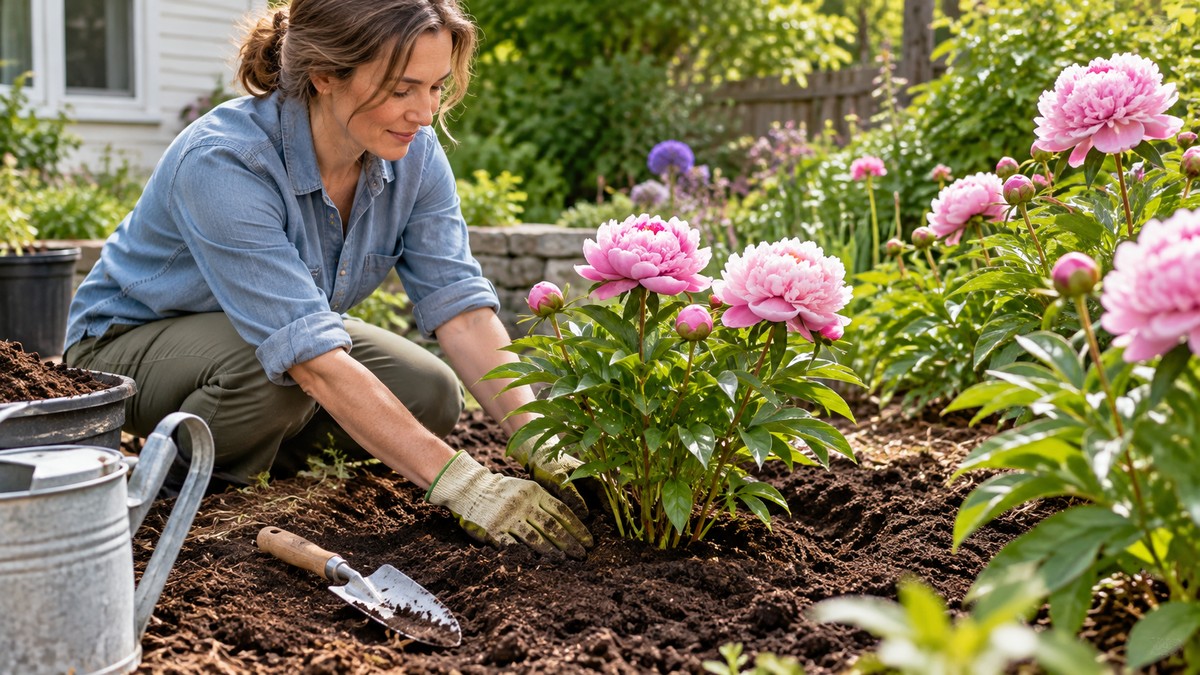
Depth is the point where the sources agree most. Iowa State says that “Common peonies prefer shallow planting depths”, and its working rule is to “Position the peony in the hole so the buds are 1 to 2 inches below the soil surface.” Penn State gives the same range as a planting step: “Place the peony in the hole and cover the top buds or eyes with only one to two inches of soil.”
The cost of planting too deep is stated plainly. Iowa State says that “When a peony is planted too deeply, it may have beautiful foliage but few (if any) flowers.” Penn State’s warning is shorter: “If planted too deeply, flowers will not emerge in the spring.”
Two other cases need a note. Container-grown plants are different, because Iowa State says they “are generally planted at the proper depth, so transplant them to a similar depth in the landscape.” Bare-root plants from a catalog or a division need more care, and Ask Extension gives the rule: “On bare root plants, the eyes should be no more than one or two inches below the soil surface.” Tree peonies sit deeper. Penn State says “A bare-root tree peony should be planted deeper”, and that “If the root is grafted, the graft union should be 4 to 6 inches below the soil surface.”
After planting, Ask Extension recommends a small mound to allow for settling: “Mound a little soil on top to compensate for settling and be sure to mulch.”
Spacing and planting time
Spacing figures differ by source. Iowa State says “Space peonies 3 to 4 feet apart”, while Wisconsin gives 3 to 5 feet for most peonies. Penn State’s height figures can help you choose within that range, since “Tree peonies can grow 3 to 7 feet tall, while herbaceous varieties grow 2 to 4 feet”.
Planting time is the other decision. Penn State ties autumn planting to the plant’s natural rhythm, since autumn falls at the start of dormancy. Iowa State’s dividing and transplanting page names September as the best month in Iowa, which is close to Penn State’s advice. Whichever month you choose, plan for a slow first year. Iowa State notes that “Sometimes it takes 2 to 3 years for plants to re-establish enough in their new location to bloom again.”
Water and mulch the first year
New plants need steady water. Iowa State says “After planting, be sure to water well the first year to establish a good root system.” Wisconsin adds a limit: “Water young plants moderately but avoid overly wet conditions as poor drainage will cause root rot; as plants age, drought tolerance improves.” As the plant ages, Wisconsin notes that drought tolerance improves.
For winter, Iowa State recommends a deep layer. It says that “In mid- to late November, apply a 4- to 6-inch-layer of mulch over the newly planted peonies.” The mulch works by stabilizing the soil, since “Mulching prevents repeated freezing and thawing of the soil during the winter months that could heave plants out of the ground.” Iowa State names straw and pine needles as suitable materials, and asks you to “Remove the mulch in early spring before growth begins.”
Wisconsin suggests a lighter mulch: “Lightly mulch peonies with woodchips to help retain soil moisture and suppress weeds.” The two pages differ on both the depth and the material, so this guide gives both. Both approaches appear in the sources, and this guide keeps both.
Divide an older clump
A peony can stay in place for years. Wisconsin says peonies “do not require regular division but it is often done to create additional plants.” When you do divide, Iowa State begins with the stems: “Begin by cutting off the peony stems near ground level.” Then comes the cut itself, and the page says to “Using a sharp knife, divide the clump into sections.”
Each section needs enough buds to flower. Iowa State says “Each division should have at least 3 to 5 buds (eyes) and a good root system.” Penn State puts the same rule in terms of the root: “ensuring that each wedge has at least three to five buds and one to two large main roots”. Iowa State adds a warning for small pieces: “Divisions with fewer than 3 buds will likely require several years to produce a good flower display.”
Timing is close across the pages. Iowa State says “September is the best time to transplant or divide peonies in Iowa.” Its bloom page offers a late-summer window, and it says that “it can be easily remedied by dividing the plant in late summer to rejuvenate it.” Both fall within the same season, so late summer and September are sensible choices for a clump that has stopped flowering.
Staking and support
Some peonies need help with their own weight. Wisconsin says “Some peonies may require staking to support their heavy blooms.” Penn State is more specific: “Tall herbaceous peonies with large, full flowers and long stems require staking to remain upright.” Penn State also notes that smaller-flowered types with short, sturdy stems need less support, so check the flower form before you buy stakes.
Why a peony will not bloom
When a healthy-looking peony does not flower, Iowa State lists the usual causes. The first is the bed itself: “The most common reasons peonies fail to bloom are cultural (planting in too much shade and planting too deeply).” Feeding comes next, as covered above, and the timing of moves and cuts is the third cause. Iowa State advises that “Removing plant foliage in July or August will weaken the plant, resulting in fewer flowers.” It also says “Leave foliage in place until the first frost.”
Weather can also cost the bloom. Iowa State warns that “A hard freeze in May may damage or destroy the flower buds”, and that “Extremely dry conditions in summer may weaken plants and reduce the number of flowers the following season.” A plant grown from seed is a special case, since “Plants grown from seed take about 4 to 5 years to mature and ultimately bloom.” Iowa State adds a patient note: “Be patient, and flowers will develop once plants are fully established.”
Know the plant type
Wisconsin’s description helps set expectations. It says that “Herbaceous peonies ( P. lactiflora) are the most common and feature bushy mounds that die back to the ground in winter.” Penn State makes the same point about the herbaceous group: “Herbaceous peonies are fleshy and die to the ground in winter”. The tree peony is a different plant, and Penn State says “A bare-root tree peony should be planted deeper”, as covered above. Check the plant type on the label, since the depth and the winter care differ.
Ants on the buds
Wisconsin says “Ants are commonly seen on peony blooms and are not a threat to plant health.” A gardener who sees ants on a bloom can take that as the page’s answer. Ants do not appear among the causes of poor bloom that Iowa State lists.
How we chose
We chose pages that give growing instructions for peonies, from university extension services that we could open with curl and read. We fetched all six pages on 2026-10-22 and read the text we received. Three of the pages come from Iowa State, which covers planting, bloom and dividing in the most detail. We also used one page from Wisconsin, one from Penn State and one Ask Extension answer from an expert responder. We quote only sentences that appear word for word in the fetched texts.
We left out retail listings and nursery pages, so no peony variety, nursery or product is named or recommended here. Where two pages disagree on a figure, such as sun hours, spacing or mulch depth, both figures appear in the text.
What we could not verify
The six pages do not give a recommended cultivar list, and this guide does not name one. This guide also gives no pest or disease treatments.
What the sources do not say
The sources do not give a single pH number, so the working range here is a band. They also give no exact size for a planting hole, beyond a note that it should be large enough for the roots. Wisconsin says a transplanted peony may not bloom in its first year, which fits the longer wait that Iowa State describes.
Frequently asked questions
Why does my peony have leaves but no flowers?
Iowa State lists planting too deeply, too much shade, excessive nitrogen, late moves or cuts, a hard freeze in May, and a dry summer as the usual causes. Start with depth and light, since those are the two most common causes on the list.
How deep should you plant a peony?
Set the buds 1 to 2 inches below the soil surface for herbaceous types. Iowa State and Penn State both give that range. Container-grown plants go to a similar depth in the landscape, and tree peonies sit deeper.
Are the ants on peony buds harmful?
Wisconsin says ants on the blooms are not a threat to plant health. For poor bloom, the causes listed earlier in this guide apply.
Should you divide a peony every few years?
Wisconsin says peonies do not need regular division, although dividing is often done to make more plants. Iowa State says a division should carry at least 3 to 5 buds, and that a piece with fewer than 3 buds may take several years to flower.
Do peonies need staking?
Some do. Penn State says tall herbaceous peonies with large, full flowers and long stems need staking to remain upright, while smaller-flowered types with short, sturdy stems need less support.
Sources
- https://yardandgarden.extension.iastate.edu/faq/how-and-where-do-i-plant-peonies (opened 2026-10-22)
- https://yardandgarden.extension.iastate.edu/how-to/reasons-why-peonies-fail-bloom (opened 2026-10-22)
- https://yardandgarden.extension.iastate.edu/how-to/transplanting-and-dividing-peonies (opened 2026-10-22)
- https://hort.extension.wisc.edu/articles/peony/ (opened 2026-10-22)
- https://extension.psu.edu/the-beloved-peony (opened 2026-10-22)
- https://ask.extension.org/kb/faq.php?id=240297 (opened 2026-10-22)