How to Grow Sweet Potatoes in Containers
As an Amazon Associate we earn from qualifying purchases.
How to grow sweet potatoes in containers comes down to four basics: a pot that drains, healthy slips rather than grocery-store roots, a warm season, and steady watering. The extension pages we opened agree on those basics. They disagree on pot size, curing time and storage temperature, so this guide gives each figure with its source and shows where the pages conflict.
Quick answer
- Plant slips in a container with drainage holes and potting mix. ACES and Penn State both give those two requirements.
- ACES plants one or two slips per 5-gallon container. Clemson says the soil should be above 65°F before planting.
- Water one to two inches a week, keep the soil moist but not soggy, and stop watering four weeks before harvest, as Illinois advises.
- Most pages put harvest at about 90 to 120 days after planting. Cure the roots, then store them cool and never in the refrigerator.
Choose a container that drains
Drainage comes first. Penn State Extension says roots need oxygen, and that water-logged soil makes it hard for roots to breathe. A container should have drainage holes at the bottom so that extra water can run out. The same page recommends a soilless mix over straight garden soil, because soil-based mixes are typically heavy and dense and can keep a container from draining properly.
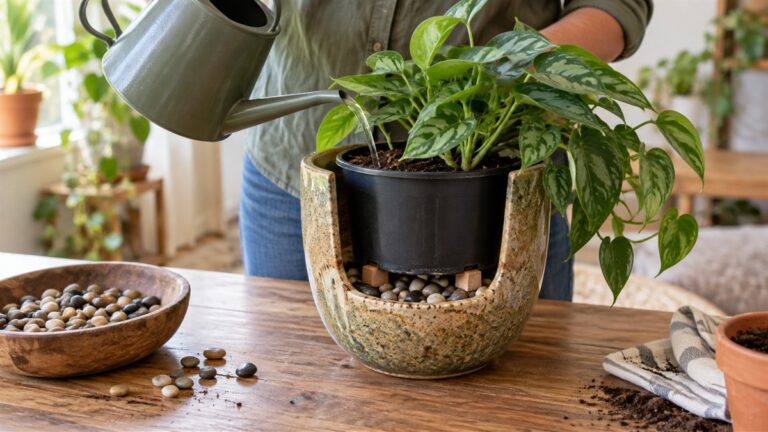
The Alabama extension guide gives the same core advice: use potting mix, and make sure the containers have drainage holes. It also mentions self-watering containers as an option. For the mix itself, see our guide to soil for pots before you buy a bag.
How many plants per pot
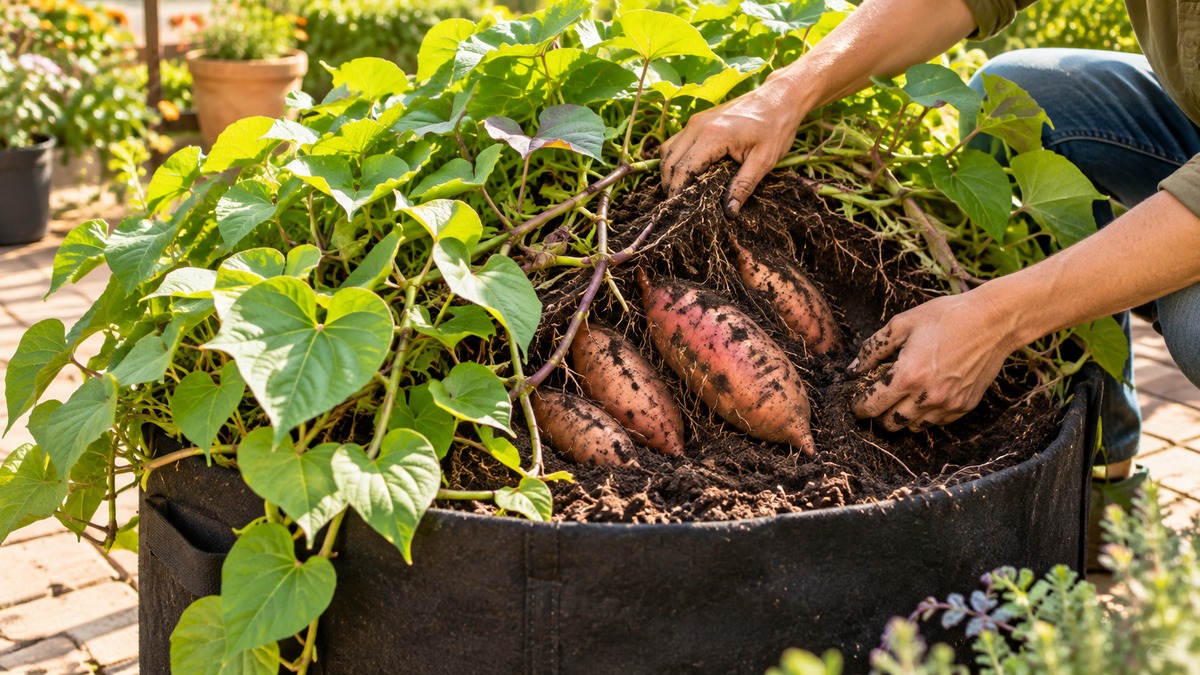
The sources disagree most on pot size. ACES gives a planting density rather than a pot-size rule. It says to space slips 12 inches apart in ridges or rows, or to plant one or two slips per 5-gallon container. Maryland Extension takes a larger view. Its Master Gardener post says that sweet potatoes grow well in containers, including fabric bags, and that the author usually suggests one plant in a 10-gallon container.
The Maryland post also reports that a co-worker harvested around five pounds of sweet potatoes from a 5-gallon bucket. That is one report, not a test, and this guide does not turn it into a yield figure.
None of the pages we opened gives a root depth for sweet potatoes, so the volume figures above are the only container measures for this crop. Penn State gives a general rule for all vegetable containers: pots should be at least as tall as they are wide, so that roots can grow well. That rule does not name a size for sweet potatoes.
Start with slips, not grocery roots
Maryland notes that sweet potato plants produce few flowers and little or no viable seed, so home growers start plants from slips. Slips are sprouts that grow from stored roots.
Clemson says most gardeners prefer to buy slips, but that slips are easy to grow from stored sweet potatoes. It adds that roots from last year’s home harvest, or roots that were organically grown, are more likely to sprout than most grocery store sweet potatoes, which were chemically treated not to sprout during storage.
Illinois Extension describes a different start. A sweet potato, either from last year’s crop or from the supermarket, is buried in moist sand, with the bottom three-quarters covered, until slips form. The Illinois writer names the supermarket as an acceptable source, which conflicts with the Clemson warning. Illinois also says a gardener who does not want to start slips can order them from a reputable seed company, which avoids the question entirely.
Clemson describes a jar method. Start with a healthy, medium-sized root and a regular or wide-mouthed quart jar. Insert three or four toothpicks halfway between the ends of the root, then rest the toothpicks on the rim of the jar, with the bottom half of the root in water. Once the sprouts are six or more inches long, twist each one free from the root. Place the sprouts in water, where they take about 10 days to form their own roots.
Mississippi State says a good slip should be firm, green, and 8 to 12 inches long, preferably with one or two leaves. Maryland links to a video that shows how to grow slips in five to six weeks, so a home start needs about that much lead time before the planting date.
When to plant and how much sun
Timing starts with warmth. Clemson says the soil temperature should be above 65°F before planting. ACES gives a planting window from mid-April through late June. Illinois ties planting to the end of frost, and says slips go in once all danger of frost has passed.
Sun is the other fixed requirement. ACES says to plant in full sun for six to eight hours, and Mississippi State says plants should get at least eight hours of full sun each day. Because the two pages differ by two hours, the longer figure is the safer target for a pot on a deck or patio.
Plant slips two to three inches deep, as ACES advises. Mississippi State gives a different figure for in-ground planting: the cut end goes four to five inches down, with slips 9 to 15 inches apart in ridged rows. That figure comes from the ridged rows Mississippi State describes, not from a pot.
Water and feed the plant
ACES asks for one to two inches of water each week, and more on hot summer days. Clemson sets the baseline at a minimum of one inch of rainfall or irrigation a week, and says to water enough to moisten the soil to at least six inches deep. That six-inch target is written for garden soil, and the pages do not give a matching target for a pot.
Illinois adds two limits. Water evenly, but do not keep the root zone constantly wet. Then stop watering during the last four weeks before harvest, to protect the developing roots from splitting. Penn State says most container vegetable gardens need water at least once a day during hot summer months, and that the potting media should stay moist but never waterlogged. For a watering routine that fits a hose, see our guide to hose attachments for watering plants.
For feeding, ACES recommends an all-purpose fertilizer at planting when no soil test is available, then a side-dress four to six weeks after planting, following the label directions. Clemson says it is best to base fertilizer on a soil test. Mississippi State says the same thing in other words: proper nutrient management begins with a soil test.
Pests and containers
The Illinois writer names rodents as the biggest issue for sweet potatoes. Voles and other small critters were the problem, and containers were the best option the writer found, because they give effective physical exclusion from those pests. That is a report from one grower, not a controlled comparison, and this guide presents it that way.
Maryland gives a different set of checks. It advises fencing out deer and groundhogs, and checking the enlarging roots for vole feeding. Mississippi State recommends a layer of mulch one to two inches thick, which should suppress most weeds and help keep soil moisture even during the growing season.
Pest control is outside the scope of this guide. For insect or disease problems, follow the label of any product you use, and ask your county extension office for local guidance.
When to harvest
Days to harvest vary by variety. ACES gives 100 to 120 days, Clemson says about 90 to 120 days after planting, and Maryland gives 85 to 120 days. Mississippi State adds that sweet potatoes never truly ripen in the way most crops do, so a count of days is only a rough guide.
The sources disagree on the trigger for harvest. Clemson says to harvest before frost, because cool soil temperatures can reduce the quality and storage capacity of the roots. Illinois says to wait until after the first frost, which it says concentrates sugars in the roots, and then to harvest right away once frost hits. Mississippi State says to harvest in late summer or early fall, before soil temperatures drop below 60°F.
Handle the roots gently. Maryland advises removing excess soil gently and not washing the roots. Mississippi State notes that curing helps heal wounds from harvest.
Curing: the sources give different times
Curing heals harvest wounds and reduces rot in storage, according to Mississippi State. The sources give different times and conditions, as the table shows.
| Source | Conditions stated | Time stated |
|---|---|---|
| ACES (Alabama) | Shady, dry area | 14 to 21 days |
| Illinois Extension | Two to three hours drying on the ground, then a warm room at 85°F and 85% relative humidity | 10 to 14 days |
| Clemson HGIC | Optimal is 85°F and 90% humidity for one week; home gardeners use the warmest room, usually the kitchen; no curing below 70°F | 14 days in a home setting |
| Mississippi State | 80 to 85°F and 85 to 90% relative humidity | 7 to 10 days |
Clemson says few home gardeners can supply its optimal conditions. Three of the four pages give a temperature, and Clemson says no curing will occur below 70°F. This guide does not pick one time, because the pages disagree and none of them gives a test result for those times.
Storage
Mississippi State says sweet potatoes should be stored in a dark, cool place, with temperatures between 55 and 60°F, and that a raw sweet potato should never go in the refrigerator. Clemson sets a lower floor: never expose the roots to temperatures below 50°F, and never refrigerate them. Under good conditions, Clemson says, they can be stored for over six months.
Illinois stores cured roots in a cool, dry location at 55°F, and names basements as a good place. Maryland recommends a cool, humid location, with basements again named as a good choice. It suggests slatted crates, baskets or cardboard boxes, filled only two to three layers deep.
Mistakes to avoid
- Starting slips from grocery-store roots. Clemson says most grocery store sweet potatoes were chemically treated not to sprout, so they are less likely to make slips.
- Keeping the root zone soggy. Illinois says not to keep it constantly wet, and Penn State says the media should never be waterlogged.
- Watering in the last four weeks before harvest, which Illinois links to splitting.
- Waiting into cold weather. Clemson says cool soil temperatures can reduce quality and storage capacity.
- Skipping the cure, or storing raw roots in the refrigerator. Mississippi State says curing reduces the risk of rot, and that raw sweet potatoes should never be refrigerated.
Where the sources disagree
| Topic | What the pages say |
|---|---|
| Container size | ACES: one or two slips per 5-gallon container. Maryland: one plant in a 10-gallon container. |
| Starting roots | Illinois: a supermarket root can start slips. Clemson: most grocery store roots were treated not to sprout. |
| Slip planting depth | ACES: two to three inches. Mississippi State, ridged rows: cut end four to five inches down. |
| Harvest trigger | Clemson: before frost. Illinois: after the first frost. Mississippi State: before soil drops below 60°F. |
| Curing time | ACES: 14 to 21 days. Illinois: 10 to 14 days. Clemson: 14 days. Mississippi State: 7 to 10 days. |
| Storage floor | Clemson: never below 50°F. Mississippi State: 55 to 60°F. Illinois: 55°F. |
Frequently asked questions
Can sweet potatoes grow in containers?
Yes. Maryland Extension says sweet potatoes grow well in containers, including fabric bags. ACES plants one or two slips in each 5-gallon container, and it also requires drainage holes and potting mix.
How big should the container be?
The pages we opened do not agree on one size. ACES gives a count for 5-gallon containers, and Maryland suggests one plant in a 10-gallon container. Penn State adds a general rule for all vegetables: a pot should be at least as tall as it is wide.
When should slips go into the pot?
Wait until the soil has warmed past the 65°F threshold that Clemson names. ACES gives a planting window from mid-April through late June, and Illinois says to plant once all danger of frost has passed.
Does a container need daily watering?
It depends on the weather. ACES gives one to two inches of water a week, and more on hot days. Penn State says most container vegetable gardens need watering at least once a day during hot summer months, so check the pot on hot days rather than relying on a weekly rule alone.
How should cured sweet potatoes be stored?
Keep them in a dark, cool place between 55 and 60°F, as Mississippi State advises. Clemson sets a floor of 50°F, says never to refrigerate, and says properly stored roots can last over six months. Basements are the storage place that both the Illinois and Maryland pages name.
What we could not verify
Several figures in these pages are written for garden beds or rows. This guide does not treat those as container figures, and where a figure comes from a garden, the text says so.
What the sources do not say
- None of the pages gives a root depth for sweet potatoes in a container.
- No page gives a yield for a container of a stated size, apart from the one co-worker report in the Maryland post.
- The pages do not compare varieties for container growing, so this guide names no variety.
- The pages do not agree on the best curing time, and none of them says which time suits a small pot indoors.
- We did not check any slip seller, catalog or product.
How we chose
We opened extension and state pages with curl on 2026-10-22, and used only pages that returned HTTP 200 and contained the statements we cite. We preferred pages that discuss containers, and we kept each figure next to the page it came from. Where two pages disagree, we show both figures and do not pick one silently. We left out retail listings, commercial blogs, and any page we could not open.
Sources
- https://www.aces.edu/blog/topics/lawn-garden/grow-more-sweet-potato/ (opened 2026-10-22)
- https://extension.illinois.edu/blogs/good-growing/2026-04-17-how-sweet-it-growing-sweet-potatoes (opened 2026-10-22)
- https://marylandgrows.umd.edu/2023/04/21/try-growing-sweet-potatoes-this-year/ (opened 2026-10-22)
- https://hgic.clemson.edu/factsheet/sweet-potato/ (opened 2026-10-22)
- https://extension.msstate.edu/publications/growing-sweet-potatoes-home (opened 2026-10-22)
- https://extension.psu.edu/container-vegetable-gardening-four-keys-to-success (opened 2026-10-22)