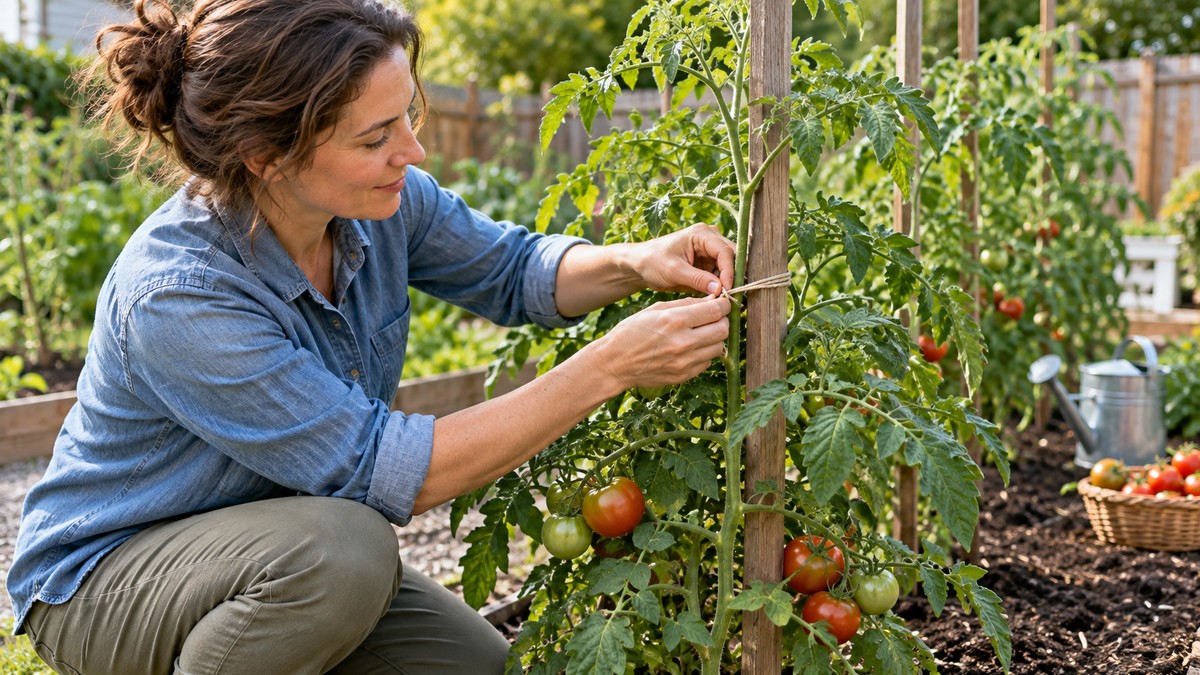
How to Stake Tomatoes
As an Amazon Associate we earn from qualifying purchases.
How to stake tomatoes starts with one question: does the plant stop growing at a set height, or does it keep going all season? Determinate types stop at a set size and suit shorter stakes or cages, while indeterminate types keep growing and need tall stakes, a Florida weave or a trellis. The extension pages we opened agree on that split. They describe stakes, cages and trellises as separate options rather than one method for every plant.
No products are recommended in this guide. Each step follows what the pages state, and the text says so when a page is silent on a point.
Quick answer
- Set support in before the plants lean over. Penn State Extension says to start when the plants are about a foot tall.
- Use stakes 6 to 7 feet long for indeterminate types and 4 feet for determinate types, according to Penn State Extension.
- Drive stakes at least six inches deep, and consider a foot deep for extra support, as North Carolina State Extension suggests.
- Tie gently with soft material and leave some give, so the ties do not cut into the stems.
Match the support to the growth habit
North Carolina State University Extension, Durham County, says that determinate tomatoes set fruit over a short period and are typically smaller plants overall. Indeterminate tomatoes grow and set fruit throughout the season, and they can reach 10 feet or more. The same page notes that many dwarf varieties are determinate and need little support, while larger types are worth extra setup work at the start.
Purdue University Extension adds that support usually matters more as the variety gets taller. It says support typically reduces the number of culls and makes harvest easier, and that the taller the variety, the greater the need for support. The Illinois Extension blog offers the same practical split from a grower’s point of view, and it lists two cage drawbacks: the cage can feel flimsy, and a plant may overtake it.
Before you lay out the rows, see companion planting and garden layout for raised beds. For other vegetables that grow well in raised beds, see vegetables that grow in raised beds.
Stake one plant at a time
For a single stake per plant, North Dakota State University Extension describes bamboo poles or 1-inch-square stakes, with plants spaced about 24 inches apart and stakes set about 3 inches from the plants. It says sisal twine or strips of cloth secure the vines to the stakes. The NDSU page also says the traditional stake maximizes sunlight to the plant and leads to earlier yields and larger fruits.
Penn State Extension gives more detail on placement. Space plants 18 to 24 inches apart in the row, and drive a stake in every other plant or every third plant. Place the stake 3 to 4 inches from the base of the plant, on the side away from the first bloom cluster, so the fruit is not trapped between the plant and the stake. Drive each stake a foot into the ground.
Set stakes early. Penn State says not to wait until the plants are large, because support is much easier to start when they are about a foot tall, and you can sucker as you go along. North Carolina State says stakes should be set at least six inches deep, and it suggests considering a foot deep for extra support where the plants are large.
Build a Florida weave row
A Florida weave, also called basket weave, uses fewer stakes than staking each plant, and it works well for many plants in one row. North Carolina State describes the setup for smaller determinate plants. Place five to six foot sturdy wooden or metal stakes every two to three plants at transplant, with double stakes at each end of the row for strength. Stakes go in at least six inches deep.
The timing is the same across two pages. Penn State says that when the plants are about 12 inches tall, and before they fall over, the weave should begin at 8 to 10 inches off the ground. Purdue University Extension says to run string along either side of the plants before they begin to lean over, when they are about a foot tall. The string is tied off at the end of the row 6 to 8 inches from the ground, then carried past the plants and wrapped around the next stake at the same height.
Add more rows as the vines grow. North Carolina State says to weave another layer of twine every six to eight inches to keep plants well supported, and to place the first row six to twelve inches above the soil. That first row can keep plants from leaning and stop leaves from touching the soil. Purdue suggests a length of half-inch PVC pipe, about 2 feet long, to guide the string around the stakes while keeping it under tension.
The weave suits some plants more than others. North Carolina State says it works for smaller determinate plants. Indeterminate plants can use it, but they will need trimming once they reach the top of the stakes, and they are more likely to be too heavy at maturity for the system. Purdue notes that the stakes should be about as tall as the plant’s final height, or taller.
Cages: quick, but limited
Cages are the simplest option, but they have limits. North Dakota State University Extension says caging tomatoes leads to high yields of quality fruits, and its advice is to get the strongest cages you can find. The same page reports that vines grown in cages have produced the highest yields of marketable, crack-free fruits compared with other support systems. That is a report the page makes about other work, and this guide does not repeat it as a finding of its own.
The Illinois Extension blog lists the drawbacks. The cage can feel flimsy, although metal and tougher cages are now available, and a plant may overtake the cage. North Dakota State University Extension also describes a homemade option: bend a length of 6-inch-mesh concrete reinforcing wire into a circle to make a cage about 2 feet across and 5 feet high. Cages may be cut in half for determinate varieties, which grow shorter.
Build a trellis or overhead support for tall vines
For large indeterminate plants, North Carolina State describes two bigger systems. The first is a trellis or cage built from wood, rolled wire fence or agricultural fence panels, with openings at least four inches square. Whatever the material, you need to reach around the plant to collect fruit, prune and scout for pests.
The second is an overhead system. Tall posts, eight feet or taller is preferred, are anchored at either end of the tomato rows, with heavy wire run between the posts. A length of twine hangs from the wire for each plant, and the plants are secured to the twine as they grow using tomato clips. North Carolina State says to prune plants to keep only the central vine, and to clip every 12 to 18 inches.
Decide on pruning before you tie. The overhead system described by North Carolina State keeps only the central vine, so the twine and clips follow that choice. Pruning also changes the harvest, because removing suckers will cause plants to produce fewer fruit, though the fruit will be larger overall.
Tie gently and check the ties
Ties matter as much as the stake. North Carolina State recommends soft materials such as jute twine, or bits of old stockings or t-shirts, to prevent ties from cutting into the plant. It adds: “Always tie plants gently, with a bit of give where they are secured.” North Dakota State University Extension names sisal twine or strips of cloth for the same job.
Check the ties through the season. As the plants grow, each new layer of twine in a weave should sit a little higher than the last. In the overhead system, clips every 12 to 18 inches hold the vine to the twine. The give in each tie matters because North Carolina State’s guidance is aimed at stopping ties from cutting into the stem.
Common mistakes to avoid
- Waiting too long. Penn State says not to wait until the plants are large, since support is much easier to start when they are about a foot tall.
- Stakes that are too short. Penn State says indeterminate types need stakes 6 to 7 feet long, and determinate types need stakes 4 feet long.
- Shallow stakes. North Carolina State says stakes should be set at least six inches deep.
- Trapping the fruit. Penn State says to place the stake on the side away from the first bloom cluster, so the fruit is not trapped between the plant and the stake.
- Tight ties. Use soft materials and leave some give, as North Carolina State advises.
- Leaving indeterminate plants in a weave. North Carolina State says indeterminate plants in a weave need trimming once they reach the top of the stakes.
How we chose
The five pages in this guide came from university and extension sites, and each returned HTTP 200 when we opened it with curl on 2026-10-22. We kept figures and steps that a page states in plain words, such as stake lengths, spacing, depths and string heights. We left out the disease claims on the Penn State and Illinois pages. The Illinois item is cited only for the cage drawbacks, because it is a blog post and not a full guide. The sections run in the order a grower meets each choice: habit first, then single stakes, weaves, cages, trellises and ties. We did not rank the pages against one another.
What we could not verify
The pages describe staking and tying methods, not the results in any particular garden. They do not give a yield for any single system in a home garden. The cage yield statement is a report the North Dakota State page makes about other work, and this guide does not present it as a finding of its own. The guide does not claim that one system suits every plant.
What the sources do not say
The pages do not give one stake height for every variety, so check the plant’s habit and final height. They do not say how many plants a single weave can hold before it sags. The Illinois item is a blog post, so its cage notes are practical trade-offs rather than measured results. None of the pages gives a tie spacing for every material, and the homemade cage size comes from a single extension page.
Frequently asked questions
Should you stake or cage tomatoes?
It depends on the habit. North Carolina State says many dwarf varieties require little support and can get by with cages, while larger determinate and indeterminate types benefit from extra work at the start. Purdue says the taller the variety, the greater the need for support.
How tall should tomato stakes be?
Penn State says to use sturdy stakes 6 to 7 feet long for indeterminate varieties and 4 feet for determinate varieties. Purdue says the stakes for a weave should be about as tall as the plant’s final height, or taller. North Carolina State says to set them at least six inches deep, and to consider a foot deep for extra support.
How far apart should tomato stakes be?
Penn State says to space plants 18 to 24 inches apart and drive a stake in every other plant or every third plant. North Dakota State University Extension uses about 24 inches between plants with stakes about 3 inches from each plant. North Carolina State places stakes every two to three plants for the weave.
Can a Florida weave support indeterminate tomatoes?
It can, with limits. North Carolina State says indeterminate plants can use the weave, but they will need trimming once they reach the top of the stakes, and they may be too heavy at maturity for the system. For larger plants, its page points to an overhead support instead.
Does removing suckers change the harvest?
North Carolina State says removing suckers will cause plants to produce fewer fruit, but the fruit will be larger overall. Its overhead system keeps only the central vine. Penn State suggests suckering as you go along once the plants are supported.
Sources
- https://www.ndsu.edu/agriculture/extension/extension-topics/gardening-and-horticulture/vegetables/3-options-supporting-tomato-vines (opened 2026-10-22)
- https://extension.psu.edu/stake-your-tomatoes (opened 2026-10-22)
- https://durham.ces.ncsu.edu/2020/04/your-tomatoes-need-your-support/ (opened 2026-10-22)
- https://ag.purdue.edu/department/hla/extension/vegetable-melons/tomato-support.html (opened 2026-10-22)
- https://extension.illinois.edu/blogs/raise-grow-harvest-eat-repeat/2018-05-30-tomato-cages-vs-stakes (opened 2026-10-22)