How to Apply Straw Mulch
As an Amazon Associate we earn from qualifying purchases.
How to apply straw mulch comes down to three decisions: which straw to buy, how deep to spread it, and when to put it down. The extension guides we opened agree on the basics. Use weed-free straw, spread a layer thick enough to do its job without smothering the soil, and wait until spring soil has warmed before you add it. This guide walks through each decision and notes where the sources stop short.
Quick answer
- Buy straw that is certified weed free (seed free) before you spread it. Colorado State University Extension calls weed-free straw excellent mulch for vegetables.
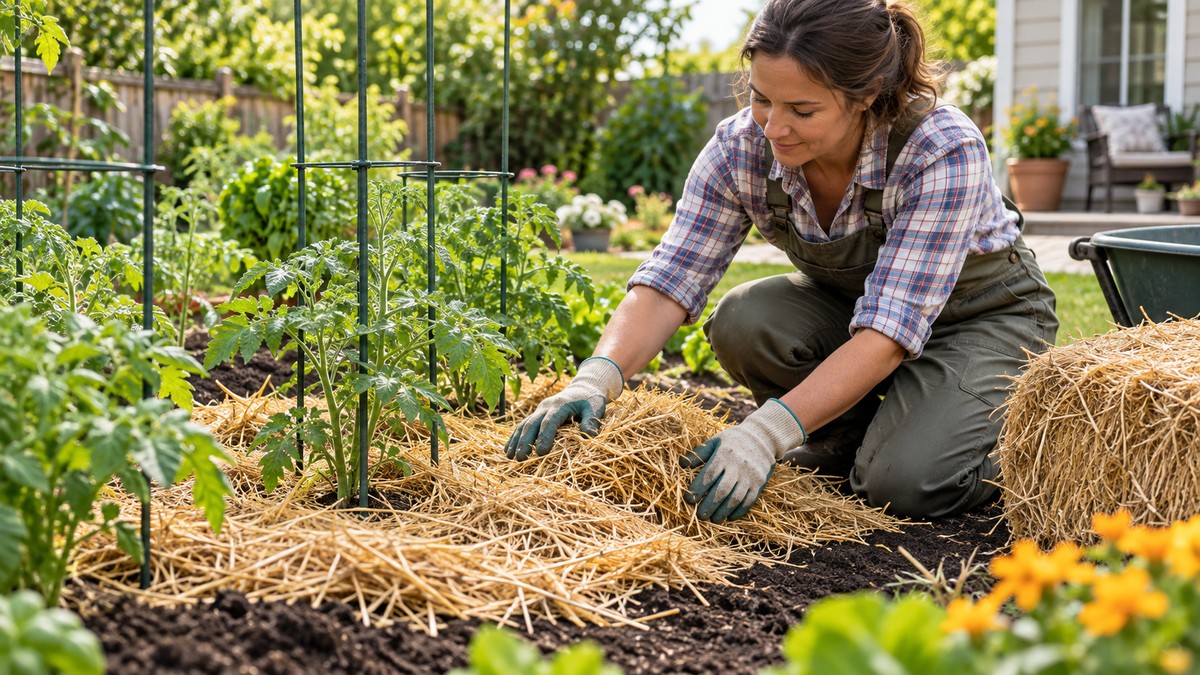
- For straw, Wisconsin Extension suggests about 4 to 6 inches, because straw packs down. Start young transplants at about 1 inch and add depth as they grow.
- Wait until the ground warms in spring. Spreading mulch too early keeps the soil cold and slows growth.
- Keep straw several inches from house foundations, away from tree trunks, and out of the layer around woody shrubs and trees.
What straw mulch does in a bed
Mulch does several jobs at once. Iowa State University Extension lists weed control first, followed by conserving soil moisture and moderating soil temperatures. Its list also includes reducing soil erosion and keeping fruits, vegetables and flowers free of rain-spattered soil. A straw layer covers the soil surface so that rain lands on the mulch rather than splashing up and running off, which Wisconsin Extension describes as a way to reduce soil erosion and crusting.
Weed control is the job most gardeners care about. Wisconsin Extension says mulch helps by preventing and slowing weed seed germination. That is why straw works best when it goes down before weeds get established, not after they have taken over a bed. The same page notes that organic mulches add organic matter to the soil and do not have to be removed at the end of the growing season or before tilling, which makes straw easier to manage than a material you must haul away each year.
Buy straw that is weed free
Straw is only as clean as the field it came from. Colorado State University Extension says that “Weed free (seed free) straw makes excellent mulch for vegetables.” The same page gives the buying rule in plain words: “When purchasing straw, look for certified weed (seed) free products.”
Colorado State also gives a clear instruction for buyers who are not sure: “Do your research before using straw as mulch.” In practice that means asking the seller where the straw came from, whether it is certified, and whether it is meant for garden use.
Iowa State University Extension describes the straw to use in its own terms. It says that “Straw Wheat, oat, or soybean straw, free of seeds, makes an excellent short-term mulch and overwintering insulation for cold-tender plants.” The phrase to notice is free of seeds. That is the same standard Colorado State sets, and it is the standard to check on the bale before you bring it home. Wheat, oat and soybean straw are the types Iowa State names. The page does not rank them against each other.
Colorado State adds a second use for certified straw. It calls weed-free straw “also a good organic source for clayey soils,” which matters for a bed that is hard to drain or slow to warm. Mulch and soil improvement can happen together, which is why this guide returns to working straw into the soil later on.
How deep to spread straw
Depth depends on the crop, the season and the material. For straw specifically, Wisconsin Extension advises applying it deeper than other organic mulches, about 4 to 6 inches, because straw packs down and loses height as it settles. Iowa State University Extension gives a wider starting point for mulch in general. Its words are “Generally, 2 to 4 inches is effective, with coarser mulches (like wood chips) on the higher end and finer mulches (like grass clippings) on the lower end.” Because straw is a coarse, light material that settles, the Wisconsin figure is the one to start with, and the Iowa State range is the check on the other end.
A thin layer is the more common mistake. Iowa State says that “A thin mulch layer is less effective at weed suppression and moisture conservation and needs frequent replenishment, increasing maintenance time and costs.” A gardener who spreads two inches of straw and hopes for the best ends up weeding and re-spreading all season. Adding depth at the start saves the second pass.
Going too deep is a separate problem. Iowa State warns that an excessively deep mulch layer can lead to waterlogging, reduced soil oxygen levels, shallow rooting, and overly warm soils in winter.
Young transplants need a lighter touch
Seedlings and small transplants cannot carry the same weight of straw as established plants. Wisconsin Extension gives a sequence that works well for vegetables: “Vegetables grown from transplants should be mulched sparingly (about 1 inch) when they are young, and then you should gradually increase the mulch depth to 3 inches as the plants grow taller.” Start light, then add straw as the plants grow. The page does not give a day count for each step, so the gardener sets the pace by checking the plants.
When to put it down
Timing is the step most gardeners get wrong in spring. Iowa State University Extension says, “In early spring, wait until the ground warms and perennials emerge.” Wisconsin Extension gives the reason: “Applying organic mulches too early in spring will keep the soil cold longer and slow plant growth.” The two pages agree, so the rule for spring is to hold off until the soil has warmed, then spread the straw.
The fall side has its own rules. Iowa State says that mulches “can be applied at any point during the growing season,” and late-season applications go on after plants go dormant in the fall, “but not too early, as it can delay dormancy and increase the risk of cold damage.” Wisconsin Extension suggests mulching perennials in the fall after several freezes, usually about Thanksgiving. Waiting for the freezes lets the plants settle into dormancy before the straw goes on.
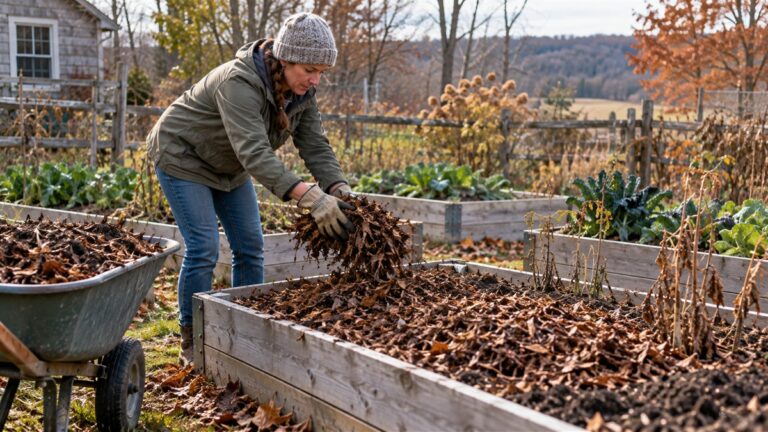
For a checklist of spring and fall tasks on raised beds, see our guide to preparing raised beds for winter. It covers the bed-side work that comes before the straw goes down.
Keep straw away from stems and trunks
Placement matters as much as depth. Iowa State University Extension advises that “To minimize the risk of infestation, mulch should be kept several inches away from the house foundation.” The same page warns against the mistake of heaping mulch against tree trunks. Mulch piled high against a trunk is what it calls a “mulch volcano,” and it describes the problem as one that shows up in some landscapes, especially around commercial and municipal properties.
The same logic applies to plant stems. Straw should lie over the soil around a plant, not pile up against the base of the stem. Wisconsin Extension shows the other extreme for winter. To protect roses and other perennials, it says to “pile about 8 inches of straw, marsh hay, or similar material around the plant crown.” That is a cold-season method for hardy perennials. It is not a method for a summer vegetable bed, where the crown and stem should stay clear.
The pages we opened do not give a set distance between straw and a vegetable stem, so keep the layer loose and pull it back from stems as the plants grow. Trunks are a different case, and the guidance on them is clear.
Straw and nitrogen
Straw is a high carbon material, and Iowa State explains the trade-off in plain words. Mulches with a high carbon-to-nitrogen ratio, a group that includes straw, “stimulate microbial growth, which depletes available nitrogen in the soil, potentially causing nitrogen deficiency in plants.” It is not a reason to skip straw. It is a reason to pay attention to how the plants look after spreading.
A practical check is to watch the plants over the next few weeks. Paler leaves or slower growth after a thick layer goes on are signs to look at the nitrogen situation. The pages we opened do not give a fertilizer rate to correct it, so follow the directions on the fertilizer you already use and do not invent a rate from a different product.
Straw for winter cover
Straw has a second life once the growing season ends. Iowa State University Extension describes it as “an excellent short-term mulch and overwintering insulation for cold-tender plants.” Wisconsin Extension says organic mulches help protect roses, strawberries, and prized perennial plants from severe cold weather and from frequent freezing and thawing in winter.
Iowa State also notes a structural benefit. Straw is “less likely to mat and smother crowns,” which is a problem with some finer mulches. The same paragraph warns that it “may provide a winter habitat for mice and other rodents,” so the page advises gardeners to avoid using straw around trees and shrubs. Keep winter straw in the open beds, and keep it well clear of woody plants.
For the timing of winter cover on raised beds, our guide on how much soil a raised bed needs is a useful companion. It explains the bed depth that a mulch layer sits on top of, which changes how much straw you need.
Common mistakes to avoid
- Buying straw without checking its seed content. Colorado State University Extension asks buyers to look for certified weed-free straw and to do their research first.
- Spreading straw too early in spring. Wisconsin Extension says early mulch keeps the soil cold and slows plant growth.
- Piling straw against tree trunks. Iowa State University Extension calls that a mulch volcano.
- Putting straw around trees and shrubs for the winter. Iowa State links that layer to mice and other rodents.
- Spreading a thin layer and expecting it to last. Iowa State says thin layers need frequent replenishment.
- Letting a very deep layer sit in a wet spot. Iowa State warns that excessive depth can cause waterlogging and reduce soil oxygen.
Removing straw and working it into the soil
Straw does not always have to be cleared away. Colorado State University Extension describes a long-term route for clayey soils. Use certified weed-free straw as a summer mulch for a few years, then “thoroughly cultivate it into the soil as a soil amendment in the fall.” That approach matches Wisconsin Extension’s point that organic mulches add organic matter and do not have to be removed before tilling.
The pages do not give a number of years for how long a bed should carry straw before it is worked in, so treat the few years in Colorado’s text as an example rather than a fixed schedule. The same extension page also mentions straw as a substitute for hilling potatoes. Its exact words are “Straw mulch may be used as an alternative to hilling.” That is a useful option for a gardener who would rather not mound soil around the plants.
Perennial beds follow a different rhythm. Wisconsin Extension says to remove the winter mulch on perennials in spring, and it gives a visible sign for the timing: “Remove the mulch in spring when leaves begin to show a yellowish tinge.” Watch for that sign rather than a calendar date, and clear the mulch before new growth gets trapped under it.
How we chose
This guide relies on three extension pages, each opened with curl on 2026-10-22 and read as text: Iowa State University Extension and Outreach, University of Wisconsin-Madison Extension Horticulture, and Colorado State University Extension. We picked them because each covers mulch in a home or vegetable garden and each states depth, timing or straw-specific advice in its own words. We left out retail guides, which tend to favor the products they sell.
Two of the three pages are general mulch guides, so the straw-specific points are the sentences they tie to straw by name. Each quoted sentence was checked against the fetched page text before use.
What we could not verify
The three pages do not settle every question a gardener will ask. Read the gaps below as open questions rather than as answers.
What the sources do not say
- How much straw one bed needs. None of the pages gives a bale count or a volume for a given bed size.
- A fertilizer rate for a straw bed. The fetched text gives the nitrogen trade-off, but no amount to add.
- How close straw can sit to a vegetable stem. The pages address trunks, shrubs and perennial crowns, not the stems of annual crops.
- How many weeks or months a straw layer lasts before it breaks down. The pages describe the decay in general terms only.
- Regional calendar dates. The pages tie timing to soil warmth and plant dormancy rather than to a date for a given state.
Frequently asked questions
Is hay an acceptable substitute for straw?
The sources do not treat hay as a safe swap for straw. Wisconsin Extension lists straw and hay together in several places, but Colorado State University Extension specifically recommends weed-free straw for vegetables. If the choice is between straw and hay, read the label, ask about seed content, and prefer straw that is certified weed free.
How deep should straw mulch be?
Wisconsin Extension gives a figure of 4 to 6 inches for straw. Iowa State University Extension’s general range for mulch is 2 to 4 inches. Young transplants start at about 1 inch and gain depth as they grow.
When is the right time to spread straw in spring?
Wait until the ground has warmed and perennials are coming up. Iowa State says so directly, and Wisconsin warns that early mulch keeps the soil cold and slows plant growth.
Will straw take nitrogen away from my plants?
It can, at least in the first weeks. Iowa State says that high carbon-to-nitrogen materials, a group that includes straw, can deplete available nitrogen and cause a deficiency. The pages we opened do not give a fertilizer rate to correct it, so follow the directions on the fertilizer you use and watch the plants.
Should straw go around shrubs and trees for winter?
Iowa State advises against it, because straw around trees and shrubs may give mice and other rodents a winter habitat. Keep straw in the open beds, keep it several inches from house foundations, and keep it away from trunks, where piled mulch becomes a mulch volcano.
Sources
- Iowa State University Extension and Outreach, Yard and Garden, “Using Mulch in the Garden”: https://yardandgarden.extension.iastate.edu/how-to/using-mulch-garden (opened 2026-10-22)
- University of Wisconsin-Madison Extension, Horticulture, “Mulches for Home Gardens and Plantings”: https://hort.extension.wisc.edu/articles/mulches-home-gardens-and-plantings/ (opened 2026-10-22)
- Colorado State University Extension, “Mulches for the Vegetable Garden”: https://extension.colostate.edu/resource/mulches-for-the-vegetable-garden/ (opened 2026-10-22)