How to Grow Sunflowers
As an Amazon Associate we earn from qualifying purchases.
How to grow sunflowers is one of the simpler jobs in a garden, as long as the plant gets full sun and the seed goes in at the right depth. The four extension pages we opened agree on the basics. They disagree on depth, spacing, timing and drying, and this guide shows those differences rather than choosing one set of numbers.
Two of the pages are Oregon State University publications, one comes from West Virginia University Extension, and one comes from Iowa State University Extension and Outreach. The Oregon timings reflect Oregon’s climate, so check local frost dates before you sow.
Quick answer
- Plant in full sun and well-drained soil. Oregon State says sunflowers “thrive in full sun and well-drained soil with a slightly acidic to near neutral pH”.
- Sow seed about 1 inch deep. West Virginia and Iowa State allow 1 to 2 inches.
- Space plants by variety. Oregon State gives 18 to 24 inches for branching types and 4 to 6 inches for single-stem types.
- Harvest when the head droops and dries, and dry it in a sheltered, well-ventilated place.
Choose a sunny, well-drained spot
Sunflowers need sun. Oregon State tells gardeners to “Choose a place in the garden that receives full sun”, and puts that at six to eight or more hours a day. Iowa State says sunflowers “need sun – full sun – for best performance” and adds that “They also prefer fertile, well-drained soils.” West Virginia makes the same point about its plant’s annual habit, saying “Sunflowers are annual plants that perform best in sunny locations.”
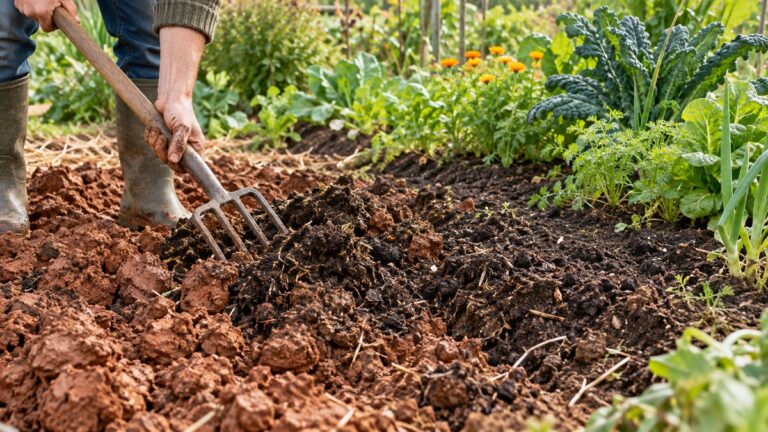
Drainage matters as much as light. Oregon State says “Sunflowers grow best in well-draining soil, so avoid low areas where water puddles.” It also warns that “Heavy clay soil can reduce sunflower growth.” If your bed is heavy, the same page gives a preparation step: “Before planting, amend the soil with 1-2 inches of compost and mix to a depth of 12 inches using a digging fork or broadfork.” For a raised bed, see how to fill raised beds.
Test the soil and feed with care
The pH figures differ. Oregon State gives a range of 6.0 to 7.5, while West Virginia says “Sunflowers prefer well-drained soils with a pH between 6.0 to 7.0”. West Virginia recommends a test before planting: “Test your soil to determine pH level and fertility needs before planting sunflowers.” Use the test result to choose between the two ranges, since the pages do not explain the gap.
Every source warns against too much nitrogen. Iowa State says “Avoid high-nitrogen fertilizers as they tend to promote vegetative growth and inhibit flowers.” Oregon State makes the same point: “Avoid high nitrogen fertilizers as these promote leaf growth rather than flower formation.” For fertilizer timing, the pages differ. Oregon State’s imported publication says “After one month of growth, add a balanced fertilizer such as 10-10-10”, while West Virginia recommends a slow-release all-purpose fertilizer once the second set of leaves appears. The sources do not agree on the exact timing, so choose one and watch the plant.
Sow the seed at the right depth
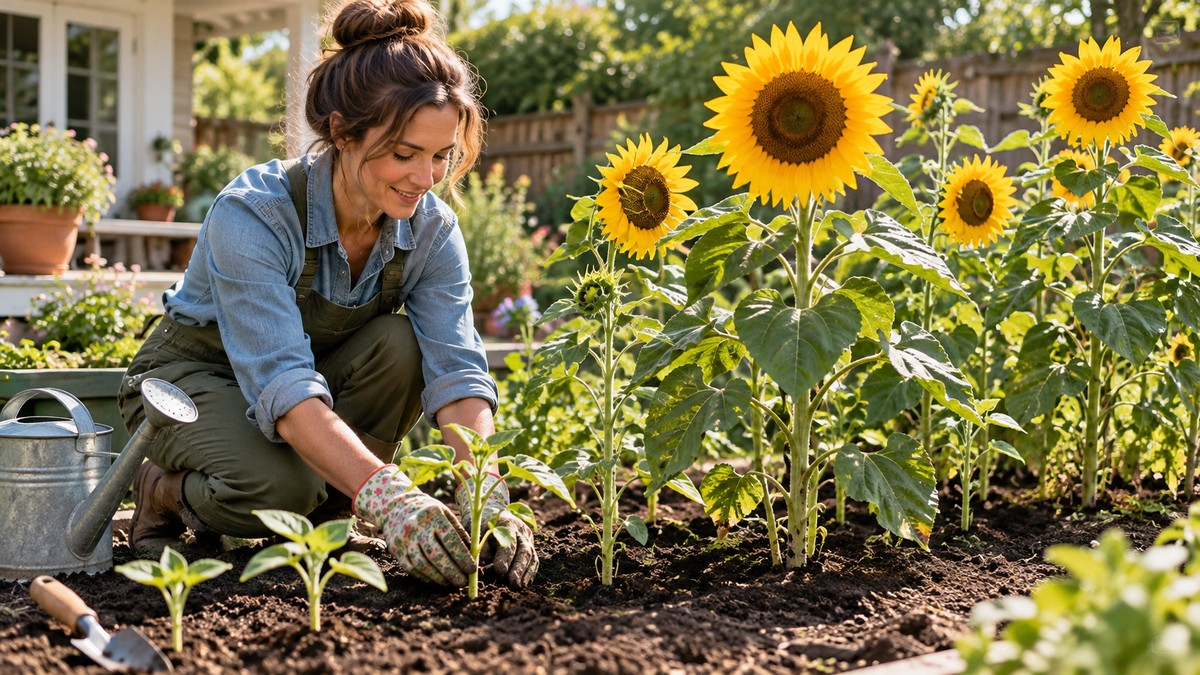
Depth is the most consistent instruction. Oregon State says “Plant seeds about 1 inch deep and keep the soil moist until the seeds have germinated.” Iowa State gives the same depth in a different form, saying that “Sunflower seeds are typically direct seeded (1-2 inches deep) outdoors in spring.” West Virginia gives a wider range: “Plant sunflower seeds 1 to 2 inches deep after the last threat of frost.” Iowa State also reports that “Seeds germinate within 1-2 weeks”, so the bed will need steady moisture for about that long.
Timing depends on where you live. Oregon State gives Oregon dates: “The best time to direct seed sunflowers is usually from April to June for the Willamette Valley and the Coast, and June for Central and Eastern Oregon.” West Virginia’s rule is simpler and tied to frost, since it says to plant after “the last threat of frost.” Check your own last frost date, and use the Oregon dates only as a reference.
Space plants by variety
Spacing depends on how tall the variety grows. Oregon State separates the two main forms: “Larger, branching varieties should be spaced 18 to 24 inches apart, while single stem varieties can be spaced as close as 4 to 6 inches apart.” West Virginia uses height instead: “Space seeds 6 inches apart for smaller varieties and 12 inches apart for taller varieties.” Iowa State gives the widest spacing for tall plants, saying “Tall growing varieties should be thinned to stand 2 to 2 1/2 feet apart in the garden”. For the giants, Iowa State adds that “Plants should be spaced about 2 feet apart for good air circulation.”
Thinning is the step that gets the spacing right. West Virginia says “Once seedlings emerge, be sure to thin out as needed.” Oregon State’s imported publication gives a clear rule for the young plants: “When seedlings are 3 to 4 inches tall, remove extras to allow 6 to 18 inches between each seedling and other nearby plants.” Sow a few extra seeds, then thin when the seedlings reach that height. For a bed that will hold several crops, see vegetables to plant in raised beds.
Water deeply and stop worrying about drought
Sunflowers want steady water while they are young. Oregon State says “Sunflowers like plenty of water to grow strong”, and gives a schedule: “Water deeply 1 to 2 times a week.” Iowa State is more relaxed about the mature plant, saying “Once established, sunflowers are quite drought-tolerant.” Oregon State’s own EM publication says the same: “Sunflowers are drought-tolerant once the plants have an established root system.”
The pages agree that water matters during flowering. Oregon State says “Flowering and seed production will be best when the plant receives regular watering.” West Virginia adds that sunflowers “do need watered regularly to help create a strong root system during the beginning stages of growth.” Oregon State’s imported publication notes that “After flowering they need less water”, so the schedule can ease off once the blooms open.
Stake the tall types
Tall plants with heavy heads need help. Oregon State’s imported publication says “Tall varieties with large or many flower heads may need support to keep from falling over.” It gives the timing and the tie: “Attach plants to sturdy stakes with soft ties when they are 2 to 3 feet tall.” Iowa State says tall types should be staked “to help support the seedhead under windy conditions.” Dwarf types are an easier option, since Oregon State says “Dwarf cultivars are less likely to become top-heavy and tip over.”
Pick a variety by height and use
Height varies widely. Iowa State says “Sunflower cultivars vary in height from 1 to 5 feet”, and that “Those cultivars 3 feet or less are considered dwarf types.” At the other end, “The giant cultivars ultimately reach 8 feet or more.” West Virginia’s range is wider still, saying “some varieties can grow anywhere from 2 to 15 feet tall.” For pots and small beds, Oregon State describes “Compact varieties (1–3 feet) are ideal for borders, containers or small gardens.”
Use also changes the choice. Oregon State says “The largest varieties should be avoided for use as cut flowers” because of size. Iowa State describes a pollenless group that is “used primarily as cut flowers or garden plants”, and Oregon State says “Pollen-free varieties are preferred for use as cut flowers” because they shed less pollen indoors. Oregon State’s imported publication advises checking the seed packet or plant catalog for the predicted height before you buy.
Protect the seed from birds and squirrels
Wildlife is the main threat to the crop. Iowa State says “Hungry birds and powdery mildew are the biggest problems.” Oregon State’s imported publication is more direct about the seedlings: “Birds, deer, rodents and squirrels love eating the young plants and seeds.” Its fix is physical rather than chemical: “Protect seeds and seedlings with a barrier such as a clear plastic bottle with its bottom cut off and the cut edge pushed into the soil.”
The two Oregon State pages give opposite advice about the mature heads. The EM publication says “Birds, deer, rodents and squirrels will eat sunflower seedheads.” It then says “Allowing the seed heads to remain standing through autumn and winter is an easy way to provide a continuous food source.” The imported publication says to cut the head “to avoid losing seeds to birds and other critters.” Decide whether you want the heads for wildlife or for your own seed, and follow the matching advice.
Iowa State adds that “They have few major insect or disease pests”, and that “Mildew can be avoided by placing the plants in full sun.” This guide gives no pest or disease treatment, and a local extension office is the right route for a specific problem.
Harvest when the head droops
The heads tell you when they are ready. Oregon State says “A sunflower is ready to harvest when the flower head begins to droop over and dry out.” Iowa State describes the same stage from another angle: “Sunflower seed heads are ready to harvest when they face downward”. Iowa State also says the inner petals should come away easily, and the back of the head should turn lemon-yellow.
The time from planting to seed differs between pages. Iowa State says “Sunflower seeds reach maturity 70-100 days after planting”, while West Virginia says “Sunflower varieties typically reach maturity in 85 to 95 days.” Use the days as a guide, and let the head signal the final call. When you cut, Oregon State advises that “Cut the head off to avoid losing seeds to birds and other critters.” It adds that “Leave some stem attached if you want to hang it to dry.”
Dry and store the seeds
Drying takes a few steps. Oregon State says to “Rub off the little flowers” and then to hang or place the heads “in a warm, dry place with airflow.” Iowa State suggests a darker place: heads are “placed in paper bags or netted in cheesecloth, and hung in a dark, dry, well-ventilated location to continue the drying process.” Both pages call for dryness and airflow, and the warm or dark choice is a matter of preference.
Once the head is dry, the seeds come off by hand. Oregon State says that “When the seeds are dry, rub or brush them off with your fingers or a stiff brush.” Then “Spread seeds on a cloth to dry for a few more days”, and “Store in airtight containers.” Iowa State gives a rough timeline, saying that “Within a couple of weeks, the seed should be ready for roasting or giving to the birds.”
How we chose
We chose pages that give growing instructions for sunflowers, published by university extension services, that we could open with curl and read. We fetched all four on 2026-10-22 and read the text we received. Two of the pages are Oregon State publications, one of which is an imported reprint. The other two are from West Virginia University Extension and Iowa State University Extension and Outreach. We quote only sentences that appear word for word in the fetched texts.
We left out retail listings and seed catalogs, so no seed brand, variety or nursery is recommended here. Where two pages disagree on depth, spacing, timing or drying, this guide shows both positions and says so.
What we could not verify
The four pages do not cover seed packets, prices or specific nurseries, so those are outside this guide. This guide also gives no yield per plant and no roasting method, since roasting is beyond a growing guide.
What the sources do not say
The pages do not settle the timing question for every climate, and they give Oregon dates that do not transfer to other regions. Only Iowa State gives a maturity range of 70 to 100 days, and only West Virginia gives 85 to 95 days, so the two cannot be reconciled from the text. None of the four pages gives a fixed number of days for seed to dry before storage, beyond Iowa State’s rough estimate of a couple of weeks.
Frequently asked questions
How deep should you plant sunflower seed?
About 1 inch deep, according to Oregon State. West Virginia and Iowa State allow a range of 1 to 2 inches, so the shallower depth is the safer reading of all four pages.
How far apart should sunflowers be planted?
It depends on the variety. Oregon State gives 18 to 24 inches for branching types and 4 to 6 inches for single-stem types, while West Virginia uses 6 inches for smaller varieties and 12 inches for taller ones.
Do sunflowers need a lot of water?
They need steady water while they are young, and regular watering during flowering helps seed production. Once established, Iowa State says sunflowers are quite drought-tolerant, and Oregon State’s publication says they need less water after flowering.
How do you keep birds and squirrels away from sunflower seed?
Oregon State suggests a physical barrier, such as a clear plastic bottle with its bottom cut off and pushed into the soil around young seedlings. Once the heads are ready, cutting them early avoids losing seed to birds and other critters.
When is a sunflower head ready to harvest?
Harvest when the head begins to droop and dry out, according to Oregon State. Iowa State adds that the head faces downward and the petals rub off easily when it is ready.
Sources
- https://extension.oregonstate.edu/catalog/em-9866-grow-your-own-sunflowers (opened 2026-10-22)
- https://extension.wvu.edu/lawn-gardening-pests/gardening/gardening-101/growing-sunflowers (opened 2026-10-22)
- https://extension.oregonstate.edu/imported-publication/sunflowers (opened 2026-10-22)
- https://yardandgarden.extension.iastate.edu/how-to/growing-sunflowers-and-their-varieties (opened 2026-10-22)