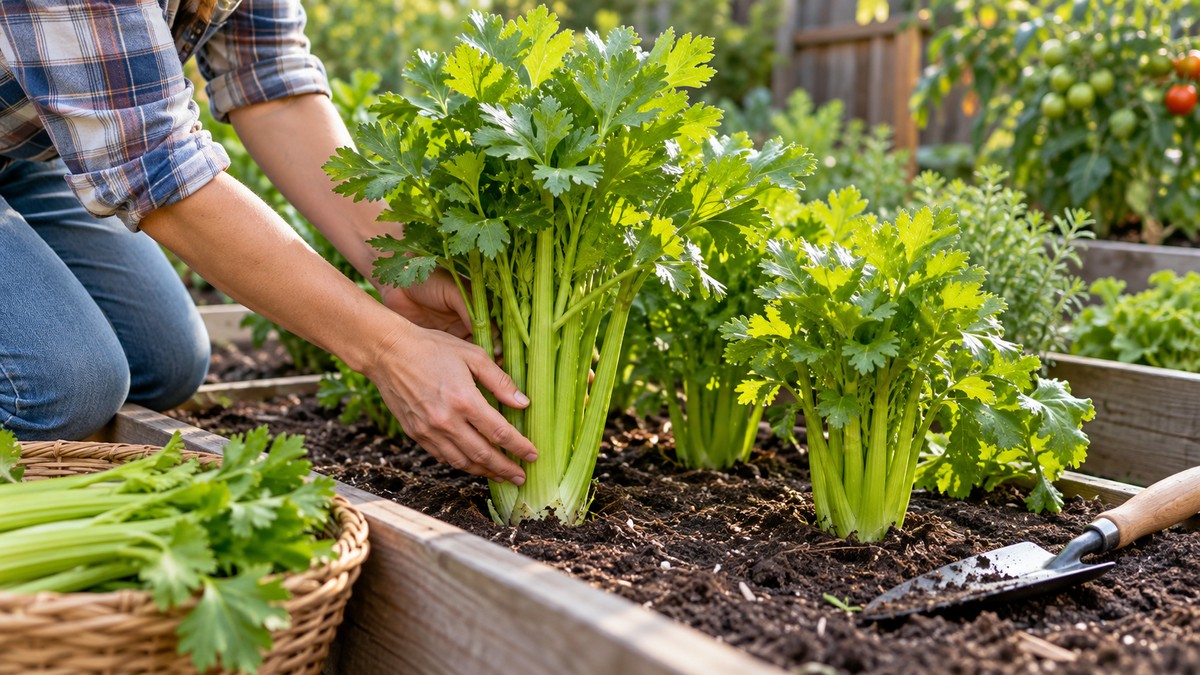
How to Grow Celery
As an Amazon Associate we earn from qualifying purchases.
Learning how to grow celery is mostly a question of timing and water. Celery needs a long season, it wants steady moisture all summer, and its stalks are only as crisp as the care it gets during the growing period. The three guides we opened agree on those points. They differ on transplant dates, on spacing and on blanching, so this article shows where each guide stands and what the figures mean for a home bed.
Quick answer
- Start seed indoors about ten weeks before planting out, and plant after the last frost in your area.
- Give the plants full sun, fertile soil, and water on a regular schedule all summer.
- Plant in a block rather than a single row, and blanch the outer stalks, or choose a self-blanching variety.
- Harvest the outer stalks once they are about a foot long, and use them within a few weeks.
Start seed indoors early
Celery needs time, so the seed usually starts indoors. The RHS guide explains why: “Celery seeds need warm temperatures to germinate and a long growing season”. It advises sowing “between mid-March and early April in seed trays, modules” and then notes that young plants “should be ready to plant outdoors about ten weeks after sowing, in late May or early June”. Those are UK dates, so shift them to your own frost calendar.
The University of Maryland sheet gives a shorter lead time for transplants: “Sow seed 10-12 weeks before field planting.” Both guides put the start about ten to twelve weeks before the plants go out. The Utah State guide frames the timing differently, saying ideal planting is “about 10-12 weeks before harvest.” That is a figure for the season from planting to harvest, not for the start indoors, so do not read the Utah sentence as a sowing date.
The Maryland sheet also covers the transplants themselves. It says that “Plants can be hardened by withholding water 7-10 days before field planting.” It adds a warning about temperature: “Never harden celery plants by lowering temperatures.” Hardening by reducing water, rather than by cold, is the method the sheet describes, and it is the one to follow.
The RHS guide gives the sowing method as well: “Sow thinly on the surface of the compost”, using seed trays or modules. The sheet does not give a light or temperature figure for indoor seedlings beyond the warmth needed for germination, so this article does not add one.
Prepare the soil and feed the plants
The Utah State guide sets the site conditions in one sentence: “Celery thrives in full sun with fertile, well-drained soil rich in organic matter.” It also gives a soil test as the starting point: “Before planting, determine fertilizer needs with a soil test and then follow the recommendations given with the test report.” A test is the only reliable way to know which nutrients the bed lacks, and it saves guesswork about fertilizer.
The Utah State guide gives a feeding plan for the growing season: “Feed with nitrogen-rich fertilizer about a month after planting, but stop once stalks start forming to prevent splitting.” Stopping nitrogen at that point is the detail to remember, because feeding late can encourage the splitting the guide warns about.
Mulch helps the bed hold moisture between waterings. The Utah State guide notes that “Black plastic mulch warms the soil, conserves soil water and helps control weeds.” It also says that “Plastic mulches allow earlier planting which is necessary for a crop such as celery.” Plastic mulch is an option rather than a requirement, and the guide presents it as a way to plant earlier in the spring.
Plant out in a block, not a single row
Spacing is where the guides differ most. The RHS guide recommends a block: “Then plant the celery in a block rather than a row, spaced about 23cm (9in) apart in each direction.” The Utah State guide gives a wider plant spacing of 18 to 24 inches, and its PDF text renders the inch mark as a hash sign, so the figure is read from that line. The Maryland sheet uses a commercial layout, with “rows 16-32 inches apart and plants 8 inches apart in row”. A tight planting helps the stalks grow, and the Utah State guide says so directly: “A tight planting helps force tall growth and long petioles.”
Plant out after the risk of frost has passed. The RHS guide says plants can be set out “once all risk of frost has passed in your area”, which is usually late May or early June in its setting. In the Maryland sheet, temperature is the main concern in the bed. It explains that celery grows best in cooler weather, and that a long cold spell can make plants “initiates seed stalks”, meaning they bolt. The sheet notes that bolting follows exposure to temperatures below 55F, so keep young plants out of cold snaps where you can.
A block layout also suits a small bed. Choose a bed that gets full sun, and check the spacing against your bed size before you buy transplants. Our guide to raised bed companion planting and garden layout covers how to plan a bed with several crops in it, and our guide to vegetables to plant in raised beds lists other crops that suit the same setup.
Blanch the stalks for mild flavor
Blanching means keeping light off the stalks so they turn pale and taste milder. The RHS guide explains the modern option: “Instead, newer ‘self-blanching’ and green varieties are planted closer together in a block, to reduce the amount of light reaching the stems.” Self-blanching varieties need less work, and the RHS guide says to choose them for that reason.
Traditional varieties need more help. The RHS guide says: “For the best quality results though, you should still blanch those on the outside of the block, but this is easily done by tying newspaper around them.” The Maryland sheet describes the other approach, which is to mound soil or use a trench: “For non self-blanching cultivars, blanching can be accomplished by trenching or other mechanical means.” It also adds that “High plant populations can promote blanching”, so a dense block helps even without extra work.
Variety matters for the result. The Utah State guide names two varieties: “Utah and Pascal are two varieties that remain green when ready for eating and are considered to be the finest quality.” The RHS guide lists ‘Tall Utah 52/70’ with the description “A tall variety with high yields of crisp, stringless, pale-green stems.” The Maryland sheet advises checking local recommendations: “Check with your seed supplier or other growers for recommendations on locally adapted varieties.”
Water well all summer
Water is the thread through every part of the growing season. The RHS guide says plainly that “Celery needs plenty of water all summer to produce deliciously crisp, juicy stems”. The Utah State guide adds that “Celery is crisper and tenderer if watered regularly especially prior to harvesting.” Watering before harvest is the step that most affects the texture of the stalks.
The Maryland sheet describes what happens when the plants are short of water: “Water stress may result in a calcium deficiency disorder causing cell death.” A steady watering routine, rather than a heavy soak once a week, is the simplest way to avoid stress. The sources do not give a number of gallons or inches per week for home beds, so check the soil and water when the top layer feels dry.
Harvest and store the stalks
The Utah State guide gives a size to aim for: “Harvest celery stalks by removal of the outer petioles when they are a foot or more in length.” Cutting the outer stalks first lets the centre keep growing, which is the method the guide describes.
The Maryland sheet adds a quality point: harvest “when stalks are of sufficient size but before any pithiness has developed in the petioles.” It also says that harvested celery should be cooled quickly, and it gives a longer storage time under cold, humid conditions: “Stalks can be held 5-7 weeks” when storage is kept near freezing with high humidity. A home refrigerator is not the same as those conditions, so the Utah State guide gives the practical figure: “Store harvested celery in the refrigerator for up to 2 weeks.”
Weather at harvest changes the eating quality. The Utah State guide warns that “Celery harvested in hot, dry weather may be tough, stringy, and bitter.” If a heat wave is coming, pick a little early and cool the stalks quickly.
Common problems the sources describe
Most problems come from timing and water rather than from the soil. Cold snaps after planting can trigger bolting, and the Maryland sheet links bolting to exposure to temperatures below 55F for a number of days. Dry weather makes the stalks tough and bitter, which the Utah State guide describes. Water stress can cause the calcium disorder the Maryland sheet mentions, and overfeeding with nitrogen late in the season can encourage splitting, as the Utah State guide notes.
Blanching problems are usually a matter of light and spacing. Stalks exposed to light stay green and stronger in flavor, so the outer stalks of a block should be wrapped or mounded, as the RHS guide recommends.
How we chose
We chose the steps that the pages we opened state in plain words, and we kept the points that more than one guide covers. Where the guides differ, both versions appear with their source. The three pages are a Utah State University Extension guide for home gardens, a University of Maryland Extension fact sheet written for production growers, and an RHS growing guide from the United Kingdom. The Maryland sheet is a commercial production guide, so its planting rates and cold-storage figures are presented as its own figures, not as a home-garden rule.
We left out pest, disease and weed control. Several of the pages discuss those topics with product names and label rates, and this guide does not recommend any product.
What we could not verify
What the sources do not say
The guides do not agree on the start date. The RHS guide suggests mid-March to early April for indoor sowing, while the Maryland sheet gives a 10-12 week lead time without a calendar date. The Utah State guide ties planting to the harvest window, not to the sowing date. Spacing also differs: the RHS block is about 9 inches each way, the Utah State guide gives 18 to 24 inches between plants without giving a row width, and the Maryland rows run 16 to 32 inches apart with plants 8 inches apart.
The pages we opened do not give a home refrigerator storage time beyond the two-week figure from Utah State, do not give a yield per plant, and do not give a fertilizer rate in pounds or ounces for a home bed. They do not cover celery grown in containers. The Maryland storage figures are for near-freezing, high-humidity conditions, and the sources do not say how to reproduce them at home.
Frequently asked questions
When should celery seed be started?
The RHS guide suggests sowing indoors between mid-March and early April, and the Maryland sheet gives 10-12 weeks before field planting. Count back from your own last frost date to choose the start.
How far apart should celery plants be spaced?
The RHS guide plants in a block about 9 inches apart each way. The Utah State guide gives 18 to 24 inches between plants. The Maryland sheet uses rows 16 to 32 inches apart with plants 8 inches apart. Choose the layout that fits your bed.
Does celery need blanching?
It depends on the variety. Self-blanching varieties need less work, and the RHS guide advises tying newspaper around the outer stalks of other types. The Maryland sheet describes trenching or mechanical blanching for non self-blanching cultivars.
When is celery ready to pick?
The Utah State guide says to harvest the outer stalks “when they are a foot or more in length.” The Maryland sheet adds a quality check: pick before any pithiness develops in the stalks.
How long does celery keep after picking?
The Utah State guide gives up to two weeks in the refrigerator. The Maryland sheet reports longer storage under near-freezing, high-humidity conditions, which a home refrigerator does not match.
Bottom line
Start celery indoors about ten weeks before planting, grow it in full sun with steady water all summer, plant it in a block, blanch the outer stalks or choose a self-blanching variety, and cut the stalks at about a foot long.
Sources
- https://extension.usu.edu/yardandgarden/research/celery-in-the-garden.pdf (opened 2026-10-22)
- https://extension.umd.edu/sites/extension.umd.edu/files/2026-02/Celery.pdf (opened 2026-10-22)
- https://www.rhs.org.uk/vegetables/celery/grow-your-own (opened 2026-10-22)
As an Amazon Associate we earn from qualifying purchases.