How to Grow Green Beans on a Trellis
As an Amazon Associate we earn from qualifying purchases.
How to grow green beans on a trellis comes down to three decisions made before the first seed goes in: choose a climbing type, build a sturdy support, and sow once the soil has warmed. Extension pages from Florida, Oregon, California, Arizona and Illinois agree on most of the basics, though they differ on spacing and planting dates. This guide sets out what those pages say and marks the points they leave open.
Quick answer
- Pick a pole type if you have a vertical support, because pole beans climb and bush beans stand without help.
- Set the trellis or tripod before planting, because bean roots are fragile and transplanting can damage them.
- Sow about 1 inch deep, spaced 3 to 6 inches apart depending on the page, once the soil has warmed to about 70 degrees F.
- Keep the soil evenly moist, water the ground rather than the leaves, and pick often to keep the vines producing.
Pole beans or bush beans?
The growth habit decides the whole layout, so settle it first. Pole beans climb, and the University of Arizona Cooperative Extension states the requirement plainly: “Pole beans must climb up a trellis, fence, or other support structure they can twine around.” The same page notes that “Bush beans stand erect without support.”
The Illinois Extension Master Gardener piece makes the trade-off in one line: “By trading height for width, they can be a good choice for limited space.” Bush types, in its account, “generally produce beans all at once” over about two weeks for a home gardener, and “Their well-defined growth pattern makes them a great choice for raised beds and large pots.” For other crops that suit raised beds, see vegetables to plant in raised beds.
Yield is the other difference. The Florida page notes that “A ten-foot row of pole beans can produce 8 pounds of beans in a single season”, against 4.5 pounds for bush beans in the same space. It adds that “If space is limited, pole beans are the plants for you.” Those are one page’s estimates, but they show why a trellis suits a small plot.
Variety matters too. The Arizona page lists Blue Lake, Kentucky Wonder and Kentucky Blue as popular pole types. The Florida page advises looking for “rust-resistant” options because of Florida’s humid climate. The Oregon State guide names Blue Lake, Romano and Kentucky Wonder. The lists overlap but are not identical, so check with your local extension office before you buy seed.
Build the support before you plant
Put the trellis up first. The Florida page gives the reason: “Because bean plants have weak root systems, sow your pole bean seed directly into your garden.” It adds: “For the same reason, install the trellis or support structure before you plant.” Transplanting, in its words, “could damage their roots”, so the support has to be in place before the seeds go in. For layout ideas that fit a bed, see raised bed companion planting and layout.
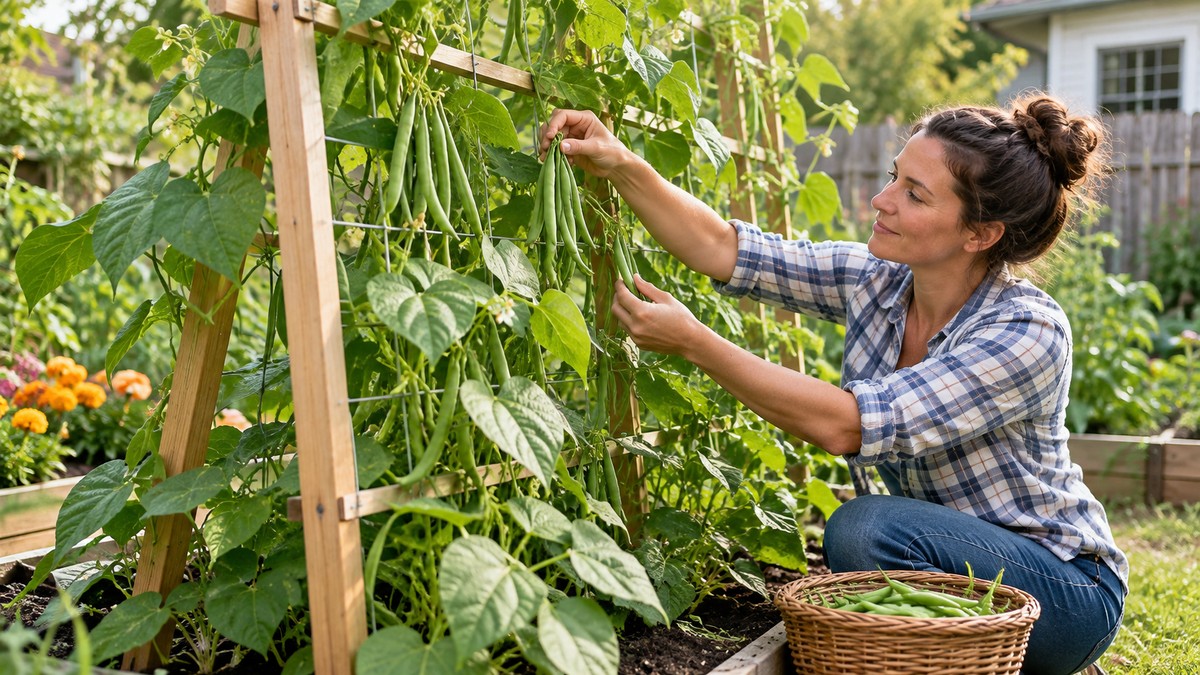
Height and strength come next. The Arizona page says “The trellis should be 6 to 8 feet tall and sturdy enough to take wind.” For a simple frame, it describes a tripod: “A teepee tripod support can be made with three wooden poles or large branches that are pushed well into the ground and fastened together at the top.” When a tripod is used, five or six seeds go in a circle “6-8 inches from each pole.”
The University of California Master Gardener guide gives a taller figure for the plant itself: “Pole beans grow on a narrow plant, but reach six to 10 feet tall and must have support with a tall trellis or tripod.” Its layout advice is “three plants to a pole, or every few inches along a trellis”, and it says to “Put any supports in place prior to planting”, which matches the Florida advice.
Sow at the right depth and spacing
The depth figures agree better than the spacing figures. The table sets out what each page states and marks each missing figure as Not stated.
| Extension page | Sowing depth | Spacing for pole beans | Support or row layout |
|---|---|---|---|
| University of Florida IFAS Extension | About 1 inch | 3 to 5 inches apart | Rows at least 36 inches apart |
| University of Arizona Cooperative Extension | One inch | 4 to 6 inches apart | Rows 30 to 36 inches apart; trellis 6 to 8 feet tall |
| Oregon State University Extension (Food Hero) | About 1 inch | 4 inches apart | Use a trellis for support |
| UC Master Gardener, Alameda County | Not stated | Three plants to a pole, or every few inches along a trellis | Tall trellis or tripod |
| University of Illinois Extension Master Gardener | Not stated | Not stated; the page points to seed packets | Vertical poles or other framework |
Three pages give the depth directly. The Arizona page says “Bean seeds of all varieties should be planted one inch deep.” The Oregon State guide says “Plant the seeds in the garden about 1 inch deep.” The Florida page asks gardeners to sow “about 1 inch into the soil”.
The Arizona page also advises against soaking. It says “For this reason, never soak bean seeds before planting.” Its alternative is “Instead water just after planting.” The page explains that beans crack and germinate poorly when the soil is too wet, so the aim is moisture after sowing rather than before.
Sun matters as well. The Florida page says pole beans need “at least six to eight hours of full sun every day”, and it notes that they grow well in containers too.
Wait for warm soil and plan more than one sowing
Beans are a warm-weather crop, so timing depends on where you garden. The Arizona page is specific about soil: green beans “should only be planted after soils have warmed up to 70 degrees F.” Once that happens, it says, “green beans can be planted every two or three weeks through July.” For a longer harvest, the Illinois page recommends staggering bush plantings one to three weeks apart.
Timing windows differ by region. The Illinois page says “In general, the seeds of both types can be sown after May 15.” Florida is warmer: “In Florida, beans are a warm-season crop and can be planted twice a year.” Oregon State gives several regional windows, such as “Plant May through August to harvest mid-June through mid-September” for the Willamette Valley. A May 15 date from Illinois says nothing about a garden in Florida or Oregon.
Water evenly and feed lightly
Water comes up on nearly every page. The Florida page says “Keep the soil consistently moist until your seeds sprout.” Once the plants have true leaves, it says, “water whenever you notice the soil surface has dried out.” The University of California guide asks for “Maintain even moisture, especially during bloom and bean formation.” Its reason is that “Beans have shallow roots”, which need “frequent irrigation to keep them from drying out.”
Watering habits also affect disease. The Oregon State guide says “Water early in the day.” It also says “Avoid wetting the leaves to prevent disease.” The Illinois page adds “Water plants on the ground, in the area where the stem meets the soil”, and warns that “Overwatering seedlings in spring when cool weather is still around can open the door for fungus.”
Feed lightly. The Florida page advises: “Fertilize pole beans at half the rate used for other vegetables.” It warns: “Avoid applying excessive nitrogen; this will increase foliage but decrease yields.” The University of California guide goes further and says beans “should not need fertilizer in well-amended soil”. If plants are weak, it suggests “a vegetable fertilizer with more phosphorus and potassium than nitrogen, following the package directions.”
Weeding needs restraint. The Florida page says “Be especially careful not to disturb the soil deeply when you weed”, and the Arizona page gives the reason: “Since bean plants have fairly weak, shallow root systems, avoid deep, close cultivation.” It adds that this “can injure the plant roots, delay harvest and reduce yield.”
Protect seedlings and manage pests
Young plants face the most risk from animals and soil pests. The Arizona page recommends a physical barrier against cutworms: “If you have had cutworm damage where seedlings are eaten off at soil level, that can be remedied by placing collars over newly germinated seeds”. The collars can be “tin cans or yogurt containers with openings at both ends”, removed “when the plant gets two or more true leaves.” The same page warns that “Rabbits love green beans so plan on excluding them from your garden plot with fence.”
Insects are the other common problem. The Oregon State guide says “Mexican bean beetles and aphids are common pests.” For disease, the Illinois page starts with variety choice: “Try to find resistant varieties.” It also advises: “If possible, relocate the beans to a different area of the garden every year or two.” The Arizona page notes that “Our arid climate inhibits many fungal and bacterial diseases”, so its disease comments describe a dry region.
Harvest often to keep the vines producing
The Florida page estimates that pole beans are ready after about 50 to 70 days, though other climbing types vary. The Arizona page gives a clear rule for green beans: “Harvest green beans when the pods are firm, crisp and fully elongated, but before the seed within the pod has developed significantly.” It adds that “Regular harvesting of green beans will prolong flowering and increase yields”, and warns to “Be careful not to break the stems or branches, which are brittle on most bean varieties.”
Pick often. The University of California guide says “Harvest every day or two to get the best flavor and encourage more beans to grow.” The Illinois page agrees in its own words: “Pick early and often. Picking stimulates new growth.” It warns that “If you leave beans on the vine too long, they get tougher and the beans inside the pod get larger as they head to dry bean status.”
Readiness has a visual check. The Oregon State guide says “Overall, the beans are ready to pick when they are about as thick as a pencil and before the pods fill out.” The same guide gives a storage window: “Store the beans in a plastic bag in your refrigerator for 7 to 10 days.”
Saving seed from the last harvest
Seed saving is where the sources disagree. The Florida page is positive: “Beans are among the easiest seeds to save; keep some of your harvest properly stored and you can replant them next season.” It also describes the drying step: “You can leave the pods to dry on the plant or pull whole vines off to dry indoors; wait until the leaves have turned yellow.”
The Arizona page takes a more cautious line: “Even though seeds are selfpollinated, you should plant new seeds each year to avoid seed-borne diseases.” Both positions can be followed at once. Keep seed only from a healthy crop, store it properly as the Florida page advises, and weigh the Arizona warning before you decide whether to replant saved seed or buy fresh.
How we chose
This guide draws only on five pages from university extension programs, all opened on 2026-10-22. We kept a claim only when at least one of those pages states it in plain words, and we quoted the exact sentence wherever the wording matters. Where two pages give different figures, we show both rather than pick one. We did not use retail listings or commercial blogs.
What we could not verify
The sources describe the basics well, but they leave gaps that matter in a real bed. Planting dates depend on your region, and the five pages give different windows. Spacing also varies by page, as the table above shows. None of the pages gives a trellis material, a cost or a build plan, so this guide does not recommend a product or a design.
What the sources do not say
- No page gives one harvest date that fits every named variety, and the Florida page gives its range for pole beans only.
- The Illinois page does not give a sowing depth or spacing, and it points to seed packets for spacing.
- The sources do not say how a 6 to 8 foot trellis handles a vine that the California guide describes as reaching 6 to 10 feet.
- No page covers a trellis set into a raised bed, so this guide cannot confirm how the frame should be anchored there.
- The Arizona disease comments describe a dry region, and the pages do not give a clear rule for wet climates beyond rust-resistant varieties.
Frequently asked questions
How tall should a trellis for green beans be?
The Arizona page gives a trellis height of 6 to 8 feet, sturdy enough to take wind. The California guide says pole plants can reach 6 to 10 feet, so the sources give two figures. This guide does not settle the gap, so check the stated height of your variety on the seed packet before you build.
Does a trellis work for green beans in a raised bed?
The Illinois page says bush types suit raised beds and large pots, while pole types need a vertical frame. The pages we opened do not discuss a trellis set into a raised bed. For bed depth and soil volume, see how much soil a raised bed needs.
Should green bean seeds be soaked before planting?
No. The Arizona page says “never soak bean seeds before planting” and recommends watering just after sowing instead. The Florida page’s instruction to keep the soil consistently moist until the seeds sprout points the same way.
How much can a row of pole beans produce?
The Florida page estimates 8 pounds from a ten-foot row of pole beans, against 4.5 pounds for bush beans in the same space. Those are one page’s estimates, and the page does not list the growing conditions behind them.
When do green beans need water most?
The California guide singles out bloom and bean formation as the time to keep moisture even. The Florida page says to keep the soil moist until sprouting and, afterward, to water when the surface dries.
Sources
- https://gardeningsolutions.ifas.ufl.edu/plants/edibles/vegetables/pole-beans/ (opened 2026-10-22)
- https://extension.oregonstate.edu/es/imported-publication/beans-bush-pole (opened 2026-10-22)
- https://ucanr.edu/node/127067/printable/print (opened 2026-10-22)
- https://www.extension.arizona.edu/sites/default/files/2024-10/GreenBeans.pdf (opened 2026-10-22)
- https://extension.illinois.edu/sites/default/files/pole_vs_bush_beans.pdf (opened 2026-10-22)