How to Care for a Small Potted Rose Bush
As an Amazon Associate we earn from qualifying purchases.
How to care for a small potted rose bush comes down to four jobs: pick a pot that drains, water by checking the soil, stop feeding in late summer, and shelter the pot before hard freezes arrive. A container changes the rules compared with a rose planted in the ground, because the roots cannot reach past the pot for water or food. The sources below agree on the basics. Where they give different numbers, this guide shows both figures and leaves the choice to you.
Quick answer
- Use a pot of at least 18 by 18 inches with drainage holes, filled with good quality potting mix.
- Check the soil often during the growing season and water when the top one to two inches feel dry.
- Feed lightly, about once a month, and stop around mid-August so new growth can harden before winter.
- Before hard freezes, move the pot into an unheated garage or shed, or insulate it outdoors.
Choose a rose that suits a pot
Start with the plant, because not every rose handles a container well. The Cornell Cooperative Extension answer advises picking a smaller, compact bush and avoiding climbers and shrub roses. It names miniature roses, floribundas and ground cover roses as the best fits. The same answer notes that ground cover roses spill over the edge of a pot nicely.
Cold hardiness matters more in a pot than in the ground. The same Cornell answer suggests a rose rated USDA Zone 5 or hardier for a Zone 6 garden, and it says one or more zones hardier will help the plant winter over better in a container. The Oregon State sheet adds one more buying check: select disease-resistant roses, and use a good catalog to find that information. The sources do not name a specific variety for a pot, so read each plant listing for its zone and growth habit before you buy.
Start with the pot and the potting mix
Size comes first. The Cornell answer calls for a container of at least 18 by 18 inches and says 24 by 24 inches is better.
Drainage comes next. The NC State Extension gardener handbook says drainage holes are necessary in all containers, so that roots do not stand in water and develop root rot. The Cornell answer makes the same point in plainer words: make sure the pot has good drainage, because roses do not like soggy roots.
Pot material changes how fast the mix dries. According to the NC State handbook, porous and semi-porous containers lose moisture more quickly and require more frequent watering than nonporous containers. The same handbook says dark-colored containers absorb more heat than light-colored ones, which dries the potting media faster and raises the temperature of the mix. A rose in a dark pot on a sunny deck is likely to need more attention on hot afternoons.
For the mix itself, the Cornell answer recommends good quality potting mix without added fertilizer. Starting with a mix that holds no fertilizer means you decide when feeding begins, which the feeding section below explains. For a related question about soil in containers, see using raised bed soil in pots.
Water by checking the soil, not the calendar
Watering does more than anything else to decide how a potted rose performs. The Arizona extension guide says roses need more frequent watering than most landscape plants. For container roses it gives a range of two or three times a week during cool weather, and as much as once a day in warm temperatures. Watch the plant during summer for signs of stress, such as wilting or yellow leaves.
The Cornell answer takes a check-first approach instead. It says to check the soil every day during the growing season and to water when the top one to two inches are dry. In very hot, dry spells it says you may need to water every day, and it says to water the soil deeply.
The sources do not give one fixed number, and that is the honest answer. The Oregon State Caring for Roses sheet offers a test that works for any pot: stick a finger in the soil after watering to check whether the root zone is moist. The Illinois Extension care page gives a general rule of thumb of one inch of water per week during the growing season, but that figure is written for roses in general, not for pots. Use it as a starting point, then adjust for pot size, sun and weather.
Steady moisture matters more than the exact count. Illinois says roses do best with uniform soil moisture throughout the growing season. A pot that swings between soaked and bone dry is the pattern to avoid. When you water, aim for the soil rather than the leaves. The Oregon State sheet says that keeping the leaves dry reduces disease problems, and that watering early in the day is the fallback when splash cannot be avoided. For a hose setup that makes regular watering easier, see hose attachments for watering plants.
Feed lightly and stop in late summer
Feeding is where the sources differ most, so each figure below belongs to the source that gave it. The Arizona guide says container roses need less total fertilizer than roses in the ground, but they need more frequent applications, because their roots cannot reach past the pot for nutrients. For roses in the ground, the same guide recommends a slow-release fertilizer every six weeks during the growing season, and it notes that some rosarians give roses a break in the hottest months.
The Cornell answer gives a container-specific plan. It says not to add fertilizer right away, to start feeding after four to six weeks with a liquid rose fertilizer, and to keep feeding monthly until mid-August. Penn State says to start monthly fertilization in April and stop in August, because late feeding can push new growth that may not harden off before winter. Illinois gives the firmest end date: no fertilizer after August 15, so that growth does not stay soft and succulent into the cold. The three end points sit close together, so the stop date is the part to take most seriously.
Water well after you feed, and read the label on any product you buy. The Cornell answer says to water well after applying fertilizer. The Arizona guide says to follow the directions on the container when using any fertilizer. The sources do not name a product or a strength for a potted rose, so the label is the guide for that choice.
Give the bush sun, and keep it deadheaded
Sun is a firm requirement. The Oregon State sheet says roses need at least six hours of sun during the growing season, from April through September. The Cornell answer sets the same floor of six hours of sun per day. If a spot does not get that much light, the sources do not describe a fix other than moving the pot to a sunnier place.
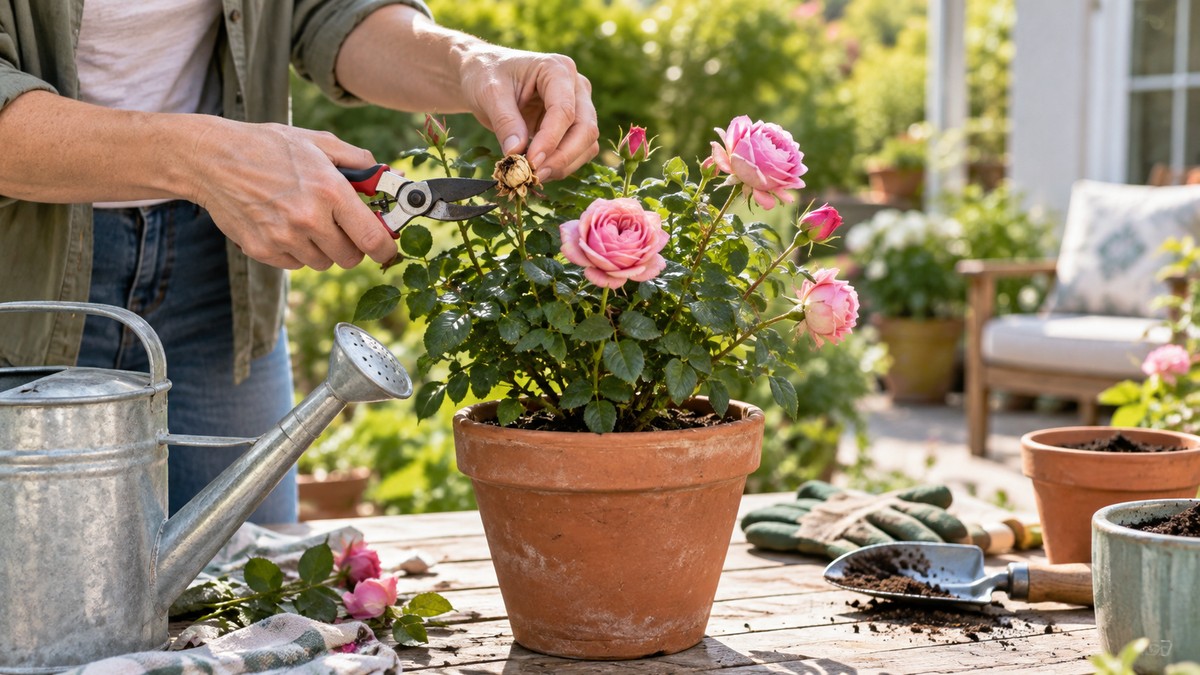
Deadheading keeps the plant blooming. The Arizona guide says to remove spent blooms by cutting back to the first five-leaflet set. It also notes that roses slow down during the hot months and produce smaller and fewer blooms. The Oregon State sheet makes a similar cut: when removing the last spent bloom, cut just above a leaf with three or five leaflets. The Cornell answer adds that pruning dead wood and deadheading spent blooms encourages more blooms.
Major pruning is a separate job. The Oregon State sheet places it in mid-February, when you open up the center for better air flow. The same sheet says to cut dead, diseased or damaged stems back to healthy branches, and to remove canes that cross or crowd each other. The sources do not give a pruning height for a container rose, so the pruning guidance here is general.
Handle pests with water and a close look
The Arizona guide offers a low-tech answer for two common pests. It says a forceful water spray can eliminate aphids and spider mites. It also recommends hosing off roses regularly, ideally in the early morning before the sun gets hot, and spraying the underside of the leaves. The guide says this keeps the roses clean, increases the surrounding humidity, and helps control insects before they can cause any damage.
The same guide asks you to learn to recognize lady beetles, lacewings and other beneficial insects in every stage of their lives. It also says to check roses on a regular basis to identify potential problems. The sources here give no product advice for pests or disease in a pot. The Oregon State sheet refers readers to its Master Gardener helpline for specific product instructions, so for any product you buy, follow the label and local extension guidance.
Protect the pot through winter
Winter is where a potted rose is most exposed. Penn State explains that container-grown roses must be protected in winter, because their roots sit above ground and are particularly exposed to the cold. Its easiest option is to move the entire container into an unheated garage or shed. If that is not an option, place the container in as protected an area outside as possible, then insulate the container and the rose.
Penn State lists several ways to insulate. You can wrap the container, and several inches above the rim, in multiple layers of bubble wrap. You can ring the pot with wire fencing or hardware cloth, then fill the fence with tree leaves or straw. You can also put the container in a large box filled with straw or leaves. For a smaller pot, the guide says you can bury it in the ground. The Cornell answer says that ideally a pot should be moved into an unheated garage or shed, or left outside and wrapped with burlap.
Two more points help the plant reach spring. Penn State says the plant needs to go into winter well-hydrated. Illinois says wet and cold is far more damaging than dry and cold, so a pot that sits in soggy mix through a freeze is at more risk than one that drains. If the rose spends winter indoors, the Cornell answer says to water it a few times during the winter. If you are also weighing planters for the cold months, see outdoor planters for winter.
Mistakes to avoid
- Using a pot with no drainage holes. The NC State handbook says roots can stand in water and develop root rot without them.
- Watering on a fixed weekly routine. The sources ask you to check the soil, and the Arizona range runs from two or three times a week up to daily.
- Feeding past mid-August. Penn State, Cornell and Illinois all put the stop date in August.
- Leaving a pot exposed through hard freezes. Penn State says container roses must be protected because their roots sit above ground.
- Choosing a climber or shrub rose for a pot. The Cornell answer advises a compact bush instead.
How we chose
We limited this guide to the care questions a potted rose raises: pot, mix, water, feed, sun, deadheading, pests and winter. We looked only at extension and university pages, and we opened six of them on 2026-10-22. We kept a point only when one of those pages states it in plain words, and we checked each quoted sentence against the fetched page text before using it. Where two sources give different figures, such as the Arizona and Cornell watering and feeding schedules, we show both and say they differ. We did not rank roses or name products.
What we could not verify
Several points matter for a small potted rose, and the pages we opened are silent or vague on them. We did not find a pot size for a mini rose that is smaller than the 18 by 18 inch minimum in the Cornell answer. We did not confirm a single watering schedule that works in every climate, and we did not confirm a fertilizer product, strength or brand for a pot.
What the sources do not say
The sources do not say how often to water a container rose in your own region, because the Arizona range and the Cornell check-first method were written for different conditions. They do not name a fertilizer product, and the Arizona guide and the Cornell answer describe feeding schedules that do not match exactly. The Oregon State sheet and the Arizona guide are written mainly for roses in the ground, so their watering and mulch figures for beds are a close guide rather than an exact one. None of the pages we opened gives a repotting schedule, a pot volume in gallons or a pruning height for a container rose.
Frequently asked questions
How big should the pot be for a small potted rose?
The Cornell answer gives at least 18 by 18 inches, and says 24 by 24 inches is better. The pages we opened do not give a smaller limit for a mini rose, so choose the largest pot that fits your space and make sure it drains.
How often does a potted rose need water?
No single number appears in the sources. Arizona gives two or three times a week in cool weather and up to once a day in warm weather, while Cornell says to check the soil daily and water when the top one to two inches are dry.
When should feeding stop for a potted rose?
Stop around mid-August. Cornell says to feed monthly until mid-August, Penn State says to stop in August, and Illinois says no fertilizer after August 15.
Can a potted rose stay outside through winter?
Penn State says container roses must be protected in winter, because their roots sit above ground. Its easiest option is an unheated garage or shed, and it also describes wrapping, fencing or burying the pot. Cornell suggests an unheated garage, a shed, or leaving the pot outside wrapped with burlap.
Which rose types suit a container best?
The Cornell answer names miniature roses, floribundas and ground cover roses as the best choices for a pot, and it advises against climbers and shrub roses.
Sources
- https://extension.arizona.edu/publication/rose-care-low-desert (opened 2026-10-22)
- https://extension.oregonstate.edu/sites/extd8/files/documents/1/2014rosecare.pdf (opened 2026-10-22)
- https://ask.extension.org/kb/faq.php?id=925748 (opened 2026-10-22)
- https://extension.psu.edu/protecting-your-roses-through-pennsylvania-winters (opened 2026-10-22)
- https://extension.illinois.edu/roses/care (opened 2026-10-22)
- https://content.ces.ncsu.edu/extension-gardener-handbook/18-plants-grown-in-containers (opened 2026-10-22)