How to Plant Lilies in Pots
As an Amazon Associate we earn from qualifying purchases.
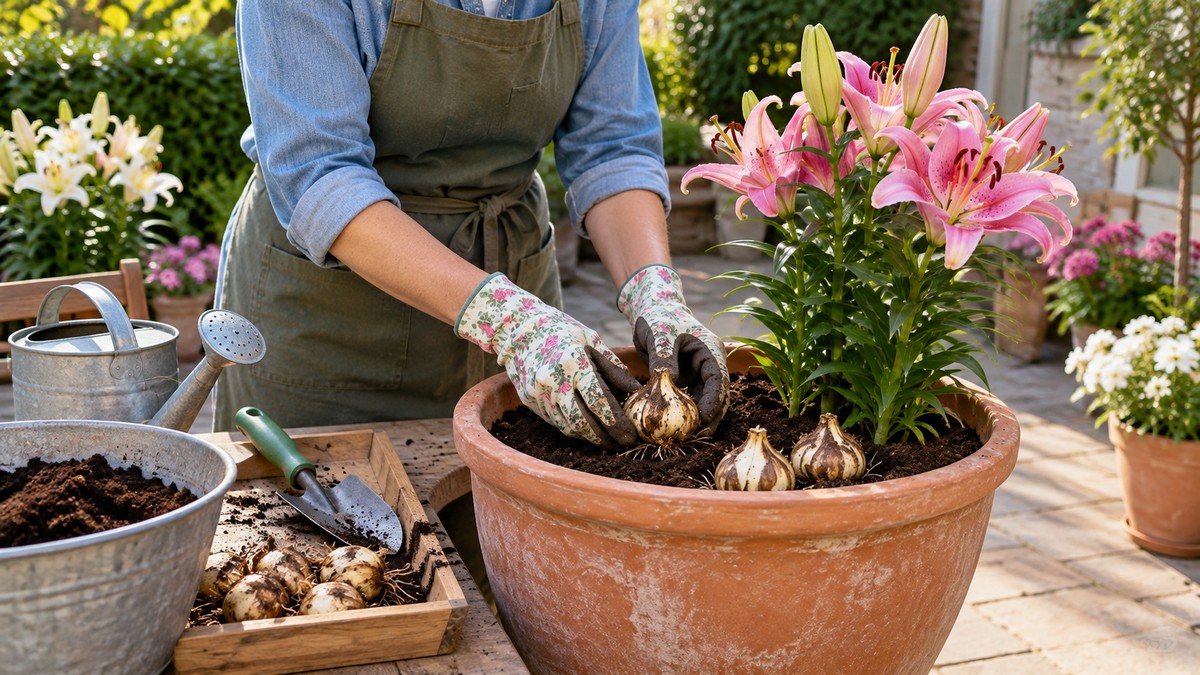
How to plant lilies in pots starts with two choices: a bulb set at the right depth and a container that drains well enough to keep it from rotting. Most extension lily advice is written for garden beds, so this guide separates what the sources say about lilies from what they say about containers in general, and it says so where the two meet. Use it as a planting plan, and check the seller’s label for anything the plant itself needs.
Quick answer
- Plant a container-grown lily at the same depth it had in the nursery pot, according to Iowa State Extension.
- For bare bulbs in the ground, Iowa State gives a depth of three times the bulb’s diameter, typically about 6 to 8 inches. No source we opened gives a pot depth for lilies.
- Use a pot with drainage holes and a mix that drains, because lily bulbs may rot in wet soil.
- Expect a lily grown in a container to be somewhat smaller than one grown in the ground.
Choose a pot that holds a bulb and its stems
The NC State plant profile says lilies “can be grown in a container but will be somewhat smaller.” The NC State container handbook says “Consider both depth and total volume of the container.” It also notes that perennial plants need large containers for adequate root growth. A lily is a perennial bulb, so pick the largest pot you can move and water, not the smallest one the bulb fits.
Tall types need more room and support. The NC State profile says “Taller plants may need to be staked.” Illinois Extension notes that some lilies exceed 5 feet and require staking. For a short container lily, the Illinois page describes a dwarf group, which it calls Pixies, that stands 18 inches or less and can be used in containers. For a larger planter that will hold more than one plant, see our notes on extra large planters.
Set the depth, then check the pot
For bulbs in the ground, Iowa State Extension says “Plant lily bulbs at a depth equal to three times their diameter, typically about 6-8 inches deep.” Illinois Extension gives a similar range for Asiatic lilies: “A recommended planting depth is 6 to 8 inches, spacing plants at least one foot apart.” The University of Wisconsin page on the Stargazer lily says large bulbs of that cultivar need about 6 inches.
A pot changes that arithmetic. If the bulb sits 6 to 8 inches below the surface, the mix above it must be at least that deep before any reservoir is added. The NC State handbook describes the reservoir as the gap between the mix and the rim, and says “larger pots require deeper reservoirs.” The handbook puts the reservoir at about a quarter inch to 3 inches, depending on the pot’s diameter. That makes the pot deeper than the planting depth, not just wider. This is our arithmetic from the Iowa State figure, not a number from any source.
A container-grown lily is simpler to set. Iowa State Extension says “Plant container-grown lilies at the same depth as in the pot.” Keep the bulb at the level it had in the nursery container, and do not bury it deeper. Wisconsin Extension says potted plants can go in “any time during the growing season.” That means you are not limited to fall planting for a potted lily.
When to plant
Iowa State Extension says “Early fall is an excellent time to plant garden lilies.” Bulbs can also go in during early spring, as the same page explains: “Bulbs can also be planted in early spring.” Those windows come from ground planting. For a potted lily from a nursery, the same page is more direct: “Container-grown lilies can be planted in spring and summer.” A bare bulb in a pot can follow the same two windows, and the depth rules above still apply.
Drainage and the bulb-rot risk
Drainage matters more for lily bulbs than for many plants. Iowa State Extension says “Good soil drainage is imperative as lily bulbs may rot in poorly drained, wet soils.” The NC State profile makes the same point in a different way: “Overly moist soil can cause bulb rot, but the soil should not be allowed to dry out completely.” Both point to a middle path, enough moisture to keep the bulb alive without letting it sit in water.
The NC State container handbook sets the basic container rule. Its words are “Drainage holes are necessary in all containers to prevent plant roots from standing in water and developing root rot.” It also warns against a gravel layer in the bottom, because water collects in the mix above the gravel instead of draining. A pot with a hole and a free-draining mix is the practical setup for a bulb.
Choose a mix that drains
Iowa State Extension describes the soil lilies want as “well-drained, slightly acidic (pH 6.0-7.0) soils high in organic matter.” That is a garden description. In a pot, the handbook’s approach is more useful: “Most commercial mixes combine finely textured and coarsely textured components to create a balance of water retention and drainage qualities.” A commercial mix is the simplest route, and the handbook suggests reading its label to check the components.
Illinois Extension recommends amending garden beds with peat and compost, “up to one-third each by volume.” That advice is for planting in the ground. Do not copy it into a pot without checking the mix’s drainage, since a dense mix can hold water around the bulb.
Light for the leaves, shade for the roots
Iowa State Extension says “Nearly all lilies grow best in full sun.” The NC State profile adds a detail that matters for a pot: lilies prefer “full sun to afternoon sun for the leaves, shade for the roots” and mulch “to keep the root zone cool.” Wisconsin Extension says the Stargazer lily “does best in full sun in the Midwest but will tolerate partial shade.”
A pot on a sunny patio can heat its root zone quickly, so the root side needs attention as well as the leaves. Mulch the surface and keep the pot out of the hottest afternoon sun if you can. The sources do not give a mulch depth for pots. Iowa State’s 2-inch layer is written for lilies planted in the ground.
Water the potted lily
Iowa State Extension advises that you “Keep lily roots cool and consistently moist, but avoid saturated soil.” In a pot, the handbook’s finger test works here too: push a finger two to three inches into the mix, and water only when that layer is dry. The NC State handbook also says larger containers need less frequent watering, so a bigger pot gives you more time between checks.
The handbook also says the water a plant needs rises “if the weather is hot and windy or if the pot is small, dark-colored, or placed in full sun.” A small, dark pot on a sunny patio therefore needs more checks than a large, pale pot in shade. A pot that drains freely is fine. A pot that sits in a puddle or in a saucer of water is not. If you want a method that waters from below, see our notes on bottom-watering planters.
Staking and care after bloom
Once the stems grow, watch the pot. A top-heavy lily can tip a light container. The NC State profile says tall plants may need staking, so set a stake at planting time rather than after the stem has bent. Choose the stake height to match the expected flower height, and tie the stem loosely.
After bloom, the profile advises that you “Deadhead blooms to reduce energy spent on creating seeds and cut back stems after bloom and when they begin to turn yellow.” Removing faded flowers keeps the bulb’s energy in the bulb, and cutting stems back once they yellow is the handoff to the next season.
Protect the pot through winter
Lilies in the ground can stay there through the winter without being dug up. The NC State profile says they “overwinter well without having to be removed from the ground for storage.” A pot is a different case. The NC State container handbook says “Root damage can occur because the root system is not as well-insulated from cold in a container as it would be in the ground.”
The handbook’s suggestion is to wrap the pot loosely with chicken wire and fill the gap with “inches of leaves or straw” for insulation. It also recommends covering quilt batting or household insulation with plastic to keep wet weather off it. Move the pot to a sheltered spot if you can, and check the mix on days when the temperature is above freezing.
A quick checklist
| Step | What to check | Source |
|---|---|---|
| Timing | Potted lilies can be planted through the growing season; bare bulbs are often planted in fall or early spring. | Wisconsin Extension; Iowa State Extension |
| Depth | Container stock at its pot depth; bare bulbs about 6 to 8 inches in the ground. | Iowa State Extension; Illinois Extension |
| Pot | Drainage holes and enough depth and volume for the plant. | NC State handbook; NC State profile |
| Mix | A commercial mix that drains and holds some moisture. | NC State handbook |
| Light | Full sun for leaves; keep roots cool with mulch. | NC State profile; Iowa State Extension |
| Water | Water when the mix is dry a few inches down; never leave the pot in standing water. | Iowa State Extension; NC State handbook |
| Support | Stake tall types at planting time. | NC State profile |
| Winter | Insulate the pot; check moisture on days above freezing. | NC State handbook |
How we chose
We opened pages from university and cooperative extension offices and kept a page only when it states the point in plain words. We checked each quoted sentence against the text of the page as fetched on 2026-10-22. Where the lily pages cover garden beds only, we say so, and we draw on the NC State container handbook for the general rules that apply to any pot.
We did not rank lily varieties or pots, and this guide does not recommend a product. Pages that returned errors when opened are not cited.
What we could not verify
The lily sources we opened are written for gardens, and only one covers containers directly. The points below are either missing or stated only in general terms.
What the sources do not say
- No source we opened gives a pot diameter or depth for a lily bulb or for a container-grown lily.
- The 6 to 8 inch planting depth comes from garden planting. The sources do not say how much mix a pot must add above the bulb.
- The NC State profile says a container lily will be “somewhat smaller” but does not say by how much.
- The Stargazer page covers one cultivar. Its 6-inch depth for large bulbs is not a rule for every lily.
- The Illinois page is a 2017 plant-of-the-week article. It is not a full cultivation guide.
- The sources do not give a mulch depth for pots, a fertilizer schedule for potted lilies, or instructions for overwintering a bulb inside a pot.
Frequently asked questions
Can a lily be grown in a pot?
Yes. The NC State profile says lilies “can be grown in a container but will be somewhat smaller.” The University of Wisconsin page says potted plants can be planted any time during the growing season.
How deep should a lily be planted in a pot?
For a container-grown lily, plant it at the same depth it had in the pot. For a bare bulb, the garden figure of about 6 to 8 inches is the only figure the sources give, and no source gives a pot depth for lilies.
Do potted lilies need staking?
Taller types may. The NC State profile and the Illinois page both point to staking for tall lilies. Set the stake at planting time, before the stem grows.
Do potted lilies need full sun?
Iowa State Extension says nearly all lilies grow best in full sun. The NC State profile asks for full sun to afternoon sun for the leaves and shade for the roots, which mulch can help provide in a pot.
How should a potted lily be protected in winter?
Insulate the pot, because roots in a container are less protected than roots in the ground. The NC State container handbook suggests wrapping the pot and filling the gap with leaves or straw, and it advises checking the mix on days above freezing.
Sources
- https://yardandgarden.extension.iastate.edu/how-to/growing-lilies-iowa (opened 2026-10-22)
- https://plants.ces.ncsu.edu/plants/lilium/ (opened 2026-10-22)
- https://hort.extension.wisc.edu/articles/stargazer-lily/ (opened 2026-10-22)
- https://extension.illinois.edu/blogs/hort-home-landscape/2017-06-13-plant-week-asiatic-lilies (opened 2026-10-22)
- https://content.ces.ncsu.edu/extension-gardener-handbook/18-plants-grown-in-containers (opened 2026-10-22)