Best Bottom Watering Planters: Reservoirs, Wicks and Overflow Compared
As an Amazon Associate we earn from qualifying purchases. Details
Updated 20 October 2026 | Author: Ken
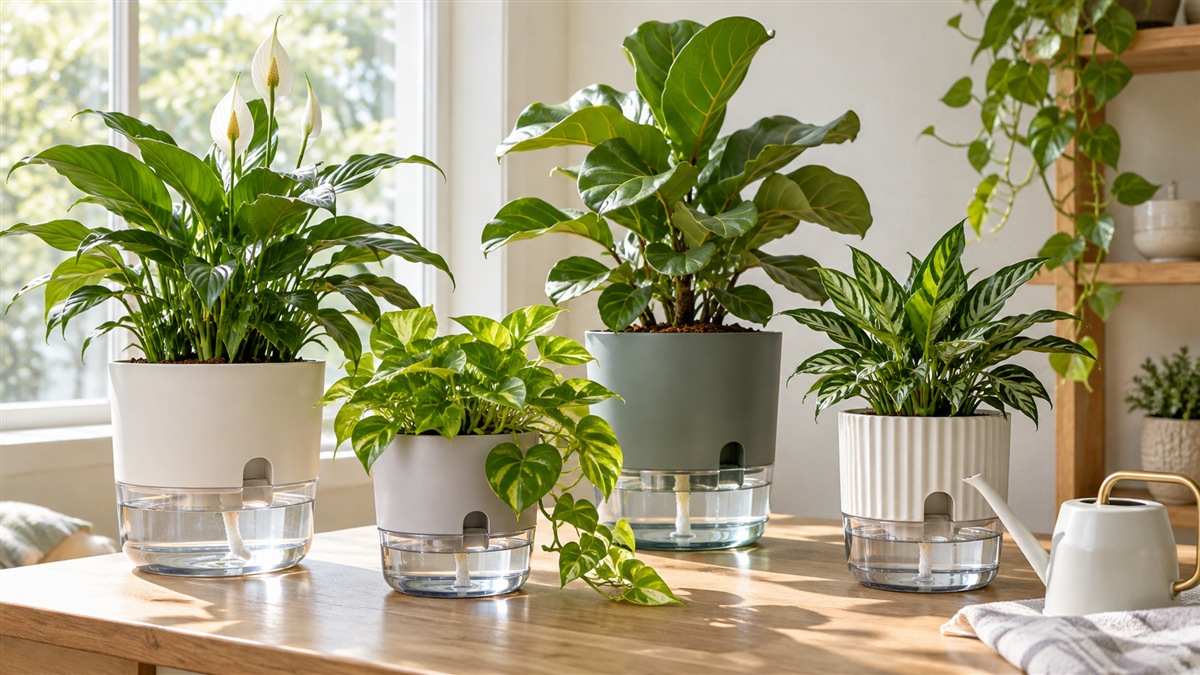
If you are looking for the best bottom watering planters, the first question is where the water waits. A bottom watering planter keeps a reservoir below the soil, and a wick or a perforated platform lifts water into the root zone as the plants use it. The eight cards in this guide range from a five-tier tower on casters to a long, low bed with a stated soil depth. We sorted the listings by what each one says about its reservoir, capacity, size and overflow, and we flag every figure that does not agree with another figure on the same page.
Quick answer
- For a reservoir with a printed fill line, start with the tomato planter with trellis. Its listing gives a capacity of 9.6 liters and tells you where to stop filling.
- For several planting levels, look at the five-tier tower. Its listing gives five levels and a height of 30.31 inches, but no soil volume.
- For a bed with a stated soil depth, look at the four-piece raised set. Its bullets give 5.85 inches of soil depth, a figure most listings in this set leave out.
- Check capacity against size before you buy. The Keter bed gives 12.7 gallons in its title and 22.4 gallons in its specifications, and its outer box works out to about 63 gallons, so neither figure is clearly a soil volume.
What a bottom reservoir does
A standard pot drains through holes in its base. A bottom watering planter works another way. The University of Maryland Extension page on self-watering containers describes a growing medium that sits on a perforated platform directly above a water reservoir, with water wicked up into the medium as it dries. The same page says these containers usually have an overflow hole on one side rather than drainage holes in the bottom. That single detail changes what you check on a listing, because the overflow is the route excess water takes out of the planter.
The Illinois Extension blog on self-watering containers describes the same idea in plainer terms: a reservoir at the bottom keeps the soil moist as needed, and the soil itself acts as a wick that pulls water up into the rest of the container. Several listings in this set use the same language. The Antmoilios planter describes a bottom water reservoir with air holes, the XHIKOWAT bed describes a self-watering disk, and the MQJIAZHI tomato planter describes a reservoir that you fill to a marked line.
Some listings describe methods that the extension pages do not cover. The MQFORU listing describes a siphon effect that lets the roots draw water, and the YNNICO listing describes a string that can be placed in the pot for bottom watering. We give those descriptions no weight beyond what the listing says, because the pages we opened do not discuss siphon action or string wicks.
What the extension pages say about drainage
The gravel question comes up in every planter guide, and it applies here too. The Illinois Extension container drainage page calls the idea that a gravel layer improves drainage a myth. The University of Maryland container page says that rocks, gravel or broken pot shards in the bottom of a container will not improve drainage. None of the listings in this set asks you to add gravel, and a reservoir does not need it. A reservoir holds water at the base through the soil or a wick. A layer of stones beneath it does not give you a controlled water level.
The same Maryland container page says every container needs adequate holes or slits to drain excess water, so that roots do not drown or rot. That rule still applies to a reservoir planter. The reservoir supplies water from below; it does not remove water that is in excess. A planter with a reservoir and no overflow path is a planter that can overfill, so the listing should show you where the extra water goes.
Illinois also warns about pots with permanently attached saucers, because emptying the overflow can be difficult or impossible. For a bottom watering planter the overflow is part of the drainage system, so a tray you cannot lift out and empty is a problem you will meet every time you water. Look for a removable tray or a drain plug before you choose.
The Iowa State container page gives watering advice for ordinary containers. It says to keep watering until water flows from the drainage holes, to water when the potting mix is dry about one to two inches down, and to expect containers to need more frequent watering than garden beds. A reservoir changes how often you fill, but it does not replace the hand check. The reservoir tells you about the bottom of the planter; the mix at one to two inches tells you about the root zone. Use both.
Reading the capacity figures
Outer volume is simple arithmetic. Length times width times height gives cubic inches, and dividing by 231 gives US gallons. Soil volume is always smaller than the outer volume, because walls, the reservoir and the base take up space. A listing figure close to the outer volume therefore needs a second look, and a listing figure far below it needs an explanation.
| Listing | Size in the listing | Capacity in the listing | Outer volume, worked out | What it tells you |
|---|---|---|---|---|
| MQJIAZHI tomato planter with trellis | 16.54 x 9.06 x 4.72 in | 9.6 liters | 16.54 x 9.06 x 4.72 = 707.3 cubic inches, or 11.6 liters | The stated figure is about 83 percent of the outer box, a plausible share once walls and the reservoir are allowed for |
| Keter Urban Bloomer | 32.3 x 14.7 x 30.7 in | 12.7 gallons (title), 22.4 gallons (specifications) | 32.3 x 14.7 x 30.7 = 14,576.7 cubic inches, or 63.1 gallons | The two capacities disagree, and they are about 20 and about 35 percent of the outer box |
| Antmoilios 56-inch planter | 12 x 12 x 56 in | “12 inches” | 12 x 12 x 56 = 8,064 cubic inches, or 34.9 gallons | The capacity field holds a length, so no soil volume is stated |
The MQJIAZHI tomato planter is the one case where the stated figure looks like a soil volume. Its 9.6 liters is about 83 percent of the 11.6 liters that the outer box works out to. The listing does not say whether that figure means soil or the whole planter, so treat it as an estimate and not a measurement of root space.
The Keter Urban Bloomer gives two capacities. Its title says 12.7 gallons and its specification field says 22.4 gallons. The outer box works out to about 63 gallons, so both figures are well below it, and the listing does not say which one describes the soil. Its item weight field gives 16 ounces, which looks low for a resin bed of this size, so this guide gives that figure no weight.
The Antmoilios planter’s capacity field reads 12 inches. That is a length, not a volume, and it does not tell you how much soil the planter holds. The bullets do give a 12 by 12 by 12 inch planter, which is a usable size for one level, but the listing does not say how the four levels divide the 56-inch height.
The VECELO five-tier tower states a height of 30.31 inches and five levels, and it gives no depth for each tier. If the height were split evenly across the five tiers, each tier would be about six inches deep. That is an assumption, not a figure in the listing, and the real depth depends on how the tiers nest.
Matching the planter to the plant
Plant choice matters more than the look of the planter. The Illinois page says that plants that need to dry out, such as thick-leaved cactus and succulents, do not usually warrant the extra cost of a self-watering container. A reservoir planter is therefore the wrong tool for succulents, and a reasonable tool for plants that want steady moisture between waterings.
The Iowa State potting media article adds a point about depth. It says that plants needing excellent drainage can be easier to care for in taller pots than in shorter ones. That matters for this set, because several planters are shallow. The MQJIAZHI tomato planter has an outer depth of 4.72 inches, and the XHIKOWAT bed states a soil depth of 5.85 inches. Both suit small plants and herbs better than deep-rooted vegetables. That judgment comes from the stated depths and the Iowa State point, not from any measured result.
Climbing plants have a different need. The Antmoilios tower stands 56 inches tall and the MQFORU pair stands 57 inches tall, and their trellis height is the reason to choose them. Their stated soil depth is not the reason, because the listings do not state the soil depth for either one.
Filling and checking a reservoir
Use the same order each time you water, so the reservoir does not become a guess.
- Find the fill mark before you pour. The MQJIAZHI tomato listing says to fill until the water reaches the first wavy line above the minimum level, and never above the second line. Read the marks on your own unit before you fill, because the listing text is the only guide we have for that unit.
- Fill the reservoir, not the soil, unless the listing gives a different method. The MQFORU listing describes a water injection port on the side, which lets you top up the reservoir without lifting the soil box.
- Locate the overflow or the drain. The University of Maryland page says self-watering containers usually have an overflow hole on one side. The Keter listing describes a drainage plug that can be opened or closed, which lets you empty the reservoir. Know which one your planter has before the first fill.
- Empty the overflow. The Illinois page warns that an overflow that is hard to empty causes trouble. Empty any overflow tray that has collected water, and do it on a schedule you can keep.
- Check the mix by hand. Push a finger one to two inches into the potting mix. The Iowa State page gives that depth for containers in general. A full reservoir does not replace this check, and a dry top layer does not always mean the reservoir is empty.
Three planting plans using the stated figures
A balcony herb row. Suppose a 96-inch wall holds two tiers of herbs on a balcony. The VECELO tower’s footprint is 13.19 inches square, so two towers side by side need 2 x 13.19 = 26.38 inches, which leaves 96 – 26.38 = 69.62 inches for chairs and a walkway. The tower still needs its own check for the tier depth, because the listing does not state it.
A two-plant tomato pair. The MQFORU pair lists a footprint of 9.8 inches square for each unit. Two units side by side take 2 x 9.8 = 19.6 inches. On a 36-inch ledge that leaves 36 – 19.6 = 16.4 inches, which is enough room to walk along the edge of the ledge, but the listing does not give a weight for a filled unit, so check the ledge load yourself.
A salad bed on a patio. The XHIKOWAT bed is a long, low frame with a stated soil depth of 5.85 inches. Shallow-rooted greens suit that depth better than carrots or beets, which need more room below the surface. The listing gives the length as 62.4 inches, so a bed of that size needs a level patio and clear access on both long sides.
Mistakes to avoid
- Reading “self watering” in a title as a reservoir. The wicker planter’s title says self-watering, but its bullets and specifications describe drainage holes and no reservoir. Read the bullets before you believe the title.
- Adding gravel for drainage. The Illinois and Maryland container pages both say gravel does not improve drainage.
- Pouring above the fill line. The MQJIAZHI listing warns against going above the second line, so do not treat the reservoir as a larger tank.
- Merging two capacity figures. The Keter bed gives two numbers. Use neither until you have confirmed which one describes the soil.
- Using a shallow planter for deep roots. The XHIKOWAT bed’s 5.85-inch soil depth is not enough for carrots or beets.
- Forgetting the overflow. A reservoir with no path for excess water is not a plan the extension pages support.
Five checks before you buy
- Confirm that the listing states a reservoir, a wick or a self-watering method, and find its fill mark.
- Compare the capacity with the outer size, and ask which figure describes the soil.
- Read the size fields against the bullets. The XHIKOWAT bullets and fields give width and height in opposite order, and the MQJIAZHI raised bed’s specification fields list a triangular item of 3 by 2 by 4 inches, which does not match its bullets.
- Confirm how the overflow leaves the planter, and whether the tray comes out for emptying.
- Plan for the weight of a filled planter. The VECELO tower lists 4.9 pounds and the Antmoilios tower lists 2.88 kilograms, but neither listing says whether that weight includes soil.
How we chose
Each listing had to describe a planter that a buyer could place on a patio, balcony or bed, and it had to say something about a reservoir, a wick, self-watering, bottom watering or an overflow path. A title alone was not enough. We read the title, the bullets and the stated specifications for each of the 12 listings in the local data for this keyword, which was checked on 20 October 2026. Eight listings passed and became cards. Each card’s reason comes from its own listing: the stated volume, the depth, the fill mark, the wheels, the number of levels or the tray. The cards appear in the order of the data and do not rank the planters.
We did not use any sales or feedback signal, because the local data for this guide has none.
What we could not verify
- Whether any reservoir keeps soil moist for longer. The listings say so. The Maryland self-watering page describes the general idea and says self-watering containers can make it possible to leave them for a few days, but the extension pages do not measure any product in this set.
- How the siphon and string wicks perform. The MQFORU and YNNICO descriptions are manufacturer claims, and the pages we opened do not cover those methods.
- The capacity of the Keter bed and the Antmoilios tower. The Keter title and specifications disagree, and the Antmoilios capacity field holds a length.
- Whether the MQJIAZHI capacity of 9.6 liters is soil or the whole planter. The listing does not say.
- Material claims. UV resistance, fade resistance and rust resistance are listing claims. The pages we opened do not test those claims for the plastics or resins in these listings.
- The filled weight of any planter. None of the listings gives the weight of a planter filled with soil.
- Mounting for the MQFORU pair. Its mounting field says wall mount while its bullets describe a planter that stands on its own.
- Plant performance. No listing says which plants it will grow best. The plant points in this guide come from the extension pages and the stated depths only.
1. Self Watering Tomato Planter with Trellis, Rectangular Tomato Cages Trellis for Raised Garden Bed (Reservoir with a printed fill line)
Specs from the listing (checked ):
- Capacity: 9.6 liters
- Item Dimensions: 16.54 x 9.06 x 4.72 inches
- Included Components: Clips, Gardening Gloves, Plant Ties
Pros
- The listing states a 9.6 liter capacity and a footprint of 16.54 by 9.06 inches
- The listing gives a fill rule with marked lines, so the water level is easy to set
Cons
- The listing does not say whether 9.6 liters means soil or the whole planter
- The outer depth of 4.72 inches is shallow for deep-rooted plants
Best for: one or two small plants on a patio that need a reservoir and a trellis in one unit
Skip if: you need deep soil for root crops, since the outer depth is 4.72 inches
View on Amazon (affiliate link)
2. VECELO 5 Tier Vertical Garden Planter, Self Watering Stackable Planters with Wheels (Five levels on wheels)
Specs from the listing (checked ):
- Number of Levels: 5
- Item Dimensions D x W x H: 13.19″D x 13.19″W x 30.31″H
- Item Weight: 4.9 pounds
Pros
- The listing gives five levels and a height of 30.31 inches in one footprint
- The bullets say the tower has movable wheels for moving it into the sun
Cons
- The listing gives no soil volume, so the tier size is unknown
- The set name says 7 pieces while the included components say 5 pots
Best for: a patio or balcony corner where you want several planting levels and a tower you can roll
Skip if: you need one deep bed, since no tier depth is stated
View on Amazon (affiliate link)
3. Raised Garden Bed with Tomato Cage & Trellis, 56″ Self-Watering Tomato Planter Box for Vegetables (Tall tower with a bottom reservoir)
Specs from the listing (checked ):
- Capacity: 12 inches
- Item Dimensions D x W x H: 12″D x 12″W x 56″H
- Number of Levels: 4
Pros
- The bullets describe a bottom water reservoir and air holes for a tall tomato or climbing planter
- The bullets give the planter as 12 by 12 by 12 inches, so one depth is stated
Cons
- The capacity field reads 12 inches, a length rather than a volume
- The item weight of 2.88 kilograms does not say whether it includes soil
Best for: a climbing vegetable grower who wants a tall bottom reservoir and lockable wheels
Skip if: you need a stated soil volume, since the capacity field is not one
View on Amazon (affiliate link)
4. YNNICO 8,7, 6.5, 6, 5.5, 5 Inches Self Watering Planters for Indoor Plants (Six sizes with a wick option)
Specs from the listing (checked ):
- Size: 8+7+6.5+6+5.5+5 inch
- Item Dimensions D x W x H: 8″D x 8″W x 5.6″H
- Number of Pieces: 6
Pros
- The listing gives six pot sizes from 5 to 8 inches, so one set covers several small plants
- The bullets describe a string that can be placed in the pot for bottom watering
Cons
- The listing gives the size of each pot but no soil volume
- The usage field says indoor only, so the set is not for an outdoor rail
Best for: a windowsill or desk with several small plants that need steady moisture
Skip if: you want outdoor use, since the usage field says indoor
View on Amazon (affiliate link)
5. MQFORU 2 Packs Raised Garden Bed Tomato Planter with Trellis, 57″ Tomato Cages for Climbing (Side injection port for the reservoir)
Specs from the listing (checked ):
- Unit Count: 2 Count
- Item Dimensions D x W x H: 9.8″D x 9.8″W x 57″H
- Mounting Type: Wall Mount
Pros
- The bullets describe a water injection port on the side, so the reservoir can be topped up without lifting the soil box
- The listing says the trellis can be built in one to four layers
Cons
- The bullets describe a siphon action that the pages we opened do not cover
- The mounting field says wall mount, which does not match the free-standing use in the bullets
Best for: two tomato or pea plants on a patio that need a reservoir and a support in one pair
Skip if: you need a stated soil volume, since none is given
View on Amazon (affiliate link)
6. 4Pcs Plastic Raised Garden Bed,62.4″×15.6″×14.4″ Elevated Wicker Planter Box with Self-Watering (Long bed with a stated soil depth)
Specs from the listing (checked ):
- Item Dimensions D x W x H: 62.4″D x 14.4″W x 15.6″H
- Special Feature: Breathable, Drainage Hole, Lightweight, Portable, Rust Resistant
- Included Components: Tools, Tray
Pros
- The bullets give a 5.85-inch soil depth, a figure most listings in this set do not state
- The bullets say the bottom tray holds moisture for roots and drains excess water
Cons
- The bullets and specification fields give the width and height in opposite order
- A soil depth under six inches limits the root crops it suits
Best for: a long, low bed of salad greens or herbs where the soil depth matters
Skip if: you plan to grow carrots or other deep roots, since the stated soil depth is 5.85 inches
View on Amazon (affiliate link)
7. Keter Urban Bloomer 12.7 Gallon Raised Garden Bed and Outdoor Herb Garden Planter with Self (Built-in water gauge and drain plug)
Specs from the listing (checked ):
- Capacity: 22.4 gallons
- Item Dimensions D x W x H: 32.3″D x 14.7″W x 30.7″H
- Manufacturer Warranty Description: 2-year limited.
Pros
- The listing describes a built-in water gauge that shows when plants need more moisture
- The listing describes a drainage plug that can be opened or closed to control watering
Cons
- The title says 12.7 gallons but the capacity field says 22.4 gallons
- The item weight of 16 ounces looks too low for a resin bed this size, so it is not used
Best for: a balcony herb planter where a water gauge tells you when to top up
Skip if: you need a confirmed capacity, since the title and specifications disagree
View on Amazon (affiliate link)
8. Raised Garden Bed Planter Box with Trellis, 71″ Self-Watering Tomato Planter with Trellis (Wheeled bed with brakes)
Specs from the listing (checked ):
- Included Components: Wheels, Brakes
- Number of Levels: 4
- Item Weight: 3.43 kg
Pros
- The bullets give a planting box of 15.7 by 11.8 inches and six drainage holes
- The listing includes wheels with brakes, so the bed can be locked in place
Cons
- The specification fields list a triangular item of 3 by 2 by 4 inches, which does not match the bullets
- The listing says the reservoir stores water but gives no reservoir volume
Best for: a tall tomato bed that you want to move and then lock in place
Skip if: you need the dimensions confirmed, since the specification fields do not match the bullets
View on Amazon (affiliate link)
Listings without a card: Four listings in the local data did not get a card. The OurWarm windowsill herb planter set has a title but no bullets or specifications in the listing data, so the title is the only claim available, and we did not write a card from it. The rectangular windowsill planter set of six has the same problem: a title and nothing else. The Pattiumo galvanized oval bed has an open bottom, which its bullets describe as natural drainage, so it has no reservoir and does not fit a bottom watering question. The 47-inch wicker elevated planter has a title that says self-watering, but its bullets and specifications describe drainage holes and no reservoir, so we did not count it as a bottom watering planter.
FAQ
Do bottom watering planters still need drainage?
Yes, in the sense that excess water has to leave. The University of Maryland container page says all containers need adequate holes or slits so that excess water drains, and its self-watering page describes an overflow hole on one side as the route for excess water. Check the listing for an overflow, a drain plug or a removable tray before you buy.
Should I put gravel in the bottom of a self-watering planter?
No. The Illinois Extension page calls the gravel idea a myth, and the University of Maryland container page says rocks, gravel or broken pot shards will not improve drainage. A reservoir gets its water to the roots through the soil or a wick, and a layer of stones does not change that.
How often should a bottom watering planter be filled?
Fill to the marked line when the reservoir is low, and check the mix by hand at one to two inches down. The Iowa State page says containers in general need more frequent watering than garden beds, and that the schedule depends on the container, the mix, the plant and the weather. A reservoir does not fix any of those factors, so the schedule is yours to set.
What is the difference between an overflow hole and a drainage hole?
A drainage hole in the base lets water leave from the bottom of an ordinary container. The University of Maryland self-watering page describes self-watering containers as having an overflow hole on one side instead of holes in the bottom. Both let excess water out. On a reservoir planter, the overflow is the route to check when you are working out where the extra water goes.
Are bottom watering planters a good choice for succulents?
Usually not. The Illinois Extension page says plants that need to dry out, such as thick-leaved cactus and succulents, do not usually warrant the extra cost of a self-watering container. For those plants, an ordinary container with drainage holes is the better fit.
Bottom line
Choose a bottom watering planter by its reservoir first, its overflow second and its capacity third. On the stated figures, the tomato planter with trellis has the clearest fill method, the five-tier tower is the choice when you need several levels, and the four-piece raised set is the one to choose when a stated soil depth matters. If a capacity figure disagrees with the size, do not buy on the title alone, and read the bullets for the overflow before you fill. For more on how much soil a raised bed holds, read our guide to how much soil a raised bed needs, and for layering a bed, see how to fill raised beds.
Sources
- University of Maryland Extension, “Self-Watering Containers” (Traunfeld), opened 2026-10-20. https://extension.umd.edu/resource/self-watering-containers
- Illinois Extension, “Container Drainage Options” (Container Gardens), opened 2026-10-20. https://extension.illinois.edu/container-gardens/container-drainage-options
- Illinois Extension, “Self Watering Containers” (Hort in the Home Landscape, 2015), opened 2026-10-20. https://extension.illinois.edu/blogs/hort-home-landscape/2015-06-22-self-watering-containers
- Iowa State University Extension and Outreach, “Care of Plants Growing in Containers” (2016), opened 2026-10-20. https://hortnews.extension.iastate.edu/2016/07-01/container.html
- University of Maryland Extension, “Growing Vegetables in Containers and Salad Tables”, opened 2026-10-20. https://extension.umd.edu/resource/growing-vegetables-containers-and-salad-tables
- Iowa State University Extension and Outreach, “Potting Media: Components and Handling” (March 2025), opened 2026-10-20. https://yardandgarden.extension.iastate.edu/article/2025/03/potting-media-components-and-handling