How to Plant Basil in Pots
As an Amazon Associate we earn from qualifying purchases.
Knowing how to plant basil in pots comes down to a few decisions: a pot with drainage holes, a well-drained potting mix, a spot with enough sun and a steady watering routine. Basil is a warm-season herb, so timing matters too. The five extension and garden-society pages below agree on most of these points. They differ on sun hours and minimum pot size, and this guide shows both figures.
Each point comes from one of five pages we opened on October 22, 2026. The Royal Horticultural Society page is a UK source, so its compost and size guidance is shown as the RHS gives it.
Quick answer
- Use a pot at least 6 to 8 inches across, with drainage holes, and fill it with a well-drained potting mix.
- Give it sun. The sources give 4 to 6 hours a day, 6 to 8 hours a day, or full sun.
- Plant outdoors only after the frost risk has passed, and water before the plant wilts severely.
- Pinch growing tips and harvest above a leaf pair to keep the plant bushy and productive.
Choose the pot and the drainage
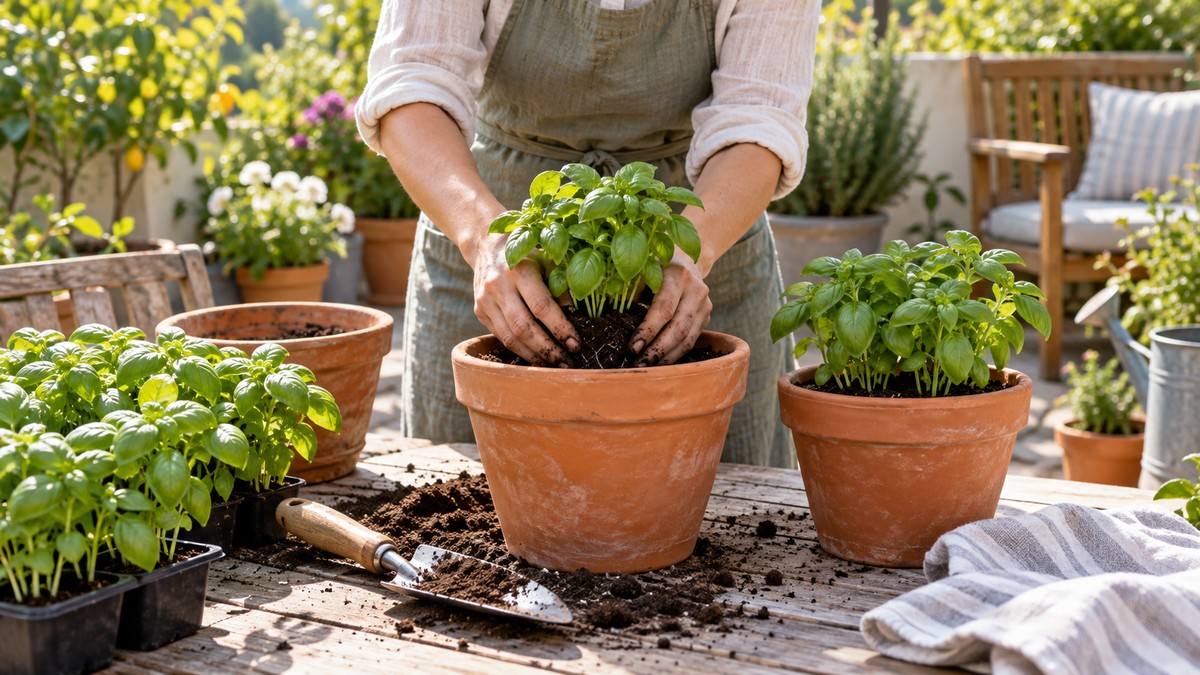
Drainage comes first. Iowa State University Extension says a container needs sufficient drainage holes in the bottom, and that herbs grow best in well-drained soil. Illinois Extension says a pot needs drainage holes too, and it warns that a small 3-inch pot will quickly outgrow the plant. Its advice is to choose pots at least 6 inches across or bigger so the basil has room through the summer.
The RHS asks for more room. Its guidance is a container at least 20 cm (8 in) wide and deep. That figure is larger than the Illinois minimum, so the two pages differ. Iowa State adds a material note: terra cotta and clay pots are popular, but clay containers dry out faster and may need more frequent watering. Plastic pots are lighter and easier to move, which matters when you need to shift a pot for sun or shelter.
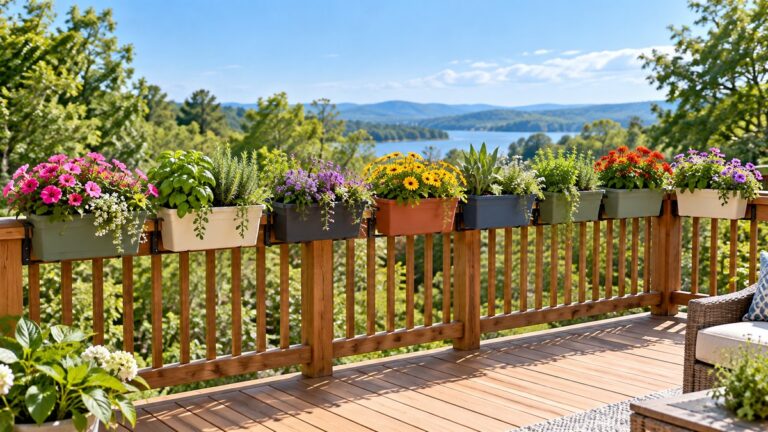
Iowa State also notes that herbs can be grown in hanging baskets and window boxes, and that several herbs can share one container or each can have its own. If you group herbs, match their water needs first. Iowa State’s Italian herb grouping lists basil with parsley, oregano, sage, rosemary and thyme. For ideas on the planter itself, see our guide to herb planters.
Fill it with the right potting mix
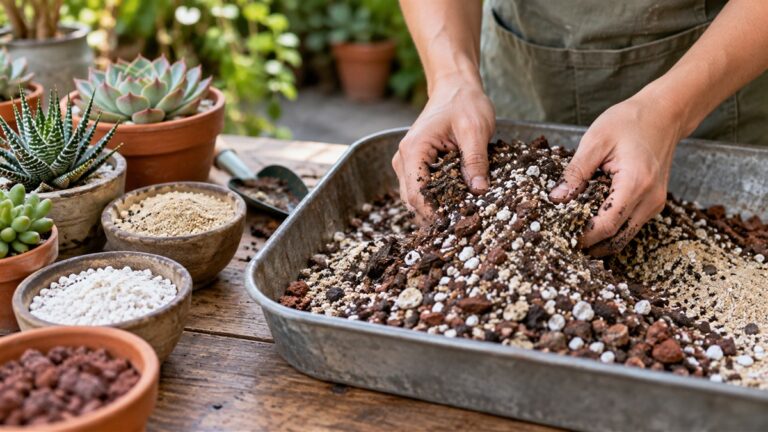
Iowa State recommends a well-drained commercial potting mix, or an equal mix of potting mix, peat moss and perlite. Illinois Extension says to use a good quality potting mix. The RHS recommends a peat-free multi-purpose or seed compost, which it describes as free-draining.
The table below gathers the main figures from the five pages so you can compare them directly.
| Source | Sun | Pot size | Drainage and mix |
|---|---|---|---|
| Iowa State Extension | 4 to 6 hours a day | Not stated | Drainage holes; well-drained potting mix |
| Illinois Extension (2015) | 4 to 6 hours a day | At least 6 inches | Drainage holes; good quality potting mix |
| Illinois Extension (2020) | 6 to 8 hours a day | Not stated | Containers with adequate drainage |
| Penn State Extension | Full sun | Not stated | Well-drained soil |
| Royal Horticultural Society | Warm, sunny, sheltered | At least 20 cm (8 in) wide and deep | Peat-free multi-purpose or seed compost; free-draining |
Choose a compact variety for a small pot
Penn State sorts basil into groups by leaf size and use, and one of those groups is small-leaf or dwarf basil for decorative and culinary use. The RHS describes compact, domed varieties as ideal for pots, with small, strongly flavoured leaves. Both pages point the same way for a small container. The sources we opened do not compare harvest size between compact and large-leaf types.
Pick a warm, sunny spot
Sun is the second decision, and the sources do not agree on the number. Iowa State and the 2015 Illinois post both say 4 to 6 hours of sunlight a day. The 2020 Illinois post says 6 to 8 hours, and Penn State says full sun. Aiming for 6 to 8 hours covers the lower figures as well. Penn State also says basil needs warmth to grow well, and the RHS calls it a plant that loves warmth.
Put the pot where it gets that sun and stays sheltered. The RHS describes a warm, sunny, sheltered location as what basil needs, and it notes that containers suit basil well because they provide the free-draining conditions the plant needs and are easier to protect from slugs and snails.
Sow or transplant at the right time
Penn State gives the sowing steps. Sow seed about one-quarter inch deep outdoors in late spring to early summer, after the risk of frost has passed. Or start seeds indoors on a heat mat about six weeks before planting outside. Seeds germinate in one to two weeks. Move seedlings outside when night temperatures are above 60 F and daytime temperatures are in the 80s. Illinois Extension in 2020 adds that basil is cold sensitive, so it must go outdoors only after the chance of frost has passed.
If you buy a young plant rather than sowing seed, the same timing applies. Set the pot outside only once the nights are warm, and give the plant the full sun it needs from the start. Penn State says basil can also be grown in containers indoors under lights.
Water and feed the pot
Pots dry out faster than the ground, so watering needs attention. Iowa State says clay containers may need more frequent watering because they dry out faster, and it advises watering before the plant begins to wilt severely. In hot weather, Iowa State says that could mean once or twice a day. Penn State says to keep basil well watered, and the RHS says containers will need regular watering.
Water in the morning if you can, and aim at the soil rather than the leaves. The RHS says to avoid splashing the leaves and to water in the morning, because basil hates having wet roots overnight. Illinois Extension recommends watering at the base of the plant, or using drip irrigation or drip hoses, to keep the foliage dry. It also says to plan on watering basil at least once a week, depending on rainfall and temperatures. For a hose that reaches the pot without soaking the leaves, see our guide to hose attachments for watering plants.
Feed lightly. Iowa State says herbs need less fertilizer than other container plants but benefit from periodic light feeding with a dilute solution. The RHS says plants in containers can run short of nutrients, and it suggests an organic-based, balanced liquid feed to boost leafy growth.
Pinch and harvest to keep it producing
Pinching helps the plant stay bushy. Penn State says to pinch out growing tips to slow flowering and promote branching and leafy growth. Iowa State says pinching can control rampant or spindly growth. Illinois Extension in 2015 says that once basil is established, you can pinch out stems for a bushier and bigger plant.
Harvest the way the sources describe. Iowa State says to harvest leafy annual herbs when the flower buds first appear, and to leave 4 to 6 inches of plant material. Penn State says to harvest throughout the season, before flowers bloom, preferably in the morning. Illinois Extension in 2020 says to cut the whole stem just above a pair of leaves and to leave at least half of the plant. New growth appears at that cut point within about a week. Flowering matters for flavor too. Penn State says leaf flavor declines after bloom, and the RHS notes that overcrowded plants flower sooner, which ends the harvest.
Store what you pick
Penn State gives two storage options for cut stems: a glass of water at room temperature for a few days, or up to a week in the refrigerator in a plastic bag wrapped in a paper towel. Illinois Extension in 2020 says freshly harvested basil keeps best for a couple of days in a vase of water at room temperature.
Penn State also gives drying and freezing options. Spread leaves to dry in a shady, well-ventilated place or on a wire-mesh tray, and do not hang basil in bundles, since leaves dry too slowly and can mold. Chopped leaves can be frozen in ice cube trays. The same page warns that leaves deteriorate in cold conditions below 50 F, so keep fresh basil out of cold spots.
A windowsill option: microgreens
The RHS also describes basil as a microgreen crop on a sunny windowsill. Seeds can be sown more densely in trays, and microgreens are ready in 10 to 14 days, depending on light and temperature. That is a different goal from a full potted plant. Use the microgreen method when you want a few leaves quickly, and the full-pot method when you want to harvest across the season, as Penn State describes.
How we chose
We limited this guide to extension pages and one garden-society page on growing basil in containers. The five pages are Iowa State University Extension’s container herb guide, two University of Illinois Extension posts from 2015 and 2020, Penn State Extension’s basil profile and the Royal Horticultural Society’s basil guide. We opened each page on October 22, 2026, with curl.
We left out one UC fact sheet. Its text credits the Old Farmer’s Almanac, so we did not treat it as an extension source. We also left out a University of Minnesota page that returned an error. We did not recommend a pot, a potting mix or a product, and the figures above are quoted as each page gives them.
What we could not verify
The sources do not agree on sun hours or minimum pot size, and none of them gives a planting date for a specific region. Treat the figures as a range and check your own spot, pot and climate before you plant.
What the sources do not say
- The spacing between basil plants in a single large pot. Penn State gives 12 to 18 inches apart for planting in the ground, and the pages we opened do not give a container figure.
- Whether mulch suits a pot. Illinois Extension in 2020 recommends 2 to 3 inches of mulch around the base of basil, but the page does not say whether that applies to containers.
- A watering schedule for a specific climate. Illinois Extension gives at least once a week as a planning figure, and Iowa State says summer heat could call for watering as often as once or twice a day. Neither page ties its figure to a region.
- A yield comparison between compact and large-leaf types. Penn State and the RHS describe the types, but the pages we opened do not compare how much each one yields.
- A single minimum pot size. Illinois gives 6 inches and the RHS gives 8 inches, and we show both.
Frequently asked questions
What size pot does basil need?
Illinois Extension says to use pots at least 6 inches across or bigger, and warns that a 3-inch pot will quickly outgrow the plant. The RHS asks for a container at least 20 cm (8 in) wide and deep. Using the RHS size gives more room for summer growth.
How much sun should a pot of basil get?
The sources give 4 to 6 hours a day (Iowa State and the 2015 Illinois post), 6 to 8 hours a day (the 2020 Illinois post), or full sun (Penn State). The sunnier end of that range meets every figure, and the RHS describes a warm, sunny, sheltered spot.
Can basil be grown in pots indoors?
Penn State says basil can be grown in containers, both outdoors and indoors under lights. Iowa State says herbs require full sun whether they are grown indoors or outside.
How often should a potted basil plant be watered?
Illinois Extension says to plan on watering at least once a week, depending on rainfall and temperatures. Iowa State says water before the plant wilts severely, which can be once or twice a day in summer heat. Water at the base of the plant, in the morning if you can, to keep the foliage dry.
Should basil flowers be removed?
Penn State says leaf flavor declines after bloom, and it recommends pinching growing tips to slow flowering. The RHS says overcrowded plants tend to flower sooner, which brings the harvest to an end. Pinching and regular harvesting are the practical steps the sources describe.
Sources
- https://yardandgarden.extension.iastate.edu/how-to/growing-herbs-containers (opened 2026-10-22)
- https://extension.illinois.edu/blogs/good-growing/2015-04-09-growing-herbs-containers (opened 2026-10-22)
- https://extension.illinois.edu/blogs/flowers-fruits-and-frass/2020-05-13-growing-basil-your-backyard (opened 2026-10-22)
- https://extension.psu.edu/herb-garden-plants-basil (opened 2026-10-22)
- https://www.rhs.org.uk/herbs/basil/grow-your-own (opened 2026-10-22)