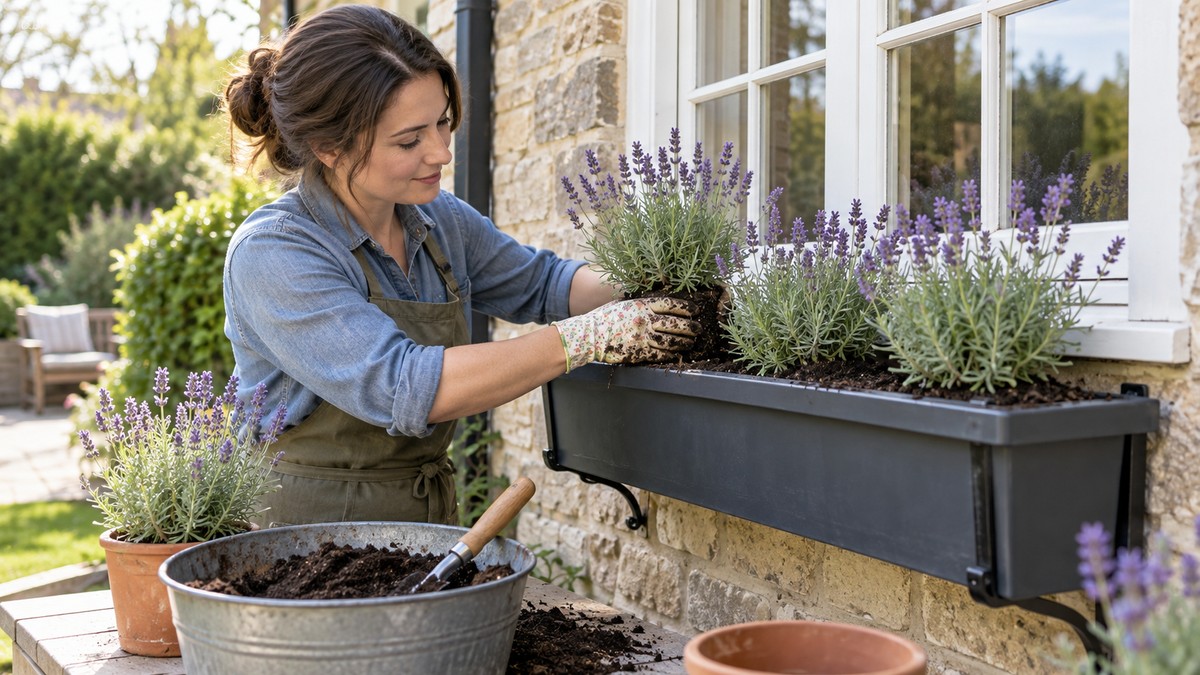
How to Plant Lavender in a Window Box
As an Amazon Associate we earn from qualifying purchases.
How to plant lavender in a window box is mostly a drainage question, and the extension pages agree on that first. Lavender wants full sun and soil that dries out between waterings, and a box can supply both only when it is set up for them. The pages we opened cover lavender in beds and in the ground more than in boxes, so this guide applies their general advice to a window box and marks where the reading is ours.
Quick answer
- Give the box full sun. Illinois Extension and NC State both list full sun among lavender’s top needs.
- Use a box with drainage holes and a mix that drains quickly, because lavender does not tolerate wet roots.
- Water new plants regularly during the first year, then let the mix dry out between waterings.
- Plan on one season or an indoor winter, since Iowa State says container-grown lavender does not overwinter well.
Give the box full sun
Iowa State gives the most specific figure for light: “Plants need at least six to eight hours of direct sunlight each day to maintain compact growth and produce abundant flowers.” Penn State’s PlantVillage reference says lavender plants “require bright sunlight for adequate growth and should be positioned accordingly.” PlantVillage also gives a temperature range, saying lavender grows optimally at “temperatures between 7 and 21°C (44.6-69.8°F).” Illinois Extension puts light first in its summary of what lavender needs: “Perennial Lavender is demanding of two things: full sun and extremely well drained soil.”
Count the hours on a clear day before you buy the plants. If the box will hang from a balcony rail instead of a sill, our guide to balcony planters covers that setup. A window that gets six to eight hours meets Iowa State’s figure for compact growth and abundant flowers. A shaded window is a poor match, since PlantVillage ties adequate growth to bright sunlight. None of the pages says how much bloom a window with four or five hours will give, so treat that as an open question.
Make the box drain first
Drainage is the point the sources repeat most often. Illinois Extension warns that “Soil that remains wet or is poorly drained, especially over the winter results in plants that have a short garden life.” NC State’s Plant Toolbox says the plant “requires perfectly drained soil, preferably on the dry side, and full sun.” Its gardening handbook also says that all containers need drainage holes, so check the box for holes before you fill it.
Gravel needs a careful reading. Illinois Extension says that “Lavender also likes to be mulched with inorganic mulches such as rock or pea gravel.” That describes a surface mulch on top of the soil. NC State’s handbook advises against a gravel layer under the potting mix, because water then collects in the mix above it. The two pages address different parts of the box, and the sources do not describe a gravel mulch in a window box specifically.
Heavy soil is the second drainage risk. Colorado State says that “Heavy soils may need to be amended prior to planting to insure good drainage.” Colorado State adds a caution about amendments: “The use of sand or gravel as a soil amendment in clay soils may create an even greater drainage problem.” Adding grit to a heavy mix does not automatically fix it. In a box the mix replaces the ground soil, so the choice of mix carries most of the weight. That reading is ours, since the pages write about beds and ground soil.
Choose a mix that drains quickly
The pages do not agree on soil type. Iowa State says lavender “grows best in sandy or loamy soils that drain quickly.” PlantVillage gives a broader range: “The plants will grow best in light to sandy, well-draining soils with a pH of 5.8-8.3.” NC State says lavender “prefers neutral to alkaline soils.” Colorado State goes further on organic matter: “Lavenders prefer full sun and an alkaline soil with very little organic matter.”
No page describes a potting mix for lavender. Oregon State’s container guide recommends an all-purpose potting soil with perlite or vermiculite for drainage, and that is a general rule for containers rather than a lavender rule. If the mix you buy is rich in organic matter, the Colorado figure suggests it may be too rich for lavender. That is our reading of the page, not a number from it.
For a second look at mix choices, see our guide to soil for raised planters, which covers the same question for raised containers.
Water new plants, then let the mix dry
Illinois Extension says that “While lavender is drought-tolerant once established, new plantings benefit from regular watering during the first year.” PlantVillage makes the same point: “The plants are drought tolerant once established but require regular watering while they establish.”
The warning runs the other way as well. PlantVillage says: “Care should be taken not to over water the plants by allowing the plants to dry out between waterings.” NC State’s Plant Toolbox is blunter: “Root rot is caused by overwatering.” In a window box, that means checking the mix before each watering rather than following a calendar.
Colorado State gives a rough schedule for the first weeks: “In general, water once or twice a week immediately after planting, until plants are established.” That schedule is written for lavender planted out, not for a box. Iowa State notes that containers as a rule need watering far more often than beds, so a box may need checks more often than that schedule suggests.
Plant at the right time, and at the right depth
Timing depends on the climate. Colorado State says that “Lavender can be planted from spring through fall in Colorado.” Iowa State is stricter for its own region: “Planting should take place in spring after the risk of severe frost has passed.” The two pages describe different climates, so use the frost dates for your own area. Colorado State also notes that “Spring-planted lavender plants can be smaller as they will have a long season in which to establish the root system.”
Fall planting needs bigger stock. Colorado State advises: “Fall planted lavenders should be in 4 inches or larger sized pots with an established root system to ensure survival over the winter.” PlantVillage gives the same caution: “If planting in the Fall, care should be taken to use larger plants with an established root system to allow the plants to establish in the soil quickly before winter sets in.”
Depth is simpler. Iowa State says plants “should be set at the same depth as they were in the container and spaced to allow good air circulation as they mature.” Plant the lavender at the depth it had in its nursery pot, and leave room between plants if the box holds more than one.
Prune after the first flush, not before
Pruning keeps lavender compact. Iowa State says that “Pruning helps maintain plant shape and encourages branching.” It adds: “Light pruning after flowering supports additional growth and keeps plants compact.” Colorado State says that “Lavender responds well to pruning.” It also says “It flowers on new growth so plants should be pruned every year after it’s established.”
The timing conflicts. Illinois Extension says to “Wait until some new growth starts to appear in the spring before doing any pruning.” That is spring pruning, while Iowa State recommends a light trim after flowering. A box gardener can pick one rule and keep to it, and the reason for each is clear: spring pruning waits for new growth, and pruning after bloom keeps the plant compact.
Plan for winter in a box
A lavender in a window box is unlikely to last many winters. Iowa State says: “Container-grown plants will not overwinter well but can be enjoyed as annuals or brought indoors for the winter.” Colorado State makes a similar point: “French and Spanish lavenders are not cold hardy in Colorado but can be used as annuals in containers and outdoor beds.”
Illinois Extension describes a winter mulch for lavender in the ground: “In cold growing areas, lavender benefits from a winter mulch of evergreen boughs or straw placed over the planting after the plants have gone completely dormant and the ground initially freezes.” That method is for plants in the ground. Iowa State names the main limits on lavender in its region: “Winter hardiness and tolerance to wet soils are the primary limiting factors.” The sources do not say whether a box should be mulched or moved, so decide that before you plant.
Feed lightly, if at all
Iowa State says that “In most cases, lavender performs best without fertilization.” It also warns that “High levels of nitrogen result in excessive vegetative growth and fewer flowers.” Those two lines give a simple rule: do not feed a box lavender heavily, and do not use a high-nitrogen product.
The other pages we opened give no feeding rate for lavender. If a box plant looks pale, the sources do not say whether feed is the cause, so check the other conditions first: sun, drainage and watering.
Mistakes to avoid
- Overwatering. NC State ties root rot to overwatering, and PlantVillage warns against it.
- Planting in a mix that stays wet. Illinois Extension says wet, poorly drained soil shortens a planting’s life.
- Pruning before new growth shows in spring. Illinois Extension says to wait for it.
- Heavy feeding. Iowa State says high nitrogen gives leaves at the expense of flowers.
- Expecting a container lavender to come back outdoors. Iowa State says container plants do not overwinter well.
What we could not verify
The lavender pages are clear on sun and drainage, and they say less about containers. The list below names the gaps.
What the sources do not say
- None of the pages we opened covers a window box, a balcony box or a box hung on a building.
- The pages do not give a pot size for a window box. Colorado State gives 4 inches as the minimum for fall-planted stock only.
- The soil advice differs. Colorado State says very little organic matter, Iowa State says sandy or loamy soil, and NC State says neutral to alkaline. No page addresses a soilless potting mix for lavender.
- The pruning timing differs. Illinois Extension says wait for spring growth, and Iowa State says light pruning after flowering.
- No page gives a watering interval for a window box. Colorado State’s post-planting schedule is written for lavender planted out.
- No page gives a feeding rate for lavender. Iowa State says most plants do best without fertilization.
How we chose
We limited this guide to university and extension pages about lavender, and to container guides from Oregon State and NC State for the points about pots and mixes. We opened each page with curl on 2026-10-22, and each page we cite returned HTTP 200. PlantVillage is hosted by Penn State rather than an extension service, so we treat it as a university reference and use it only for general care.
We left out commercial pages and gardening blogs from the search results, and we did not open a University of California fact sheet that appeared in those results, so it is not cited.
Frequently asked questions
Can lavender grow in a window box?
Yes, if the box gets full sun and drains well. Iowa State says container-grown lavender will not overwinter well, so expect a box plant to last one season or to move indoors for winter.
How much sun does a window box lavender need?
Iowa State gives six to eight hours of direct sun each day for compact growth and abundant flowers. PlantVillage says bright sunlight is needed for adequate growth, and NC State and Illinois Extension both list full sun.
Should gravel go in the bottom of a lavender box?
The sources do not recommend it. NC State advises against a gravel layer under the potting mix, because water collects above it. Illinois Extension describes gravel as a surface mulch, which is a different use.
How often should a window box lavender be watered?
Water new plants regularly during the first year, and after that let the mix dry out between waterings. The sources do not give a box schedule, so check the mix by touch before each watering.
Should a window box lavender be pruned in spring or after flowering?
The sources differ. Illinois Extension says to wait for new growth in spring, and Iowa State recommends a light trim after flowering. Pick one, note the reason, and keep to it.
Sources
- University of Illinois Extension, Lavender: https://extension.illinois.edu/herbs/lavender (opened 2026-10-22)
- PlantVillage (Penn State), Lavender: https://plantvillage.psu.edu/topics/lavender/infos (opened 2026-10-22)
- Colorado State University Extension, Growing Lavender in Colorado: https://extension.colostate.edu/resource/growing-lavender-in-colorado/ (opened 2026-10-22)
- Iowa State University Extension and Outreach, Growing Lavender in Iowa: https://yardandgarden.extension.iastate.edu/how-to/growing-lavender-iowa (opened 2026-10-22)
- NC State Extension, Plant Toolbox, Lavandula angustifolia: https://plants.ces.ncsu.edu/plants/lavandula-angustifolia/ (opened 2026-10-22)
- NC State Extension, Gardener Handbook, Plants Grown in Containers: https://content.ces.ncsu.edu/extension-gardener-handbook/18-plants-grown-in-containers (opened 2026-10-22)
- Oregon State University Extension, Container Gardening Basics: https://extension.oregonstate.edu/catalog/em-9544-container-gardening-basics (opened 2026-10-22)
As an Amazon Associate we earn from qualifying purchases.