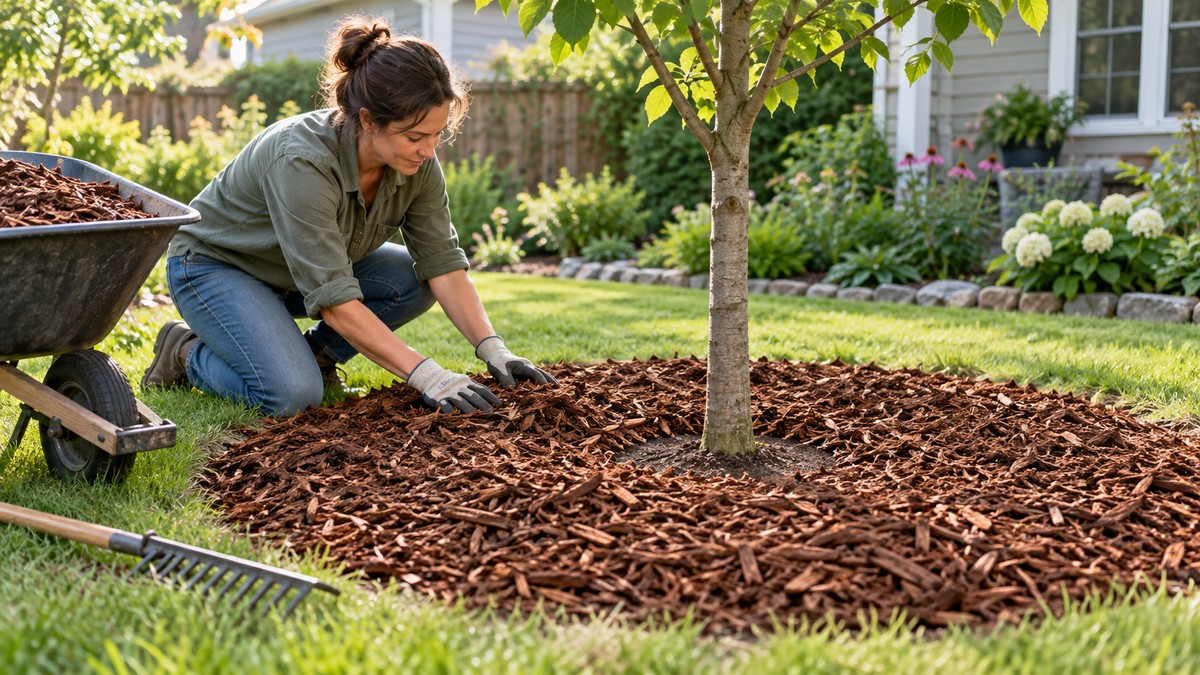
How to Mulch Trees
As an Amazon Associate we earn from qualifying purchases.
How to mulch trees comes down to one rule that every source repeats: keep the mulch off the trunk. Illinois Extension calls mulching “one of the most beneficial practices for better tree health”, but it adds that proper application matters, and the other sources agree. The guidance covers three things: the gap at the trunk, the depth of the layer and how far the mulch spreads. This guide sets out each figure, shows where the four sources disagree, and explains the mistakes that cause the most harm.
Quick answer
- Keep mulch at least 6 inches from the trunk. That figure meets every minimum in the gap table below.
- Apply 2 to 4 inches of mulch, and use the shallower end on heavy soils.
- Spread the mulch out to the dripline, or as far as possible.
- Never pile mulch into a volcano against the bark.
Why mulch a tree at all
Maryland’s page defines the material as “Mulch is a material applied to the surface of the soil around trees and shrubs.” The sources list practical gains. Illinois Extension says that mulch “Insulates the soil, protecting tree roots from extreme summer and winter temperatures” and that “Applying mulch to the soil surface maintains moisture and improves soil conditions.” The University of Maryland Extension page gives a shorter list: “Mulch reduces weeds, conserves soil moisture, and minimizes soil erosion.” Iowa State’s FAQ on mulch depth says that “Mulches, such as wood chips and shredded bark, help to conserve soil moisture and control weeds.”
Those gains depend on the layer being right. Illinois Extension notes that “Thick layers of mulch can become matted, reducing water and oxygen penetration.” A thin layer does less of the same work. Iowa State says that “A thin layer of mulch will not effectively control weeds or conserve soil moisture.” The aim is a layer that is thick enough to work and open enough to let air and water through.
Keep the mulch away from the trunk
This is the step all four sources agree on, and each one says it in its own words. Illinois Extension says: “Apply mulch near but not touching the trunk.” Maryland says: “Mulch should never touch the trunk of the tree.” Mississippi State University Extension says: “Don’t allow the mulch to touch the trunk.” Iowa State adds: “Do not pile mulch against the trunks of trees.”
The reason is harm to the bark and the root zone. Illinois Extension warns that “Mulch against the tree can soften the bark, leading to insects, diseases, and root girdling.” The numbers for the gap differ, so the table shows each one.
| Source | Gap from the trunk | Spread out from the trunk |
|---|---|---|
| Illinois Extension | At least 4 inches | To the dripline or as far out as possible |
| Iowa State University Extension | At least 6 inches | Not stated |
| University of Maryland Extension | About 3 inches | As far as the spread of the branches, if possible |
| Mississippi State University Extension | Pull back 2 to 3 inches | 3 to 6 feet around the entire tree |
The four gaps run from 2 to 3 inches up to 6 inches. A gap of at least 6 inches meets every minimum in the table, which is why it is the figure in this guide. The sources do not explain why the gaps differ, so the table shows the spread instead of averaging it.
Avoid the mulch volcano
The mounded layer is the mistake people make most often. Mississippi State says: “A common example of harmful mulch application is the mulch volcanoes you see around trees.” Its advice is direct: “don’t mound it up around the trunk.” Illinois Extension names the same problem: “Overmulching and applying mulch against the sides of the trunk and root flare are among the most common causes of tree decline.”
Iowa State explains the risk. “Mulch piled up against tree trunks may create favorable conditions for fungal cankers, root rots, and rodents.” Maryland adds a root-zone problem: “Plants that are not mulched correctly can experience problems, decline, and even die from too much mulch piled on root systems”. If a volcano is already there, Illinois Extension says that “If mulch is piled against the trunk, expose the base of the trunk by pulling back the mulch several inches.”
Set the depth by the material
Depth depends on what the mulch is made of. The sources give different ranges, and the table lists each one.
| Source | Depth stated | Condition |
|---|---|---|
| Illinois Extension | 2 to 4 inches | Composted materials 2 to 3 inches; coarse mulches 3 to 4 inches |
| Iowa State University Extension | 3 to 4 inches | Well-drained sites; 2 to 3 inches on heavy soils |
| University of Maryland Extension | 1 to 3 inches | For bark mulches |
| Mississippi State University Extension | 3 to 4 inches | Stated for the whole ring around the tree |
Iowa State states the principle behind the differences: “The optimum mulch depth depends upon the type of mulch, soil texture, plant type, and other factors.” Illinois Extension explains that “Each type of mulch will decompose at different rates depending on the soil microorganisms present, climate, and material used.” Too much depth brings its own harm. Iowa State warns that “An excessively deep layer of mulch may result in water logging of heavy soils and may interfere with the movement of oxygen into the soil.”
Maryland’s general rule is blunt: “Always keep mulch shallow, from one to three inches.” The other sources allow more depth for some materials, so the material decides the figure. Illinois Extension also lists what too much mulch can cause: “Excess mulch can also cause decay, delay the onset of dormancy or bud break, and provide hiding places for rodents.” Keep the layer within the range for your material, and look at the result each season rather than adding more.
Spread it out, not up
The mulch should cover the root zone around the tree, not just the area next to the trunk. Illinois Extension says to “Extend the layer to the dripline or as far out as possible.” Its limit is practical: “A 3-foot radius ring is the maximum for most trees.” Maryland uses a different reference: “Apply mulch as far out as the spread of the branches, if possible.” Mississippi State gives a wider ring: “extend from the trunk 3 to 6 feet around the entire tree.”
The sources disagree on the radius. Illinois Extension caps most trees at a 3-foot radius, while Mississippi State allows 3 to 6 feet. Both agree that the ring should be as large as the site allows, and both treat the trunk as the one place the layer must not touch. Where the two differ, a wider ring with a clear gap at the trunk fits both guides.
Refresh old mulch instead of stacking
Mulch breaks down, so an old layer does not stay the same depth. Illinois Extension says: “Mulch will need to be replenished as it decomposes.” Its advice on an existing layer is to check first: “If mulch is already present, check the depth. If enough is present, refresh the appearance with a rake, breaking up matted layers.” The same guide adds the timing: “Wait to replenish or refresh mulch after it has decomposed.”
Adding a new layer on top of an old one is the easy mistake. The depth rule applies to the layer you have now, so measure before you add more. For a homemade option to buy less, see how to make a compost pile.
Choose a mulch material
Illinois Extension lists common choices: wood chips, pine needles, hardwood and softwood bark, cocoa hulls, leaves and compost mixes. Maryland describes two bark types. “Softwood (pine-bark) mulches are readily available and slow to decompose and have a pleasant appearance.” “Hardwood bark mulches are readily available and less expensive than other mulches.”
Fresh wood chips need one caution. Maryland says: “It is okay to use fresh arborist wood chips as mulch around trees and shrubs as long as they are not incorporated into the soil.” The rule is about the mulch staying on top. Keep the material on the surface, and do not dig it into the bed around the trunk.
Check the layer for pests
Mulch can shelter animals that do harm. Illinois Extension advises: “Check under mulching to ensure rodents and other pests have not moved in.” Mississippi State ties the gap to the same problem: “Pull the mulch 2 to 3 inches away from the trunk to prevent problems, including disease and rodent damage.” Checking the base each season is a simple way to catch a problem before it grows.
Apply it in five steps
Put the rules together and the job is short. Start by clearing back any mulch that touches the bark, so the base of the trunk is visible. Illinois Extension gives the action directly: “If mulch is piled against the trunk, expose the base of the trunk by pulling back the mulch several inches.”
- Set the gap at 6 inches or more from the trunk, which meets every figure in the gap table.
- Spread the layer out to the dripline or as far as the site allows, following the Illinois and Maryland guidance.
- Check the depth against the range for your material, which for most sources sits between 2 and 4 inches.
- Look under the layer for rodents and other pests, since Illinois Extension names them as a problem to check for.
- Check the depth before you add more, as the refresh advice above describes.
For fall beds around the yard, see preparing raised beds for winter. The steps above apply to trees and shrubs, and the sources say the same rules hold across those plants.
Mistakes to avoid
- Letting mulch touch the bark, which Maryland and Mississippi State both warn against.
- Mounding mulch into a volcano around the trunk.
- Applying a layer deeper than the source ranges, especially on heavy soils.
- Adding new mulch on top of an old layer without checking its depth first.
- Leaving the base of the trunk unchecked, when the sources name rodents and pests under mulch.
How we chose
We chose four extension pages from Illinois, Iowa State, Maryland and Mississippi State that give mulch guidance for trees and shrubs, and that we could open and read. A University of Florida blog page returned a 200 status but its text said the page was no longer available, so we did not cite it. We kept a figure only when a page states it in plain words, and where the figures differ, the tables show each one. Not every page carries a date, so check your local extension office for current figures.
What we could not verify
What the sources do not say
The sources do not agree on the trunk gap or the outer radius, and they do not say which figure is right for your tree or soil. They do not give separate mulch figures for newly planted trees. They do not say how many years a layer lasts, only that it must be replenished as it breaks down. None of the four pages names a product, and this guide does not recommend one.
Frequently asked questions
How far should mulch stay from a tree trunk?
Keep it at least 6 inches away to meet every figure in the gap table. Illinois Extension says 4 inches, Maryland says about 3 inches, and Mississippi State says to pull it back 2 to 3 inches. The sources do not agree, so the wider gap is the safer choice.
How deep should tree mulch be?
Most of the sources give 2 to 4 inches. Iowa State says 3 to 4 inches for well-drained sites and 2 to 3 inches on heavy soils. Maryland’s figure of 1 to 3 inches applies to bark mulches.
Can you pile mulch against the trunk to protect it?
No. Iowa State says “Do not pile mulch against the trunks of trees.” Illinois Extension warns that piled mulch against the trunk is among the most common causes of tree decline.
How far out should the mulch reach?
Illinois Extension says to the dripline or as far out as possible, with a 3-foot radius as the maximum for most trees. Mississippi State says 3 to 6 feet around the entire tree. Maryland says as far as the spread of the branches, if possible.
Is fresh wood chip mulch a problem?
Maryland says fresh arborist wood chips are fine as mulch around trees and shrubs, as long as they are not worked into the soil. Keep them on the surface.
Bottom line
Keep tree mulch 2 to 4 inches deep, at least 6 inches from the trunk, spread out as far as the site allows, and never piled into a volcano.
Sources
- https://extension.illinois.edu/sites/default/files/proper_mulching_techniques_infosheet.pdf (opened 2026-10-22)
- https://yardandgarden.extension.iastate.edu/faq/how-deep-should-mulch-layer-be-around-trees-and-shrubs (opened 2026-10-22)
- https://www.extension.umd.edu/resource/mulching-trees-and-shrubs (opened 2026-10-22)
- https://extension.msstate.edu/blog/how-mulch (opened 2026-10-22)