How to Start Seeds Indoors for Beginners
As an Amazon Associate we earn from qualifying purchases.
How to start seeds indoors for beginners is mostly a matter of timing and a few basic conditions: a start date counted back from planting day, a clean container with drainage, a light close to the seedlings, a damp mix and gentle watering. The University of Maryland, Colorado State, Penn State and Illinois extension services describe the same basic setup and agree on most points. Where they differ, this guide shows both figures.
Quick answer
- Count back from your planting date. Colorado State gives a general range of four to eight weeks indoors before the average frost-free date.
- Keep the grow light close and on for 14 to 16 hours a day, following the Maryland guide’s setup for fluorescent and LED fixtures.
- Use clean containers with drainage holes and a soilless mix, not garden soil.
- Water when the top of the mix is nearly dry, and harden seedlings off for about a week before planting them outside.
Start from the planting date
Start with the calendar. Penn State’s Adams County article gives the method: “Count back from the time that you can plant seedlings outside.” Then allow one to two weeks of growing time after germination, and add the germination time listed on the seed packet.
Colorado State gives the broad range in one sentence: “Start seeds indoors four to eight weeks before the average frost-free date in your area.” Its guide also warns: “Starting too early usually results in spindly plants due to crowding and lack of sufficient light.”
Crop-by-crop timing
Timing also depends on the crop. Maryland gives approximate weeks indoors before transplanting:
- Leafy greens: 2 to 4 weeks.
- Cabbage, broccoli and cauliflower: 4 to 6 weeks.
- Cucumber, squash and melons: 3 to 5 weeks.
- Tomato: 5 to 6 weeks.
- Pepper, eggplant and onion: 8 to 10 weeks.
Maryland names the usual error these figures help prevent: “A common mistake is to sow seeds too early, resulting in tall, root-bound plants that do not perform well in the garden.” Cool-season crops benefit from an indoor head start, since they mature before summer heat. If you are still choosing crops for a first season, the easiest vegetables to grow in raised beds guide is a useful next read.
Gather containers, mix and light
A beginner setup needs a container, a mix, a light and a way to keep the top layer moist. Most of it can be simple and reused. Lights, heat mats and outlet timers are electrical equipment, so follow the maker’s manual for mounting, cords and outlets, and your local rules.
Containers and trays
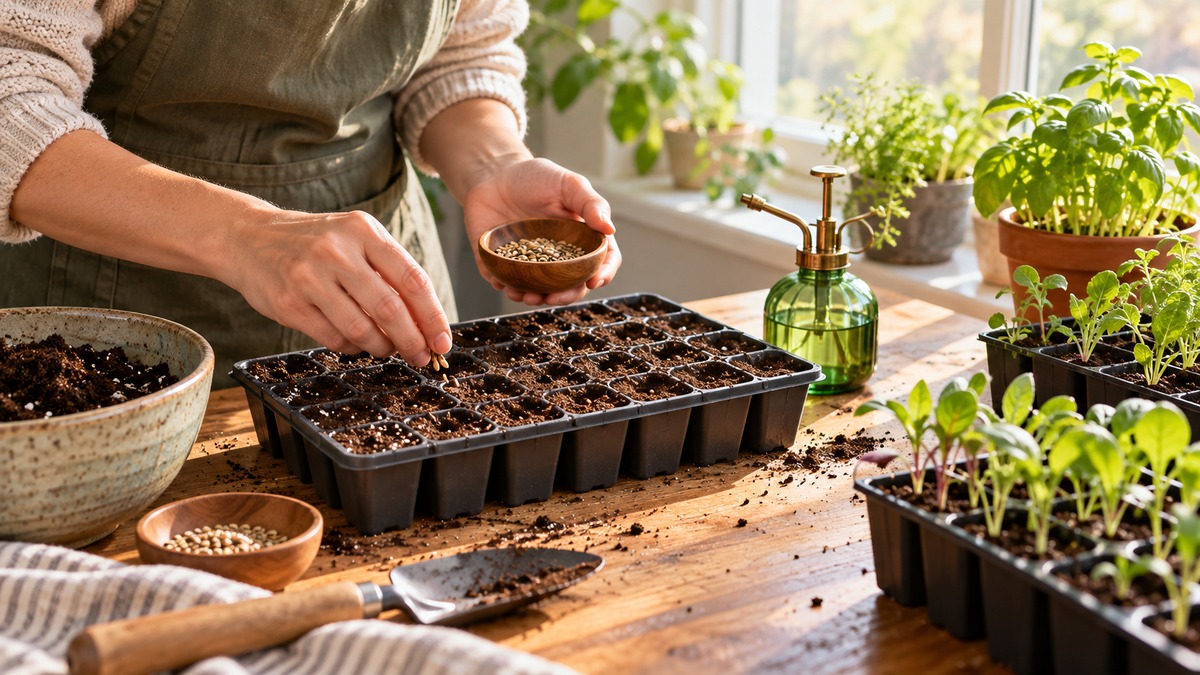
Maryland puts the basic rule plainly: “Almost any clean container can be used for seed starting, provided it allows for good drainage and is at least 2 inches deep.” Its examples include reused yogurt and cottage cheese containers, milk cartons and clear clamshell food containers. Colorado State lists paper milk cartons cut in half, Styrofoam cups and tin cans. Illinois, writing about herbs, asks for a container about 4 inches deep with drainage.
Flats without drainage holes catch drips, but Maryland warns that undrained flats need care to avoid overwatering. Cell packs, which are connected small pots, make seedlings easy to move as a group. Maryland lists cell sizes of 3 to 6 square inches for lettuce, beets, spinach and kale, and 9 to 16 square inches for tomato, eggplant and pepper. Peat pots can go into the garden, but Maryland says to remove the pot base and any rim above the soil line, because a rim left above the soil can wick moisture away from the roots.
Growing mix
Use a soilless mix rather than garden soil for containers. Maryland gives the reason: “Soil is too dense (approximately 75 pounds per cubic foot) to allow for good air and water movement around roots when used in a container.” The same guide says high-quality soilless media weigh about 10 pounds per cubic foot and drain well. Soil can also carry weed seeds and plant pests.
Penn State’s Adams County article gives the plain instruction: “Use a light, soilless mixture that is formulated for seed starting.” Colorado State says commercial potting mixes are usually suitable and do not have weed seeds, though they cost more than home mixes. Its home mix blends well-drained topsoil with sphagnum peat and sharp sand, at about one-third of the volume each.
Sow, moisten and cover
Moisten the mix
Moisten dry mix before filling containers. Maryland notes that peat moss repels water when dry, so sprinkled water can bead up and roll off. Its target is “It should be as moist as a wrung-out sponge, not sopping wet.” Fill containers to within one inch of the top, then firm the mix lightly so the surface is flat.
Plant at the right depth
A common rule is to plant a seed about twice its diameter deep. Maryland gives that rule, and Illinois puts it as about two times the seed’s thickness under the soil. Colorado State is firmer about the limit: “Do not cover seeds too deeply, as this may reduce or prevent germination.” It says to cover no more than four times the seed’s diameter, and suggests spreading fine soil with a piece of window screen or an old flour sifter.
For tomato, pepper and eggplant, plant one seed per cell and move the seedlings into larger containers 2 to 3 weeks after germination. For cucumber, squash, melon, corn and beans, sow two or three seeds per cell and keep the strongest seedling once they sprout.
Warmth and cover until sprouts appear
Maryland gives 65 to 75 degrees F as a good potting-mix range for most vegetable seeds. Penn State gives a higher range for the soil, 75 to 85 degrees F, so the two figures differ and both appear here. A heat mat speeds germination, as Colorado State and Illinois both note.
Maryland suggests covering the tray with clear plastic or a seed-starting dome, keeping the cover off the mix, and removing it as soon as sprouts appear. Illinois says a clear plastic bag should come off once herb seeds germinate, which it expects in 10 to 14 days.
Light, water and feeding after sprouts
Light for stocky growth
Window light is often not enough. Maryland says: “Natural light from a window is seldom enough for strong seedling growth.” Penn State is blunter: “Starting seeds in a brightly lit window is difficult.” If a window is the only option, Penn State says to use a south-facing one.
Maryland’s rule for fluorescent and LED fixtures is: “Keep fluorescent and LED light fixtures 2 to 6 inches above plants and lit for 14 to 16 hours a day using an outlet timer.” Illinois, writing about herbs, gives a different schedule: fluorescent lights no more than 4 inches from the seedlings and on for at least 10 hours a day, rising to 16 hours if plants get leggy. Maryland says tomato and cabbage-family seedlings stretch toward the light, so a thin chain or wire on each end of the fixture lets you raise it as the plants grow.
Water without drowning roots
Maryland gives the rule: “Wait until the top of the media is nearly dry before watering.” The reason is in the same guide: “Roots will stop growing and die due to a lack of oxygen when the growing media is saturated with water.” Colorado State warns in both directions. Small containers used for starting plants “dry out quickly.” On the other hand, soil kept soaking wet inhibits seedling growth.
For herbs, Illinois suggests a light sprinkle about twice a week, adjusted for pot size, temperature and humidity, and warns that constant moisture can attract fungus gnats.
Feed only when needed
Most potting mixes already hold enough fertilizer to grow a seedling for at least 6 weeks, according to Maryland. When feeding is needed, use a water-soluble fertilizer at the label rate for indoor plants or transplants. Young seedlings are easily damaged by too much fertilizer.
Thin, pot up and harden off
Thin and pot up
Maryland calls it “One of the most common mistakes gardeners make is leaving seedlings in the seed flat too long.” Crowded roots are hard to separate without damage. Colorado State advises using tweezers to pinch off unwanted seedlings rather than pulling them, so the one you keep is not disturbed.
Pot up when the first true leaves appear, because seedlings are then small and recover quickly from transplant shock. Handle seedlings by their leaves, not their stems, and set each one so the leaves sit just above the soil line. Keep the tops 1 to 2 inches from the grow lights after potting up.
Harden off before planting out
Colorado State says: “About one week before planting-out time, gradually expose seedlings to longer periods outdoors (unless temperatures are below 50F) to harden them.” At the same time, it says to reduce watering to a minimum as long as plants do not wilt.
Penn State describes setting seedlings in a protected area for a few days to one week, and adds: “Be sure there is no danger of frost if you are keeping them outside overnight.” Illinois suggests placing herb seedlings outdoors on mild days, bringing them in each night, and keeping them out of direct sun at first, for five to seven days.
Once the seedlings are sturdy and the weather is steady, the vegetables to plant in raised beds guide can help you decide which crops go into the bed.
Check seedlings before they go outside
Before moving a seedling outdoors, check that it looks stocky and is about as wide as it is tall, as Maryland describes an ideal transplant. Penn State says it should have true leaves and the soil and air should be warm enough. Colorado State and Illinois both give a hardening period of about a week, or five to seven days, before planting out.
Common mistakes to avoid
- Starting too early. Colorado State links early starts to spindly plants, caused by crowding and low light.
- Waiting too long to pot up. Maryland says crowded roots are hard to separate without damage.
- Covering seeds too deeply. Colorado State says that may reduce or prevent germination.
- Using garden soil in containers. Maryland says it is too dense for good air and water movement around roots.
- Overwatering. Roots need oxygen, and a saturated mix can cut off their supply.
- Too much fertilizer. Maryland says young seedlings are easily damaged by it.
- Relying on a window alone. Penn State calls starting seeds in a brightly lit window difficult.
- Skipping hardening off. Colorado State says the step helps plants adjust without undue shock.
How we chose
This guide relies on four extension pages, opened on 2026-10-21 and read in full: the University of Maryland Extension guide on starting vegetable seeds indoors, Colorado State University Extension’s publication on growing annual plants from seed, a Penn State Extension Adams County Master Gardeners article on starting seeds, and a University of Illinois Extension article on starting herb seeds indoors.
Each page comes from a state or land-grant extension service, covers the path from sowing to transplant, and gives figures or steps a beginner can check. Where the pages agree, this guide keeps the point. Where they differ, both figures appear. Maryland’s page is dated August 14, 2026, Colorado State’s was reviewed in August 2025, Penn State’s was posted January 22, 2024, and Illinois’s is dated May 5, 2020. A University of Minnesota page returned HTTP 403, so it is not cited.
What we could not verify
The sources answer the basic questions, but they differ on some figures and do not cover every home setup. Light is the clearest difference: Maryland gives 14 to 16 hours a day with fixtures 2 to 6 inches above plants, while Illinois asks for at least 10 hours with lights no more than 4 inches away. Timing differs as well. Colorado State’s table lists six weeks indoors for tomato and pepper, while Maryland gives 5 to 6 weeks for tomato and 8 to 10 weeks for pepper.
What the sources do not say
- The sources do not give a planting date for your area. Illinois points readers to the Illinois State Water Survey for frost-free dates.
- None of the sources names a grow light model, brand or wattage, and none gives a number of days that home-stored seed stays viable.
- The sources do not set a fixed watering schedule for every pot. Illinois gives a rough figure of a light sprinkle about twice a week for herbs, depending on conditions.
- The sources give no dollar figures for containers, mixes or lights, and do not give electrical safety guidance for grow lights or heat mats. Follow the maker’s manual and local rules.
Frequently asked questions
When is the right time to start seeds indoors?
Count back from the date you can plant seedlings outside, as Penn State advises. Colorado State gives four to eight weeks before the average frost-free date, and Maryland’s crop ranges run from two to four weeks for leafy greens to eight to 10 weeks for pepper.
Does a beginner need a grow light for seedlings?
Most of the sources say a window is not enough on its own. Maryland says natural light from a window is seldom enough, and Colorado State says even a sunny window may need supplemental lighting.
What container works best for starting seeds?
Maryland advises a clean container with good drainage that is at least 2 inches deep. Cell packs or small pots make seedlings easy to move as a group, and Colorado State lists Styrofoam cups and tin cans as common containers.
Is garden soil acceptable for starting seeds?
Maryland says garden soil is too dense for containers and can carry weed seeds and plant pests. Colorado State says commercial mixes are usually suitable and have no weed seeds, and Penn State recommends a soilless mix made for seed starting.
Why do seedlings grow tall and weak?
Colorado State ties spindly plants to crowding and too little light. Maryland says stems stretch toward the light, and Penn State says that for long, stretchy seedlings the answer is to “throw them out and start over at the right time.”
Sources
- University of Maryland Extension, starting vegetable seeds indoors: https://extension.umd.edu/resource/starting-seeds-indoors (opened 2026-10-21)
- Colorado State University Extension, growing annual plants from seed: https://extension.colostate.edu/resource/growing-annual-plants-from-seed/ (opened 2026-10-21)
- Penn State Extension, Adams County Master Gardeners, starting seeds: https://extension.psu.edu/programs/master-gardener/counties/adams/news/starting-seeds (opened 2026-10-21)
- University of Illinois Extension, start herb seeds indoors: https://extension.illinois.edu/news-releases/start-herb-seeds-indoors (opened 2026-10-21)
As an Amazon Associate we earn from qualifying purchases.