How to Dry Herbs From Your Garden
As an Amazon Associate we earn from qualifying purchases.
How to dry herbs well comes down to three choices: when you cut, how much air moves past the leaves, and how much heat you use. Four extension pages we opened, from Oregon State, Vermont, Washington State and Tennessee, agree on the core steps. They differ on details such as how long air drying takes and whether heat is needed afterward, so this guide shows where each page stands.
Quick answer
- Cut herbs in the morning, before the flowers open and after the dew has dried. Oregon State and Tennessee both give that timing.
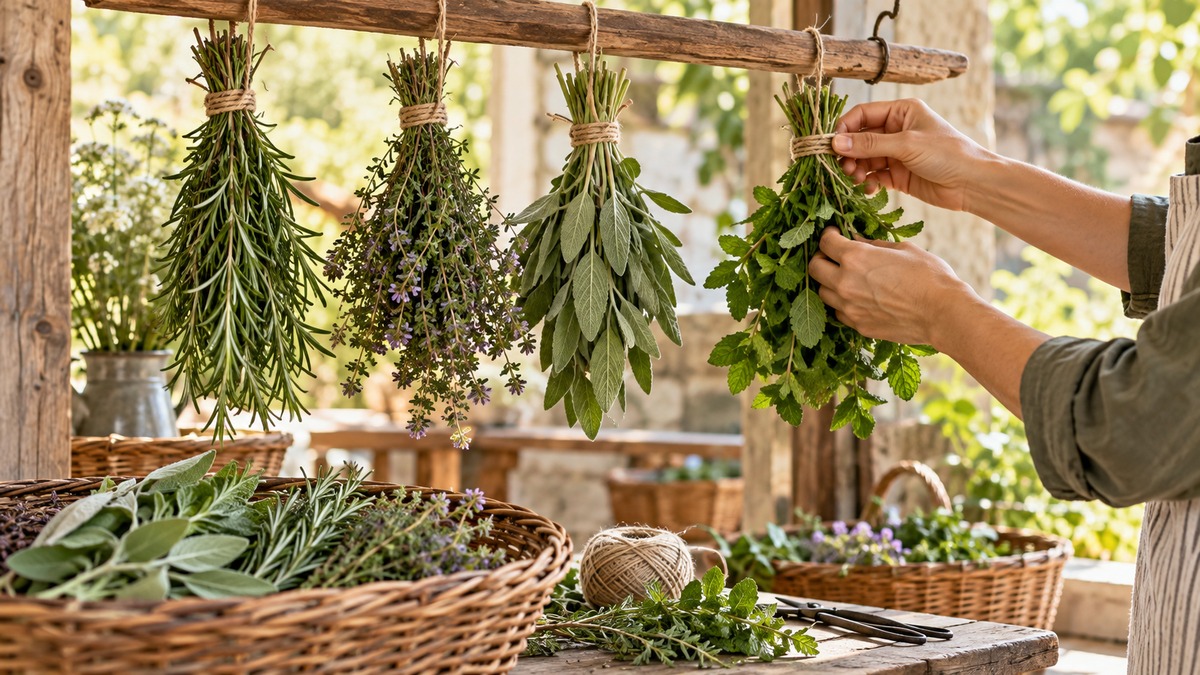
- Air dry sturdy herbs such as sage, thyme, rosemary and parsley as small bundles, in a warm, airy spot away from direct light.
- For a dehydrator, preheat to 95°F to 115°F, dry for one to four hours, and check often. Herbs are dry when they crumble and stems break when bent.
- Store fully dry herbs in airtight containers in a cool, dark, dry place. Oregon State gives six months to one year for the best flavor.
Harvest at the right moment
Timing starts in the garden. Oregon State says the best time to harvest herbs for drying is just before the flowers first open, and Tennessee gives the same timing. Washington State adds that leafy herbs such as basil and oregano taste best when cut from young leaves on stems, before the plant goes into flower production. Tennessee also notes that leaves near the top of the plant have the most concentrated flavor.
Oregon State advises gathering in the early morning, after the dew has evaporated, to minimize wilting, and avoiding bruising the leaves. It also says cut herbs should not lie in the sun or go unattended. Tennessee suggests cutting stems with scissors and leaving four to six inches of stem for later growth.
Once the herbs are inside, rinse them in cool water and shake off the excess moisture. Tennessee says to discard bruised, soiled or damaged leaves and stems, and to look carefully for insects while you do so.
Pick herbs that suit the method
Sturdy herbs are the easiest to dry. Oregon State lists sage, thyme, rosemary, summer savory, cilantro and parsley as the sturdier herbs, and says they can be tied into small bundles and air dried. Tennessee gives a nearly identical list for drying without a dehydrator. Its list leaves out cilantro.
Moist herbs need faster drying and more care. Washington State says basil, tarragon, oregano, lemon balm and mints hold more water than sage, thyme, parsley and rosemary. Tennessee warns that these tender herbs mold if they are not dried quickly, and that large bundles mold too.
Vermont suggests a different approach for moist herbs. Basil and mint can go in a paper bag with vent holes, hung with the herb bundle inside, or they can lie in a single layer on a cooling rack. Flowers such as chamomile dry well on a rack, according to Vermont.
Air drying step by step
Vermont calls air drying the most straightforward method. It needs a warm spot with good air circulation, and Vermont suggests hanging herbs away from sunlight, because that keeps their color and flavor better. Washington State makes the same point about light, saying that light during drying affects color.
For bundles, Washington State recommends small bunches of stems wrapped with butcher’s twine and hung up. Oregon State describes a bag instead: a paper bag with vent holes cut in the top and side, hung where air currents move through it, so that falling leaves and seeds collect in the bottom. Tennessee also uses a bag, with holes punched in its sides and the top closed with a rubber band.
Keep bundles small. Tennessee says that if bundles are too large, the herbs will mold. It also says to hang herbs away from the sink, stove or dishwasher, where there is moisture.
Washington State says the drying area needs good ventilation, and an oscillating fan works well. Oregon State names an attic, a kitchen, or any warm location with air circulation as good places to hang herbs.
Leaves can dry flat on a tray instead of hanging. Oregon State says a tray lined with paper towels works well for leaves such as bay, mint and sage, and that the leaves dry flat and keep their color. It also says air drying usually takes five to 10 days.
Tennessee suggests drying the leaves of mint, sage or bay separately, rather than with the stems. It says this works better in areas of high humidity.
Humidity, heat and sun
Humidity is the main risk in air drying. Washington State ties proper drying to humidity of 45 to 55 percent, and warns that mold can form or that the product can dry limp and discolored. In the Pacific Northwest, where that guide was written, average outdoor humidity stays above 60 percent even in the drier summer months. A barometer or humidity gauge helps decide whether drying is possible.
Sun is a problem too. Oregon State says sun drying is not recommended because it affects color and flavor. Tennessee gives the same reason, saying herbs lose more flavor and color outdoors.
Heat needs care as well. Oregon State says drying at too high a temperature can cause flavor loss. Washington State says heated air can lead to a higher loss of essential oils than air drying does, and advises choosing a dehydrator that can run at as low a temperature as possible.
Using a dehydrator or oven
Oregon State calls dehydrator drying fast and easy, because temperature and air circulation can be controlled. It says to preheat the dehydrator to 95°F to 115°F, and to go as high as 125°F in areas with higher humidity. Tennessee gives the same 95 F to 115 F range, and says the thermostat may need to reach 125 F when indoor humidity is high.
Spread the herbs out. Oregon State says to rinse and shake off the moisture, then place the herbs in a single layer on the trays. Washington State says to arrange the leaves so they do not touch, because overcrowding can result in longer drying times.
Drying takes one to four hours in a dehydrator, according to both Oregon State and Tennessee, and both say to check periodically. Washington State says the time varies with humidity, plant water content and temperature, so trial and error may be needed.
Tennessee also describes an oven method for herbs with small leaves. The leaves go on a fine screen or on paper towels, in a very cool oven with the oven light on, which gives a little heat for overnight drying.
Check for dryness
Oregon State gives the clearest test. Herbs are dry when they crumble easily between the fingers, the stems are brittle and break when bent, and the leaves and seeds fall from the stems. Tennessee uses the same idea for leaves: crumple crispy leaves between your fingers, and if they are easy to crumble, they are dry and ready to package and store.
If herbs stay limp, the drying space is probably too humid. Washington State says a space that is too moist cannot produce a crisp, dry texture, and advises raising the temperature and air circulation. It adds that trial and error may be needed, because the time of year and the water content of the plants both change the result.
Washington State also warns that any moisture left in the plants after drying can lead to spoilage.
Storage, strength and use
Store dried herbs in an airtight container in a cool, dark, dry place. Tennessee says this protects color and fragrance, and Oregon State says dried herbs keep effectively for up to one year in such a place. Oregon State also gives six months to one year as the window for the best flavor.
Leaves can be left whole and crumbled as you use them, which Tennessee says preserves flavor, or they can be coarsely crumbled before storage. Dried herbs are usually three to four times stronger than fresh, so Tennessee suggests using one quarter to one third of the fresh amount called for in a recipe.
Freezing gives another option. Oregon State says dried herbs can be stored in airtight containers in the freezer. Vermont says a large amount of dried, packaged herbs can be kept in the freezer until needed. Washington State describes freezing fresh herbs: single leaves laid on cookie sheets and flash frozen, or chopped herbs packed in ice cube trays and covered with water or oil.
If you are still planting herbs for the season, see our guide to herb planters. For pots on a balcony, see our guide to balcony planters.
Mistakes to avoid
- Drying in the sun. Oregon State and Tennessee both say sun drying costs color and flavor.
- Using too much heat. Oregon State says too high a temperature causes flavor loss, and Washington State says heated air can cost more essential oils than air drying does.
- Tying large bundles. Tennessee says large bundles mold.
- Drying in a humid spot. Washington State ties proper drying to 45 to 55 percent humidity, and warns that mold can form or the product can dry limp and discolored.
- Storing herbs before they are fully dry. Washington State warns that leftover moisture can lead to spoilage.
Where the sources disagree
| Topic | Oregon State | Vermont | Washington State | Tennessee |
|---|---|---|---|---|
| Harvest timing | Just before flowers open | Not stated | Before the plant flowers, for leafy herbs | Just before flowers open |
| Air drying time | Usually five to 10 days | Not stated | Varies with weather and conditions | Not stated |
| Dehydrator setting | 95°F to 115°F; up to 125°F in humid areas | Not stated | 95°F to 115°F, citing the National Center for Home Food Preservation | 95 F to 115 F; up to 125 F when indoor humidity is high |
| Dehydrator time | One to four hours | Not stated | Varies with humidity, water content and temperature | One to four hours |
| Sun drying | Not recommended | Keep herbs away from sunlight | Avoid light during drying | Not recommended |
| Storage time | Up to one year; six months to one year for best flavor | Not stated | Shelf-stable; no period given | Not stated |
The table uses only what each page states. Where a page is silent, the cell says so, and this guide does not fill the gap from another page.
Frequently asked questions
Which herbs are easiest to dry?
Sturdy herbs such as sage, thyme, rosemary and parsley are the easiest. Oregon State also includes summer savory and cilantro, and Tennessee lists summer savory but leaves out cilantro.
How long does air drying take?
Oregon State says air drying usually takes five to 10 days. Vermont and Tennessee do not give a time, and Washington State says the time depends on weather and drying conditions.
Should herbs be dried in the sun?
No. Oregon State says sun drying is not recommended because it affects color and flavor, and Tennessee says herbs lose more flavor and color outdoors. Vermont suggests keeping herbs away from sunlight so they keep their color and flavor.
Can a dehydrator dry herbs quickly?
Yes, according to Oregon State and Tennessee. Both give a setting of 95°F to 115°F and a drying time of one to four hours, and both say to check the herbs periodically.
How long do dried herbs keep?
Oregon State says dried herbs keep effectively for up to one year in a cool, dry, dark place, and gives six months to one year for the best flavor. Vermont and Tennessee do not give a storage period, and Washington State gives none in months.
What we could not verify
The pages agree on the broad steps but leave several details open. This guide does not supply figures for those details.
What the sources do not say
- No page gives a drying time for each herb in a dehydrator. Oregon State and Tennessee give one to four hours for all herbs together.
- Vermont and Tennessee give no air-drying time, so the five to 10 day range comes from Oregon State alone.
- Vermont and Tennessee give no storage life for dried herbs, and Washington State gives none in months.
- One page, Tennessee, describes a heat step for air-dried herbs that is meant to deal with insects. This guide does not repeat that step, and the other three pages do not mention it.
- No page names a dehydrator, a drying rack or a bag brand, so this guide names none.
How we chose
We opened extension pages with curl on 2026-10-22, and used only pages that returned HTTP 200 and contained the statements we cite. Each page is a university or state extension page, and we picked four that cover air drying, dehydrator drying and storage. We kept the wording of each figure next to its page, and where two pages differ, the table shows both. We left out retail listings and any page we could not open.
Sources
- https://extension.oregonstate.edu/es/food/preservation/drying-herbs (opened 2026-10-22)
- https://www.uvm.edu/extension/news/drying-garden-herbs (opened 2026-10-22)
- https://wpcdn.web.wsu.edu/extension/uploads/sites/57/2024/09/Drying-Herbs.pdf (opened 2026-10-22)
- https://lawrence.tennessee.edu/wp-content/uploads/sites/116/2023/06/Drying-Herbs.pdf (opened 2026-10-22)