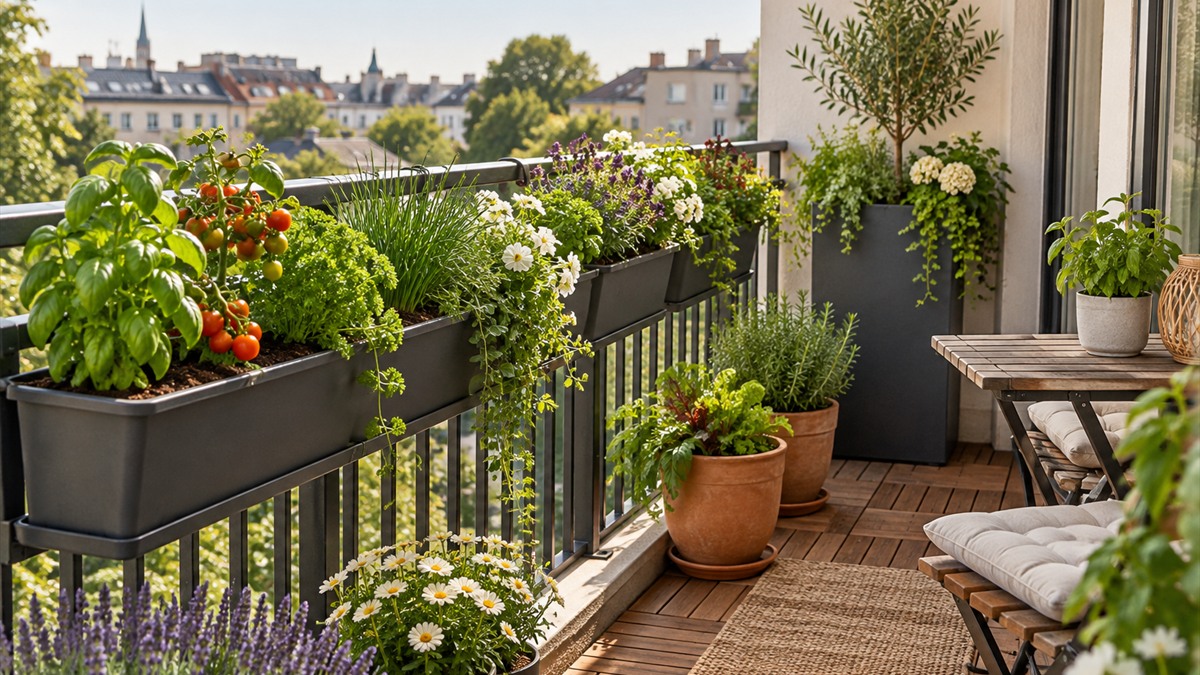
Best Balcony Planters: Sizes, Soil Depth and Drainage Compared
As an Amazon Associate we earn from qualifying purchases. Details
Updated 20 October 2026 | Author: Ken
If you are looking for the best balcony planters, sort the options by three things before you look at style: how much floor space the balcony gives you, how deep the soil needs to be for the plants you want, and whether you need to move the planter. The 12 listings we read for this guide include tall stacked boxes, raised beds on legs, wheeled beds and plastic pots. Their stated sizes run from a 7.2-inch overall depth to a 48-inch length, and only some of them state a soil capacity. Where two listings give different capacity figures for the same outer size, this guide shows both numbers and says they disagree.
Quick answer
- For a narrow balcony, go vertical or wheeled. The ETELI three-tier stack lists a footprint of 14.2 by 31.4 inches, and the BTY four-tier stand lists 19.1 by 18 inches.
- For deep soil, use the bed that states its depth. Only one listing in this set gives a depth of 16 inches, the natural Best Choice bed, and it also gives a capacity of 299 quarts.
- For a planter you may need to move, look at the two wheeled beds. The BIRDSINYARD bed lists wheels and a handle, and the Chuangshuo pair lists wheels and a 400-pound capacity in its title.
- Check the capacity figure against the size. The BIRDSINYARD bed lists 1.9 cubic feet for an outer size that works out to about 7.78 cubic feet, and its listing does not explain the gap.
Start with the balcony, not the catalog
A balcony is a different site from a garden bed. Floor space is usually the first limit, followed by the rail, the door swing and how far you have to reach across the planter to tend it. Sun comes next. One of the beds in this set, the BIRDSINYARD bed, says its wheels let you move it to follow the sunlight, which is useful on a balcony that gets sun in one corner and shade in another.
Water is the part that needs the most planning. The listings in this set describe drainage holes, removable trays or open bottoms. None of them says where the drained water should go on a balcony, and the sources we opened do not cover balcony drainage. Plan for a tray you can empty, and check what happens to water that runs out of the bottom of a stacked planter before it reaches the floor below or the rail.
What the extension pages say about drainage
The University of Maryland Extension page on growing vegetables in containers says every container needs adequate holes or slits so that excess water can drain. Without them, plant roots can drown and rot. That single point rules out a lot of decorative planters that have no hole in the base, and it is the first thing to check on any listing in this set.
The Illinois Extension page on container drainage calls the idea of a gravel layer at the bottom of a pot a myth. Its point is that a gravel layer beneath the soil does not improve drainage, and that drainage of excess water is vital for the health of plant roots. The University of Maryland page makes the same point with rocks, gravel or broken pot shards. If you have been told to add stones before the soil, the extension sources say that step does not help.
The Illinois page also warns about pots with permanently attached saucers, because emptying the overflow can be difficult or impossible. On a balcony, that detail decides whether a tray is useful or a problem. A tray you cannot empty will hold water against the roots, and a tray you can empty gives you a simple way to see how much water the planter is passing.
Watering is the other half of drainage. The Iowa State Extension page on containers says to keep watering until water begins to flow from the drainage holes, to water when the potting mix is dry about 1 to 2 inches down, and that containers in general need much more frequent watering than garden beds. A balcony planter is a container, so plan to check it more often than a bed on the ground.
Soil depth: why taller containers help
Depth is the figure that most listings leave out. The Iowa State potting media article says that shallow containers are often chosen for plants that need good drainage, and then calls that a misconception. Its point is that taller containers give more of the mix above the saturated zone at the bottom, so plants that need excellent drainage are generally easier to care for in taller pots than in shorter ones. The same article says that when soil is put into a container, the lack of depth can deter drainage.
For a balcony, this means a 7.2-inch-deep stack suits herbs, small annuals and trailing plants, and it is a weaker fit for root crops. Carrots and beets need room below the surface, and the listings in this set do not state the depth of each stacked tier, so you cannot check the fit from the listing alone.
Raised beds raise a different question. The Iowa State raised bed article says higher beds are easier to work in but need more soil to fill them. The University of Maryland raised bed article says the looser texture of a raised bed lets the soil drain well, which reduces the risk of waterlogging and root rot. That article describes raised beds, not container planters, so treat it as background rather than a measurement for any listing here. The balcony beds in this set give a height but, in most cases, not a soil depth, so compare the stated depth first and the height second.
Reading the numbers in the listings
The table below uses only the size and capacity fields in the listings. The outer size is length times width times height. It is not the same as the soil volume, because walls, liners and the bottom of the bed take up space, and the listings do not say how much of the outer size holds soil. Even so, the gap between the two is worth a look before you buy.
| Listing | Size in the listing | Capacity in the listing | Outer size, worked out | What it tells you |
|---|---|---|---|---|
| Best Choice, natural (16-inch depth) | 48 x 24 x 30 in | 299 quarts | 48 x 24 x 16 = 18,432 cubic inches, or 10.67 cubic feet | Close to the stated capacity; 299 / 29.92 = 10 cubic feet |
| Best Choice, gray | 48 x 24 x 30 in | 5 cubic feet | Bed depth not stated, so not worked out | The bullets say 5CuFt, but the listing gives no depth |
| BIRDSINYARD, white | 30 x 14 x 32 in | 1.9 cubic feet | 30 x 14 x 32 = 13,440 cubic inches, or 7.78 cubic feet | The stated capacity is far below the outer size, and the listing does not explain why |
| Chuangshuo Guard, grey (pair) | 37 x 15.7 x 32 in | 400 pounds (a weight, not a volume) | 37 x 15.7 x 32 = 18,588.8 cubic inches, or 10.76 cubic feet | No soil volume is stated |
The natural Best Choice bed is the one case where the numbers line up. A 16-inch depth gives 18,432 cubic inches, which is 10.67 cubic feet when you divide by 1,728 cubic inches per cubic foot. The stated 299 quarts is about 10 cubic feet, using 29.92 quarts per cubic foot. The gray Best Choice bed has the same outer size, but its listing gives 5 cubic feet and no depth, so there is no way to check that figure from the listing.
The BIRDSINYARD bed is the reverse case. Its listing gives 1.9 cubic feet, while the outer size works out to about 7.78 cubic feet. The listing does not say whether the figure refers to soil, to a shallow bed inside a deeper frame, or to something else. We treat the 1.9 figure as unexplained, and we would ask the seller or read the full product page before you rely on it for a planting plan.
The Chuangshuo listing gives a weight, not a volume. The 400-pound figure is useful for the load question, but it says nothing about how much soil the pair holds.
Planning the footprint: a worked example
Suppose one wall of your balcony is 96 inches long and you want three stacked planters along it. The ETELI three-tier stack lists a width of 31.4 inches, so three of them take 3 x 31.4 = 94.2 inches. That leaves about 1.8 inches, which is tight for a balcony with a door or a chair. If you use the BTY four-tier stand, which lists 18 inches of width, four of them take 4 x 18 = 72 inches and leave 24 inches for a walkway. The example is not a measurement of your balcony. It shows how one stated width changes the number of planters that fit.
The same method works for beds. Multiply the stated width by the number of beds, add the gap you need to reach each one, and compare the total to the floor you have. Do not add the stated depth to the width, because the depth of a bed is the side you reach across, not the length you walk along.
Matching the planter to the plant
Herbs and trailing flowers are the easiest fit for the stacked planters and the shallow beds in this set. The ETELI stack, with six separate boxes, lets you keep herbs apart from flowers so one does not crowd the other. The OYEAL bed with a trellis gives a place for climbing plants and lists four boxes, which suits a mixed row of herbs and tomatoes if the boxes are deep enough for the plant you choose, and the listing does not state that depth.
Root crops need the deepest soil. Of the listings here, only the natural Best Choice bed gives a depth of 16 inches in its listing text, so it is the only one in this set that the depth figure supports for carrots, beets and radishes. The bullets for that bed mention those crops directly. The Iowa State raised bed article makes the same general point: a taller bed needs more soil, and the soil needs to be light and well drained.
For a planter that holds one large plant, a bed or a large pot with a stated size is the safer choice than a stack. The RooTrimmer four-pack lists a top width of 13 inches, a bottom width of 7 inches and a height of 10 inches. That suits a medium plant in a plastic pot, and the listing says the pots are for both indoor and outdoor use.
Five checks before you buy
- Count the planters you need. The ETELI stack holds six boxes, the OYEAL bed has four, and the Chuangshuo listing is a pair. Match the count to the number of plants you want before you compare planters.
- Measure the floor and the reach. Measure the balcony floor, the path to the door and the space you need to reach each planter from both sides.
- Look for drainage holes and a tray you can empty. The Illinois saucer point applies to any tray. Check that the tray can be lifted out, emptied and put back.
- Work out the weight of a full planter. The item weights in the listings are for the empty product. The OYEAL bed lists 10.5 pounds and the ETELI bed lists 10.4 pounds, but neither listing gives a weight for a filled planter, so you need to estimate the soil weight yourself.
- Plan the watering. The Iowa State page says containers need more frequent watering than garden beds, so decide who will water the balcony when you travel.
Mistakes to avoid
- Choosing by the title size only. The two Best Choice listings with the same outer size give different capacity figures, and the gray one gives no depth at all.
- Filling a shallow stack with root crops. The ETELI and OYEAL beds list 7.2 inches of overall depth, and the Iowa State article says deeper containers are generally easier to keep drained.
- Adding gravel for drainage. The Illinois page and the University of Maryland container page both say a gravel layer does not improve drainage.
- Leaving a saucer full. The Illinois page says a tray that cannot be emptied can hold water against the roots.
- Trusting a wheel figure without checking the soil weight. The Chuangshuo bullets say the wheels move 200 pounds of soil, which is a listing claim. Check it against the soil you plan to use.
1. Vertical Garden Planter 4 Tier Planters for Outdoor Plants Vertical Raised Garden Bed with Drainage (Four tiers for a narrow balcony)
Specs from the listing (checked ):
- Item Dimensions D x W x H: 19.1″D x 18″W x 47.9″H
- Number of Levels: 4
Pros
- The listing gives an overall size of 19.1 by 18 by 47.9 inches with four tiers
- The listing says the triangular frame stays stable in wind and rain
Cons
- The listing does not state the depth of each tier or the weight of the stand
Best for: a narrow balcony that needs several planting levels in a small footprint
Skip if: you need deep soil for root crops, since the listing gives no tier depth
View on Amazon (affiliate link)
2. Best Choice Products 48″ x 24″ x 30″ Raised Garden Bed with Extra Deep 16″ Depth, Elevated Wood (Deep bed with a stated 16-inch depth)
Specs from the listing (checked ):
- Item Dimensions D x W x H: 48″D x 24″W x 30″H
- Capacity: 299 quarts
- Item Weight: 33 pounds
Pros
- The listing states 16 inches of soil depth, which fits carrots, beets and radishes
- The listing gives a 48 by 24 by 30 inch size and a capacity of 299 quarts
Cons
- Another Best Choice listing of the same outer size gives 5 cubic feet, so the capacity figures disagree
Best for: a balcony bed that stays in one spot and needs a large soil volume
Skip if: you need to move the bed often, since the listing shows no wheels
View on Amazon (affiliate link)
3. Elevate 2Pcs 32″ Tall Raised Garden Bed with Wheel,Planter Box for Backyard,Outdoor Garden, Patio (Wheeled pair for a narrow corner)
Specs from the listing (checked ):
- Item Dimensions D x W x H: 37″D x 15.7″W x 32″H
- Capacity: 400 pounds
Pros
- The listing says the bed fits a narrow balcony corner at 29.5 inches wide
- The title gives a 400-pound capacity and the bullets describe two wheels
Cons
- The listing does not state a volume for the soil or a weight for the empty beds
Best for: a balcony that needs two beds you can roll for sun or shade
Skip if: you need a bed with a stated soil depth, since the listing does not give one
View on Amazon (affiliate link)
4. ETELI Vertical Raised Garden Bed 3 Tier Garden Planter Indoor Outdoor Herb Planter with 6 Removable (Six boxes in a compact stack)
Specs from the listing (checked ):
- Item Dimensions D x W x H: 14.2″D x 31.4″W x 31.9″H
- Number of Levels: 3
Pros
- The listing gives an overall size of 14.2 by 31.4 by 31.9 inches with three levels
- The listing describes six removable planting boxes for herbs and small plants
Cons
- The listing does not state the depth of each removable box
Best for: a narrow balcony where you want to keep herbs and flowers in separate boxes
Skip if: you want one deep bed for root vegetables
View on Amazon (affiliate link)
5. Vertical Raised Garden Beds 32.4″ Tall Planter Raised Beds Boxes Patio Herb Garden Planter Outdoor (Tall bed with a trellis)
Specs from the listing (checked ):
- Item Dimensions D x W x H: 7.2″D x 35.1″W x 32.4″H
- Item Weight: 10.4 pounds
Pros
- The listing describes metal fence panels that support small climbing plants
- The listing gives an item weight of 10.4 pounds for the product
Cons
- The listing gives an overall depth of 7.2 inches, which is shallow for root crops
Best for: herbs and trailing plants on a balcony where floor space is tight
Skip if: you grow root vegetables that need deep soil
View on Amazon (affiliate link)
6. RooTrimmer 4 Pack 13 Inch Plant Pots with Drainage Holes,Lightweight Durable Planters for Indoor (Four movable plastic pots)
Specs from the listing (checked ):
- Material: Plastic
- Unit Count: 4 Count
Pros
- The listing gives a top width of 13 inches, a bottom width of 7 inches and a height of 10 inches
- The listing describes drainage holes at the bottom of each pot
Cons
- The listing describes plastic pots, so the root space is limited to each pot
Best for: a mixed set of medium plants you can move around the balcony
Skip if: you need a built-in trellis or a raised bed
View on Amazon (affiliate link)
7. OYEAL Raised Garden Bed with Legs & & Trellis 32″ Tall Vertical Herb Garden Planter Indoor Outdoor (Four boxes with a trellis)
Specs from the listing (checked ):
- Item Dimensions D x W x H: 7.2″D x 35.1″W x 32.4″H
- Item Weight: 10.5 pounds
Pros
- The listing describes four planter boxes with a removable tray for drainage
- The listing gives an overall size of 7.2 by 35.1 by 32.4 inches
Cons
- The listing gives an item weight but no load limit for the boxes
Best for: a balcony where you want a tall herb stand that is easy to lift and move
Skip if: you need a deep box for root crops, since the listing gives only the overall depth
View on Amazon (affiliate link)
8. Elevated 32″ Tall Raised Garden Bed with Legs and Wheels for Mobility, Metal Planter Boxes Outdoor (Rolling bed with a shelf)
Specs from the listing (checked ):
- Item Dimensions D x W x H: 30″D x 14″W x 32″H
- Capacity: 1.9 cubic feet
Pros
- The listing says the large wheels and handle let you move the bed to follow sunlight
- The listing gives a 32-inch height, which reduces bending while you garden
Cons
- The listing gives 1.9 cubic feet of capacity, which is far below its outer size, with no explanation
Best for: a balcony where you want to roll the bed out of the wind or into the sun
Skip if: you need the stated capacity to match the outer size, since the listing does not explain the gap
View on Amazon (affiliate link)
Listings without a card: The Hosley set of two galvanized wall planters, which is a small hanging planter with a 10-inch height and a 4-inch depth, so it does not work as a floor planter on a balcony. The second Best Choice bed in gray, which has the same outer size as the natural bed and gives the 5 cubic foot figure covered in the table above. The Best Choice bed in acorn brown, which is the same bed in another color with 48-inch and 72-inch sizes and a 16-inch depth. The LIQING wagon-style planter, whose listed dimensions of 2 by 2 by 2 inches do not describe a planter of this kind, so we did not use it.
How we chose
We read the title, the bullets and the stated specifications for each of the 12 listings in the research pool, which was checked on 20 October 2026. The criteria were simple. The product had to be a planter a balcony reader can buy, whether a floor planter, a stacked planter, a bed or a pot. The listing had to state a size that could fit a balcony. It had to state drainage holes or a tray. And it had to give enough figures to cross-check against the others.
Eight listings passed those criteria and became cards. Each card has a reason taken from its own listing, such as the stated footprint, depth, number of levels, wheels or material. Four listings were not used. Three of those were not floor planters or had a figure that did not describe a planter, and one was a duplicate colour of a bed that already had a card.
We did not use any sales or feedback signal. The picks are an editorial selection from the listing text, and the order of the cards follows the order in which they are shown, not a ranking.
What we could not verify
- Balcony load limits. None of the sources we opened gives a load figure for a balcony floor, so this guide makes no load claim.
- Where drained water goes. The sources we opened do not cover what happens to water that drains from a balcony planter, or whether building rules allow a tray.
- Durability. The listings describe rust-resistant, fade-resistant or weather-resistant materials. The sources we opened do not confirm those claims for plastic, galvanized steel or HDPE.
- Soil depth for most listings. Only the natural Best Choice bed gives a depth of 16 inches in the listing text we read. The other beds give a height and an overall depth.
- Weight of a filled planter. The listings give item weights for the empty product. None gives a weight for a planter filled with soil.
- The capacity figures that do not match. We could not check the 5 cubic foot figure for the gray Best Choice bed, or the 1.9 cubic foot figure for the BIRDSINYARD bed, from the listing.
FAQ
Are stacked planters good for a small balcony?
Yes, for a narrow space. Stacked planters use less floor space because they go up, and the listings here state footprints of about 14 by 31 inches for the ETELI stack and 18 by 19 inches for the BTY stand. Check the depth of each tier before you buy, because most listings do not state it. Stacked planters suit herbs, trailing flowers and small plants, and they are a weaker fit for root crops that need deep soil.
How deep should a balcony planter be?
The answer depends on the plant. The Iowa State potting media article says taller containers are generally easier to keep drained, and the University of Maryland raised bed article says a looser soil drains well. In this set, only the natural Best Choice bed states a 16-inch depth in its listing. For the other listings, use the stated depth rather than the height when you compare them.
Do balcony planters need drainage holes?
Yes. The University of Maryland container page says all containers need adequate holes or slits to drain excess water, so roots do not drown or rot. Choose a planter that lists drainage holes, and check that each hole is open before you fill it with soil.
Should I put gravel in the bottom for drainage?
No. The Illinois Extension page calls the gravel layer idea a myth, and the University of Maryland container page says rocks, gravel or broken pot shards do not improve drainage. A planter with holes and a tray you can empty does the job that the gravel was supposed to do.
How often should a balcony planter be watered?
Check the soil by hand rather than following a fixed schedule. The Iowa State container page says to water when the potting mix is dry about 1 to 2 inches down, to keep watering until water runs out of the drainage holes, and to expect containers to need more frequent watering than garden beds. The size of the container, the mix, the plant and the weather all change how often you need to water.
Bottom line
Match the planter to the space and the plant before you compare styles. Choose a stacked planter for a narrow balcony, a wheeled bed when you need to move it, and a listing with a stated soil depth for anything that needs deep soil. If a capacity figure does not match the outer size, do not buy on the title alone.
For more on the soil side of balcony beds, read our guide to how much soil a raised bed needs. For a tall, narrow planting plan, see how to fill raised beds.
Sources
- University of Maryland Extension, “Growing Vegetables in Containers and Salad Tables”, opened 2026-10-20. https://extension.umd.edu/resource/growing-vegetables-containers-and-salad-tables
- Illinois Extension, “Container Drainage Options” (Container Gardens), opened 2026-10-20. https://extension.illinois.edu/container-gardens/container-drainage-options
- Iowa State University Extension and Outreach, “Care of Plants Growing in Containers” (2016), opened 2026-10-20. https://hortnews.extension.iastate.edu/2016/07-01/container.html
- Iowa State University Extension and Outreach, “Potting Media: Components and Handling” (March 2025), opened 2026-10-20. https://yardandgarden.extension.iastate.edu/article/2025/03/potting-media-components-and-handling
- University of Maryland Extension, “Growing Vegetables in Raised Beds” (updated March 26, 2026), opened 2026-10-20. https://extension.umd.edu/resource/growing-vegetables-raised-beds